Generative Engine Optimization (GEO) Explained
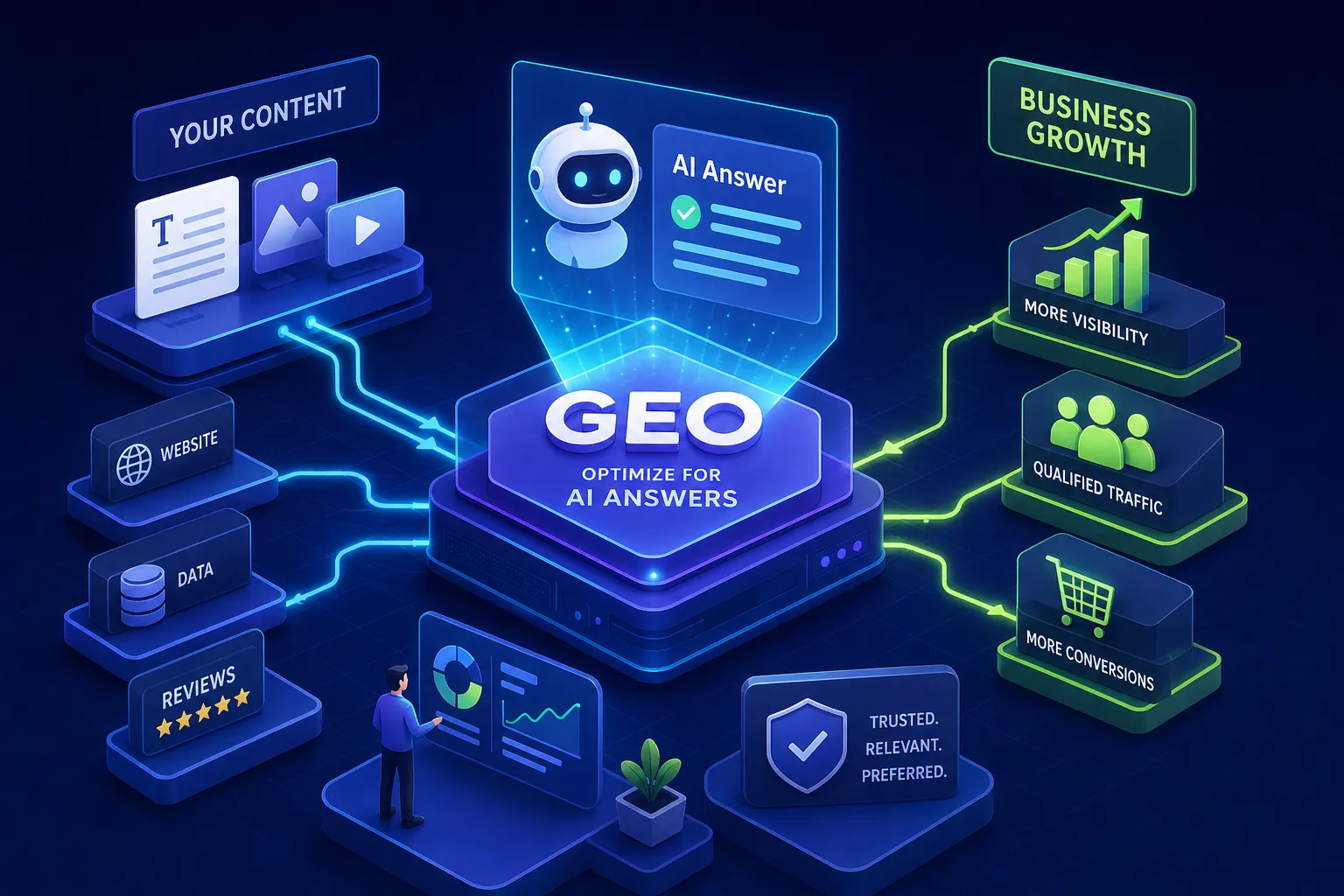
Generative engine optimization (GEO) is the practice of structuring your content and technical signals so that AI tools like ChatGPT, Google Gemini and Perplexity use your pages when they generate answers. Traditional SEO earns you a blue link in search results. GEO earns you a citation inside the AI’s answer itself. The game has shifted from ranking to being quoted.
AI engines don’t rank pages the way a classic search algorithm does. They retrieve candidate pages, extract relevant passages, and weave those passages into one synthesized answer. Your job is to make those passages easy to find and easy to cite.
For most businesses, the obstacles are structure and credibility, not effort. This guide covers both: what GEO is, how it compares to SEO and AEO, what AI engines look for when they pick a source, a 5-step implementation plan, and how to measure results.
Key takeaways
- GEO is not renamed SEO. It optimizes for citation inside AI-generated answers, not for rankings or clicks.
- Passage-level answerability matters. AI engines lift a paragraph that directly answers a question. They don’t read your whole page.
- SEO is still the foundation. A page must be crawlable, indexed and credible before any AI engine can cite it.
- Five core steps: content structure, schema markup, authority signals, distribution, and measurement.
- Measure separately. Track citation rate, mention rate and AI-referred traffic as three distinct signals.
- Tools exist now. Platforms like the Semrush AI Visibility Toolkit, Profound and Otterly.AI run fixed prompts across AI engines and report your share of voice.
What is generative engine optimization, and why does it matter now?
Generative engine optimization matters because more buyers now ask an AI tool before they ever click a search result. If your content isn’t structured to be extracted and cited, your business is missing from those answers, even if you rank well on Google.
The shift from ranking to being cited
Generative engines work in three stages: they retrieve candidate pages, extract relevant passages, and synthesize those passages into one answer, often with inline citations. A page can rank first on Google and still never appear in an AI answer if its content isn’t easy to extract.
The key idea is passage-level answerability. The AI doesn’t read a whole article. It lifts the one paragraph that directly answers the specific question it’s working on. If your most important facts are buried in a long introduction or spread across several paragraphs, they won’t be lifted.
GEO vs. AEO: are they the same thing?
Answer engine optimization (AEO) is the broader goal of appearing in answer-style results: featured snippets, People Also Ask boxes and voice assistants. GEO is specifically about being cited inside answers that large language models write themselves.
Some people use the terms interchangeably, but the difference matters for strategy. AEO is largely about winning a single featured answer. GEO is about being one of several sources an AI chooses to combine into its own response.
How does GEO compare to traditional SEO and AEO?
All three build on the same foundation but measure success differently. SEO aims for rankings and clicks, AEO for featured answers, and GEO for citations inside AI-generated responses.
| Area | Traditional SEO | AEO | GEO |
|---|---|---|---|
| Content structure | Comprehensive pages built around keyword intent, internal links and engagement | Question-matching sections with a concise answer near the top | Answer-first sections, standalone paragraphs, definitions, tables and clear evidence |
| Technical signals | Title tags, meta descriptions, canonicals, XML sitemaps, page speed | Structured data for featured snippets, clear entities, schema markup | Semantic HTML, machine-readable entities, accurate JSON-LD that matches the visible content |
| Authority signals | Quality backlinks, expertise, trustworthiness | Backlinks plus clear structured data | Backlinks plus brand mentions, reviews, community discussions and third-party citations |
| Main success measure | Rankings, organic traffic, click-through rate | Featured snippets, position zero, zero-click visibility | Citation rate, mention rate, citation share of voice, AI-referred traffic |
Where traditional SEO still forms the foundation
GEO doesn’t replace SEO; it extends it. A page must be crawlable, indexed and credible on its topic before any AI engine can consider citing it. In practice, that means consistent internal linking, real subject-matter depth and clear authorship.
The simplest way to put it: SEO helps a page win a search result. GEO helps its facts become usable evidence in an answer. Skip the SEO foundation, and no amount of restructuring will get you cited.
What GEO adds on top of that foundation
GEO adds three things to conventional SEO:
- Answer-first structure: each section opens with a direct, concise answer before the supporting detail.
- Machine-readable entities: semantic HTML and accurate schema markup that tell AI systems exactly who you are and what you do.
- Authority beyond backlinks: brand mentions, reviews and community discussions that corroborate your business across many sources, even without a link.
What do AI engines look for when they pick a source?
AI engines generally favor sources that are easy to retrieve, directly relevant to the question, easy to quote, and credible. None of them publish their exact formula, so the goal is to clear every visible threshold rather than chase a specific score.
The common citation selection model
Based on how these platforms behave, selection tends to follow this sequence:
- Retrievable source: the page can be crawled and indexed.
- Relevance: the page matches the question and the sub-questions the AI generates.
- Extractable passage: a clear paragraph, list or table answers the question on its own.
- Credibility and freshness: the source looks trustworthy and current.
- Citation fit: the passage fits naturally into the answer being written.
The first three stages are easy to observe. How heavily each engine weighs authority, freshness and corroboration is proprietary.
Platform-specific tendencies worth knowing
Each platform retrieves sources differently, so treat these as tendencies, not rules:
- Google Gemini and AI Overviews draw on Google Search, so classic SEO signals, passage relevance and freshness carry over directly.
- Perplexity shows numbered citations and offers different search modes that change which sources it draws from. Clear headings and well-structured documents make passages easier for it to pick up.
- ChatGPT search needs your pages to be discoverable by its search tools. Relevance to the exact question matters most.
The same core practices (clear structure, direct answers, credible sources) help across all of them.
What does a 5-step GEO plan look like?
A practical GEO plan restructures your content for extraction, adds accurate schema, builds authority signals, distributes your expertise beyond your own site, and measures citations with a fixed set of prompts.
Step 1: Restructure content for passage extraction
Rewrite your key pages so each section opens with a direct answer of 40 to 60 words, followed by the supporting detail. In practice:
- A question-phrased H2 heading, written the way your audience would type it
- A standalone paragraph that fully answers the question in plain language
- Supporting evidence, examples or steps below it
The formats AI engines cite most often are direct Q&A sections, FAQ blocks, numbered step-by-step guides, definitions and HTML comparison tables. Keep important facts in crawlable text, not inside images or elements that only load with JavaScript.
Step 2: Add schema and semantic markup
Use semantic HTML correctly: an article element, logically nested headings, ordered and unordered lists, and real tables for comparisons. For JSON-LD schema, the most useful types are:
- Article for blog posts and guides
- FAQPage for question-and-answer sections
- HowTo for step-by-step instructions
- Organization and WebSite for your business identity
Accuracy is non-negotiable. Schema must match the visible content exactly, or it creates a trust mismatch. Validate your markup after adding it, and check that your key pages are actually being crawled.
Step 3: Build authority signals
Authority for GEO goes beyond backlinks. Brand mentions, reviews on third-party platforms, citations in industry publications and genuine forum discussions all help AI engines confirm that your business is real and credible.
Step 4: Distribute your expertise
Publish your expertise where AI tools look for sources, not just on your own blog: industry publications, LinkedIn, relevant communities and partner sites. Original data, clear methodology and attributed expert quotes give AI engines something worth citing that generic content doesn’t.
Step 5: Set up measurement before you optimize further
Define a fixed set of prompts before you change anything:
- Branded: questions that name your business
- Category: “best [service] for [industry]” style questions
- Comparison: you versus alternatives
- Problem-solving: the questions your buyers ask before they need you
Track citation rate and mention rate separately from traffic, so you can tell AI visibility apart from AI-referred clicks.
Before you start, run your site through our free AI Search Visibility Checker to confirm AI crawlers can reach your pages and the technical basics are in place.
How do you know if GEO is working?
You know GEO is working when your brand is mentioned and your pages are cited more often across a fixed set of prompts, and when AI-referred visits start showing up in your analytics. Measure all three over time, because AI answers vary from run to run.
The KPIs that matter for generative search
- Mention rate: the percentage of tracked prompts where your brand is named in the answer.
- Citation rate: the percentage where your URL appears as a linked source.
- Citation share of voice: your citations divided by all citations across your prompt set.
- Position and prominence: whether you’re the main answer, one option in a comparison, or a minor supporting source.
Also check that AI tools describe your business accurately. Treat all results as directional, because AI answers change with model versions, location and timing.
Tools for AI citation monitoring
Dedicated AI visibility platforms run fixed prompts across ChatGPT, Perplexity, Gemini and Claude on a schedule and report mentions, citations, competitors and share of voice. Options include the Semrush AI Visibility Toolkit for teams already using Semrush, Profound for enterprise-level analytics, and Otterly.AI for affordable multi-engine tracking.
Smaller businesses can start with a manual prompt audit: run the same prompts every week and save screenshots of the answers. Combine that with Google Search Console and your analytics to see whether AI visibility is turning into real visits.
Why is GEO harder to execute than it sounds?
GEO is harder to execute than it sounds because it needs content strategy and technical implementation to work from the same plan. When those sit with separate vendors, the content and the technical work drift out of sync and progress stalls.
The gap between knowing GEO and implementing it
Most teams can manage the content advice above. The harder part is technical: schema implementation, semantic HTML audits, crawlability checks, entity setup and ongoing content updates. All of it needs a content strategist and a technical implementer working from the same brief.
Why one team shortens the timeline
Omnivance works as one company with two brands: Omnivance Media handles the content and AI search strategy, and Omnivance Technology handles the technical implementation. Both work from a single client plan, so strategy and execution stay in sync instead of waiting on separate vendors.
Start optimizing for the answer layer now
Generative engine optimization is quickly becoming a standard part of how businesses earn visibility in AI search. The five steps are straightforward: structure content for extraction, add accurate schema, build broad authority, distribute your expertise, and measure with a fixed prompt set.
The mindset shift that matters most: SEO wins the ranking; GEO wins the citation. Both matter, and neither replaces the other. A page that ranks but can’t be extracted won’t appear in AI answers. A page that’s well structured but not indexed won’t be found at all.
Want to know where your business stands in AI search today? Request a free audit, or see how we run GEO and AI visibility campaigns.
Frequently asked questions
Will generative engine optimization replace traditional SEO?
No. SEO remains the foundation, because a page must be crawlable, indexed and credible before any AI engine can cite it. GEO builds on that foundation to make your facts easy for generative engines to extract and cite.
Which schema types help most with AI citations?
Article, FAQPage, HowTo, Organization and WebSite are the most useful. Make sure the JSON-LD matches the visible content exactly, and validate the markup after adding it.
Who in our organization should own GEO?
A content strategist and a technical implementer working from the same brief. The hardest parts of GEO (schema, semantic HTML, crawlability and entity setup) need both skills working together.
Can we track AI citations without enterprise tools?
Yes. Start with a manual prompt audit: run a fixed set of prompts weekly and save the answers. Combine that with Google Search Console and your analytics to see whether AI visibility is turning into visits.