Lead Generation vs Brand Awareness: A CMO's Guide

Brand awareness builds mental availability; lead generation captures buyers. Prioritize whichever your business stage and cash runway require — and run both when you can afford to.
That one-sentence rule sounds simple, but most marketing teams get the balance wrong. They either chase leads so hard that nobody outside their existing pipeline has ever heard of them, or they spend on brand campaigns while the sales team starves for contacts. The practical version of lead generation versus brand awareness explained is this: awareness is the long game that makes every lead cheaper over time, and lead generation is the short game that keeps the lights on. You need a clear signal to know which one to weight right now.
Two operational triggers help. If your branded search volume is low and prospects consistently say "I've never heard of you" in discovery calls, awareness is the bottleneck. If your pipeline is short and you have a proven offer with a defined audience, lead generation deserves the bigger budget slice. When the product-market fit is confirmed and the cash runway is sufficient, running both in parallel is the right call.
Table of Contents
- What is lead generation versus brand awareness?
- How do the two approaches compare side by side?
- Where does each activity sit in the buyer journey?
- When should you prioritize awareness, lead gen, or both?
- Which tactics work best for awareness versus lead generation?
- How do you measure brand awareness and lead generation results?
- What does a 30- and 90-day plan actually look like?
- How an integrated approach drove both brand and pipeline results
- Key Takeaways
- The mistake most teams make with this balance
- Omnivancemedia runs awareness and lead gen as one program
- Useful sources and further reading
What is lead generation versus brand awareness?
Brand awareness is the degree to which your target market recognizes and recalls your brand when a need arises. The goal is mental availability: you want to be the name that surfaces in a buyer's mind before they start comparing options. In practice, it looks like a consistent presence across channels where your audience spends time, measured by brand lift surveys, share-of-voice, branded search growth, and direct traffic trends.
Lead generation is the process of building interest in a product or service and converting that interest into a measurable action, typically a form fill, demo request, or phone call. According to Salesforce's lead generation guide, it relies on channels, gated assets, marketing automation, and lead scoring to build and manage a pipeline. The output is a contact record with enough context to qualify and route to sales.
A quick operational contrast: a brand lift survey measures awareness; a demo request form measures lead generation. Both are valid. They just answer different questions.
Typical brand awareness activities:
- Programmatic display and connected TV (CTV) campaigns targeting broad in-market audiences
- Organic content, thought leadership, and PR placements
- Podcast sponsorships, social video, and community-building
Typical lead generation activities:
- Gated assets (whitepapers, calculators, templates) behind a form
- Paid search targeting high-intent keywords
- Webinars, live demos, and free trial offers
How do the two approaches compare side by side?
| Dimension | Brand awareness | Lead generation |
|---|---|---|
| Primary objective | Build recognition and mental availability | Capture and qualify buyer intent |
| Customer-journey stage | Top of funnel (awareness, discovery) | Mid-to-bottom of funnel (consideration, decision) |
| Typical tactics/channels | Display, CTV, organic social, PR, content series | Paid search, gated assets, email, webinars, referrals |
| Key metrics | Brand lift, share-of-voice, branded search volume, direct traffic | CPL, conversion rate, MQL volume, pipeline value |
| Time to impact | Months to years (compounding effect) | Days to weeks (faster feedback loop) |
| Cost signal | Higher upfront, lower CPL over time as brand compounds | Predictable short-term CPL; can plateau without brand support |
The two approaches overlap more than most teams admit. Retargeting, for example, starts as an awareness touchpoint and ends as a lead-gen trigger. A well-produced content series builds brand equity while every gated piece inside it captures leads. Audience warming, where you expose prospects to brand messaging before hitting them with a conversion ad, consistently improves response rates on performance campaigns.
The direction of influence matters: awareness feeds lead generation. Research from Adwave shows that brand building improves response rates and reduces cost-per-lead over time. A prospect who already recognizes your name clicks a paid search ad at a higher rate and converts at a higher rate than a cold prospect seeing you for the first time.
Pro Tip: The most common mis-measurement trap is attributing a conversion entirely to the last paid click while ignoring the three brand touchpoints that preceded it. Before cutting your awareness budget because "it doesn't convert," check whether your top-converting paid search terms are branded. If they are, awareness is doing the work.
Where does each activity sit in the buyer journey?
The buyer journey runs from awareness through consideration to conversion. Brand awareness owns the top: it gets you into the consideration set before a buyer even starts evaluating options. Lead generation owns the middle and bottom: it captures buyers who are already in-market and moves them toward a decision.
TechTarget's definition of lead generation breaks leads into two key types that map directly to this funnel:
- Marketing Qualified Lead (MQL): a contact who has engaged with marketing content at a level that suggests genuine interest (downloaded a guide, attended a webinar, visited a pricing page multiple times)
- Sales Qualified Lead (SQL): an MQL that sales has reviewed and accepted as worth a direct conversation, based on fit criteria like company size, budget, and timeline
Basic lead scoring signals to track:
- Behavioral: page visits, content downloads, email clicks, webinar attendance
- Demographic/firmographic: job title, company size, industry, geography
- Engagement recency: how recently the contact showed intent
- Negative signals: unsubscribes, competitor mentions, wrong-fit firmographics (subtract points)
A simple scoring example: a VP of Marketing at a 200-person SaaS company who downloaded your pricing guide and attended a webinar this week scores higher than a coordinator at a 10-person company who opened one email three months ago.
MQL to SQL handoff checklist:
- Define the MQL threshold score in your CRM before any campaign launches
- Set a sales SLA: sales must respond to an MQL within a defined window (commonly 24 hours for B2B)
- Confirm the SQL acceptance criteria: budget, authority, need, timeline (BANT or equivalent)
- Log every rejection with a reason code so marketing can refine scoring over time
- Review the MQL-to-SQL conversion rate monthly and adjust thresholds when the rate drifts
When should you prioritize awareness, lead gen, or both?
The one-sentence rule: prioritize awareness when your market doesn't know you exist; prioritize lead generation when you have a known offer and a short pipeline; run both when you have confirmed product-market fit and a runway that allows it.
The 95-5 Rule frames this well for B2B teams: in most markets, roughly 5% of your total addressable market is actively buying at any given moment. Lead generation captures that 5%. Brand awareness reaches the other 95%, who aren't buying yet but will be eventually, and who will remember you when they are.
| Business stage | Primary goal | Recommended budget split | Watch for |
|---|---|---|---|
| Early-stage startup | Prove the offer works | — | Burning budget on brand before offer is validated |
| Revenue-constrained SMB | Fill pipeline fast | 80% lead gen / 20% awareness | Zero brand investment creates CPL ceiling over time |
| Growth-stage company | Scale both | — | Siloed teams measuring different things |
| Scale-up / pre-IPO | Build category authority | 40% lead gen / 60% awareness | Awareness spend without measurement rigor |
| Seasonal business | Shift by quarter | 80/20 in off-season (awareness); 60/40 in peak (lead gen) | Flat annual budget that ignores demand cycles |
The internal conflict between stakeholders demanding immediate leads and leaders investing in brand is real and predictable. The way to resolve it is not to pick a side but to show the connection. When you can demonstrate that branded search volume has grown over time and that branded paid search converts at a higher rate than non-branded, the argument for awareness investment becomes concrete. Track leading indicators for brand (branded search, direct traffic, share-of-voice) alongside lagging indicators for lead gen (CPL, pipeline value) and report them together. That single reporting change tends to reduce the tension faster than any internal debate.
Which tactics work best for awareness versus lead generation?
Modern lead generation has moved away from broad "spray and pray" tactics toward targeted, personalized campaigns that rely on automation and measurement, as Search Engine Land's lead generation guide notes. The same shift applies to awareness: generic reach campaigns are giving way to precision-targeted brand building.
Awareness tactics:
- Programmatic display and CTV: Reaches audiences at scale before they search; the KPI is brand lift (measured via survey holdout). Why branding investment pays off is most visible here: repeated exposure builds the familiarity that makes later conversion ads work harder.
Lead generation tactics:
- Paid search (Google, Microsoft Ads): — Captures in-market intent directly; the KPI is cost-per-lead and lead-to-opportunity rate. High intent, high cost, works best when brand recognition already exists.
For testing, A/B test one variable at a time: subject line versus subject line, landing page headline versus headline, offer versus offer. Holdout tests, where you withhold a campaign from a matched audience segment and compare outcomes, are the most reliable way to measure true incremental lift from either awareness or lead-gen spend.
Pro Tip: When running A/B tests on lead-gen landing pages, resist testing design and copy simultaneously. Change one element, run the test for at least two full business weeks, and require a minimum sample size before calling a winner. Most "tests" that declare a winner in three days are noise, not signal.
How do you measure brand awareness and lead generation results?
Measurement is where most teams underinvest, particularly on the awareness side. Digital attribution tools capture clicks well but miss the dark-funnel influence that brand touchpoints create. The 2023 Edelman Trust Barometer special report found that brand trust materially affects purchase behavior in ways that last-click attribution never captures, which is why measurement improvements are not optional for teams that want to prove awareness ROI.
Brand awareness metrics checklist:
- Brand lift (measured via survey holdout tests run through Google, Meta, or a third-party tool)
- Share-of-voice across organic search and social
- Branded search volume trend (Google Search Console, month-over-month)
- Direct traffic growth (Google Analytics 4, filtered by new vs. returning)
- Unaided and aided recall scores from periodic brand surveys
Lead generation metrics checklist:
- Cost-per-lead (CPL) by channel and campaign
- Lead-to-MQL conversion rate
- MQL-to-SQL conversion rate
- Lead-to-opportunity rate
- Pipeline value influenced by marketing
- Time-to-close for marketing-sourced leads
Measurement methods that actually work:
- Brand lift surveys: Run a holdout group that doesn't see your campaign; survey both groups on recall and preference. The difference is your lift.
- Geo or market holdout tests: Run the campaign in some markets but not others; compare pipeline velocity between markets.
- CRM attribution with UTM rigor: Every paid and organic touchpoint should carry a UTM parameter that writes to a contact field in your CRM. This lets you see the full multi-touch path, not just the last click.
- Self-reported attribution: Add "How did you hear about us?" to every form. Imperfect, but it surfaces channels that digital tracking misses entirely.
Pro Tip: Connect your ad platforms (Google Ads, Meta) to your CRM via server-side tracking or a tool like Segment. Cookie-based tracking loses 20–40% of conversions depending on browser and consent settings. Server-side tracking closes that gap and gives you cleaner CPL data to optimize against.
For teams managing CRM automation, routing high-intent leads to sales within minutes of a conversion event materially improves close rates. Speed-to-lead is one of the highest-leverage variables in lead generation, and it's almost entirely an automation problem.
What does a 30- and 90-day plan actually look like?
30-day quick-start checklist
- Audit your current pipeline: calculate CPL by channel, MQL-to-SQL rate, and time-to-close
- Pull branded search volume from Google Search Console and set a baseline
- Confirm UTM tagging is consistent across all active campaigns
- Define or confirm MQL and SQL criteria in your CRM
- Launch one gated asset (a guide or calculator) targeting your highest-intent keyword cluster
- Set up a brand lift survey baseline if you're running any display or video spend
- Identify your top three referral sources and reach out to activate or strengthen them
- For low-cost lead capture, audit your organic content for conversion opportunities (missing CTAs, ungated high-value pages)
90-day milestones
At 30 days: CPL baseline established, UTM coverage at 90%+, first gated asset live and generating MQLs, MQL/SQL definitions confirmed with sales.
At 60 days: First A/B test on a lead-gen landing page complete, brand lift survey baseline collected, referral program active, email nurture sequence running for new MQLs.
At 90 days: CPL trend visible by channel, branded search volume compared to baseline, MQL-to-SQL rate tracked for the first time, first holdout test designed for next quarter.
Sample budget splits by company stage
| Stage | Awareness % | Lead gen % | Milestone KPIs to watch |
|---|---|---|---|
| Early-stage (under $500K revenue) | 20% | 80% | CPL, lead-to-opportunity rate, pipeline value |
| Growth-stage ($500K–$5M) | 40% | 60% | Branded search growth, MQL volume, CPL trend |
| Scale-up ($5M+) | — | — | Share-of-voice, brand lift score, pipeline velocity |
| Enterprise / pre-IPO | 60% | 40% | Category share-of-voice, NPS, brand recall scores |
These splits are starting points, not rules. A growth-stage company in a crowded category may need to weight awareness higher to break through. A scale-up with a long sales cycle may need more lead-gen investment to keep pipeline full during a brand-building phase.
How an integrated approach drove both brand and pipeline results
The strongest argument for running awareness and lead generation together is not theoretical. It shows up in the numbers when the two are coordinated through a single operating model.
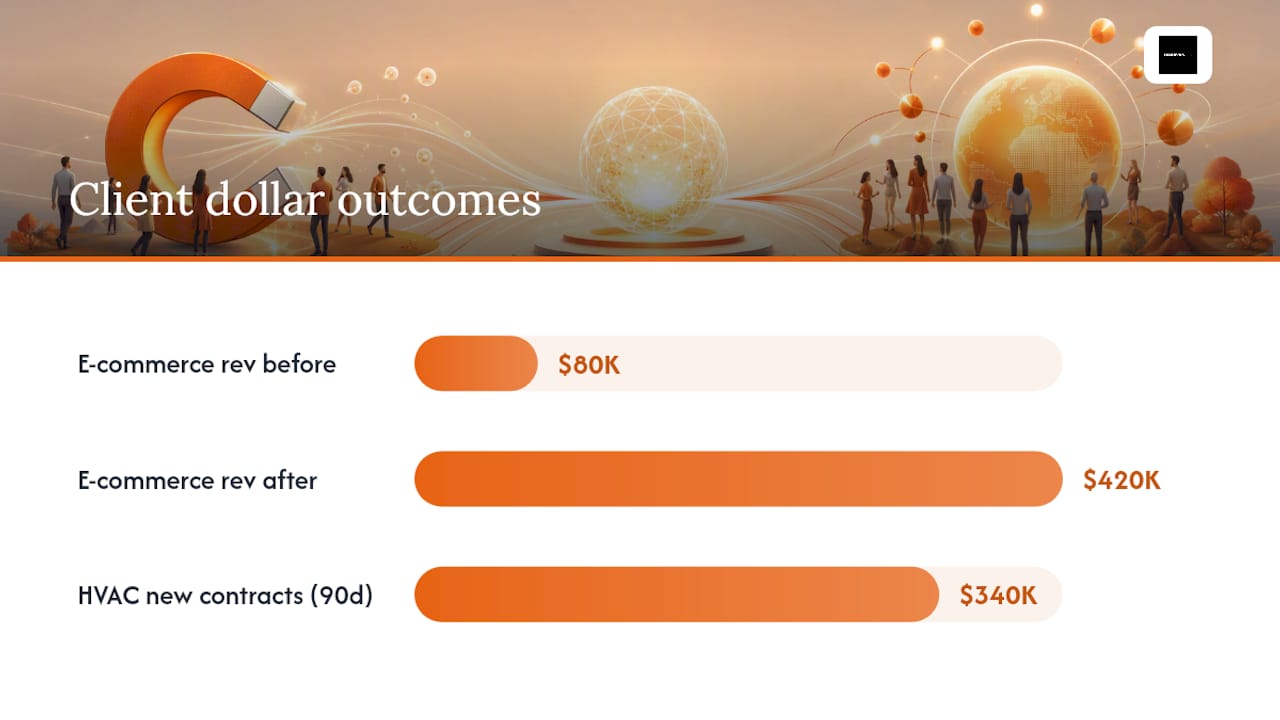
An HVAC contractor working with Omnivancemedia came in with a common problem: strong local reputation, near-zero digital presence, and a pipeline that depended entirely on referrals. The integrated approach combined local SEO and Google Business Profile optimization (awareness), Google Search and Local Services Ads (lead generation), and CRM automation to route and follow up on every inbound inquiry within minutes.
The result: $340K in new contracts within 90 days. The awareness work (SEO, GBP) drove branded search volume up and reduced the cost-per-click on paid search because Google rewarded the relevance signals. The CRM automation ensured no lead sat unanswered for more than 15 minutes. Each layer fed the next: brand visibility lowered acquisition cost, and fast follow-up converted more of the leads that came in.
The integrated stack that produced this outcome:
- Creative production: — Consistent visual and messaging identity across every touchpoint
- CRM setup and automation: Routed leads, triggered follow-up sequences, and tracked every contact from first touch to closed contract
The data flow between components is what makes it work. Ad platforms feed impression and click data into the CRM. The CRM feeds conversion data back to the ad platforms for optimization. SEO performance informs which topics to amplify in paid. Creative assets are tested in paid first, then deployed in organic when they prove out. Nothing operates in isolation.
For the e-commerce client who grew from $80K to $420K in monthly revenue, the same principle applied: Meta and Google ads drove awareness and retargeting, email automation converted warm audiences, and SEO compounded organic traffic over the same period. The full services breakdown shows how each component connects.
The Edelman trust research reinforces why this works: known brands convert at materially higher rates on performance channels. Brand investment shortens sales cycles and reduces acquisition costs. The integrated model captures both effects simultaneously.
Key Takeaways
Brand awareness and lead generation are not competing priorities — the most effective marketing programs coordinate both, with budget splits adjusted by business stage and cash runway.
| Point | Details |
|---|---|
| Prioritization rule | Prioritize awareness when the market doesn't know you; prioritize lead gen when pipeline is short and the offer is proven. |
| The 95-5 reality | Roughly 95% of your B2B market isn't buying right now — awareness reaches them before lead gen can. |
| Measurement gap | Last-click attribution misses dark-funnel brand influence; add brand lift surveys and holdout tests to close the gap. |
| 30-day priority | Audit CPL by channel, confirm UTM coverage, define MQL/SQL criteria, and launch one gated asset before anything else. |
| Omnivancemedia's model | Omnivancemedia's integrated SEO + paid + CRM approach coordinates awareness and lead gen in a single operating model, as demonstrated by the HVAC contractor's $340K result in 90 days. |
The mistake most teams make with this balance
The conventional wisdom says to "align sales and marketing" and "balance short-term and long-term goals." That advice is correct and almost completely useless without a concrete mechanism.
The real problem is that most teams measure awareness and lead generation on separate scorecards, reported to different stakeholders, on different timelines. Awareness gets a quarterly brand report that nobody in sales reads. Lead gen gets a weekly pipeline review that nobody in brand attends. The two programs never talk to each other, so neither can prove it's helping the other.
The fix is a single shared dashboard that shows both leading indicators (branded search volume, share-of-voice, brand lift) and lagging indicators (CPL, MQL volume, pipeline value) in the same view, updated on the same cadence. When a CMO can show that a six-month awareness investment reduced CPL by a measurable amount on branded paid search, the internal debate about budget allocation becomes a data conversation instead of a political one.
The other mistake worth naming: over-indexing on short-term lead generation to the point where the brand never builds. Lead gen delivers faster feedback loops and clearer short-term ROI, which makes it tempting to keep doubling down. But CPL tends to rise over time on activation-only programs because you're always fishing in the same small pond of in-market buyers. Awareness expands the pond. Teams that ignore it eventually hit a CPL ceiling they can't optimize their way out of.
One more: ignoring sales SLAs. A lead that sits uncontacted for 48 hours loses most of its conversion potential. Automating lead routing and follow-up is not a nice-to-have. It's the operational layer that makes the entire top-of-funnel investment pay off.
Omnivancemedia runs awareness and lead gen as one program
Most agencies hand you a choice: brand work or performance work. Omnivancemedia's integrated model removes that tradeoff. The same team that builds your SEO authority and runs your paid search campaigns also sets up your CRM automation and produces your creative assets, so every dollar spent on awareness feeds directly into a measurable lead pipeline.
For businesses ready to scale past $500K, the typical first engagement starts with a discovery audit: current CPL by channel, branded search baseline, CRM setup review, and a gap analysis of where awareness and lead gen are disconnected. From there, the 60–90 day roadmap sets the first tests, defines the MQL/SQL criteria with your sales team, and launches the initial integrated campaigns. The HVAC contractor's $340K result and the e-commerce client's growth from $80K to $420K in monthly revenue both started with that same audit.
If your pipeline is short, your CPL is rising, or your brand is invisible outside your existing customer base, the next step is a conversation. See the full integrated services and request a discovery call to get your baseline audit started.
Useful sources and further reading
- What is Lead Generation? Guide & Best Practices | Salesforce
- What is Lead Generation? | Definition from TechTarget
- Guide: What is lead generation? | Search Engine Land
- Lead Generation vs Brand Awareness: 2026 B2B Guide
- Brand Awareness vs. Lead Generation: What Should SMBs Prioritize? | Adwave
- 2023 Edelman Trust Barometer special report: The collapse of the purchase funnel
- Lead generation — Wikipedia
- All Services | Omnivance Media