Marketing ROI Tracking Best Practices That Actually Work

The single best practice for measuring marketing ROI is a tiered measurement system: tactical multi-touch attribution (MTA) for channel optimization, strategic marketing mix modeling (MMM) for budget allocation, and causal incrementality testing to validate what actually drove results. Connect every tier to CRM revenue through strict UTM tagging, and account for every dollar spent, including production, labor, and tools, not just media.
Non-negotiables to implement first:
- Build a consistent UTM taxonomy across every paid and owned channel before running any campaign.
- Connect your CRM to GA4 (or your analytics platform) so revenue flows back to the marketing touchpoints that generated it.
- Account for full costs: media spend plus production, agency fees, internal labor hours at a blended rate, and tool subscriptions.
The bottom line: Reliable ROI in digital marketing requires triangulation, not a single attribution model. CCPA-compliant first-party data collection and server-side tagging are now table stakes for U.S. marketers who want numbers they can defend to a CFO.
Key Takeaways
A tiered measurement system combining MTA, MMM, and incrementality testing, anchored to CRM revenue and full-cost accounting, produces the most defensible marketing ROI numbers available to U.S. marketing teams.
| Point | Details |
|---|---|
| Use a tiered measurement system | Combine MTA for tactics, MMM for budget allocation, and incrementality tests for causal validation. |
| UTM discipline is the foundation | Consistent UTM taxonomy across every channel is the prerequisite for any reliable attribution. |
| Include all costs | Media, production, agency fees, internal labor, and tool subscriptions must all enter the ROI denominator. |
| Match windows to channels | Paid search needs 30–90 days; content and SEO need 6–12 months to show full revenue contribution. |
| Omnivancemedia integrates the stack | Omnivancemedia connects CRM, paid media, SEO, and creative into one reporting system for defensible ROI. |
Table of Contents
- Why a tiered measurement system outperforms a single attribution model
- Core ROI formulas, worked examples, and a spreadsheet template
- Which attribution model fits your situation?
- What does a solid tracking stack actually require?
- What costs belong in your ROI calculation?
- A practical measurement playbook with reporting cadence
- Common measurement pitfalls and how to fix them
- What Omnivancemedia client results show in practice
- The measurement gap most teams never close
- Omnivancemedia builds the measurement infrastructure, not just the campaigns
- Sources
Why a tiered measurement system outperforms a single attribution model
Most teams pick one attribution model and trust it completely. That's the mistake. Triangulation across MTA, MMM, and incrementality testing is the most defensible measurement architecture available, precisely because each layer compensates for the other's blind spots.
Tier 1: Tactical (MTA). Multi-touch attribution tells you which campaigns and channels are generating conversions right now. It's fast, granular, and useful for daily bid decisions. The weakness: it depends on cookies and pixel tracking, both of which are eroding under CCPA, browser restrictions, and Privacy Sandbox changes.
Tier 2: Strategic (MMM). Marketing mix modeling uses aggregate spend and revenue data to estimate channel contribution without relying on user-level tracking. It handles offline channels, long sales cycles, and privacy gaps that MTA can't see. The tradeoff is latency: MMM typically needs 12–18 months of data to produce reliable coefficients.
Tier 3: Causal validation (incrementality). Geo-holdout tests and time-based experiments answer the question MTA and MMM can only approximate: would this revenue have happened anyway? This is the only layer that produces genuine causal evidence.
Why triangulation matters: Each model has a different failure mode. MTA over-credits last-touch channels. MMM can miss short-term tactical shifts. Incrementality tests are expensive and slow. Used together, they correct each other — and the result is a number leadership can actually trust.
The practical implication: lean on MTA for weekly campaign decisions, MMM for quarterly budget allocation, and incrementality tests to validate your biggest spend decisions before scaling them.
Core ROI formulas, worked examples, and a spreadsheet template
The standard ROI formula is straightforward. The campaign-attributable version is where most teams go wrong.
Three formulas to know:
- Simple ROI: (Revenue from campaign – Campaign cost) / Campaign cost × 100
- Campaign-attributable ROI: (Sales growth – Organic baseline – Campaign cost) / Campaign cost × 100
- Lead-value ROI: ((Leads × Lead-to-customer rate × Average sale price) – Campaign cost) / Campaign cost × 100
The organic baseline adjustment in formula 2 is critical.
Worked example 1: Direct-response paid search campaign
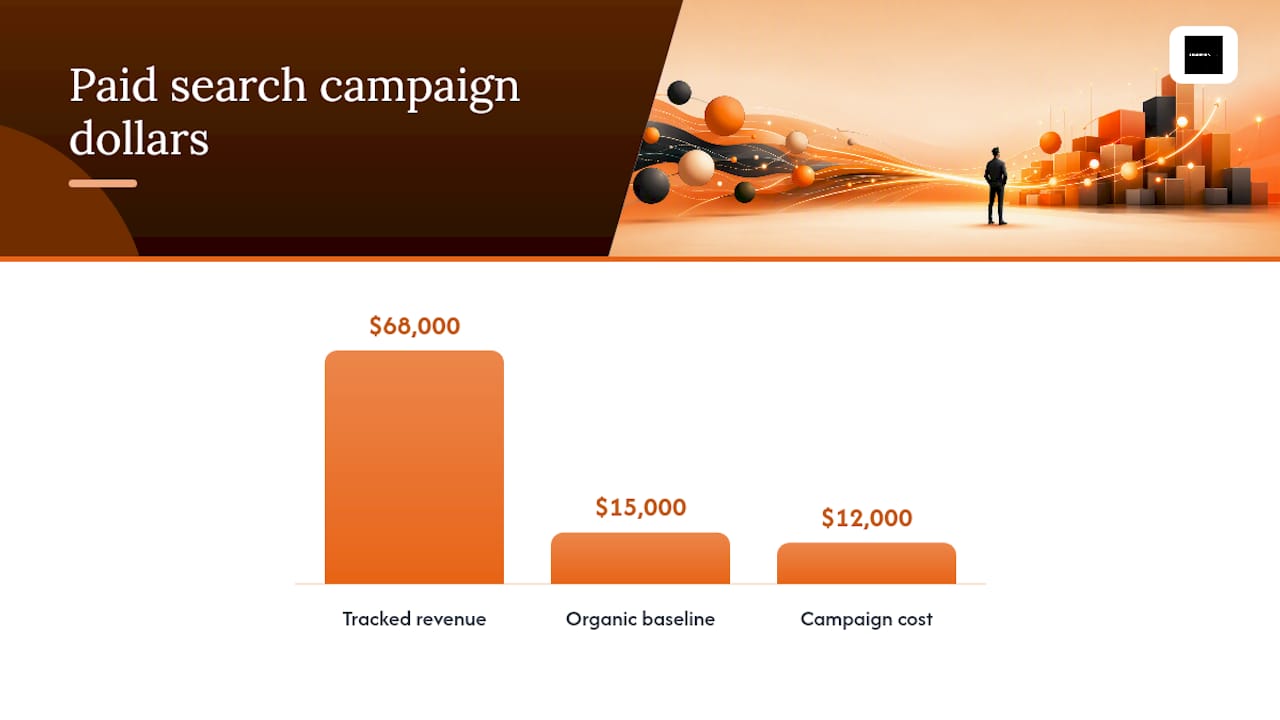
A Google Ads campaign costs $12,000 (media + management). It generates $68,000 in tracked revenue. Organic baseline for the period is $15,000. Campaign-attributable ROI = ($68,000 – $15,000 – $12,000) / $12,000 × 100 = 341.7%.
Worked example 2: Lead-generation funnel
A content campaign costs $8,500 (production + promotion + labor). It generates 120 leads. Average sale is $4,200.
Minimal spreadsheet template columns: Campaign name | Channel | Total cost (media + production + labor + tools) | Leads or conversions | Revenue attributed | Organic baseline | Campaign-attributable revenue | ROI % | Notes/assumptions.
Content and brand campaigns need longer measurement windows — often 6–12 months — before their full revenue contribution appears. Short measurement windows on SEO campaigns can undervalue their full returns, which typically require longer periods to assess.
Which attribution model fits your situation?
| Model | Best for | Key limitation |
|---|---|---|
| Last-touch | High-volume, short-cycle direct response | Over-credits closers; ignores awareness |
| First-touch | Brand and awareness measurement | Ignores nurture and conversion channels |
| Linear / time-decay MTA | Mid-funnel B2B, multi-session journeys | Requires clean cross-device tracking |
| MMM | Budget allocation, offline + online mix | Needs 12+ months of data; slow to update |
| Incrementality / geo-holdout | Validating causal lift before scaling | Resource-intensive; needs market scale |
Campaign ROI alone is insufficient — teams also need pipeline contribution and influenced revenue to tell the full story. For most U.S. businesses under $5M in annual revenue, last-touch or linear MTA plus one annual incrementality test is a practical starting point. Larger budgets justify a full MMM build.
On choosing models: The right attribution model is the one your team will actually maintain and reconcile monthly. A theoretically superior model with inconsistent data inputs produces worse decisions than a simpler model with clean, audited data.
Pro Tip: Run your first geo-holdout on your highest-spend channel. Pause ads in two comparable markets for four weeks, keep them running in two control markets, and compare revenue trajectories. The gap is your causal lift estimate — and it will almost certainly differ from what the ad platform reports.
What does a solid tracking stack actually require?
Practical instrumentation matters more than model choice. UTM discipline, server-side tagging, and CRM linkage produce the biggest improvements in ROI data quality, regardless of which attribution model you use.
Setup checklist:
- Define a UTM taxonomy: source / medium / campaign / content / term — document it and enforce it across every team and vendor.
- Connect your CRM (HubSpot, Salesforce, or equivalent) to GA4 so closed-won revenue maps back to the originating marketing session.
- Deploy server-side Google Tag Manager to reduce data loss from browser-side blocking and improve first-party signal quality.
- Enable enhanced conversions in Google Ads and Meta's Conversions API to pass hashed first-party data where permitted under CCPA.
- Mark your primary conversion events in GA4 (purchase, form submit, phone call) and confirm revenue values are passing correctly.
- Run a monthly reconciliation: compare GA4 goal completions against CRM closed deals and ad-platform conversion counts. Gaps above 10–15% signal a tagging or attribution problem.
Server-side tagging is a high-leverage investment in a privacy-constrained environment, particularly for teams running cross-channel campaigns where browser-side pixels lose signal on iOS and in Chrome's evolving privacy model.
What costs belong in your ROI calculation?
Reporting ROAS instead of true ROI is the most common way marketing teams overstate their results. Full-cost accounting requires including every input, not just the media line.

| Cost category | What to include |
|---|---|
| Media spend | All paid placements: search, social, display, programmatic, streaming |
| Production & creative | Design, copywriting, video, photography — production time included |
| Agency fees | Management fees, retainers, project fees |
| Internal labor | Hours × blended hourly rate (salary + benefits / annual hours) |
| Tool subscriptions | Analytics, CRM, attribution, automation platforms |
| Allocated overhead | A proportional share of office, software licenses, and management time |
If the campaign is only profitable under the optimistic assumption, it's a riskier bet than the headline number suggests.
Non-financial outcomes like brand lift and search volume growth belong in strategic decision-making, not in short-term ROI calculations. Holistic investment ranking combines financial ROI with normalized non-financial metrics — useful when comparing a brand campaign against a direct-response one.
A practical measurement playbook with reporting cadence
30-day actions: Roll out UTM taxonomy, connect CRM to GA4, confirm revenue values are passing, and establish your organic baseline.
90-day actions: Run first monthly reconciliation, build a campaign-level ROI spreadsheet, and design your first geo-holdout test on the highest-spend channel.
180-day actions: Complete the geo-holdout, begin MMM data collection, and present a channel-mix ROI report to leadership with attribution model assumptions documented.
| Reporting cadence | What to cover |
|---|---|
| Weekly | Paid channel performance: spend, conversions, cost-per-acquisition, ROAS |
| Monthly | Channel ROI (full-cost), pipeline generated, CRM reconciliation, UTM audit |
| Quarterly | MMM update or review, incrementality test results, budget reallocation recommendations |
Leadership report checklist: Total cost by channel (full-cost) | Revenue attributed (model used, stated explicitly) | Campaign-attributable ROI | Known blind spots (dark social, offline, long-cycle deals) | Recommended budget moves with supporting evidence.
Common measurement pitfalls and how to fix them
Attribution gaps, incomplete cost accounting, and misaligned time windows are the three most common reasons ROI numbers mislead rather than inform.
Quick-fix checklist:
- Missing costs: Add a labor column to every campaign report. Internal time is real cost.
- Broken UTM links: Audit UTM coverage monthly. Any traffic arriving as "direct" from a known campaign is a tagging failure.
- Double-counting: Ad platforms routinely over-report conversions. Reconcile platform numbers against your CRM and transaction data — trust the internal system when they diverge.
- Wrong time window: Paid search feedback loops run 30–90 days. Content and SEO need 6–12 months. Measuring both on the same 30-day window systematically undervalues slower channels.
- Dark social gaps: Direct traffic from newsletters, podcasts, and messaging apps is often misattributed. Use UTM-tagged links in every owned channel and consider a post-purchase survey asking "How did you hear about us?"
On privacy-related data loss: CCPA opt-outs and cookie deprecation reduce observable signal in browser-side tracking. The mitigation is first-party data: server-side tagging, hashed email matching via enhanced conversions, and CRM-anchored attribution that doesn't depend on third-party cookies.
Pro Tip: *Before your next budget review, pull your top five campaigns and add the internal labor hours your team spent managing them.
What Omnivancemedia client results show in practice
Case 1: HVAC contractor, 90-day paid media program. The measurement problem was simple: the client was tracking inbound calls but not connecting them to closed contracts. Omnivancemedia instrumented call tracking with UTM-tagged landing pages, mapped closed deals back to the campaign source in the CRM, and applied full-cost accounting including internal sales labor. The result: $340K in new contracts attributed to the campaign within 90 days, with a documented cost-per-contract that justified a 3× budget increase.
Case 2: E-commerce brand, revenue scaling. Monthly revenue was $80K when the engagement began. Attribution was last-touch only, which was crediting paid social for conversions that email and organic search had initiated. Omnivancemedia rebuilt the attribution model using linear MTA, connected Klaviyo and GA4 to Shopify revenue data, and ran a four-week paid social holdout to validate causal lift. Monthly revenue reached $420K over the following months.
Key methodology notes across both cases:
- Full-cost accounting was applied from day one, including creative production and account management hours.
- Attribution model choice was documented in every leadership report, with known blind spots stated explicitly.
- Incrementality validation preceded any major budget increase.
The measurement gap most teams never close
The real barrier to credible ROI measurement isn't the formula or the tool. It's alignment: marketing, sales, and finance need to agree on definitions before any number means anything. What counts as a "marketing-sourced" lead? Which revenue line does the campaign get credit for? How long is the attribution window?
Teams that answer those questions in a shared document, then reconcile monthly, produce ROI numbers that hold up in a budget meeting. Teams that skip that step produce numbers that get challenged every quarter.
Start small. UTM discipline and one clean CRM integration will improve your data quality more than any attribution platform. Add an incrementality test at the six-month mark. Build toward MMM when you have 12+ months of clean data. Measure efficiency and scalable contribution, not just percentage ROI. A channel that produces a modest ROI at high volume often contributes more to the business than a high-ROI channel that can't scale.
The siloed team problem is usually what prevents this alignment from happening. Fix the process before you fix the model.
Omnivancemedia builds the measurement infrastructure, not just the campaigns
Fragmented vendors mean fragmented data. When your SEO agency, paid media team, and CRM admin are all separate, no one owns the full-cost picture or the cross-channel attribution model.

Omnivancemedia integrates CRM setup and automation, paid media management, SEO, and creative production under one reporting system, so your ROI numbers reflect the whole program, not just one channel's self-reported conversions. For new clients, the first 30 days typically cover UTM rollout, CRM-to-analytics connection, and a baseline MMM data pull. The HVAC contractor's $340K result and the e-commerce brand's growth from $80K to $420K monthly both came from that integrated foundation. If you're ready to build a measurement system that holds up to CFO scrutiny, see what Omnivancemedia's full-service programs include and request a scoping call.