Why Law Firms Need Paid Search Campaigns in 2026

Paid search campaigns are the fastest path a law firm has to put its name in front of a prospect who is actively searching for legal help right now. Unlike organic SEO, which can take six to twelve months to produce meaningful traffic, a well-structured Google Ads campaign generates qualified leads within days of launch. This is why law firms need paid search campaigns as a core part of their client acquisition strategy, not a supplemental experiment. The firms that treat pay-per-click (PPC) advertising as a measurable business investment, rather than a marketing line item, consistently outpace competitors who rely on referrals and organic rankings alone.
Why law firms need paid search campaigns to win clients today
Paid search places your firm's ad directly in front of someone typing "personal injury lawyer near me" or "divorce attorney in Chicago" at the exact moment they are ready to hire. That intent signal is the most valuable thing in legal marketing, and no other channel captures it as reliably. Paid search delivers leads in days rather than the months organic SEO requires, which matters enormously in practice areas where a prospect contacts two or three firms and hires the first one that responds.
The mechanics work through real-time ad auctions. Every time a user submits a legal query on Google, an auction runs in milliseconds, and your bid, ad quality, and landing page relevance determine whether your ad appears. This means you can target hyper-specific queries by practice area, geography, and even case type, filtering out the casual researchers and reaching the people who are ready to book a consultation.
Measurement is the other defining advantage. Every click, call, and form submission ties back to a specific keyword and ad, giving your firm data that a billboard or a referral network simply cannot provide. When you connect that data all the way to signed clients, you have a system that tells you exactly which campaigns are generating revenue, not just traffic.
- Speed: Campaigns go live and generate leads within days, not months.
- Intent targeting: Ads trigger on high-intent queries like "workers' comp attorney near me," not broad informational searches.
- Measurability: Click-to-call tracking and form attribution connect ad spend to real client outcomes.
- Scalability: Once a campaign proves ROI, budget increases produce proportional lead volume.
Pro Tip: Set up call tracking from day one. Without it, you are counting clicks and ignoring the phone calls that actually become clients.
How legal keyword costs work, and why PPC is still profitable
Legal keywords are the most expensive in Google Ads. Legal keywords average $8.58 CPC compared to a cross-industry average of $5.26, a gap that reflects the lifetime value of a retained legal client. A personal injury case that settles for $150,000 generates a contingency fee that dwarfs the cost of acquiring that client through paid search, which is why firms bid aggressively and why competition is fierce.

The cost picture gets more complicated in major metros. Legal CPCs in large markets can run three to four times higher than in smaller cities, meaning a firm in Los Angeles or New York may pay $30 to $50 per click on competitive keywords. That number sounds alarming until you calculate cost per signed client rather than cost per click.
| Metric | Standard view | Strategic view |
|---|---|---|
| Cost per click | $8.58 average | Varies by market and practice area |
| Cost per lead | $70.11 (search ads) | Includes unqualified and duplicate leads |
| Cost per signed client | Often 3x+ cost per lead | The only number that measures true ROI |
| Quality Score impact | Baseline | Raising score from 5 to 7 cuts CPC by 28% |
Cost per signed case is the meaningful KPI, not cost per lead. A campaign generating 50 leads per month at $70 each looks efficient until you discover only 5 of those leads sign retainers. The real cost per client is $700, and that changes every budget and bidding decision.
Pro Tip: Raising your Google Ads Quality Score from 5 to 7 reduces effective CPC by 28%. Improving ad relevance and landing page alignment is the highest-leverage cost reduction available without cutting bids.
What is closed-loop attribution and why it changes everything
78% of law firms run paid search, but 82% report they do not believe it works. That contradiction has one root cause: attribution gaps. Most firms count calls as conversions without knowing which calls became retained clients. The result is a campaign that looks busy but cannot prove it generates revenue.
Closed-loop attribution solves this by connecting every touchpoint from ad click to signed retainer. Here is how to build it:
- Implement dynamic number insertion (DNI). Assign unique phone numbers to each campaign, ad group, or keyword. When a prospect calls, the system records exactly which ad triggered the call.
- Tag lead outcomes in your CRM. Every inbound call and form submission gets tagged as a qualified lead, consultation scheduled, or signed client. Tools like CallRail or WhatConverts feed this data back into Google Ads.
- Pass conversion values to Google Ads. When a client signs a retainer, that event fires as a high-value conversion. Google's Smart Bidding then shifts optimization toward the keywords and audiences that produce retained clients, not just calls.
- Review cost per signed client weekly. This single metric tells you whether to scale, pause, or restructure a campaign.
"Fix attribution before scaling budgets. Without connecting spend to retained clients, growing the campaign risks high waste." — Attorney at Work
Dynamic number insertion and call outcome tagging close the attribution loop and enable Smart Bidding to optimize for quality leads rather than raw call volume. This is the single structural change that separates firms generating a positive return from those convinced paid search does not work. For a deeper look at tracking frameworks, Omnivancemedia's guide on measuring digital marketing ROI covers the full attribution stack for legal campaigns.
How Google Local Services Ads complement traditional PPC
Google Local Services Ads (LSAs) sit above standard paid search results and above traditional Google Ads, making them the highest-visibility placement on the search results page. They display your firm's name, rating, and a "Google Screened" or "Google Guaranteed" badge, which signals credibility before a prospect even clicks. That trust signal matters in legal services, where the hiring decision carries significant personal and financial stakes.
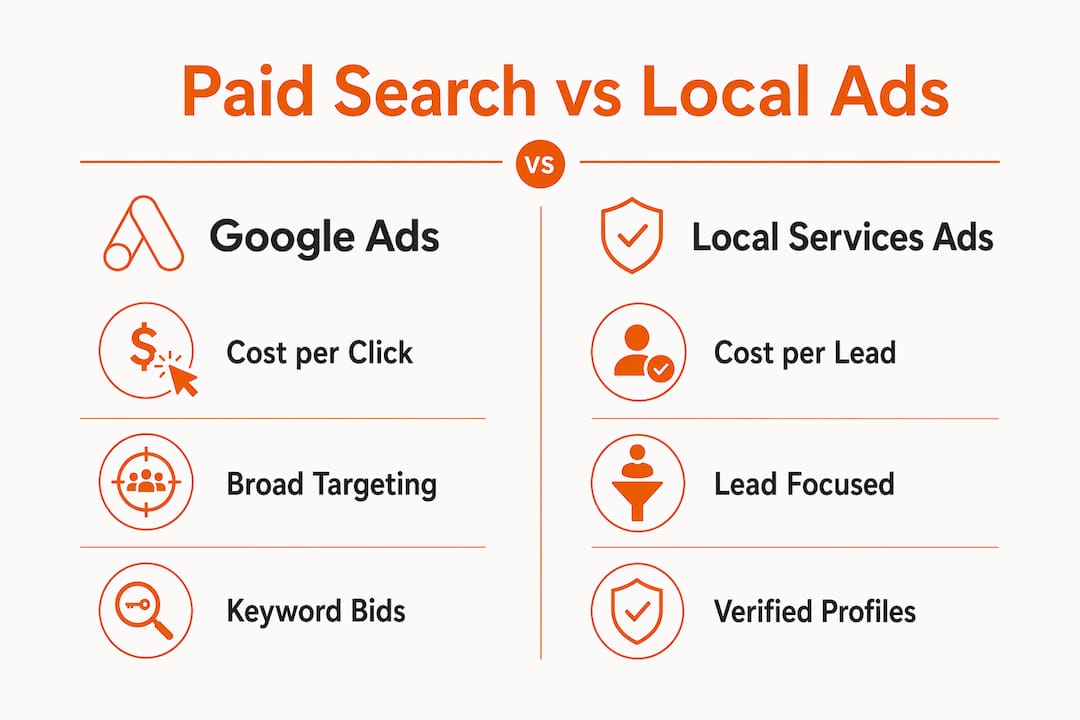
The pricing model is fundamentally different from standard PPC. LSAs charge per lead, not per click, which eliminates the cost of window shoppers who click but never call. LSA average cost per lead runs around $60 compared to $70.11 for standard search ads, making them a lower-cost acquisition channel for many practice areas.
| Feature | Standard Google Ads | Google Local Services Ads |
|---|---|---|
| Pricing model | Cost per click | Cost per lead |
| Average cost | $8.58 CPC | ~$60 per lead |
| Page position | Below LSAs | Top of search results |
| Trust signal | Ad label | Google Screened badge |
| Best use | Broad keyword coverage | High-intent, local queries |
Running LSAs alongside traditional paid search gives your firm two bites at the same apple. A prospect searching "estate planning attorney Houston" may see your LSA at the top and your standard ad below it, doubling your visibility and reinforcing brand recognition before they make contact.
Pro Tip: Dispute irrelevant LSA leads directly in the Google Local Services dashboard. Google credits you for leads that do not match your practice area, which keeps your effective cost per lead lower than the sticker price suggests.
Best practices for optimizing paid search to sign more clients
The difference between a law firm PPC campaign that breaks even and one that generates a 5x return on ad spend comes down to execution discipline. These are the practices that move the needle.
- Use high-intent, practice-area-specific keywords. "Car accident lawyer Chicago" converts at a higher rate than "lawyer Chicago." Specificity filters out unqualified traffic before it costs you a click. Review the law firm ad targeting options available in 2026 to build a keyword architecture that matches how your best clients actually search.
- Write ad copy that matches the searcher's situation. Include the city, the practice area, and a differentiator like "Free Consultation" or "No Fee Unless You Win." Generic ads lose to specific ones in both click-through rate and Quality Score.
- Build landing pages that mirror your ads. A prospect clicking "DUI attorney Denver" should land on a page about DUI defense in Denver, not your firm's homepage. Ad-to-page relevance directly affects both conversion rate and Quality Score, which in turn affects your CPC.
- Build and maintain negative keyword lists. Broad matches without negatives drain budget on informational searches like "how to become a lawyer" or "law school near me." Audit your search term reports weekly and add irrelevant queries to your negative list.
- Optimize for signed clients, not just leads. Lowest-cost leads do not always produce the best ROI because conversion rates to signed clients vary across practice areas. A $40 lead in a low-conversion practice area costs more than a $90 lead that signs 40% of the time.
The firms that scale paid search successfully treat it as a data operation, not an advertising expense. Every week, the question is not "how much did we spend?" but "what did each dollar produce in signed retainers?"
Key takeaways
Law firms that run paid search without closed-loop attribution are spending money without knowing what it returns, and fixing that attribution gap is the prerequisite to scaling any campaign profitably.
| Point | Details |
|---|---|
| Speed advantage | Paid search generates leads within days, unlike organic SEO which takes months. |
| True cost metric | Cost per signed client, not cost per lead, is the only KPI that measures real ROI. |
| Attribution is foundational | Dynamic number insertion and CRM tagging connect ad spend directly to retained clients. |
| LSAs reduce acquisition cost | Google Local Services Ads average $60 per lead versus $70.11 for standard search ads. |
| Quality Score cuts CPC | Raising Quality Score from 5 to 7 reduces effective cost per click by 28%. |
Where most law firms are leaving money on the table
I have reviewed paid search accounts for law firms spending anywhere from $3,000 to $80,000 per month on Google Ads, and the pattern is almost always the same. The campaigns are technically running. The ads are showing. The phone is ringing. But nobody can tell you which keywords are producing signed clients versus tire-kickers, because the attribution stops at the call.
The firms that frustrate me most are the ones scaling spend without that data. Doubling a budget from $15,000 to $30,000 per month when you cannot prove which half of the original spend is working is not aggressive marketing. It is a coin flip with your firm's money.
The counterintuitive truth is that the firms generating the best returns from paid search are not always the ones spending the most. They are the ones who spent three months building attribution infrastructure before they scaled. They know their cost per signed client by practice area, by keyword, and by geography. When they increase budget, they increase it in the channels they can prove are working.
The other mistake I see constantly is treating LSAs and standard Google Ads as competing channels. They are complementary. LSAs capture the highest-intent prospects at the top of the page. Standard ads capture broader intent and allow for more granular keyword control. Running both, with separate tracking for each, gives you a complete picture of your paid search performance and two distinct lead sources feeding the same intake pipeline.
Paid search in competitive legal markets is not a set-and-forget channel. The firms winning in 2026 are the ones treating it as a continuous optimization process, reviewing data weekly, testing new ad copy monthly, and making budget decisions based on cost per signed client rather than gut instinct.
— laya
How Omnivancemedia helps law firms turn ad spend into signed clients

Omnivancemedia manages paid search campaigns built specifically for law firms competing in high-cost legal markets. That means Google Ads and Local Services Ads structured around your practice areas, call tracking and CRM integration that connects every lead to a case outcome, and weekly optimization driven by cost per signed client rather than surface-level metrics. For firms ready to stop guessing which ads are working, Omnivancemedia's law firm digital marketing services deliver the attribution infrastructure and campaign management that turns ad spend into a predictable client acquisition system.
FAQ
Why do law firms need paid search campaigns specifically?
Paid search captures prospects at the exact moment they are searching for legal help, producing higher-intent leads than any other digital channel. Unlike organic SEO, campaigns generate leads within days of launch.
How much do Google Ads cost for law firms?
Legal keywords average $8.58 per click, with costs in major metros running three to four times higher. The relevant number is cost per signed client, which accounts for lead quality and conversion rates.
What is the difference between Google Ads and Local Services Ads for lawyers?
Standard Google Ads charge per click and offer broad keyword targeting. Google Local Services Ads charge per lead, average around $60 per lead, and display a Google Screened badge that increases prospect trust.
How do law firms measure paid search ROI accurately?
Accurate ROI measurement requires dynamic number insertion, lead outcome tagging in a CRM, and passing signed-client conversion events back to Google Ads so Smart Bidding can optimize for retained clients rather than call volume.
What is the biggest mistake law firms make with PPC?
Scaling ad budgets before fixing attribution. Without knowing which keywords and campaigns produce signed clients, increasing spend amplifies waste rather than results.