The Role of Google Ads for Law Firms in 2026

Google Ads for law firms is a paid search system that places legal services directly in front of prospects who are actively searching for an attorney right now. The role of Google Ads for law firms goes beyond simple visibility. It creates a direct pipeline between high-intent searchers and your intake team, at a moment when the prospect is already motivated to hire. With average CPCs around $8.94 and conversion rates ranging from 2% to 10% depending on practice area, legal paid search is expensive but delivers a client lifetime value that justifies the spend. Local Services Ads (LSAs), a complementary Google product, add a pay-per-lead layer that further sharpens acquisition economics. Together, these tools form the backbone of modern digital marketing for law firms.
What types of Google Ads campaigns work best for law firms
Not every campaign type performs equally in legal marketing. The three formats that matter most are Search Network campaigns, Local Service Ads, and Display or Performance Max campaigns, and each serves a distinct role in your acquisition funnel.
Search Network campaigns target keywords with direct hiring intent, such as "divorce attorney near me" or "personal injury lawyer free consultation." These are the highest-converting campaign type for most practice areas because the searcher is already in decision mode. About 75% of users never scroll past the first page of results, which means appearing in the top three paid positions is not optional. It is the entire game.

Local Service Ads operate differently. Rather than paying per click, you pay per lead, and Google places a "Google Screened" or "Google Guaranteed" badge next to your listing. LSA costs per lead range from $25 to $150 depending on location and case type. That trust badge meaningfully increases call-through rates, particularly for practice areas like family law, criminal defense, and estate planning where personal trust is a deciding factor.
Performance Max and Display campaigns require caution. These formats work best when you already have substantial conversion data and a clear remarketing audience. Without that foundation, they tend to generate impressions and clicks from low-intent users, burning budget without producing signed cases.
Pro Tip: Build a dedicated landing page for each practice area before you launch any Search Network campaign. Sending traffic to a generic homepage destroys Quality Score and raises your cost per click.
| Campaign type | Best use case | Cost model | Key requirement |
|---|---|---|---|
| Search Network | High-intent keyword targeting | Cost per click | Dedicated landing pages per practice area |
| Local Service Ads | Trust-driven lead generation | Cost per lead | Google verification and reviews |
| Display / Remarketing | Re-engaging past site visitors | Cost per click or impression | Existing audience data |
| Performance Max | Broad reach with automation | Cost per conversion | Sufficient historical conversion volume |
Geographic and practice area segmentation amplifies all of these formats. A personal injury firm in Chicago should not run the same campaign structure as an immigration attorney in Phoenix. Separate ad groups by city, suburb, and case type so your budget flows toward the searches that actually convert in your specific market.
How do Google Ads compare to Local Service Ads for attorneys
The comparison between Google Ads and LSAs is not a question of which is better. It is a question of what each one does and why you need both.
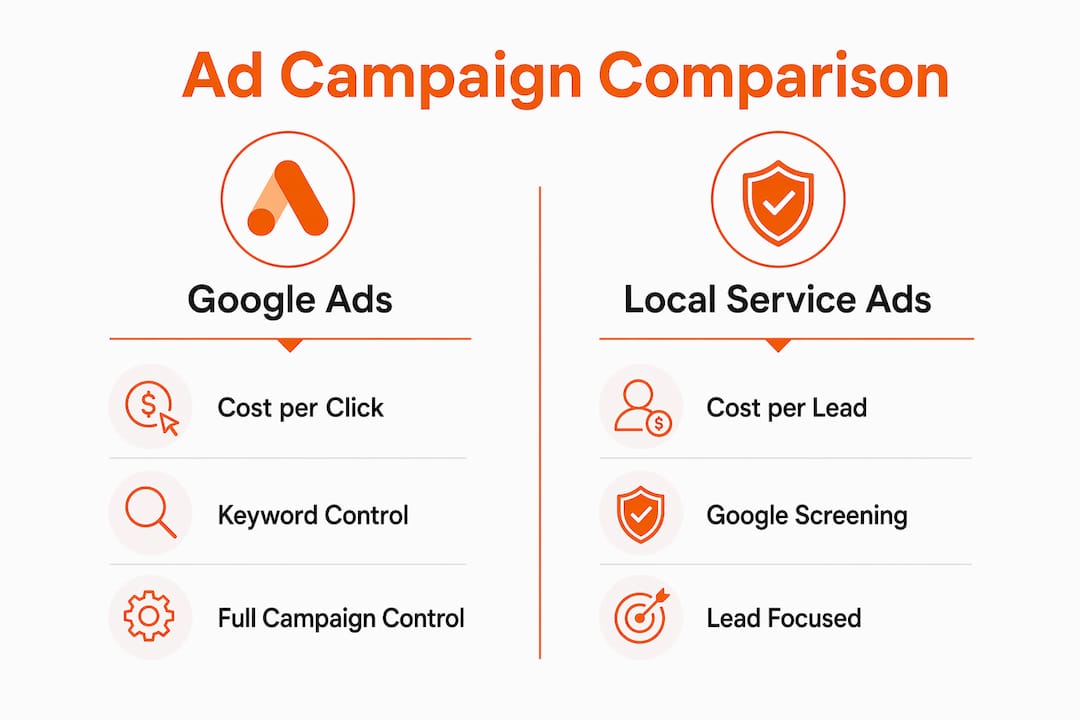
LSAs produce signed cases at 30% to 50% lower acquisition cost than traditional search ads. The data is specific: LSA cost per signed case averages $2,485 versus $2,971 for traditional search campaigns. That $486 difference per case compounds significantly across a full year of marketing spend.
However, LSAs generate fewer total leads. Google controls which queries trigger your LSA listing, and the volume ceiling is lower than what a well-funded Search Network campaign can produce. Traditional Google Ads give you full control over keywords, match types, bid adjustments, and audience layering. That control translates to volume when you need it.
The practical framework most high-performing law firms use looks like this:
- Use LSAs as your primary lead source for practice areas where Google Screening is available, because the cost per acquisition is lower and lead quality is higher.
- Use Search Network campaigns to fill volume gaps, target practice areas not covered by LSAs, and capture competitive keywords where you need to outbid rivals.
- Layer Display and remarketing campaigns on top to re-engage prospects who visited your site but did not convert.
- Track cost per signed case, not cost per lead. Focusing solely on cost-per-lead misguides budget allocation and causes firms to abandon channels that actually produce clients.
One counterintuitive finding: firms that run LSAs and Search Network campaigns simultaneously often see their Search Network conversion rates improve. The LSA trust badge creates brand familiarity that makes the paid search listing more credible when the same prospect sees it moments later.
What are the key strategies for optimizing law firm Google Ads campaigns
Optimization in legal PPC is not about tweaking bids every week. It is about building a system that converts clicks into signed cases reliably. These are the practices that separate profitable campaigns from expensive experiments.
-
Start with manual CPC bidding. Automated bidding strategies require substantial high-quality conversion data to function correctly. Without at least 30 to 50 conversions per month, Smart Bidding optimizes for the wrong signals. Manual CPC keeps you in control while you build that data foundation.
-
Build an extensive negative keyword list from day one. Proper Google Ads accounts contain hundreds of negative keywords. Filter out job seekers searching "lawyer salary," students searching "law school," and competitors researching your firm. Every irrelevant click is money that could have gone toward a qualified prospect.
-
Create practice-area-specific landing pages. Dedicated landing pages per practice area improve conversion rates and reduce ad costs by raising Quality Score. A personal injury landing page should speak exclusively to accident victims. A family law page should address divorce and custody concerns directly. Generic pages dilute relevance and raise your cost per click.
-
Track signed cases, not just form fills. Integrate Google Ads conversion tracking with your CRM and phone call analytics. If your intake team closes 20% of leads from one campaign and 8% from another, that data should drive your budget allocation, not raw lead volume.
-
Build a fast intake and follow-up system. The speed at which your team responds to a new lead is one of the strongest predictors of whether that lead becomes a client. A prospect who submits a form at 9 PM and hears back at 10 AM the next day has likely already called three other firms.
-
Write ad copy that leads with empathy, not credentials. Ads succeed not by listing bar admissions and years of experience, but by conveying emotional relief early in the prospect's journey. "We handle the legal fight so you can focus on healing" outperforms "Board-certified attorney with 20 years of experience" in most personal injury markets.
Pro Tip: Use call-only ads during business hours and switch to standard text ads with a strong call-to-action after hours. This routes prospects to a live person when your intake team is available and captures form leads when they are not.
What common pitfalls do law firms face with Google Ads
Most law firms that fail with Google Ads do not fail because the platform does not work. They fail because of execution errors that are entirely preventable.
"The biggest waste in legal PPC is not overspending on clicks. It is underspending on the systems that convert those clicks into clients." — Omnivancemedia
The most damaging mistakes in legal PPC campaigns include:
- Sending ad traffic to the homepage. A homepage is designed for multiple audiences. A paid search landing page should be designed for one audience with one goal. Mixing these destroys conversion rates.
- Tracking leads instead of signed cases. A campaign that generates 50 leads per month but signs 2 clients is not performing. A campaign that generates 15 leads and signs 5 clients is. Google Ads deliver an average 2:1 ROI across industries, but law firms only capture that return when they measure the right outcome.
- Ignoring LSAs or misallocating budget based on cost per lead. Many firms abandon LSAs because the cost per lead looks high compared to organic traffic. The cost per signed case tells a completely different story.
- Activating automated bidding too early. Without clean conversion data, Smart Bidding optimizes for signals that do not correlate with signed cases.
- Underestimating minimum viable budgets. Law firms need at least $3,000 to $5,000 per month in Google Ads spend to generate meaningful data and consistent leads. Below that threshold, you are not running a campaign. You are running a test with no statistical power.
- Neglecting negative keywords. A single week without negative keyword maintenance can drain hundreds of dollars on irrelevant searches.
How Google Ads fit into a broader client acquisition system
Google Ads are the high-intent entry point of a client acquisition system, not the entire system. Fewer than 10% of law firms currently use PPC and LSAs, which means the firms that build integrated acquisition systems now hold a structural advantage over the majority of their competitors.
An integrated system works like this. A prospect searches for a personal injury attorney, clicks your Search Network ad, lands on a practice-area-specific page, and submits a form. Your CRM immediately triggers an automated text and email sequence. A trained intake specialist calls within five minutes. If the prospect does not convert on the first contact, a remarketing campaign keeps your firm visible while a nurture email sequence builds trust over the following two weeks.
Integrating AI-driven marketing automation and CRM with Google Ads transforms sporadic lead flow into a predictable client acquisition pipeline. The firms generating 5 to 20 consultations daily are not doing so through ad spend alone. They are doing it through the system that surrounds the ads.
Balancing paid search with SEO and referral strategies matters for long-term stability. Google Ads produce immediate case flow. SEO builds compounding organic authority over 12 to 24 months. Referral networks provide the highest-quality leads at the lowest acquisition cost. The firms that win long-term treat these as complementary channels and use law firm digital marketing ROI measurement to allocate budget across all three based on actual signed case data.
For a detailed breakdown of how these channels compare on targeting precision and cost, the 2026 ad targeting guide from Omnivancemedia covers the full spectrum of options available to legal marketers this year.
Key takeaways
Google Ads for law firms produce the highest return when Search Network campaigns, Local Service Ads, and CRM-driven intake systems operate as a single coordinated acquisition pipeline rather than isolated tactics.
| Point | Details |
|---|---|
| LSAs lower acquisition cost | LSA cost per signed case averages $2,485 versus $2,971 for Search Network campaigns. |
| Manual CPC first | Start with manual bidding until you have 30 to 50 monthly conversions before switching to automation. |
| Dedicated landing pages | Each practice area needs its own landing page to protect Quality Score and conversion rates. |
| Measure signed cases | Track cost per signed case, not cost per lead, to allocate budget accurately across channels. |
| Minimum budget threshold | Firms need $3,000 to $5,000 per month in ad spend to generate reliable data and consistent leads. |
Why most law firms are still leaving PPC money on the table
I have reviewed dozens of legal PPC accounts over the years, and the pattern is almost always the same. The firm launched Google Ads, spent $2,000 a month for 90 days, got a handful of leads that did not convert, and concluded that paid search does not work for their practice. What actually happened is that they ran a campaign without a system.
The firms I have seen generate real, predictable case flow from Google Ads share three traits. They treat the ad as the beginning of a conversation, not the close. They have an intake process that responds in minutes, not hours. And they measure success at the signed case level, not the click or even the lead level.
The untapped opportunity here is significant. With fewer than 10% of law firms actively running PPC, the competitive pressure in most markets is lower than it appears. A well-structured campaign with a $5,000 monthly budget, a dedicated landing page, and a responsive intake team will outperform a competitor spending $15,000 with none of those fundamentals in place.
The shift I would encourage every legal marketing professional to make is this: stop thinking about Google Ads as an advertising expense and start thinking about it as the front end of a client acquisition machine. The ads are just the door. The system behind the door is what actually signs cases.
— laya
Build a client acquisition system that actually signs cases
Law firm marketing professionals who want predictable case flow need more than a Google Ads account. They need a coordinated system where paid search, landing pages, CRM automation, and intake workflows operate together.

Omnivancemedia builds exactly that for law firms ready to scale. From paid search campaign management to CRM and follow-up automation, every component is designed to convert high-intent clicks into signed clients. If your current Google Ads strategy is generating leads that do not close, the problem is almost never the ads. It is the system around them. Omnivancemedia's integrated approach addresses that gap directly, with results measured at the case level, not the click level.
FAQ
What is the role of Google Ads for law firms?
Google Ads connect law firms with prospects who are actively searching for legal help, placing paid listings at the top of search results at the exact moment of highest intent. The primary function is lead generation, with success measured by signed cases rather than clicks or impressions.
How much should a law firm spend on Google Ads?
Law firms need a minimum monthly budget of $3,000 to $5,000 to generate enough data and lead volume for meaningful results. Budgets below that threshold rarely produce reliable conversion data or sufficient case flow to justify the spend.
What is the difference between Google Ads and Local Service Ads for lawyers?
Google Ads charge per click and give firms full control over keywords and targeting, while Local Service Ads charge per lead and display a Google trust badge. LSAs typically produce signed cases at 30% to 50% lower acquisition cost, but Search Network campaigns generate higher total lead volume.
Why do law firm Google Ads campaigns fail?
The most common failure points are sending traffic to generic homepages instead of dedicated landing pages, tracking leads instead of signed cases, and activating automated bidding before accumulating sufficient conversion data. Slow intake response times are equally damaging once leads do arrive.
How do you measure Google Ads ROI for a law firm?
ROI measurement for legal PPC requires tracking conversions all the way through to signed cases, not just form submissions or calls. Integrating Google Ads with a CRM and using advanced attribution tracking allows firms to calculate true cost per acquired client and allocate budget to the channels that produce the best case economics.