The Role of Google Local Services Ads in 2026

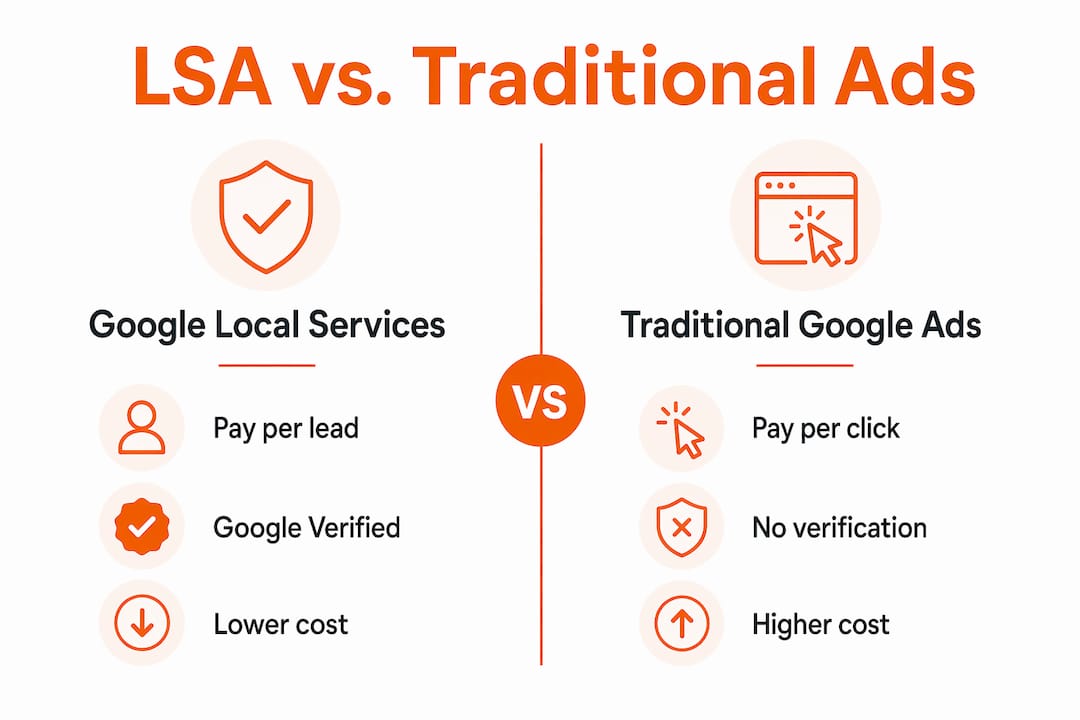
Google Local Services Ads (LSAs) are a pay-per-lead advertising format that connects service-based businesses directly with local customers at the very top of Google search results. Unlike traditional pay-per-click campaigns, LSAs charge you only when a verified lead contacts your business through the ad. The role of Google Local Services Ads goes beyond simple visibility. These ads carry a Google Verified badge, appear above the map pack and all organic listings, and capture high-intent searches including Google Assistant voice queries. For any local business competing on Google in 2026, LSAs represent the most direct path from search to paying customer.
How do Google Local Services Ads work?
LSAs operate on a fundamentally different model than traditional Google Ads. You do not bid on keywords. Instead, Google matches your ad to relevant local searches automatically, triggering based on thousands of local intent signals. Leads arrive as phone calls or messages directly through the ad interface.
The placement advantage is significant. LSAs appear at the top of search results above the map pack, traditional paid ads, and all organic listings, including visibility in Google Assistant voice search. That means your business shows up before any competitor running a standard PPC campaign.

Before your ad goes live, Google requires you to pass a verification process. As of October 2025, Google consolidated all trust badges into a single Google Verified status. This requires proof of business license, insurance, and background checks for both the business and its staff. Passing this process is not optional. It is the foundation of the entire LSA system.
Here is how LSAs compare to traditional Google Ads at a glance:
| Feature | Google Local Services Ads | Traditional Google Ads |
|---|---|---|
| Billing model | Pay per lead | Pay per click |
| Keyword targeting | Automatic, intent-based | Manual keyword selection |
| Placement | Above map pack and paid ads | Below LSAs |
| Trust signal | Google Verified badge | None |
| Lead format | Calls and messages | Website visits |
| Average cost per lead | ~$53 | $104–$149 |
Pro Tip: Set up a dedicated Google account for your LSA profile and keep it separate from your standard Google Ads account. This prevents budget confusion and makes performance tracking cleaner from day one.
What benefits do Local Services Ads offer over traditional Google Ads?
The most measurable benefit of LSAs is cost efficiency. LSA leads average $53 per lead, compared to $104–$149 for traditional Google Ads depending on targeting. That gap compounds fast across a full campaign budget. The same source reports a 43.9% booking rate for LSA leads versus 37.6% for non-branded search ads. Lower cost and higher conversion is a rare combination in paid advertising.
The Google Verified badge does real work on the trust side. Consumers searching for a plumber, electrician, or HVAC technician are making a high-stakes decision. Seeing a Google Verified badge next to your business name removes friction. It signals that Google has vetted your license, insurance, and background. That credibility is built into the ad itself, not something you have to earn separately through reviews or landing page copy.
LSAs also capture demand that traditional ads miss. Voice searches through Google Assistant increasingly drive local service queries. Because LSAs extend reach through voice assistant queries, your business appears in results that keyword-targeted campaigns simply cannot access.
Running LSAs alongside traditional Google Ads compounds the advantage further. Accounts running both formats get wider coverage: LSAs capture high-intent local leads at the top of the page, while traditional ads allow keyword and audience targeting further down. The two formats serve different segments of the same search audience without cannibalizing each other.
What factors influence your LSA ranking and visibility?
Google ranks LSAs based on five primary factors. Understanding each one gives you direct control over how often your ad appears and how many leads you receive.
- Reviews: Business profiles with 50+ reviews at 4.5 stars or higher carry a significant ranking advantage in LSAs. Review volume, quality, and recency all count. A business with 80 reviews at 4.6 stars will consistently outrank a competitor with 15 reviews at 4.8 stars.
- Responsiveness: This is the most overlooked factor. Google explicitly uses response rate and speed as ranking signals. The data is striking: 74.1% of contractor calls go unanswered, which directly harms ad ranking and reduces lead volume. Answering calls fast is not just good service. It is an ad optimization strategy.
- Proximity: Google matches your ad to searches within your defined service area. Accurate service area settings prevent wasted impressions and improve lead relevance.
- Business hours: Your ad ranks higher during your listed operating hours. If you set hours of 8 a.m. to 5 p.m. but most searches happen at 7 p.m., you are invisible during peak demand.
- Budget allocation: Operating hours, proximity, and budget all influence rank, but reviews and responsiveness weigh most heavily. A tight budget during high-demand hours will cap your visibility regardless of how strong your profile is.
Pro Tip: Use call forwarding or a dedicated answering service during business hours. Even a 10-minute improvement in average response time can move your ad ranking noticeably within a few weeks.
How to set up and optimize your LSA for maximum lead generation
Getting your LSA live quickly and running it well are two separate skills. Here is how to handle both.
- Organize your verification documents first. The most common reason for LSA setup failure is disorganized or missing documentation. Consolidate your insurance certificate, business license, and any trade certifications into a single digital folder before you start. This reduces setup time to under two hours.
- Set service categories accurately. Google uses your selected categories to match your ad to relevant searches. Choosing too many categories dilutes relevance. Choosing too few limits reach. Pick the categories that describe your core services precisely.
- Align your hours with actual demand. Check Google Search Console or your existing Google Business Profile for peak search times in your area. Set your LSA hours to cover those windows. A well-maintained Google Business Profile with consistent hours, categories, and contact details also reinforces your LSA ranking signals.
- Build a review generation system. Ask every satisfied customer for a Google review immediately after job completion. A text message with a direct review link converts far better than a verbal request. Aim for 50+ reviews before expecting strong LSA ranking.
- Dispute invalid leads within 30 days. Google allows you to dispute leads that do not match your services or service area. Most contractors fail to use this option, leaving real money unclaimed. Log into your LSA dashboard weekly and flag any lead that clearly does not qualify. Google issues credits for valid disputes.
- Monitor lead quality and adjust budget by day and hour. If you notice low-quality leads clustering on certain days, reduce your budget for those windows. Shift that spend toward your highest-converting time slots.
For businesses running multi-channel paid advertising alongside LSAs, the combination of keyword targeting and intent-based lead capture creates coverage across the full search funnel.
Key takeaways
Google Local Services Ads deliver the lowest cost per lead in local paid search while ranking above every other ad format, making them the highest-priority channel for service-based businesses competing on Google.
| Point | Details |
|---|---|
| Pay-per-lead model | You pay only for verified contacts, not clicks, which cuts wasted spend significantly. |
| Google Verified badge | Passing license, insurance, and background checks builds consumer trust directly in the ad. |
| Responsiveness drives ranking | Answering calls fast improves your LSA rank. Over 74% of contractor calls go unanswered. |
| Reviews are the top ranking factor | Profiles with 50+ reviews at 4.5 stars or higher rank consistently above competitors. |
| Dispute invalid leads | Submit disputes within 30 days to recover credits on leads outside your service scope. |
Why most businesses are using LSAs wrong
The businesses I see struggling with LSAs almost always share the same problem: they treat the setup as a one-time task and then walk away. They get verified, set a budget, and assume the leads will flow. They do not, at least not at the volume they should.
The responsiveness issue is the clearest example. Knowing that 74.1% of contractor calls go unanswered should stop every business owner cold. Google is literally penalizing you in real time for every missed call. Your ad drops in rank. Your competitors move up. You pay the same budget for fewer leads. The fix is not complicated. It is a process change, not a technology investment.
The second mistake is ignoring invalid lead disputes. I have reviewed LSA accounts where businesses paid for leads from outside their service area, leads for services they do not offer, and outright spam calls. None of those leads were disputed. That is money Google would have returned.
The businesses that win with LSAs treat them like a performance system, not a set-it-and-forget-it ad. They track response rates, request reviews after every job, dispute bad leads weekly, and adjust hours to match real demand patterns. When you layer LSAs on top of a well-run Google Ads strategy for local services, the compounding effect on lead volume is real and measurable.
One more thing: the Google Verified badge is not just a trust signal for consumers. It is a signal to Google that you are a legitimate, accountable business. Businesses that maintain clean profiles, high review scores, and fast response times get rewarded with better placement over time. That is the long game, and it is worth playing.
— laya
How Omnivancemedia can help you get more from local ads
Omnivancemedia works with service businesses, dental practices, retail stores, and SaaS companies to build paid advertising systems that generate measurable returns. An HVAC contractor using Omnivancemedia's integrated approach generated $340,000 in new contracts within 90 days. That result came from combining LSAs, traditional Google Ads, and CRM automation into a single lead capture system. If you are running LSAs in isolation, you are leaving a significant portion of your potential lead volume on the table. Explore Omnivancemedia's full marketing services to see how LSAs fit into a complete growth strategy built for businesses ready to scale past $500,000.
FAQ
What is the role of Google Local Services Ads for small businesses?
Google Local Services Ads connect small service-based businesses with local customers at the top of Google search results using a pay-per-lead model. They reduce wasted ad spend by charging only for verified calls and messages, not clicks.
How much do Google Local Services Ads cost per lead?
LSA leads average approximately $53 per lead, compared to $104–$149 for traditional Google Ads. The lower cost per lead combined with a 43.9% booking rate makes LSAs the most cost-efficient paid channel for local service businesses.
What is the Google Verified badge and why does it matter?
The Google Verified badge confirms that a business has passed license, insurance, and background check requirements. It appears directly on the ad and builds consumer trust before a potential customer even clicks or calls.
How do reviews affect LSA ranking?
Reviews are the top ranking factor in LSAs. Business profiles with 50 or more reviews at 4.5 stars or higher rank significantly above competitors with fewer or lower-rated reviews. Recency of reviews also contributes to rank.
Can you dispute invalid leads on Google Local Services Ads?
Yes. Google allows businesses to dispute invalid leads within 30 days for a potential credit or refund. Most businesses do not use this option, but submitting disputes weekly for out-of-area or irrelevant leads directly improves your return on ad spend.