How to Train Your Team on AI Marketing Tools

Effective AI marketing training is defined as the deliberate combination of tool fluency, prompt engineering, workflow redesign, data literacy, and governance that enables marketing teams to produce on-brand, measurable outputs at scale. Most teams fail not because they lack access to tools like ChatGPT, Claude, Midjourney, or Perplexity, but because they receive no structured framework for using them. Hands-on, customized training tied to real campaign briefs produces results like 5x faster content production and 40+ hours saved per month. That kind of outcome requires a deliberate plan, not a one-hour demo.
How to train your team on AI marketing tools: core skills first
The foundation of any AI marketing training program is practical tool fluency. Your team needs to know which tool solves which problem before they can use any of them well. ChatGPT and Claude handle long-form drafting, ideation, and research synthesis. Midjourney produces visual assets. Perplexity accelerates research with cited sources. Knowing the difference between these tools is the first skill gap to close.

Prompt engineering is the second pillar. A marketer who writes vague prompts gets generic output. The SBA's 2026 guidance makes a point that resonates with experienced practitioners: you don't need coding skills to get high-value AI outputs. You need to feed the tool meaningful business context, including brand tone, audience segment, campaign goal, and content format. That context is what separates publishable copy from a first draft that needs complete rewriting.
The third pillar is quality control and governance. Every team member who touches AI output needs a clear understanding of what "on-brand" means in practice, what requires a compliance check, and who signs off before content goes live. Without this layer, AI accelerates the production of content that creates legal or reputational risk. The 10 AI tools guide from Omnivancemedia covers tool selection across common marketing use cases and is a practical starting point for building your team's tool literacy.
| AI tool | Primary use case | Complexity level |
|---|---|---|
| ChatGPT | Long-form content, email, ideation | Low to medium |
| Claude | Research synthesis, nuanced drafting | Low to medium |
| Midjourney | Visual asset creation | Medium |
| Perplexity | Cited research and fact-checking | Low |
| Jasper | Brand-consistent content at scale | Medium |
Pro Tip: Start with one task-specific tool per role. Content creators begin with ChatGPT or Claude. Designers start with Midjourney. Analysts start with AI-assisted reporting tools. Parallel adoption across all tools at once creates confusion, not capability.
How can your team design AI-powered marketing workflows?
Tool fluency without workflow design produces isolated wins, not repeatable results. Workflows redesigned around AI lead to better adoption and output quality than generic prompt training alone. The goal is to embed AI into the steps your team already follows, not to add a separate AI layer on top of existing processes.
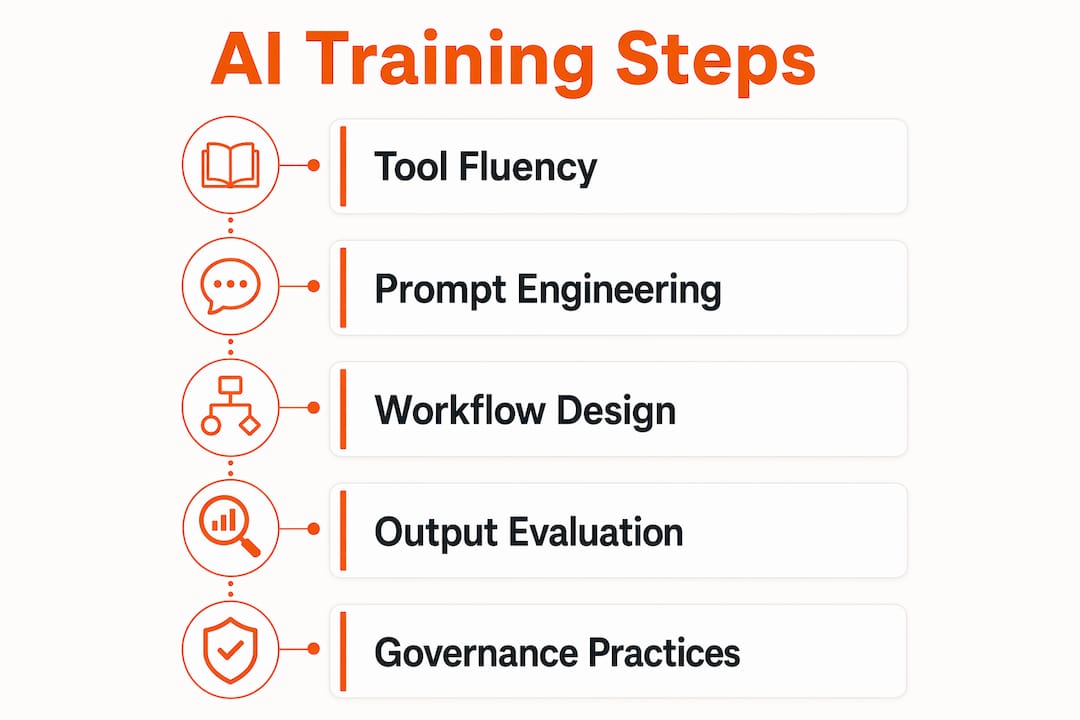
A well-designed AI marketing workflow for content creation follows a predictable structure. The campaign brief defines the goal, audience, and brand parameters. An AI tool generates the first draft based on a structured prompt. A human editor reviews for accuracy, tone, and compliance. The content moves through an approval workflow before publishing. Each step has a defined owner and a quality checkpoint.
Role-based training matters here. Content creators need different benchmarks than campaign managers or analysts. A content creator's proficiency metric is draft quality and revision cycles. A campaign manager's metric is time from brief to launch. An analyst's metric is the accuracy of AI-generated performance summaries. Defining these benchmarks before training begins gives your team a clear target. The business process automation frameworks from Omnivancemedia provide a useful structural model for building these role-specific workflows.
Here is a numbered process for building an AI marketing workflow from scratch:
- Map your current workflow for a specific marketing artifact, such as a blog post or paid ad.
- Identify which steps are repetitive, research-heavy, or template-driven. These are your AI insertion points.
- Write a structured prompt template for each AI insertion point, including brand tone, audience, and format instructions.
- Assign a human review step after every AI output before it moves forward.
- Define quality criteria for each output type so reviewers know what "good" looks like.
- Run the workflow on one real campaign before scaling it across the team.
Pro Tip: Pilot your AI workflow on a priority campaign with a small group before wider rollout. This surfaces friction points without disrupting your entire production calendar.
How should marketers evaluate AI outputs and measure performance?
Purchasing AI technology without training teams to critically evaluate its outputs produces zero return. Salesforce's 2026 guidance identifies the core failure point as marketers' inability to question AI outcomes, not just operate the software. This is the skills gap that separates teams that get results from teams that get busy.
Data literacy is the skill that closes this gap. Your team needs to understand what an AI-generated performance report is actually measuring, where the model's predictions come from, and when to override a recommendation. An AI tool that suggests doubling ad spend on a low-converting segment is not wrong by accident. It is optimizing for the metric it was given, which may not align with your actual business goal. Recognizing that distinction requires human judgment trained on the right questions.
Setting up AI-assisted performance reporting requires defining KPIs before the AI touches the data. Relevant KPIs for AI marketing tools include content production cycle time, draft-to-publish revision rate, campaign launch speed, and compliance pass rate. These metrics tell you whether the AI is actually improving your team's output, not just generating more of it.
| Data literacy element | Training focus | Relevant tool |
|---|---|---|
| Interpreting AI recommendations | Question model logic and data inputs | Salesforce Marketing Cloud |
| Evaluating predictive models | Understand confidence intervals and assumptions | Google Analytics 4 |
| Performance reporting | Define KPIs before AI generates summaries | HubSpot, Looker Studio |
| Bias detection | Identify skewed outputs in audience targeting | Internal audit checklists |
Continuous education is not optional here. AI models update, platforms change their algorithms, and new tools enter the market regularly. Building a culture of technical curiosity, where team members are expected to question outputs and share findings, is what sustains AI literacy over time.
What governance practices belong in AI marketing training?
AI governance for marketing is structured around five pillars: decision rights, brand standards, data privacy, ethics, and continuous improvement. Training that skips governance produces teams that are fast but exposed. Scaled AI deployment without governance creates brand inconsistency, compliance failures, and reputational risk.
Decision rights training answers one question: who approves what? Every AI-generated output needs a defined approver before it reaches a customer. Brand standards training defines what the AI is and is not allowed to produce on behalf of your brand. Data privacy training covers what customer data can be fed into AI tools and under what conditions. Ethics training addresses disclosure requirements and the risks of misleading claims.
FTC enforcement guidance makes the stakes concrete. Reviewers need training on spotting inflated AI claims and on proper transparency in marketing outputs. Undisclosed AI use in advertising is an active regulatory concern, not a theoretical one. Your training program needs to address this directly, with a review checklist that flags AI-generated content for disclosure review before publication.
Governance training best practices include:
- Create a campaign review template that indicates where AI was used in content production.
- Assign a named reviewer for every AI-generated asset before it goes live.
- Document brand tone guidelines in a format that can be pasted directly into AI prompts.
- Schedule a governance audit every six months to review compliance pass rates and update policies.
- Build a central knowledge hub where team members can access current policies, prompt templates, and approved tool lists.
Pro Tip: Maintain a living document that tracks your approved AI tools, their permitted use cases, and any restrictions. Update it every time a tool changes its data handling policy or your regulatory environment shifts.
What are the most effective methods for delivering AI marketing training?
A structured workshop series that uses real campaign briefs and produces actual work outputs is the most effective delivery format for AI marketing education. The AMA's 2026 program uses ChatGPT, Claude, and Perplexity across four weeks to produce on-brand content and performance reports. Attendance at a one-hour overview session does not produce the same results.
Delivery format options each serve a different need. Live workshops build shared vocabulary and allow real-time problem solving. Cohort-based series create accountability and peer learning. Self-paced modules work for onboarding new team members. Embedded coaching, where a trainer works alongside your team on live campaigns, produces the fastest skill transfer. The right mix depends on your team's size, existing skill level, and campaign calendar.
Role-specific literacy programs with 30 to 60 minute sessions, documentation hubs, and six-month review cadences produce measurable compliance and adoption. This structure works because it respects your team's time while building consistent habits. Measuring success by workflow adoption and output quality, rather than attendance, keeps the program accountable to business results.
Here is a numbered process for building an internal AI literacy program:
- Audit your team's current AI tool usage and identify skill gaps by role.
- Define proficiency benchmarks for each role: content creator, analyst, campaign manager.
- Select delivery formats that match your team's schedule and learning preferences.
- Build a documentation hub with prompt templates, tool guides, and governance policies.
- Run a pilot cohort on a real campaign and measure cycle time, revision rate, and compliance pass rate.
- Schedule a six-month refresh to update training materials as tools and regulations evolve.
- Offer certification or digital badges to recognize proficiency and motivate continued learning.
Tracking evidence of skill application, such as before-and-after cycle times on specific marketing artifacts, gives you data to justify continued investment in training. An AI-powered content workflow that cuts research time by 60% is a concrete benchmark your team can target and measure against.
Key takeaways
Effective AI marketing training requires tool fluency, workflow design, data literacy, and governance working together. Training on prompts alone produces isolated gains. Training on the full system produces competitive advantage.
| Point | Details |
|---|---|
| Start with tool fluency by role | Assign one task-specific AI tool per role before expanding to a broader toolkit. |
| Embed AI into existing workflows | Redesign current workflows to include AI drafting, human review, and approval steps. |
| Train teams to question AI outputs | Data literacy and critical evaluation prevent costly errors from unchecked AI recommendations. |
| Governance training is non-negotiable | Decision rights, brand standards, and disclosure training protect against regulatory and reputational risk. |
| Measure adoption, not attendance | Track cycle time reduction, revision rates, and compliance pass rates to evaluate training success. |
Why most AI training programs miss the point entirely
Most AI training programs I have seen focus on the wrong thing. They teach marketers how to open a tool and write a prompt. They call that AI literacy. It is not. It is the equivalent of teaching someone to type and calling it content strategy.
The teams that get real results from AI are the ones whose managers invested in workflow redesign first. They mapped their existing processes, identified where AI could replace repetitive steps, and built quality checkpoints into every handoff. The tool training came second, after the workflow was designed. That sequence matters more than most training vendors will tell you.
The other mistake I see consistently is measuring training success by attendance or prompt completion rates. Those numbers tell you nothing about whether your team is producing better work faster. The metrics that matter are cycle time on specific artifacts, revision rounds before approval, and compliance pass rates on AI-generated content. If those numbers are not improving, the training is not working, regardless of how many people showed up.
Leadership involvement is the variable that separates programs that stick from programs that fade. When a marketing director participates in the same workshop as their team, asks questions, and applies the skills to their own work, the signal to the team is clear. AI literacy is not optional. It is how this team operates now. That cultural signal is worth more than any certification program.
— laya
How Omnivancemedia helps marketing teams implement AI tools
Omnivancemedia builds AI marketing training programs designed for teams that need results, not theory. The approach combines hands-on workshops, workflow integration, and ongoing support tailored to your industry, whether you are in SaaS, retail, or a service-based business.
Every engagement starts with a workflow audit and role-based skill gap assessment, then moves into practical training on tools your team will actually use. The goal is measurable output improvement, not just tool familiarity. If your team is ready to move from scattered AI experiments to a system that produces consistent, on-brand results, explore Omnivancemedia's marketing services or see how the approach applies specifically to SaaS and technology companies.
FAQ
What does it mean to train a team on AI marketing tools?
Training a team on AI marketing tools means building practical skills across tool selection, prompt engineering, workflow design, data literacy, and governance. It goes beyond showing team members how to open a tool and write a basic prompt.
How long does AI marketing training take to show results?
Hands-on programs tied to real campaign briefs show measurable results within a month, including faster content production and reduced revision cycles. Generic overview sessions produce little measurable change.
What is the biggest risk of skipping governance in AI marketing training?
Skipping governance training exposes your brand to regulatory risk, including FTC scrutiny of undisclosed AI use, and to brand inconsistency from unreviewed AI-generated content. Both risks are preventable with a structured review and approval process.
How do you measure whether AI marketing training is working?
Measure training success by workflow adoption rates, cycle time reduction on specific marketing artifacts, and compliance pass rates on AI-generated content. Attendance numbers and prompt completion rates do not indicate whether output quality has improved.
Which AI tools should marketing teams learn first?
Content creators should start with ChatGPT or Claude for drafting. Analysts should start with AI-assisted reporting inside tools like HubSpot or Google Analytics 4. Starting with one role-specific tool before expanding prevents the confusion that comes from adopting multiple platforms simultaneously.