What Is Conversational Marketing AI? 2026 Guide

Conversational marketing AI is defined as the use of AI-powered dialogue systems to engage customers in real time through two-way, personalized interactions that accelerate lead generation and conversion. Unlike static forms or passive ads, this technology replaces one-directional messaging with dynamic conversations that qualify, route, and convert prospects at scale. Platforms like Amazon Ads, Braze, and Twilio have each built frameworks around this model, recognizing that two-way AI dialogue outperforms traditional marketing touchpoints in both speed and relevance. For marketing professionals and business leaders, understanding conversational marketing AI is no longer optional. It is the structural shift separating high-performing pipelines from stagnant ones.
What is conversational marketing AI and how does it work technically?
Conversational marketing AI is built on three interlocking technologies: large language models (LLMs), natural language processing (NLP), and brand-specific contextual data. According to Braze, conversational AI components combine foundation LLMs and NLP with real-time brand context to produce human-like, contextually appropriate responses. This means the AI does not simply match keywords to scripted replies. It interprets intent, infers meaning, and generates responses that reflect your brand voice.
The data layer is what separates effective conversational AI from generic chatbots. Inputs include first-party behavioral data, CRM records, browsing signals, and purchase history. When a prospect lands on a pricing page, the AI already knows their company size, previous content interactions, and product interest before the first message is sent. That context shapes every question the AI asks and every response it delivers.

AI agents sit at the center of this architecture. They orchestrate multi-stage conversations, route leads based on qualification signals, and trigger human handoffs when complexity exceeds their scope. The result is a system that scales human-quality dialogue across thousands of simultaneous conversations without adding headcount.
Key technologies powering conversational marketing AI:
- Large language models (LLMs): Generate natural, contextually relevant responses based on training data and brand guidelines
- Natural language processing (NLP): Interprets customer intent, sentiment, and meaning from unstructured text or voice input
- First-party data integration: Pulls CRM records, behavioral signals, and purchase history to personalize each conversation
- AI agent orchestration: Manages conversation flow, qualification logic, routing rules, and escalation triggers across systems
Pro Tip: Connect your conversational AI directly to your CRM before launch. Without live data sync, the AI operates blind and produces generic responses that destroy the personalization advantage you paid for.
How does conversational marketing AI generate and qualify leads?
The operational sequence begins the moment a high-intent signal fires. A prospect visits your demo page, clicks a pricing comparison, or engages with a retargeting ad. The AI agent initiates a conversation immediately, within seconds, not hours. Responding within 5 minutes increases lead qualification likelihood by 21 times compared to a 30-minute delay. Conversational AI makes sub-minute response the default, not the exception.
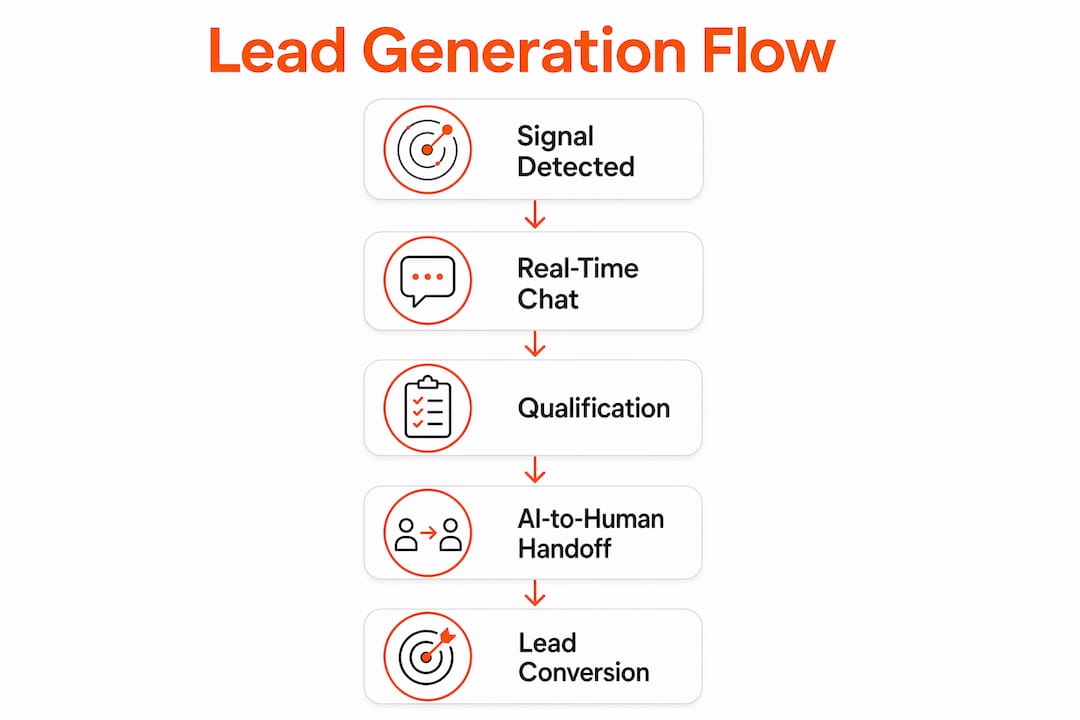
From there, the AI runs structured discovery. This is not a scripted FAQ bot. It asks open-ended questions about use case, budget, stakeholders, urgency, and competitive context. Perspective AI reports that conversational qualification artifacts capture all of this data and export actionable summaries for sales teams in under 60 seconds. A sales rep receives a briefing, not a raw transcript.
The qualification sequence typically follows this pattern:
- Trigger and initiate: AI detects a high-intent signal and opens a conversation on the relevant channel, whether that is a website widget, WhatsApp, or SMS
- Discovery questioning: AI asks structured, open-ended questions to surface use case, budget range, decision-making authority, and timeline
- Intent scoring: Responses are scored against qualification criteria in real time, routing hot leads to immediate booking and cold leads to nurture sequences
- Structured handoff: When a lead meets the threshold, the AI generates a briefing schema including conversation ID, intent summary, and escalation reason before transferring to a human agent
- Human engagement: The sales rep enters the conversation with full context, no repetition required from the prospect
The handoff step is where most implementations fail. Transferring working state rather than raw transcripts is the standard Twilio and Zylos Research recommend. A structured briefing schema that includes memory, profile, intent, and escalation reason allows human agents to engage immediately with full context. Customers never repeat themselves. That single improvement drives measurable increases in satisfaction and close rates.
Pro Tip: Treat your AI-to-human handoff as a working state transfer, not a transcript dump. Build a briefing schema that tells your rep exactly who they are talking to, what the prospect wants, and why the AI escalated. Your reps will close faster and your prospects will feel heard.
What are the benefits of conversational marketing AI vs. traditional funnels?
Traditional marketing funnels are built on passive collection. A prospect fills out a form, waits for a follow-up email, and sits in a nurture sequence for weeks. Conversational marketing AI replaces that architecture with active, real-time dialogue that qualifies and converts in a single session.
Perspective AI's 2026 SaaS Trend Report found that conversational funnels increase qualified pipeline by 2 to 4 times and reduce qualification time by 50 to 70 times compared to static forms. That is not a marginal improvement. It is a structural advantage that compounds across every campaign you run.
"78% of B2B SaaS funnels now use conversational qualification, with measurable gains in demo show rates and lead quality." — Perspective AI, 2026 Pipeline Report
The channel advantage matters too. 78% of customers already message brands on apps like WhatsApp and SMS. Conversational AI meets them there, on channels they use daily, rather than forcing them into a form submission workflow that interrupts their behavior.
| Dimension | Traditional funnel | Conversational marketing AI |
|---|---|---|
| Response speed | Hours to days | Under 60 seconds |
| Qualification depth | Form fields only | Structured multi-question discovery |
| Personalization | Segment-level | Individual, context-driven |
| Lead handoff quality | Raw contact data | Structured briefing with intent and context |
| Qualification time | Days to weeks | Single conversation session |
The table above captures the operational gap. Every dimension where traditional funnels underperform is precisely where conversational AI excels. For businesses running paid acquisition, this means lower cost per qualified lead and higher return on ad spend from the same traffic volume. For AI in marketing strategies, this shift represents the highest-leverage change available in 2026.
How to implement conversational marketing AI effectively
Effective implementation starts with placement. Deploy chat widgets on your highest-intent pages first: pricing, demo request, and product comparison pages. These are where purchase intent peaks and where a real-time conversation has the greatest chance of converting a visitor into a qualified lead.
From there, build your conversation flows with depth. Generic chatbots ask one or two questions and dead-end. True conversational qualification AI runs multi-stage flows that infer meaning, adapt based on responses, and route intelligently across your CRM and scheduling systems. ChatbotKit identifies instant qualification and intelligent routing as the core differentiators between conversational marketing AI and traditional static forms.
Practical implementation checklist:
- Start with high-intent pages: Pricing, demo, and comparison pages generate the strongest ROI from conversational AI deployment
- Integrate CRM before launch: Live data sync with platforms like HubSpot or Salesforce enables personalized conversations from the first message
- Build multi-stage flows: Design conversations that ask 5 to 8 nuanced questions, not 2, to capture full qualification data
- Define escalation triggers: Set clear rules for when the AI hands off to a human, based on lead score, budget threshold, or explicit request
- Measure business outcomes: Track qualified leads generated, demo bookings, and pipeline value. Chat volume is a vanity metric
- Enable 24/7 coverage: Conversational AI operates around the clock on WhatsApp, SMS, and web, capturing leads your team would otherwise miss overnight
The measurement framework is where most teams get this wrong. They optimize for chat engagement rates and session counts. The only metrics that matter are qualified leads generated, meetings booked, and revenue influenced. Align your reporting to those outcomes from day one, and you will make better decisions about where to deploy and how to refine your flows. Pairing conversational AI with CRM automation workflows creates a closed-loop system where every qualified conversation feeds directly into your sales pipeline without manual intervention.
Key takeaways
Conversational marketing AI works because it replaces passive, form-based funnels with real-time, context-driven dialogue that qualifies leads faster, routes smarter, and hands off to sales with full context intact.
| Point | Details |
|---|---|
| Speed-to-lead is decisive | Responding within 5 minutes raises qualification likelihood 21x versus a 30-minute delay. |
| Technology stack matters | LLMs, NLP, and live CRM data must integrate for conversations to feel personalized, not scripted. |
| Handoff quality determines close rates | Transfer working state with intent, profile, and escalation reason, not raw transcripts. |
| Funnel impact is structural | Conversational funnels increase qualified pipeline 2 to 4x and cut qualification time by up to 70x. |
| Measure outcomes, not activity | Track qualified leads, demo bookings, and pipeline value, not chat volume or session counts. |
Where conversational marketing AI is actually heading
I have watched marketing teams adopt chatbots for years, and most of them made the same mistake: they treated the tool as a cost-cutting measure rather than a revenue-generating system. They deployed a scripted bot, called it conversational AI, and wondered why their pipeline numbers did not move. The problem was never the technology. It was the architecture.
The real shift happening now is from scripted interaction to genuine conversational qualification. When Perspective AI reports that MQLs are being replaced by conversationally qualified leads, they are describing a fundamental change in how sales-ready status gets determined. A form submission tells you someone raised their hand. A structured AI conversation tells you their budget, their timeline, their decision-making authority, and their competitive alternatives. Those are two completely different inputs for a sales team.
What I find most underappreciated is the handoff engineering piece. Teams spend months perfecting their conversation flows and then wire up a handoff that dumps a raw transcript into a Slack channel. The rep reads three paragraphs of chat history, asks the prospect to repeat themselves, and loses the deal. The structured briefing schema that Zylos Research describes is not a nice-to-have. It is the difference between a system that works and one that frustrates everyone involved.
My honest view is that conversational marketing AI will become the default qualification layer for every serious B2B and high-ticket B2C operation within two years. The businesses that build this infrastructure now, with proper CRM integration, multi-stage flows, and engineered handoffs, will hold a durable advantage over competitors still running form-to-email nurture sequences.
— laya
How Omnivancemedia can build your conversational AI system
Omnivancemedia builds integrated marketing systems where conversational AI connects directly to your CRM, paid acquisition channels, and sales workflows. The result is a pipeline that qualifies leads around the clock without adding headcount.
Whether you are a SaaS company looking to replace demo-request forms with AI-led qualification, a retail brand converting browsers into buyers on WhatsApp, or a dental practice booking appointments through automated conversations, Omnivancemedia builds the full system. That includes CRM integration, conversation flow design, handoff engineering, and outcome-based reporting. If your current funnel relies on static forms and delayed follow-up, the gap between where you are and where conversational AI can take you is measurable in revenue. Explore Omnivancemedia's CRM and automation services to see how the system gets built.
FAQ
What is conversational marketing AI in simple terms?
Conversational marketing AI is technology that enables brands to have real-time, two-way AI-powered conversations with customers through chatbots, voice assistants, or messaging apps to qualify leads and drive conversions. It replaces static forms and delayed follow-up with instant, personalized dialogue.
How does conversational marketing AI differ from a regular chatbot?
A regular chatbot follows a fixed script and dead-ends when questions fall outside its decision tree. Conversational marketing AI uses LLMs and NLP to interpret intent, ask nuanced discovery questions, and route leads intelligently based on their responses.
What are the main benefits of conversational marketing AI?
The primary benefits include 21x faster lead qualification through instant response, 2 to 4 times more qualified pipeline compared to static forms, and 24/7 engagement across channels like WhatsApp and SMS where customers already communicate.
Which channels does conversational marketing AI work on?
Conversational marketing AI operates across website chat widgets, WhatsApp, SMS, and voice interfaces. Braze reports that 78% of customers already message brands on apps, making these channels the highest-engagement deployment points.
How do you measure conversational marketing AI performance?
Measure qualified leads generated, demo bookings completed, and pipeline revenue influenced. Chat volume and session counts are activity metrics. Business outcomes are the only indicators that reflect whether the system is working.