How to Reduce Marketing Agency Overhead Costs

Overhead costs in a marketing agency are defined as all operating expenses not directly billable to a client, including office leases, software subscriptions, administrative labor, and insurance. Industry benchmarks show that healthy agencies keep overhead at 20 to 25% of Adjusted Gross Income, while the average sits between 28 and 35%. That gap is where profitability lives or dies. This article covers four proven strategies to reduce marketing agency overhead costs: expense auditing, technology rationalization, staffing optimization, and AI-driven automation. Each approach is grounded in real data and built for marketing managers and business owners who need results, not theory.
What are the main categories of overhead expenses in marketing agencies?
Overhead expenses fall into four primary buckets, and most agencies bleed money across all four simultaneously. Identifying which category is your biggest drain is the first step toward cutting it.
Office and facilities costs include commercial leases, utilities, and physical infrastructure. For agencies that shifted to hybrid or remote models post-2020, this category often carries legacy costs that no longer reflect actual space usage. A 10-person team paying for 3,000 square feet of downtown office space is a common and correctable problem.

Technology subscriptions represent one of the fastest-growing overhead categories. CRM platforms, project management tools, design software, SEO platforms, reporting dashboards, and communication apps each carry monthly fees. The problem is not the tools themselves. The problem is that most agencies accumulate them without a decommissioning process.
Non-billable labor is the most expensive and least visible overhead category. Administrative roles, internal meetings, proposal writing, and account coordination that cannot be charged to a client all consume payroll dollars without generating revenue. Mid-size agencies waste 8,000 to 12,000 hours annually on non-billable work. At an $80 loaded hourly cost, that translates to $640,000 to $960,000 in annual operational drag.
Miscellaneous overhead covers training, professional development, insurance, legal fees, and professional association memberships. These costs are individually small but collectively significant, often representing 3 to 5% of revenue when left unmanaged.
| Overhead Category | Typical % of Revenue | Primary Reduction Lever |
|---|---|---|
| Office and facilities | 8–15% | Remote/hybrid transition, sublease |
| Technology subscriptions | 5–10% | Usage audits, vendor consolidation |
| Non-billable labor | 10–18% | Automation, role alignment |
| Miscellaneous (insurance, training, legal) | 3–5% | Annual contract reviews, bundling |
How can auditing expenses and technology rationalization reduce marketing agency overhead?
A structured expense audit is the fastest way to find money you are already spending but not using. The process is straightforward, but most agencies skip it because it requires someone to own it.
Start by pulling every recurring charge from your bank statements and credit card accounts for the past 90 days. Categorize each line item as billable, partially billable, or pure overhead. Flag any subscription that has not been actively used in the past 30 days. This single step typically surfaces 15 to 20% of your software spend as immediately cuttable.
- Export all recurring charges from your financial accounts into a spreadsheet.
- Assign each charge to a team member who can confirm active usage.
- Rate each tool on a scale of 1 to 3: critical, useful, or redundant.
- Cancel or downgrade all tools rated redundant within 30 days.
- Negotiate annual contracts for all tools rated critical to secure 15 to 30% discounts.
- Schedule the next audit for 90 days out and assign a standing owner.
Technology sprawl is the specific term for the accumulation of overlapping or underused software tools. Agencies overpay for software by 20 to 30% due to unmanaged subscriptions. A mid-size agency running separate tools for project management, time tracking, invoicing, and client communication can often consolidate three of those four functions into a single platform like ClickUp or HubSpot, cutting both cost and context-switching time.
Vendor negotiation is underused as a cost lever. Most SaaS vendors will offer a 10 to 20% discount for annual prepayment or for reducing seat counts to match actual users. You will not get these discounts unless you ask, and the audit gives you the utilization data to negotiate from a position of fact.
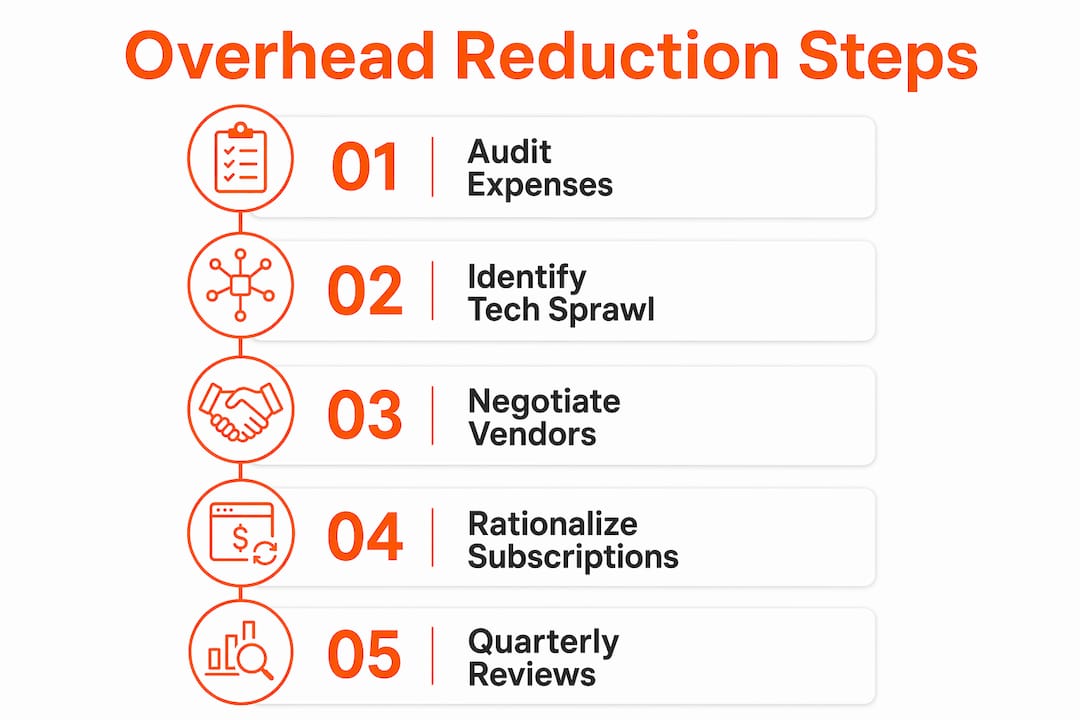
Pro Tip: Conduct a full software usage audit every quarter, not just annually. Subscription creep happens fast, especially when individual team members add tools on free trials that auto-convert to paid plans.
How to optimize staffing and outsourcing models to minimize overhead
Staffing is the largest single cost in most agencies, and it is also the most mismanaged. The instinct to cut headcount when margins compress is understandable but often counterproductive.
The smarter approach is role cost alignment. This means matching the cost of a role to the revenue value of the tasks it performs. A licensed senior strategist spending 40% of their time on internal reporting is a structural problem, not a performance problem. Reassigning that reporting work to a junior coordinator or automating it entirely frees the senior role to generate billable output.
- Fractional roles work well for functions like CFO-level financial oversight, HR, and legal review. These are high-cost roles that most agencies do not need full-time.
- Contract specialists cover production-heavy work like video editing, copywriting, and paid media management during peak periods without adding permanent payroll.
- Virtual assistants handle administrative tasks including scheduling, inbox management, and data entry at a fraction of in-house labor costs.
- AI-augmented generalists are the emerging model. One well-trained team member using tools like ChatGPT, Jasper, or Midjourney can produce output that previously required two or three specialists.
Headcount reduction should rarely be the first strategy. The better path is capacity expansion through AI and workflow automation, which lets your existing team handle more without burning out or requiring new hires. Omnivancemedia's own client work demonstrates this: an e-commerce client scaled from $80K to $420K in monthly revenue without proportional headcount growth, because the operational model was built on automation from the start.
Pro Tip: Before cutting any role, map what that person actually does for one week. You will almost always find that 30 to 50% of their tasks can be automated or reassigned to a lower-cost resource.
What role does AI-driven automation play in reducing overhead costs?
AI automation is the highest-leverage tool available to agencies right now, and most are using it at 20% of its actual capacity. The agencies extracting real savings are not just using off-the-shelf tools. They are building internal systems.
The functions AI handles most effectively in a marketing agency context include:
- Content production: First drafts, ad copy variations, email sequences, and social captions. Tools like ChatGPT and Claude reduce production time by 60 to 80%.
- Reporting and analytics: Automated dashboards using tools like Google Looker Studio or AgencyAnalytics pull data and generate client-ready reports without manual assembly.
- Billing and invoicing: Platforms like QuickBooks and FreshBooks automate recurring invoice generation, payment reminders, and expense categorization.
- Client onboarding: Workflow tools like Zapier and Make.com automate intake forms, contract delivery, and kickoff scheduling.
AI-driven automation can reduce operational overhead by 40 to 60% within 90 days, with typical annual savings for mid-market agencies ranging from $280,000 to $680,000. Content production sees the steepest reduction, often 60 to 80% in cost per deliverable.
The agencies seeing the fastest overhead reduction are not buying more tools. They are building custom AI prompt libraries and internal workflow documentation that turn one-time efficiency gains into permanent operating standards.
Building custom prompt libraries for recurring tasks like client briefs, competitive analysis, and campaign summaries compounds savings over time in a way that generic SaaS subscriptions cannot. AI tooling spend typically runs 4 to 8% of revenue, with reliable ROI appearing within 60 to 120 days when workflows are properly designed. For a practical starting point, the AI implementation checklist from Omnivancemedia walks through the setup process step by step.
One critical warning: reactive cost-cutting without operational design creates inefficiencies that cost more long-term than the original overhead. Cutting tools or people without redesigning the workflows they supported just transfers the burden to whoever remains.
When does agency consolidation help reduce overhead?
Agency consolidation is the practice of reducing the number of vendors, partners, or service providers an organization manages. Done correctly, it lowers management overhead and improves margins. Done incorrectly, it degrades service quality and creates new problems.
The critical distinction is consolidating by capability versus consolidating by cost. Consolidating by capability means choosing fewer partners who can each do more, which reduces coordination overhead and builds genuine working relationships. Consolidating by cost alone, meaning choosing whoever bids lowest, typically results in service gaps that require expensive remediation later.
| Consolidation Approach | Pros | Cons |
|---|---|---|
| Capability-based (fewer, stronger partners) | Lower coordination costs, better integration, stronger accountability | Higher per-partner fees, dependency risk |
| Cost-based (lowest bidder) | Short-term savings, easy to justify internally | Service gaps, high churn, remediation costs |
| Single integrated agency | One point of contact, unified strategy | Less specialization depth in niche areas |
Client portfolio optimization follows the same logic on the revenue side. Auditing client accounts for margin attribution and offboarding low-margin clients frees resources for accounts that generate real profit. A client paying $3,000 per month but requiring 60 hours of service time is a net loss at any reasonable loaded labor rate. Reallocating that capacity to a $10,000 per month client with 40 hours of service demand changes the entire profitability picture. For more on how switching to a single agency affects management overhead, the dynamics are worth understanding before making any consolidation decision.
Key takeaways
Reducing marketing agency overhead costs requires a combination of structured auditing, AI automation, and strategic consolidation rather than reactive cuts to headcount or tools.
| Point | Details |
|---|---|
| Benchmark your overhead | Healthy agencies keep overhead at 20 to 25% of Adjusted Gross Income; anything above 28% signals a structural problem. |
| Audit technology quarterly | Agencies overpay for software by 20 to 30% due to unmanaged subscriptions; quarterly reviews prevent compounding waste. |
| Automate before cutting headcount | AI automation can recover up to 120 hours per month of back-office time before any staffing changes are needed. |
| Consolidate by capability | Choosing fewer, stronger partners reduces coordination overhead without degrading service quality. |
| Align roles to revenue tasks | Reassigning non-billable work to lower-cost resources or automation frees senior talent for revenue-generating output. |
Why overhead reduction is a systems problem, not a budget problem
Most marketing managers I have worked with approach overhead reduction as a line-item exercise. They look at the P&L, find the biggest numbers, and start cutting. That approach almost always makes things worse before it makes them better.
The real problem is operational debt. Manual processes, undocumented workflows, and knowledge that lives only in one person's head inflate overhead more than any single subscription or salary. I have seen 15-person agencies running leaner than 40-person agencies because the smaller team had documented systems and the larger team was held together by institutional memory and heroic effort.
The agencies that successfully cut overhead without hurting growth treat it as a systems redesign project. They map every workflow, identify where time disappears, and build automation into the gaps before touching headcount or vendor contracts. The 7 essential workflow automations that Omnivancemedia covers are a good starting framework for that mapping exercise.
My honest advice: do not start with the budget. Start with a one-week time audit across your team. You will find the overhead problem faster than any spreadsheet will show you.
— laya
How Omnivancemedia helps you cut costs without cutting growth
Omnivancemedia is built on the premise that fragmented marketing is expensive marketing. When SEO, paid advertising, CRM automation, and creative production run as separate engagements with separate vendors, coordination overhead alone can consume 15 to 20% of your total marketing budget.
Omnivancemedia consolidates those functions into one integrated system, which is how an HVAC contractor generated $340K in new contracts within 90 days and an e-commerce client scaled from $80K to $420K in monthly revenue. If you are managing multiple vendors and watching margins compress, the CRM and marketing automation services at Omnivancemedia are the most direct path to cutting operational costs while expanding capacity. Explore the full services catalog to see where consolidation makes the most financial sense for your specific situation.
FAQ
What is a healthy overhead percentage for a marketing agency?
Healthy marketing agencies target overhead at 20 to 25% of Adjusted Gross Income. The industry average runs between 28 and 35%, meaning most agencies have meaningful room to improve margins through structured cost reduction.
How quickly can AI automation reduce agency overhead?
AI-driven automation can reduce operational overhead by 40 to 60% within 90 days when workflows are properly designed. The fastest savings appear in content production, reporting, and billing functions.
Should I cut staff to lower agency expenses?
Headcount reduction should not be the first move. Automating non-billable tasks and realigning roles to revenue-generating work typically recovers more margin than layoffs, without the service disruption or rehiring costs that follow.
What is technology sprawl and how does it affect overhead?
Technology sprawl is the accumulation of overlapping or underused software subscriptions across an agency. It causes agencies to overpay for software by 20 to 30% and is correctable through quarterly usage audits and vendor consolidation.
How does client portfolio optimization reduce overhead?
Offboarding low-margin clients and reallocating resources to high-margin accounts directly improves overhead efficiency. A client requiring 60 hours of service at a $3,000 monthly fee consumes capacity that a $10,000 client with 40 hours of demand would use far more profitably.