Why Businesses Switch to a Single Marketing Agency

Switching to a single marketing agency is defined as consolidating all digital marketing functions — SEO, paid advertising, content, CRM, and creative — under one partner rather than distributing them across multiple specialized vendors. Business leaders who make this move report three consistent gains: lower total costs, faster campaign delivery, and stronger brand consistency across every channel. The case for marketing agency consolidation is no longer theoretical. Cost reductions of 10 to 20% on direct billed fees are documented, and the velocity gains from integrated teams often double that financial benefit. This article explains exactly why companies transition to single marketing partners, when that choice makes sense, and how to execute it without losing specialist depth.
Why businesses switch to a single marketing agency
The primary driver is not cost. It is the hidden tax that fragmented vendor relationships impose on internal teams. When a company runs separate agencies for SEO, paid media, and creative, someone inside the business must coordinate between them. That coordination burden, measured in management hours, meeting overhead, and revision cycles, represents 8 to 15% of annual vendor spend in hidden labor costs that never appear on an invoice.
Beyond the coordination tax, brand consistency suffers when multiple agencies interpret the same brief independently. A paid media team optimizing for clicks and a content team writing for organic search will produce conflicting messaging unless a single strategic layer connects them. Centralized marketing under one agency eliminates that conflict by design, not by effort.
"The real savings from consolidation come not just from lower fees, but from reclaiming the internal time your team spends managing vendors who don't talk to each other."
The advantages of centralized marketing also include accountability. With multiple agencies, finger-pointing is structurally inevitable. When a campaign underperforms, each vendor can attribute the failure to another team's deliverable. A single agency owns the full outcome, which changes the incentive structure entirely.
- Cost reduction: Eliminating duplicate software licenses, redundant reporting tools, and overlapping retainer fees cuts direct spend by 10 to 20%.
- Time recovery: Marketing managers reclaim hours previously spent on cross-vendor coordination, status meetings, and brief translation.
- Faster launches: Integrated teams that share backlogs and communication platforms reduce campaign launch timelines from weeks to days.
- Brand coherence: One creative direction, one messaging framework, and one strategic voice across every channel.
- Clear accountability: One partner owns results, which produces more honest performance conversations.
Pro Tip: Before calculating agency consolidation savings, track how many internal hours per week your team currently spends coordinating between vendors. That number, multiplied by fully loaded labor cost, is your true baseline for comparison.
How does a single agency improve project velocity?
The operational difference between a consolidated agency and a fragmented vendor setup comes down to how information moves between disciplines. In a multi-vendor model, a brief travels from the client to the SEO agency, then gets reinterpreted and sent to the content team, then revised again before reaching the paid media buyer. Each handoff introduces delay, context loss, and the risk of misalignment.

A genuinely integrated agency operates with shared backlogs and unified communication platforms, where design, content, and development teams work in parallel rather than sequentially. A single project lead holds the full picture, which means revisions happen in hours rather than days and campaign launches compress from a typical four to six week cycle to one to two weeks.
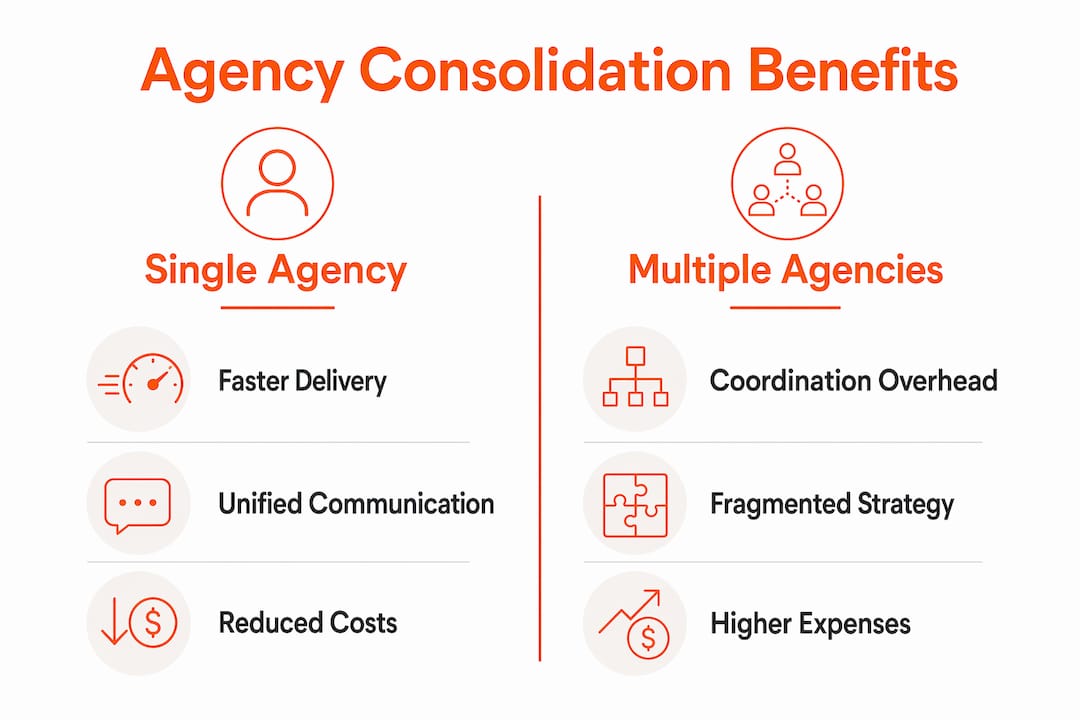
| Factor | Single agency | Multiple agencies |
|---|---|---|
| Brief handoffs | One internal pass | Three or more external passes |
| Revision cycles | Same-day turnaround | Three to five day delays |
| Campaign launch time | One to two weeks | Four to six weeks |
| Brand consistency | Enforced by shared strategy | Dependent on vendor alignment |
| Accountability | Single point of contact | Distributed, often contested |
The table above reflects the structural difference, not just the theoretical one. Businesses recover more value from reclaimed project velocity and internal labor savings than from direct fee reductions alone. That finding reframes the consolidation decision: it is an operational upgrade, not just a procurement choice.
Pro Tip: Ask any agency you evaluate to walk you through a specific example of how their SEO and paid media teams collaborated on a single campaign. If they describe two separate teams that "share reports," that is a siloed structure wearing a full-service label.
When should you keep multiple specialist agencies?
Consolidation is not the right answer for every business. Three scenarios favor retaining specialist agencies over a single full-service partner.
-
Mission-critical channel depth. If paid search drives 70% of your revenue, the difference between a specialist and a generalist in that channel is material. Keeping specialist agencies for channels where deep expertise directly affects revenue is a documented best practice, not a compromise.
-
Smaller businesses with low coordination overhead. A company spending $3,000 per month across two agencies may not generate enough cross-channel complexity to justify the cost of a full-service retainer. The coordination tax only becomes painful at scale.
-
Hybrid models. Many mid-market companies use a full-service agency as their strategic and operational core, then retain one or two specialists for channels that require elite-level execution. This model captures the brand consistency and accountability benefits of consolidation while preserving specialist depth where it matters most.
The risk that most businesses underestimate is false consolidation. Many agencies label themselves full-service but operate as siloed internal pods, producing the same fragmentation problems as multiple vendors. The label "full-service" is not evidence of integration. The only reliable test is asking how teams share work, not how they are organized on an org chart.
Industry leaders confirm that verifying internal team integration, rather than accepting a full-service label at face value, is the core differentiator between genuine consolidation and repackaged fragmentation. That verification step belongs in every agency evaluation process.
What budgeting and selection practices ensure a successful switch?
The financial baseline for a genuine full-service engagement starts at $8,000 per month for retainer-based work in 2026. Budgets below that threshold typically produce partial service coverage, which recreates the fragmentation problem under a single contract. That number is not arbitrary. It reflects the minimum team size required to staff SEO, paid media, content, and creative with dedicated practitioners rather than shared resources.
Preparation before the agency search matters more than the search itself. Businesses that enter conversations with a detailed 12-month growth problem definition, including current revenue, target revenue, primary channels, and known constraints, get meaningfully better proposals than those who ask agencies to "tell us what we need." The requirements document forces internal alignment and gives agencies the context to propose realistic solutions.
- Define the problem, not the solution. Describe where you are and where you need to be. Let the agency propose the channel mix.
- Assess internal integration directly. Ask for a walkthrough of how a specific past campaign moved from strategy to execution across disciplines.
- Clarify exit terms upfront. A 90-day exit clause with defined performance milestones protects both parties and signals a mature agency relationship.
- Prioritize onboarding conversations over pitch decks. Misaligned expectations cause 63% of agency switches, which means the onboarding conversation is where most partnerships succeed or fail.
- Check for commercial alignment. An agency that pushes back on your assumptions and asks hard questions in the sales process is more likely to tell you the truth when a campaign underperforms.
For a structured framework on evaluating agency integration, the criteria above translate directly into interview questions and scoring rubrics that remove subjectivity from the selection process.
Pro Tip: Request a sample onboarding agenda from any agency you are seriously evaluating. An agency with a defined onboarding process has done this before. An agency that improvises onboarding will improvise everything else.
Successful agency onboarding involves pushback, hard questions, and commercial alignment rather than vendor compliance with client demands. That dynamic is a feature, not a friction point.
Key takeaways
Businesses that consolidate marketing under a single agency gain more from recovered internal time and faster delivery than from direct fee reductions alone.
| Point | Details |
|---|---|
| Coordination tax is real | Fragmented vendors cost 8 to 15% of annual spend in hidden internal labor. |
| Velocity gains outweigh fee savings | Integrated teams cut campaign timelines from weeks to days, doubling the financial benefit. |
| False consolidation is a real risk | Verify internal team integration directly; a full-service label is not sufficient evidence. |
| Budget at $8,000+ per month | Below this threshold, full-service coverage is structurally impossible for most agencies. |
| Onboarding predicts partnership quality | Agencies with defined onboarding processes deliver more consistent results than those that improvise. |
What I've learned about agency consolidation that most articles won't tell you
The conversation about why businesses switch to a single marketing agency almost always focuses on cost and efficiency. Those benefits are real. But the more interesting dynamic, the one I have seen play out repeatedly, is what consolidation does to the quality of strategic thinking inside the client organization.
When you stop managing four vendor relationships, you free up the cognitive bandwidth to actually think about marketing strategy. Marketing managers who previously spent 30% of their week on vendor coordination suddenly have time to analyze performance data, challenge agency recommendations, and build internal knowledge. That shift changes the client-agency relationship from oversight to partnership.
The misconception I encounter most often is that full-service agencies are generalists who do everything adequately but nothing exceptionally. That was true of the previous generation of agencies. The integrated agencies built around shared tooling, unified project leads, and parallel execution workflows are a different category. The distinction is structural, not cosmetic.
The practical advice I give every marketing leader considering consolidation is this: do not evaluate agencies on their service list. Evaluate them on how their teams communicate internally. Ask to see a Slack channel. Ask who owns the brief when it moves from strategy to creative to paid media. The answers to those questions tell you more about delivery quality than any case study ever will.
One more thing worth saying directly: the hybrid model is underrated. Keeping one specialist agency for your highest-revenue channel while consolidating everything else under a full-service partner is not a compromise. For many businesses scaling past $500K in revenue, it is the most rational structure available.
— laya
How Omnivancemedia helps businesses make the switch
Omnivancemedia is built specifically for businesses that are done managing fragmented vendor relationships and ready to operate from a single, integrated marketing system. The full-service offering covers SEO, paid advertising across Google and Meta, CRM automation, and creative production under one team with one project lead and one strategic framework. An HVAC contractor generated $340K in new contracts within 90 days. An e-commerce client grew monthly revenue from $80K to $420K. Those results come from channel integration, not channel isolation. If your business is ready to scale past $500K and wants a partner that owns the full outcome, Omnivancemedia is worth a direct conversation.
FAQ
What is the main reason businesses consolidate marketing agencies?
The primary reason is reducing the coordination tax. Fragmented vendor setups cost 8 to 15% of annual vendor spend in hidden internal labor, and consolidating under one agency eliminates that overhead while improving brand consistency.
How much does a full-service marketing agency retainer cost?
A genuine full-service retainer starts at $8,000 per month in 2026. Below that budget, most agencies cannot staff dedicated practitioners across SEO, paid media, content, and creative simultaneously.
How do I know if an agency is truly integrated or just repackaged fragmentation?
Ask how their SEO, content, and paid media teams share work on a single campaign. Truly integrated agencies use shared backlogs, unified project leads, and parallel workflows. Siloed agencies describe separate teams that exchange reports.
When does it make sense to keep multiple specialist agencies?
Retain specialist agencies for channels that are mission-critical and require deep expertise, particularly when a single channel drives the majority of your revenue. A hybrid model combining a full-service core with one or two specialists is a proven structure for mid-market businesses.
What causes most agency switches to fail?
Misaligned expectations cause 63% of agency switches according to HubSpot survey data. The fix is a detailed requirements document and a rigorous onboarding conversation before signing any contract.