Why First-Party Data Powers AI Marketing: A CMO Playbook

First-party data is the proprietary signal layer that makes AI marketing specific, measurable, and defensible. Without it, your AI is running on borrowed signals that competitors share, regulators are restricting, and platforms can revoke overnight. With it, every model, agent, and campaign you run reflects something no one else can replicate: your actual customers, their actual behavior, and the consent trail that makes it all usable.
Two findings anchor this fast. Databricks describes a "composable canvas" where AI agents live natively in the data layer, cutting campaign prep from hours to minutes by eliminating manual CSV exports. And Think with Google research found that tailored messaging using first-party signals shifted up to 43% of respondents to prefer a better-fit brand in a simulated buying scenario. That is not a marginal lift.
The TL;DR for a CMO: First-party data turns AI from a generic content machine into a precision growth engine. The marketers who build this capability in the next 90 days will have a structural advantage that compounds. Think with Google research found that tailored messaging using first-party signals shifted up to 43% of respondents to prefer a better-fit brand in a simulated buying scenario.
Three things you get immediately:
- Better personalization: AI models trained on your customer signals produce recommendations and content that match real purchase intent, not demographic proxies.
- Stronger model performance: Consented, structured first-party signals supply the high-quality labels that recommendation engines, churn models, and LTV forecasters need to be accurate.
- Defensible measurement: Owned data lets you run proper incrementality experiments instead of relying on last-touch attribution that agentic workflows break.
Who should own this: The CMO sets the business case and success metrics. The Head of Data (or equivalent) owns the architecture and governance. Both need to be in the room from week one.
Table of Contents
- Why first-party data powers AI marketing now
- Concrete AI use cases your first-party data unlocks
- What counts as first-party data and how to collect it well
- What your technical architecture needs to activate first-party data for AI
- Privacy, compliance, and governance checklist for U.S. teams
- Step-by-step roadmap to build your first-party data capability
- How to measure the impact of first-party data in AI workflows
- Common pitfalls when building first-party data for AI
- Agency outcomes: what first-party data plus AI actually produces
- Your 90-day pilot checklist and next steps
- Key Takeaways
- The part most playbooks skip
- Omnivancemedia's integrated approach to first-party data and AI marketing
- Useful sources and further reading
Why first-party data powers AI marketing now
The strategic case has three converging pressures, and they all point the same direction.
Privacy and platform changes have shrunk the third-party signal pool. With third-party cookies blocked by default in Safari and Firefox, and Chrome moving to a user-choice model, cookie-based targeting has become unreliable infrastructure. Privacy laws like CCPA/CPRA have raised the cost and legal risk of buying or renting audience data. The marketers who built their personalization on third-party audiences are now flying partially blind.
AI models are commoditized. Your data is not. GPT-4, Gemini, Claude — every major foundation model is available to your competitors on the same API terms. The competitive advantage is not which model you use. It is the proprietary, consented, well-organized first-party signal that acts as the context layer keeping AI outputs specific to your customers. Generic inputs produce generic outputs. Your CRM transaction history, app event stream, and loyalty data produce outputs no one else can replicate.
Agentic AI raises the stakes further. BCG notes that agentic AI surfaces richer customer intent and requires brands to be findable and credible to AI decision-makers, not just human ones. An agent evaluating purchase options on a customer's behalf will favor brands with structured, authoritative signals. That means your first-party data infrastructure is now a visibility asset, not just a targeting asset.
Stat to know: Think with Google's simulation found that layering first-party data onto behavioral science principles shifted up to 43% of respondents to prefer a better-tailored brand. Relevance, driven by owned signals, is the mechanism.
The benefits stack up across four dimensions:
- Personalization: Match messaging to the specific mission or feature preference a customer has shown in your owned channels, not a third-party segment approximation.
- Model accuracy: High-quality, labeled first-party signals improve recommendation engines, churn models, and propensity scores in ways third-party data cannot.
- Measurement: Owned data enables holdout experiments and incrementality testing that prove causal lift, not just correlation.
- AI trust and visibility: Credibility signals — original first-party research, clear authorship, structured content — increase the likelihood AI systems will cite and surface your brand.
Concrete AI use cases your first-party data unlocks
The use cases below are not theoretical. Each one requires a specific first-party signal and produces a measurable KPI shift.

Real-time personalization agents use live session behavior (pages visited, search queries, product views) combined with CRM purchase history to serve the right offer at the right moment. The KPI to watch: conversion rate on personalized versus control sessions. Expect a meaningful lift within four to six weeks of a properly instrumented pilot.
Churn-prevention triggers rely on behavioral decay signals: declining login frequency, reduced purchase cadence, support ticket volume. An agent monitoring these signals can fire a retention offer before the customer churns rather than after. The signal required is event-level telemetry from your app or site, joined to CRM tenure and LTV data.
Offer-eligibility automation uses purchase history, loyalty tier, and geographic data to determine in real time which customers qualify for a promotion. This replaces manual segmentation that takes days with an agent that runs continuously. The KPI is redemption rate versus a holdout group.
Recommendation engine training is where structured first-party signals produce the biggest model accuracy gains. Purchase sequences, category affinity, and dwell time give the model labeled examples that third-party data cannot supply. Better labels mean better recommendations, which means higher average order value.
LTV forecasting uses transaction history, acquisition channel, and early behavioral signals to predict which customers will be high-value at 12 months. Marketing can then shift acquisition spend toward the channels producing those customers, compounding efficiency over time.
Dynamic content generation uses first-party context (industry, role, past content consumed) to generate email or landing page copy that reflects what a specific customer actually cares about. Without that context, AI-generated content is indistinguishable from a generic template. With it, the output is specific enough to feel written for one person.
Propensity-to-buy models score your entire contactable audience daily based on recency, frequency, and monetary signals from your CRM. The output feeds paid media platforms like Google and Meta, letting you bid higher for customers your model predicts are close to converting. This is one of the highest-ROI applications of first-party data in AI-driven social advertising.
What counts as first-party data and how to collect it well
First-party data is any information collected directly from your own customers and audience through channels you own and operate. The consent trail is clear because the customer shared it with you directly.
Common first-party sources:
- Website analytics and on-site search queries
- CRM records: contact data, transaction history, deal stage
- Purchase and order history (e-commerce or POS)
- Membership and loyalty program activity
- Mobile app events and in-product telemetry
- Email engagement: opens, clicks, unsubscribes
- Support logs and chat transcripts
- Owned survey responses and preference centers
- Agent interaction logs (for brands running AI chat)
Collection best practices:
- Explicit consent flows: Present clear, granular consent choices at every collection point. Explain what you collect and why. Make opt-out easy and honor it immediately.
- Progressive profiling: Do not ask for everything at once. Collect a name and email on first visit, then enrich the profile over time through behavior and preference selections.
- Value exchange: Customers willingly share data when they get something useful in return. Quizzes, loyalty programs, personalized recommendations, and exclusive offers are proven mechanisms.
- Event-level telemetry: Instrument every meaningful customer action as a named event with a timestamp and consistent identifier. Raw page views are not enough. You need
product_viewed,cart_abandoned,offer_redeemedwith context attached.
Data quality basics matter from day one. Agree on a schema standard before you instrument anything. Consistent event naming, reliable timestamps, and a single canonical identifier (email hash or customer ID) are the difference between a data asset and a data swamp.
Pro Tip: Map your three highest-value customer touchpoints first — the moments where intent is clearest — and instrument event plus context for each one before expanding. A narrow, clean dataset beats a broad, messy one every time.
What your technical architecture needs to activate first-party data for AI
The architecture question is not which tools to buy. It is whether your agents can act on live data or are stuck waiting for manual exports.

Identity is the foundation. You need deterministic identifiers (hashed email, customer ID) that persist across channels and devices. An identity graph or resolution layer stitches together the same customer's web session, app event, and CRM record into a single customer 360 profile. Without this, your AI is working on fragments.
The data foundation layer should support both governance (access controls, lineage, consent metadata) and low-latency reads for real-time agents. A modern lakehouse or cloud data warehouse (Databricks, Snowflake, BigQuery) handles this when configured correctly. The key requirement is that agents can query live data, not yesterday's batch export.
The activation layer sits on top and includes:
- A CDP or engagement platform (LiveRamp for identity resolution and data connectivity, Braze for real-time cross-channel engagement) that unifies profiles and triggers campaigns.
- A feature store that precomputes and serves the signals your models need at inference time without rebuilding them per request.
- Model serving endpoints that score customers in real time and return predictions to the activation layer.
- Real-time event streaming (Kafka, Kinesis, or equivalent) that feeds live behavioral signals to agents without batch lag.
LiveRamp is particularly strong for identity resolution across channels and for connecting first-party segments to paid media platforms without exposing raw PII. Braze excels at real-time, event-triggered engagement across email, push, SMS, and in-app, making it a natural activation layer for churn-prevention and personalization agents. StackAdapt extends first-party audience activation into programmatic display and connected TV, useful when you want to reach high-propensity segments beyond owned channels.
Pro Tip: Prefer architectures where agents run natively on the data layer — the composable canvas model — rather than bolting AI on top of an existing stack. Bolted-on AI requires CSV handoffs, introduces lag, and breaks real-time use cases before they start.
The operating model matters as much as the tools. Define a clear RACI: who owns data quality, who owns ML use cases, who owns campaign activation. Ambiguity here is where pilots stall.
Privacy, compliance, and governance checklist for U.S. teams
First-party data is only as clean as the consent behind it. A governance gap does not just create legal risk; it degrades model quality when non-consented signals contaminate your training data.
Consent-first design:
- Present transparent, plain-language explanations of what you collect and how you use it.
- Offer granular consent choices (marketing emails vs. personalization vs. analytics) rather than a single all-or-nothing checkbox.
- Make opt-out easy, honor it within the timeframes your privacy policy states, and propagate opt-outs to every downstream system.
- Apply purpose limitation: data collected for one use should not silently flow to a different one.
Data minimization and retention:
- Collect only what you have a clear business purpose for. Every additional field is a liability if it is not actively used.
- Document retention policies and enforce them technically, not just in policy documents.
- Delete or anonymize records when the retention period expires.
U.S. regulatory touchpoints:
- CCPA/CPRA: California residents have rights to know, delete, correct, and opt out of the sale or sharing of their personal information. If you serve California consumers, these obligations apply regardless of where you are incorporated.
- FTC guidance: The FTC has issued guidance on deceptive data practices. Consent obtained through dark patterns or buried disclosures is not valid consent.
- Sector-specific rules: Healthcare data touching PHI is subject to HIPAA. Financial data has its own overlay under GLBA. If your first-party data includes either, the compliance requirements are materially different.
Governance controls:
- Attach consent metadata to every customer profile so your activation layer knows what each customer has agreed to.
- Implement role-based access controls so only authorized teams can query sensitive fields.
- Maintain data lineage documentation so you can trace any model input back to its source and consent basis.
- Run periodic privacy audits, not just at launch.
This article is general information, not legal advice. Consult qualified legal counsel before activating first-party data in regulated categories or novel use cases.
Step-by-step roadmap to build your first-party data capability
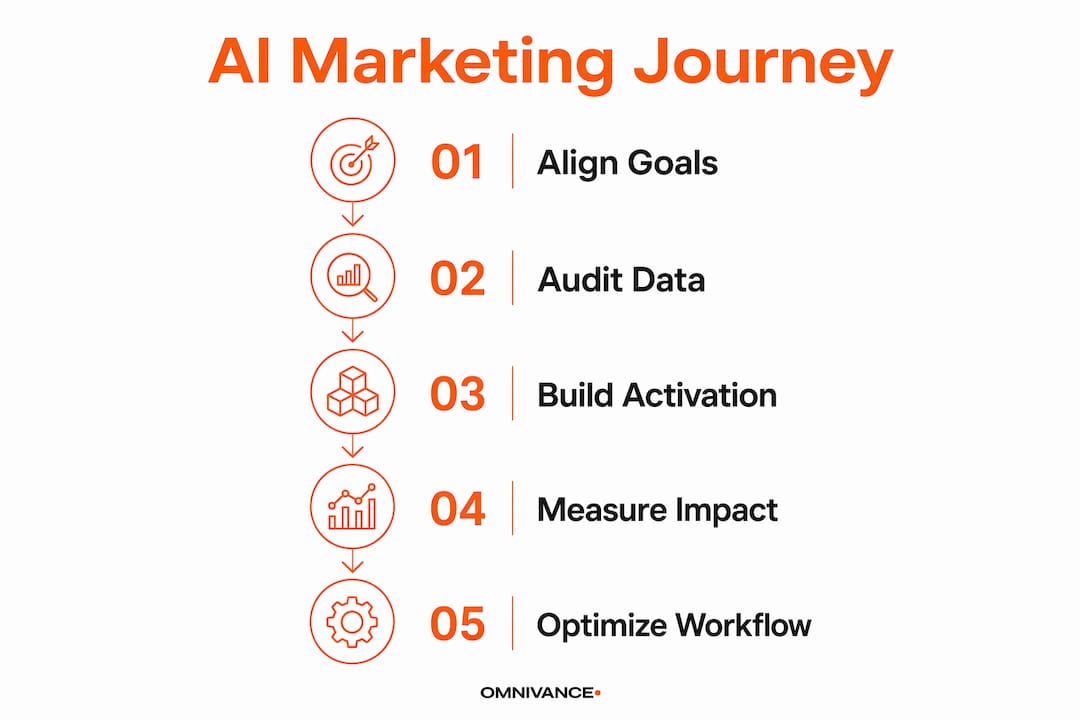
This is a 24-week plan structured as four phases. Each phase has a decision gate before you proceed.
1. Phase 0 (weeks 0–2): Align on outcomes Define the business outcome you are trying to move (retention rate, conversion rate, acquisition cost) and the one or two AI use cases most likely to move it. Assign owners using a RACI. Set your success metrics before you touch any data. Decision gate: leadership sign-off on pilot scope and KPIs.
2. Phase 1 (weeks 2–8): Audit and instrument Map every customer touchpoint and assess data quality at each one. Fix the top five data quality issues (missing identifiers, inconsistent event naming, broken consent flags). Stand up identity resolution for your highest-priority channel. Decision gate: at least one clean, consented data stream flowing into a unified profile.
3. Phase 2 (weeks 8–16): Build the minimal viable activation Build one feature store segment or CDP audience. Deploy one agentic use case: real-time personalized email triggered by behavioral events, or a churn-prevention offer triggered by decay signals. Use Braze or an equivalent engagement platform for the activation layer. Decision gate: the agent is running on live data, not batch exports, and the experiment is instrumented.
4. Phase 3 (weeks 16–24): Measure, iterate, and scale Run your incrementality experiment (holdout group or geo-split). Automate model refreshes so scores update on a defined cadence. If the pilot KPI is met, expand to two additional use cases. If not, diagnose before scaling. The AI implementation checklist from Omnivancemedia covers the operational steps in detail.
Timeline and cost drivers to plan for:
- Internal engineering effort is usually the largest cost. Instrumentation, identity resolution, and feature store setup each require dedicated sprint capacity.
- CDP and feature store licensing varies widely. Entry-level CDP configurations start in the low four figures per month; enterprise platforms scale significantly higher.
- Change management is underestimated. Getting sales, product, and marketing to agree on a shared customer identifier and consent standard takes longer than the technical work.
- Vendor resources (LiveRamp, Braze, StackAdapt professional services) can accelerate Phase 1 and 2 but add to the budget. Evaluate against internal capacity honestly.
How to measure the impact of first-party data in AI workflows
Most marketers cannot yet prove AI ROI conclusively, which is exactly why measurement design has to come before activation, not after. Experimentation frameworks are what separate teams that can defend their spend from those that cannot.
Primary KPIs to track:
- Incremental revenue attributed to AI-personalized touchpoints
- Conversion lift in treated versus holdout groups
- Cost per acquisition across first-party-targeted versus broad audiences
- Retention and repurchase rate for customers in personalization programs
- LTV uplift at 6 and 12 months for cohorts acquired through first-party-powered channels
Experimentation approaches:
- Randomized holdouts: The cleanest method. Randomly assign a percentage of eligible customers to a control group that receives no AI-personalized treatment. Measure the difference in your primary KPI.
- Geo-splits: When randomization is not feasible, run the treatment in matched geographic markets and use the others as controls.
- Model A/B: Compare a model trained on first-party signals against a baseline model using only demographic or third-party inputs. The delta in prediction accuracy and downstream KPI is your proof point.
Last-touch attribution breaks for agentic workflows because a single customer may be touched by multiple agents across multiple channels before converting. Randomized holdouts and geo experiments give you causal estimates that last-touch cannot.
| KPI | Measurement method | Expected lead time |
|---|---|---|
| Conversion lift | Randomized holdout experiment | 4–8 weeks |
| Retention / repurchase rate | Cohort analysis with holdout | 8–12 weeks |
| Cost per acquisition | Paid media A/B with first-party vs. broad audience | 4–6 weeks |
| LTV uplift | 6-month cohort comparison | 24+ weeks |
| Model accuracy (churn) | Offline evaluation + live holdout | 6–10 weeks |
Pro Tip: Instrument event-level logging for every activation from day one. When a pilot underperforms, event logs let you diagnose whether the problem is data quality, model accuracy, or activation timing — without that granularity, you are guessing.
The role of AI in campaign optimization covers additional measurement frameworks for ongoing campaign performance.
Common pitfalls when building first-party data for AI
Most pilots fail for operational reasons, not technical ones. These are the patterns worth watching.
Siloed teams and point-to-point integrations are the most common failure mode. Marketing, product, and data engineering each build their own pipelines to the same source systems, creating inconsistent customer records and duplicated effort. The mitigation is a shared data foundation with a single canonical customer identifier that every team reads from. If a full consolidation is not feasible immediately, build a prioritized integration roadmap and stop adding new point-to-point connections.
Data quality and identity gaps surface the moment you try to join CRM records to web events. Missing or inconsistent identifiers mean your customer 360 profile is full of holes. Start with a small set of critical identifiers (hashed email, customer ID) and enforce QA rules on those before expanding. A narrow, clean identity graph is more useful than a broad, leaky one.
Over-ambitious scope kills more pilots than technical complexity. Teams that try to instrument every touchpoint, build five models, and activate across six channels simultaneously end up with nothing working well. Pick one narrow, high-frequency agentic use case, prove the value, then expand. The RACI operating model recommended by practitioners exists precisely to prevent scope creep from diffusing accountability.
Governance blind spots create downstream problems that are expensive to fix. Consent metadata not attached to profiles means your activation layer cannot enforce what customers agreed to. The fix is to treat consent as a first-class data attribute, not an afterthought.
"License corpses" accumulate when teams buy CDP, feature store, and engagement platform licenses before they have the use cases and operating model to justify them. Consolidate around a few high-frequency pilots before committing to broad platform rollouts.
Pro Tip: Require a measurable KPI and a named owner before any AI use case gets engineering resources. A RACI without a KPI is just a meeting.
Agency outcomes: what first-party data plus AI actually produces
Two cases from Omnivancemedia's client work show what the combination of first-party signals and integrated AI activation produces in practice.
HVAC contractor: $340K in new contracts in 90 days. The pilot used CRM transaction history and service-area data as the primary first-party signals. Activation ran through targeted paid search and direct response campaigns calibrated to high-intent behavioral triggers. Measurement used a before-and-after revenue comparison with a defined attribution window. The result: $340K in new contracts within 90 days of activation.
E-commerce client: monthly revenue from $80K to $420K. First-party purchase history, cart abandonment events, and email engagement data fed a personalization and retargeting system across Google, Meta, and owned email. The activation layer used behavioral triggers to serve the right offer at the right moment in the purchase cycle. Revenue scaled from $80K to $420K per month as the model accumulated more signal and the audience segments sharpened.
Both cases share the same structural pattern: a clean first-party data feed, a defined activation channel, and a measurement method agreed on before launch. Neither required a massive data infrastructure investment to start. They required discipline about which signals mattered and a willingness to run the experiment properly.
Credibility signals like these documented outcomes also matter for AI search visibility. When AI systems evaluate which brands to surface in response to a query, original case evidence and structured authorship are among the factors that increase citation probability.
Your 90-day pilot checklist and next steps
First-party data is the proprietary signal layer that makes AI marketing specific and measurable. The business upside of acting this quarter is a structural advantage that compounds as your models accumulate signal while competitors are still debating the architecture.
90-day pilot checklist:
- Define one business outcome and a measurable KPI (e.g., reduce 90-day churn by 15%).
- Identify the one first-party data source with the clearest signal for that outcome (CRM events, app telemetry, purchase history).
- Instrument event-level logging for that source with consistent identifiers and timestamps.
- Build one agent or model: a churn-prevention trigger, a personalized email sequence, or a propensity-scored paid audience.
- Set up a randomized holdout group before you activate.
- Measure at week 4 and week 8. Document what worked and what did not before expanding.
For teams that want to extend first-party activation into AI search visibility, the Answer Engine Optimization guide covers how owned content and structured data signals influence AI platform citations.
Key Takeaways
First-party data is the non-negotiable foundation for AI marketing: without it, your models train on shared signals, your personalization is generic, and your measurement cannot prove causal lift.
| Point | Details |
|---|---|
| Proprietary signals are the advantage | AI models are commoditized; your consented first-party data is what makes outputs specific to your customers. |
| 43% preference shift is possible | Think with Google found tailored first-party messaging shifted up to 43% of respondents toward a better-fit brand. |
| Start narrow, prove value fast | Pick one high-frequency agentic use case, instrument it properly, and run a holdout experiment before scaling. |
| Governance is infrastructure | Attach consent metadata to every profile and enforce purpose limitation technically, not just in policy documents. |
| Omnivancemedia integrates the full stack | Omnivancemedia connects CRM, paid activation, AEO, and creative into a single system — the same approach behind the $340K HVAC and $80K-to-$420K e-commerce results. |
The part most playbooks skip
The conventional wisdom on first-party data says: collect more, unify it, activate it. That is correct but incomplete. The part most playbooks skip is the operating model gap between having good data and actually running agents on it in real time.
Most marketing teams have more first-party data than they use. The bottleneck is not collection. It is the architecture decision to embed agents in the data layer versus bolting AI onto an existing stack. Bolted-on AI requires someone to export a CSV, upload it somewhere, wait for a batch job, and then activate a campaign that is already 24 hours stale. That is not agentic marketing. That is manual marketing with an AI label on it.
The teams winning with first-party data right now are the ones who made the architectural decision early: agents live in the data layer, read live signals, and trigger activations without human handoffs. That decision is harder to reverse than any tool choice. It is also the one that determines whether your 90-day pilot produces a real result or a polished slide.
The other thing worth saying plainly: governance is not a compliance checkbox. Consent metadata attached to profiles is what allows your activation layer to move fast without legal exposure. Teams that treat governance as a post-launch problem spend the next year retrofitting it while their pilots sit idle. Build it in from week one, even if the initial implementation is simple.
Omnivancemedia's integrated approach to first-party data and AI marketing
If the roadmap above describes where you want to go, Omnivancemedia is built to get you there without the vendor coordination overhead. The firm's integrated model connects CRM setup and automation, paid media activation across Google and Meta, Answer Engine Optimization for AI search visibility, and creative production into a single system designed around your first-party signals. That is the same architecture behind the HVAC contractor's $340K in 90 days and the e-commerce client's revenue growth from $80K to $420K per month.
The difference from a traditional agency engagement is that every channel shares the same data foundation. Your CRM signals feed your paid audiences, your paid performance data feeds your creative decisions, and your content is structured to be cited by AI platforms. No handoffs between vendors, no inconsistent customer records across teams. If you are ready to run a first-party data pilot this quarter, see the full services overview and reach out to scope the engagement.
Useful sources and further reading
These are the most useful sources from the research behind this article, organized by what you need next.
For technical architecture and composable AI design:
- The last mile: why great first-party data still doesn't make great marketing — Databricks. The best single source on composable canvas architecture and why embedding agents in the data layer matters. Start here if you are making infrastructure decisions.
For strategy and the agentic AI shift:
- Agentic AI Is Redefining Marketing Growth — BCG. Covers how agentic AI changes the requirement to be findable by both human and AI decision-makers.
- AI Marketing in 2026: A Practitioner's Playbook — Neal Schaffer. Strong on measurement, credibility signals, and why most teams cannot yet prove AI ROI.
For personalization and value exchange:
- First-party data in the AI era — Think with Google. The source for the 43% preference-shift finding and the behavioral science case for relevance-driven messaging.
- What Is First-Party Data? Definition, Examples & Guide — CDP.com. Practical on CDP architecture, value exchange, and building unified customer profiles.
For privacy and governance:
- What Is First-Party Data? The Complete Guide — Countly. Covers cookie deprecation, CCPA/CPRA context, and the privacy-first collection framework.
For model training and AI activation:
- First-party data and AI guide — FirstPartyData.com. Focused on how consented, structured signals improve ML model performance for recommendations and churn prediction.
For operating model and RACI governance:
- AI in Marketing — MaibornWolff. The most practical source on RACI design, use-case mapping, and avoiding "license corpses."
For content strategy and AI search visibility:
- Content Marketing Ideas 2026: Build Trust and Win — Hala Creative Agency. Useful for structuring first-party content to build credibility with both human readers and AI citation systems.