Why Businesses Need an AI Marketing Strategy in 2026

An AI marketing strategy is a system that integrates AI capabilities, governance, measurement, and human judgment to drive competitive marketing outcomes. Understanding why businesses need an AI marketing strategy in 2026 comes down to one fact: the consumer journey has fundamentally changed. Google's 2026 guidance frames AI marketing as the tool businesses must use to master the AI-accelerated consumer journey across Search and YouTube. Brands that treat AI as a collection of tools rather than an operating system will lose ground to those that build integrated systems. The difference between winning and losing in 2026 is not which tools you buy. It is whether you have a strategy that connects them.
Why businesses need an AI marketing strategy in 2026
The marketing bottleneck in 2026 has shifted from execution to strategy. Neal Schaffer identifies this directly: AI marketing must function as an integrated system covering strategy, visibility, execution, and brand voice. Tools are now commoditized. Any competitor can access the same AI writing tools, ad platforms, and automation software. What separates high-performing brands is the system that governs how those tools work together.
Generative AI has also changed how consumers discover products. AI-driven search engines and platforms like Google's AI Overviews now surface answers before users click a single link. Lilach Bullock's 2026 analysis confirms that competitive advantage now depends on visibility inside AI systems, requiring what practitioners call "generative engine optimization" (GEO). This goes beyond classic SEO. Businesses that do not appear inside AI-generated answers are effectively invisible to a growing segment of buyers.

Brand differentiation is the third driver. When every brand uses the same AI tools without a governing strategy, output starts to look identical. Audiences notice. A business with a defined AI marketing system controls its voice, its positioning, and its audience relationships in ways that pure tool adoption cannot replicate.
What components make an effective AI marketing strategy?
An effective AI marketing strategy in 2026 has four layers: strategy, operating infrastructure, use-case management, and measurement. Each layer depends on the one below it. Skipping infrastructure to chase use cases is the most common and costly mistake.
The four core components are:
- Strategy layer: Defines brand positioning, audience segments, and the role AI plays in each stage of the consumer journey.
- Operating infrastructure: Covers data foundation, governance policies, cross-channel orchestration, and talent upskilling. BCG identifies this layer as the foundation for AI-native marketing, not the tools themselves.
- Use-case portfolio: A managed set of AI applications prioritized by business impact, compliance requirements, and organizational readiness.
- Measurement methodology: Tracks efficiency, operational quality, and business outcomes across every AI initiative.
The operating infrastructure layer is where most businesses underinvest. Data cleanup must come before any AI deployment. Feeding AI systems with fragmented or inaccurate data produces unreliable outputs at scale. Governance policies define who approves AI-generated content, how compliance is maintained, and what human review looks like at each stage.
Pro Tip: Before selecting any AI tool, document your current data sources and identify gaps. A clean data foundation produces better AI outputs than any premium tool subscription.
| Component | What it requires |
|---|---|
| Strategy layer | Defined brand positioning and AI role per funnel stage |
| Operating infrastructure | Clean data, governance policies, and upskilling plan |
| Use-case portfolio | Prioritized list managed by impact and compliance |
| Measurement methodology | Baselines set before deployment, tracked across three outcome levels |
Cross-functional collaboration is non-negotiable. Marketing, IT, legal, and data teams must align on governance before AI workflows go live. BCG's operating model framework assigns clear ownership to each layer, preventing the fragmentation that kills AI ROI.
How does AI marketing strategy improve business outcomes and ROI?
The ROI case for AI marketing strategy is measurable and specific. Teams that manage use-case portfolios with compliance and measurement frameworks in place achieve 30–50% efficiency gains and conversion lifts of 10–25%. Those numbers come from structured strategy execution, not from buying more tools.
The measurement gap is the biggest risk. Only 29% of organizations measure AI marketing ROI dependably. That means the majority of businesses are spending on AI without knowing whether it works. An effective strategy sets baselines before deployment and tracks outcomes across three layers: cost reduction, operational quality, and business impact.
The four most common ROI improvements from structured AI marketing strategy:
- Production efficiency: AI handles high-volume content creation, ad copy testing, and reporting automation. This frees human teams for positioning and creative direction.
- Conversion lift: Personalized messaging at scale, driven by AI audience segmentation, increases conversion rates across email, paid ads, and landing pages.
- Cost reduction: Automating repetitive tasks reduces agency spend and internal labor costs over time.
- Faster decision cycles: AI-generated performance reports surface insights in hours rather than weeks, enabling faster campaign adjustments.
Without a structured approach, businesses fall into what MaibornWolff calls "license corpses." These are paid AI tool subscriptions that sit unused because no one defined the use case, the owner, or the success metric. Wasted spend on unused tools is the most preventable form of AI marketing failure. A use-case portfolio with assigned ownership and defined KPIs eliminates this problem before it starts.
Pro Tip: Set your measurement baselines before you deploy any AI tool. Comparing results without a pre-deployment benchmark makes ROI impossible to prove.
Why AI marketing must be a system, not a tool list
BCG's research on redesigning end-to-end processes with agentic AI makes the case clearly: organizations generating real value are not deploying more bots. They are redesigning how work flows through their marketing operations. This is the operating model shift that separates high performers from everyone else.
Agentic AI refers to AI systems that can execute multi-step tasks autonomously, such as running a full ad campaign from brief to launch without manual intervention at each step. The value is not in the individual AI action. It is in the workflow that governs when AI acts, when humans review, and how outcomes are measured.
The risks of treating AI as a tool list include:
- Brand voice erosion: When multiple teams use different AI tools without a shared style guide and governance layer, brand voice fragments across channels.
- Compliance exposure: AI-generated content that skips legal review creates liability, especially in regulated industries.
- Output sameness: Brands using the same AI tools with the same prompts produce content that looks identical to competitors.
- Measurement gaps: Without a system, there is no consistent way to attribute results to specific AI activities.
Lilach Bullock's 2026 framework draws a clear line: human judgment must retain strategy, positioning, and brand voice, while AI handles high-volume production, optimization, and reporting. This division is not about limiting AI. It is about deploying it where it creates the most value without introducing brand risk.
How to implement an AI marketing strategy in 2026
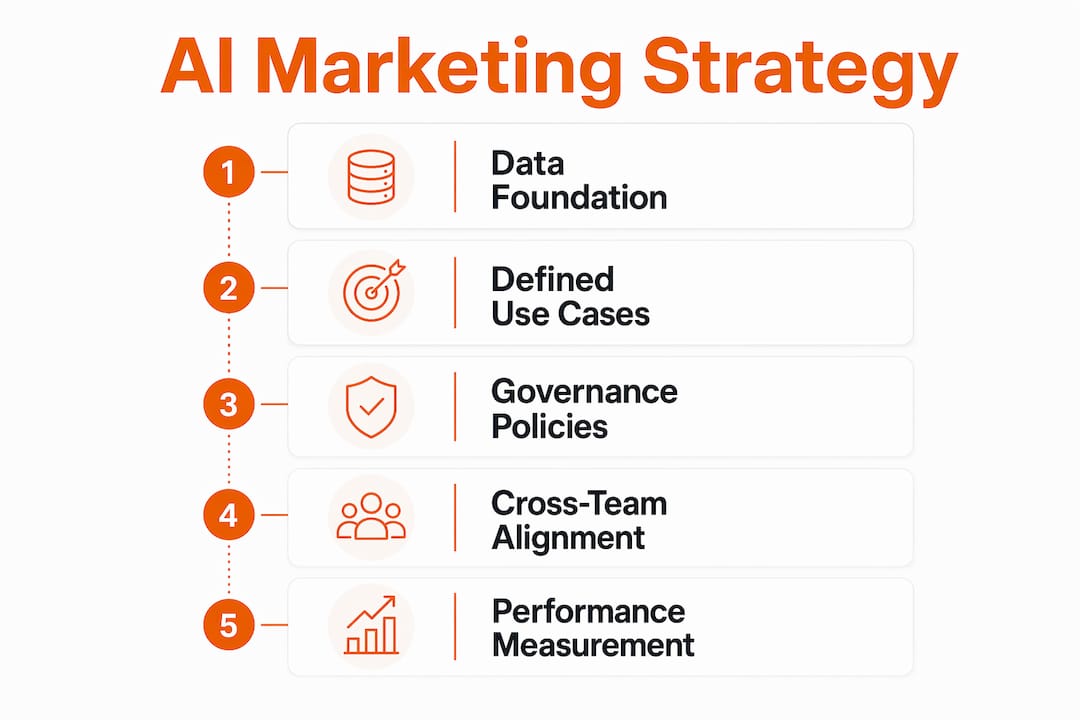
Implementation follows a five-step sequence. Skipping steps creates the exact problems that undermine AI ROI.
- Clean your data foundation. Audit all customer data, CRM records, and content assets before connecting them to AI systems. Garbage in, garbage out is not a cliché. It is the most common cause of failed AI marketing deployments.
- Define your use-case portfolio. List every AI application you plan to deploy. Assign an owner, a success metric, and a compliance review process to each one. Omnivancemedia's AI implementation checklist provides a structured framework for this step.
- Set measurement baselines. Before any AI tool goes live, document current performance on every KPI you plan to track. This is the only way to prove ROI after deployment.
- Build governance policies. Define who approves AI-generated content, what human review looks like, and how compliance is maintained across channels.
- Upskill your team continuously. AI platforms change faster than annual training cycles can keep up with. Omnivancemedia's guide on training your team covers how to build ongoing learning into your marketing operations.
| Approach | Outcome |
|---|---|
| Tool-first deployment | High spend, low adoption, no measurable ROI |
| System-first deployment | Defined use cases, measurable outcomes, sustainable cost reduction |
| Governance-led deployment | Compliance maintained, brand voice consistent, scalable execution |
Cross-functional collaboration determines whether implementation succeeds or stalls. Marketing leaders need buy-in from IT for data infrastructure, legal for compliance review, and finance for ROI reporting. Building those relationships before deployment prevents the organizational friction that kills AI initiatives after launch.
Key takeaways
An AI marketing strategy in 2026 succeeds only when it combines a clean data foundation, defined use cases, governance policies, and multi-layer measurement before any tool goes live.
| Point | Details |
|---|---|
| System over tools | AI marketing requires an integrated operating system, not a tool list. |
| Data foundation first | Clean, unified data must precede any AI deployment to produce reliable outputs. |
| Measure before you deploy | Set KPIs and baselines before launch to make ROI provable. |
| Governance prevents brand risk | Assign human review at every stage where brand voice or compliance is at stake. |
| Efficiency gains are real | Structured AI strategy delivers 30–50% efficiency gains and 10–25% conversion lifts. |
What I've learned about AI marketing strategy that most guides skip
The most common mistake I see business leaders make is treating AI marketing as a technology project. They assign it to IT, buy a stack of tools, and wait for results. AI marketing is a business strategy problem. The technology is the easy part.
The harder part is organizational. Getting marketing, legal, data, and finance teams aligned on governance before deployment is where most initiatives stall. The businesses that get this right treat the operating model redesign as the primary project and the tool selection as secondary. That inversion is counterintuitive, but it is what the evidence supports.
The measurement gap is the other issue I find consistently underestimated. When only 29% of organizations measure AI marketing ROI dependably, that means the majority are flying blind. Setting baselines before deployment is not optional. It is the only way to know whether your AI marketing investment is working or just generating activity.
The future of AI marketing belongs to businesses that build systems, not collections of subscriptions. Start with governance. Start with data. Start with measurement. The tools will follow, and they will actually work.
— laya
How Omnivancemedia helps you build a real AI marketing system
Omnivancemedia works with businesses that are ready to move beyond fragmented tool adoption and build an integrated AI marketing system. The approach combines AI-powered SEO, paid advertising, CRM automation, and creative production into a single operating model designed around measurable outcomes.
Omnivancemedia has helped an HVAC contractor generate $340,000 in new contracts within 90 days and scaled an e-commerce client from $80,000 to $420,000 in monthly revenue. Those results come from system-level integration, not individual tool deployments. If your business is ready to scale past $500,000 and wants an AI marketing strategy built on governance, data, and measurement, explore Omnivancemedia's full services to see how the system works.
FAQ
What is an AI marketing strategy?
An AI marketing strategy is an integrated system that combines AI tools, governance policies, data infrastructure, and measurement frameworks to drive consistent and measurable marketing outcomes. It goes beyond individual tool adoption to redesign how marketing operations function end to end.
How does AI improve business marketing results?
Structured AI marketing strategy delivers 30–50% efficiency gains and 10–25% conversion lifts by automating high-volume production tasks while freeing human teams for strategy and brand positioning.
What is generative engine optimization (GEO)?
Generative engine optimization is the practice of structuring content and brand presence to appear inside AI-generated search results, such as Google's AI Overviews. It extends beyond classic SEO to ensure visibility in AI-driven discovery systems.
Why do most AI marketing investments fail to show ROI?
Only 29% of organizations measure AI marketing ROI dependably. Most deployments fail to set performance baselines before launch, making it impossible to attribute results to specific AI activities or prove return on investment.
How should a business start building an AI marketing strategy?
Start with a data audit, then define a use-case portfolio with assigned owners and KPIs, set measurement baselines, build governance policies, and establish a continuous upskilling program for your marketing team.