Why AI Outperforms Manual Marketing Campaigns in 2026

AI outperforms manual marketing campaigns on speed, personalization at scale, and iterative optimization — and the performance gap is widening as agentic workflows move from experiment to production. HubSpot research found that 75% of marketers report positive ROI from AI investments, and 78% say AI cuts time spent on manual tasks. BCG's 2026 analysis of agentic marketing leaders found up to triple marketing ROI and cycle times running up to ten times faster than manual equivalents. Omnivancemedia's own client work reflects this: an HVAC contractor generated a substantial amount in new contracts within three months. An e-commerce client scaled monthly revenue significantly using an integrated AI-driven approach.
Three things you can do right now:
- Validate your data foundation. AI models are only as good as the signals they train on. Audit your CRM, ad platform, and analytics data for gaps before launching any pilot.
- Run a focused pilot on one channel. Paid search or email personalization are the fastest to instrument and measure. Set a 60-day window with a clear CPA or conversion rate target.
- Lock in consistent attribution before you scale. Multi-touch attribution models require agreement upfront — changing the model mid-flight makes before/after comparisons meaningless.
Table of Contents
- How AI and manual campaigns compare across the metrics that matter
- Benchmarks and case evidence that prove AI's performance edge
- Practical AI techniques that deliver the advantage right now
- Where AI can fail and the governance you need to prevent it
- A pragmatic roadmap from pilot to agentic workflows
- What comes next: agentic AI, AEO, and the 2026 shift
- Key Takeaways
- The case for AI is strong — but the implementation gap is where most teams lose
- Omnivancemedia builds the AI marketing system your team actually needs
- Useful sources and further reading
How AI and manual campaigns compare across the metrics that matter
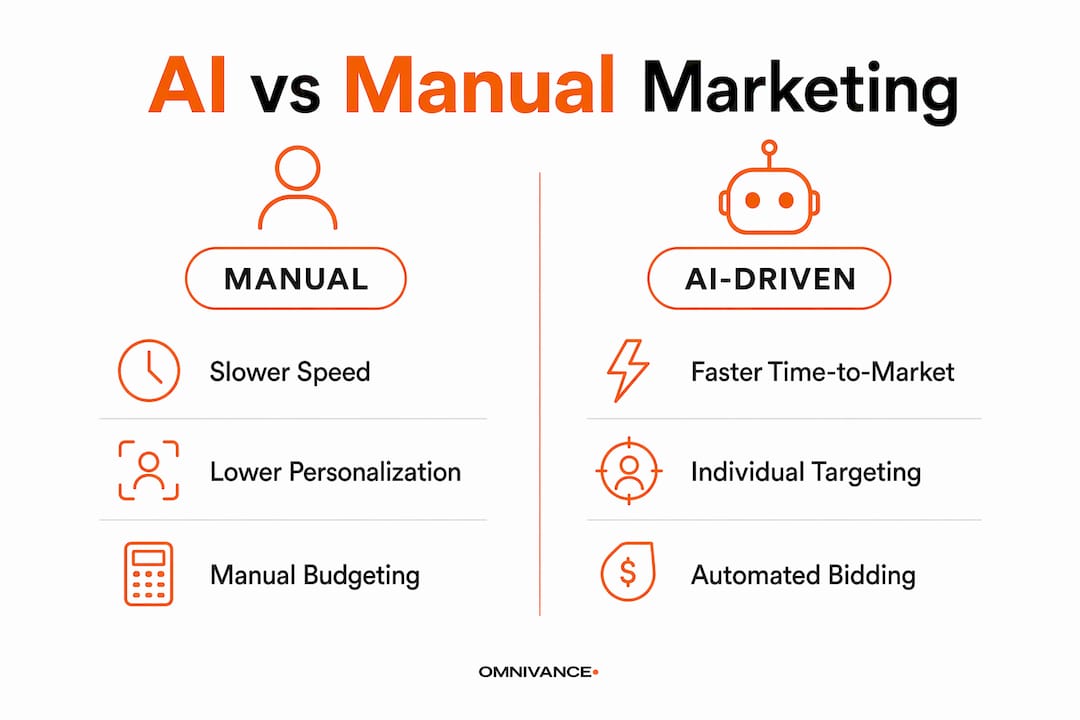
The difference between AI-driven and manual campaigns is not just speed. It shows up across every dimension a performance marketer actually cares about.
| Dimension | Manual Campaigns | AI-Driven Campaigns |
|---|---|---|
| Speed / time-to-market | Days to weeks for creative, copy, and targeting setup | Hours to days; generative tools produce variants in minutes |
| Scale / personalization | Segment-level targeting; limited by analyst bandwidth | Individual-level personalization using cross-platform signals |
| Optimization cadence | Weekly or bi-weekly manual bid and budget reviews | Continuous; models adjust bids and budgets in real time |
| Creative throughput | One or two variants per flight; A/B testing is slow | Hundreds of variants generated and tested simultaneously |
| Measurement accuracy | Last-click or single-touch attribution; manual reporting | Multi-touch attribution with automated anomaly detection |
| Cost efficiency (CPA/CAC) | High labor cost; slow to react to market shifts | Lower CPA over time; notable overhead reduction reported in operational contexts |
Where manual still wins: brand-building creative that requires genuine emotional nuance, regulatory-sensitive campaigns where every word needs legal review, and early-stage brand positioning where the signal data simply does not exist yet. AI optimizes toward what it can measure. When the goal is unmeasurable or the audience is too small to generate statistical signal, a skilled strategist with a blank page still has the edge.
Benchmarks and case evidence that prove AI's performance edge
The numbers marketers most often debate — ROI lift, time-to-market reduction, productivity gains — are now well-documented across multiple independent sources.
Core KPIs to track, with baseline vs. AI-improved ranges
| KPI | Typical Manual Baseline | AI-Improved Range | Source Signal |
|---|---|---|---|
| Click-through rate (CTR) | 1–2% (display/social) | 1.1–2.3% with personalization lift | Personalization engagement data |
| Conversion rate (CVR) | 2–4% (e-commerce) | 10–15% lift over baseline | Factors.ai benchmark |
| Cost per acquisition (CPA) | Varies by channel | Trending down as models learn | BCG agentic leader data |
| Return on marketing investment (ROMI) | 1–2x | up to triple for agentic leaders | BCG 2026 |
| Campaign cycle time | 2–4 weeks | Up to 10x faster with AI orchestration | BCG agentic data |
Client outcome snapshots from Omnivancemedia:
HVAC contractor: a substantial amount in new contracts within three months. Measurement approach: revenue attribution tied to inbound call tracking and CRM deal stages, with a 90-day attribution window.
E-commerce client: Monthly revenue grew from $80K to $420K. Measurement approach: platform-reported revenue with UTM-consistent attribution across paid and organic channels, tracked over a six-month period.
Agency-level research corroborates these outcomes. Firms that pair AI adoption with genuine process change report productivity and ROI gains that compound over time rather than plateau after the initial tool deployment.
Practical AI techniques that deliver the advantage right now
Understanding why AI wins is one thing. Knowing exactly which applications to run first is what separates teams that see results from teams that run expensive experiments with nothing to show.

Audience segmentation and micro-personalization
AI pulls behavioral, transactional, and contextual signals across platforms to build individual-level audience profiles. The practical payoff: ad creative and landing page content that matches where a specific user is in the buying cycle, not just which demographic bucket they fall into. This is the primary driver of CTR and CVR lifts. For social media advertising, lookalike modeling and real-time audience refresh are the fastest wins.
Creative variant generation and multivariate testing
Generative AI tools produce dozens of headline, image, and copy combinations in the time it takes a human team to brief a single concept. The operational requirement: a clear brand voice document and a human reviewer in the loop before anything goes live. Without that guardrail, the model optimizes for clicks, not brand equity.

Automated bidding and budget allocation
Smart bidding algorithms on Google Ads and Meta's Advantage+ already operate this way. The key is feeding them clean conversion data — garbage signals produce garbage bids. Teams that connect their CRM conversion events (not just pixel fires) to the bidding model see the sharpest CPA improvements.
Predictive lead scoring
AI-powered CRM tools score leads based on behavioral patterns, not just firmographic fit. A lead who visits the pricing page three times in a week scores differently than one who downloaded a whitepaper six months ago. CRM automation tied to predictive scoring lets sales teams prioritize the right conversations at the right moment.
Multi-touch attribution
Last-click attribution systematically undercredits top-of-funnel channels. AI-driven attribution models distribute credit across the actual path to conversion, giving media planners an accurate picture of which channels are pulling weight. The data requirement is non-trivial: you need consistent UTM tagging, a unified data layer, and enough conversion volume to train the model.
Pro Tip: Start with automated bidding and predictive scoring before you touch creative generation. These two applications have the shortest path from deployment to measurable CPA impact, and they surface the data quality gaps you will need to fix before scaling anything else.
Where AI can fail and the governance you need to prevent it
AI marketing tools fail in predictable ways. The failure modes are not random — they follow from specific structural weaknesses that governance can address before they become expensive.
Top failure modes:
- Data gaps and proxy bias. A model trained on historical data reflects historical biases. If your past campaigns over-indexed on one demographic, the AI will too — and it will do so at scale and speed that amplifies the problem. Research on AI-generated outputs in high-stakes domains has documented racial bias in AI recommendations, a pattern that applies wherever training data is skewed.
- Poor objective alignment. Optimizing for CTR when you actually care about pipeline value is a classic mismatch. The model delivers exactly what you told it to optimize for — which may not be what you actually want.
- Creative fatigue at scale. AI generates hundreds of variants faster than audiences can absorb them. Creative shelf life burns down faster when the same audience sees dozens of AI-generated permutations in a short window.
- Model drift. A model trained on Q4 holiday data performs differently in Q2. Without scheduled retraining and performance monitoring, drift goes undetected until CPA spikes.
- Brand safety and compliance. Generative outputs can drift from brand voice, introduce unapproved claims, or violate platform policies. The ethical use of AI in advertising requires explicit guardrails, not just post-hoc review.
Governance checklist:
- Define brand guardrails in a written document the AI system can reference (tone, restricted terms, visual standards).
- Run bias audits on audience segments quarterly — check reach and performance by demographic.
- Implement privacy-by-design: consent management, data minimization, and clear retention policies before connecting any new data source to an AI tool.
- Set model drift alerts: flag any campaign where CPA or CVR moves significantly from the recent average.
- Require human sign-off on all net-new creative before it enters rotation, regardless of how it was generated.
Pro Tip: Schedule a monthly "creative freshness audit." Pull performance data on every active ad variant, retire anything running more than six weeks without a refresh, and inject at least two human-crafted assets per campaign per month. This single habit prevents the performance plateau that kills most AI creative programs.
A pragmatic roadmap from pilot to agentic workflows
The transition from manual to AI-driven campaigns does not happen in a single sprint. Leaders who try to skip the pilot phase and go straight to full automation consistently overspend and underdeliver.
Phase 1: Pilot (months 0–3)
- Choose one channel and one objective. Paid search with a CPA target is the most instrumented starting point. Avoid multi-channel pilots — they make attribution impossible.
- Audit and fix your data layer. Confirm UTM consistency, CRM-to-ad-platform conversion sync, and a single source of truth for revenue attribution.
- Define success metrics upfront. a defined CPA reduction or CVR lift over the control period — pick one, write it down, and do not change it mid-flight.
- Staff the pilot correctly. You need one data analyst, one channel specialist who understands the AI tool's optimization logic, and one brand reviewer. Three people, clear lanes.
Phase 2: Scale (months 3–9)
- Expand to adjacent channels using the same attribution model. Paid social, then email personalization. Each new channel adds signal that improves the model's cross-channel view.
- Build a creative production pipeline. Pair AI-generated variants with a human refresh schedule. Training your team on prompt engineering and output review is as important as the tool itself.
- Instrument ROMI, not just channel metrics. Connect campaign spend to pipeline and closed revenue in your CRM. This is the number leadership will ask for.
Phase 3: Agentic orchestration (months 9–18)
- Invest in the connective tissue. Agentic AI requires a data foundation, a brand intelligence layer, and an orchestration framework that lets multiple specialized agents hand off tasks to each other.
- Upskill for oversight, not execution. The role of the marketing team shifts from building campaigns to auditing, curating, and governing what the agents produce.
- Evaluate vendors on three criteria: transparency of training data, SLA commitments on model drift detection, and the presence of a brand intelligence layer that enforces your guardrails automatically.
Red flags in vendor conversations: vague answers about how the model was trained, no documented process for handling model drift, pricing structures that lock you into a single platform before you have validated results, and any vendor who cannot explain how their tool handles brand safety at the output level.
Pro Tip: Use the AI implementation checklist to pressure-test your pilot design before you commit budget. The most common reason pilots fail is not the AI tool — it is an unresolved data quality problem that the tool exposes.
What comes next: agentic AI, AEO, and the 2026 shift
The next competitive frontier is not better targeting or faster creative. It is visibility to AI agents themselves.
Harvard Business Review's 2026 analysis identifies two simultaneous shifts: conversational AI changing how consumers discover products, and agentic AI changing who makes the buying decision. When a user asks an AI assistant to "find the best CRM for a 50-person sales team," the agent does not run a Google search. It queries its training data, retrieves structured information from trusted sources, and makes a recommendation. Brands that are not structured to be cited by those agents will not appear in that recommendation.
This is the emerging discipline of Agentic Engine Optimization (AEO) — structuring your content, data, and brand signals so that AI discovery systems can find, understand, and recommend you. It sits alongside traditional SEO and GEO (Generative Engine Optimization) as a distinct channel requiring its own investment.
Two metrics that will matter more than click-through rate by the end of 2026: share of agent citations (how often your brand appears in AI-generated recommendations) and recommendation rate (the percentage of AI-assisted purchase journeys where your brand is surfaced as a top option). Neither metric exists in most marketing dashboards today. Building the infrastructure to track them is a first-mover advantage.
For marketing leaders, the 2026 priority list is short: invest in your data foundation, build a brand intelligence layer that makes your positioning machine-readable, and run experiment-driven measurement so you can prove what is working to a CFO who has seen too many AI promises underdeliver.
Key Takeaways
AI outperforms manual marketing campaigns because it operates faster, personalizes at the individual level, and continuously optimizes toward measurable outcomes — advantages that compound as agentic workflows mature.
| Point | Details |
|---|---|
| Fix data before AI | Clean CRM data, consistent UTMs, and unified attribution are prerequisites — not afterthoughts. |
| Pilot one channel first | Paid search with a defined CPA target gives the fastest, cleanest signal in a 60-day window. |
| Measure ROMI, not clicks | Tie campaign spend to pipeline and closed revenue; vanity metrics will not survive a budget review. |
| Govern creative output actively | Rotate human-crafted assets monthly and audit AI outputs for brand drift and bias quarterly. |
| Omnivancemedia integrates the full stack | Omnivancemedia combines SEO, paid ads, CRM automation, and creative production in one system — clients have seen revenue scale from $80K to $420K monthly using this integrated approach. |
The case for AI is strong — but the implementation gap is where most teams lose
The evidence for why AI outperforms manual marketing campaigns is not ambiguous at this point. The productivity data, the ROI benchmarks, and the client outcomes all point in the same direction. What I find underappreciated in most CMO conversations is not whether to adopt AI — that debate is over — but where the real risk lives.
Most teams treat AI adoption as a tooling problem. Buy the platform, connect the data, watch the CPA drop. What actually happens is more complicated. The AI finds the path of least resistance to the metric you gave it, which is often not the metric you actually care about. A model optimizing for form fills will happily generate low-quality leads at scale. A creative AI optimizing for CTR will produce clickbait that erodes brand trust over six months. The tool is doing exactly what it was told. The failure is in the objective-setting, not the algorithm.
The teams that get durable results from AI marketing are the ones that invest as much in governance and measurement design as they do in the tools themselves. They define what "good" looks like before the model runs, not after. They keep humans in the loop for brand judgment calls, not because AI cannot generate the content, but because brand equity is not a metric any current model can optimize for directly.
The agentic era raises the stakes on this. When multiple agents are running campaigns autonomously, the cost of a misaligned objective compounds across every touchpoint simultaneously. That is not a reason to slow down. It is a reason to build the governance infrastructure now, while the programs are still small enough to course-correct cheaply.
Omnivancemedia builds the AI marketing system your team actually needs
Most agencies sell you a channel. Omnivancemedia builds the system that connects them.
The gap between a promising AI pilot and a production-grade campaign program is almost always an integration problem: paid ads optimizing toward the wrong conversion event, CRM data not feeding the bidding model, creative rotating too slowly to sustain performance. Omnivancemedia's integrated approach combines AI-driven paid advertising, CRM automation, SEO, and creative production into one connected system — so the data from each channel improves the performance of every other. Clients scaling past $500K in revenue stop juggling vendors and start seeing compounding returns instead.
The results are documented: $340K in new contracts for an HVAC contractor in 90 days, and an e-commerce client growing from $80K to $420K in monthly revenue. Both outcomes came from the same integrated model, not a single-channel fix.
To see the full scope of what Omnivancemedia offers, visit the services overview — or book a consultation to discuss a focused AI pilot for your highest-priority channel.
Useful sources and further reading
BCG — Making the Agentic Marketing Transformation a Reality (2026) The most current CMO-level benchmark on agentic AI adoption rates, cost efficiency gains, and the operating model shifts required. Essential for anyone building a board-level AI investment case. Read the report
BCG — Agentic AI Is Redefining Marketing Growth (2026) Companion piece focused on the infrastructure layer: data foundations, brand intelligence, and orchestration. Defines what separates leaders from laggards in the agentic transition. Read the report
HubSpot — 8 Ways to Use AI in Digital Marketing The source for the 78% time-savings and 75% positive ROI figures. Practical use-case breakdowns with adoption data from a large marketer survey. Read the article
Harvard Business Review — AI Is Upending Marketing on Two Fronts (2026) The clearest articulation of why AEO and agentic discoverability are distinct from traditional SEO. Required reading for any marketing leader planning their 2026 channel strategy. Read the article
Factors.ai — AI Marketing vs Traditional Marketing Balanced comparison with sourced benchmark ranges for personalization lift, overhead reduction, and sales productivity. Useful for building a balanced internal case that acknowledges where manual still wins. Read the article
Wevion.ai — AI-Generated Ads vs Human Performance Data The most direct treatment of creative fatigue in AI-driven campaigns. Practical guidance on rotation schedules and human-refresh cadences. Read the article
IAPP — The Ethical Use of AI in Advertising Governance and privacy framework for AI advertising. Covers consent, bias, and the regulatory landscape — the reference to cite when building your compliance checklist. Read the article
Omnivancemedia — AI in Campaign Optimization: 2026 Guide Internal resource covering how AI integrates across campaign management functions, with implementation guidance for marketing teams. Read the guide
Omnivancemedia — Why Businesses Need an AI Marketing Strategy in 2026 Strategic rationale for AI-first operating models, written for marketing leaders making the case internally. Read the guide
BabyLoveGrowth.ai — AI for Agencies: 3.2x ROI and Real Productivity Gains Agency-focused research on AI marketing ROI and productivity outcomes. Useful corroboration for the BCG and HubSpot figures, with an agency-operations lens.