Performance Marketing Framework: Build a System That Scales

A performance marketing framework is a documented, repeatable system that converts marketing spend into predictable, measurable revenue. Not a campaign. Not a channel strategy. A system with defined inputs, a control layer, and measurable outputs that compounds over time.
Marketing leaders who treat performance marketing as "running paid ads" consistently overpay for customer acquisition and can't explain why. The ones who build a framework first know their unit economics before they buy a single impression, and they scale with confidence because the measurement infrastructure tells them what's working before the budget does.
The five components every framework must address:
- Business economics and goals: CAC targets, LTV bands, and Marketing Efficiency Ratio (MER) thresholds that define what a profitable customer looks like
- Channel architecture: which channels serve which funnel stages, and in what sequence
- Creative production system: a continuous pipeline of tested assets, not one-off creative sprints
- Measurement and attribution: a source-of-truth reporting layer that survives privacy changes
- Governance: weekly optimization cadences, kill rules, and budget reallocation triggers
Pro Tip: Before you brief an agency or hire a media buyer, write down your maximum allowable CAC and your LTV-to-CAC ratio target. If you can't state those two numbers, you're not ready to scale paid media.
Table of Contents
- What is a performance marketing framework, and how is it different from running ads?
- What are the core pillars of an effective performance marketing framework?
- Which channels and pricing models should you use, and when?
- How do you measure performance marketing success?
- How do you build and operationalize a performance marketing framework?
- What technology stack does a modern performance framework require?
- What do real performance framework results look like?
- What are the most common performance marketing mistakes, and how do you avoid them?
- What are your immediate next steps to implement a performance framework?
- Key Takeaways
- Why AI is the control layer your performance framework can't skip
- Omnivancemedia builds performance frameworks that produce verifiable results
- Useful sources and further reading
What is a performance marketing framework, and how is it different from running ads?
Performance marketing is a strategic approach to digital advertising where payment is tied directly to specific, measurable actions: clicks, leads, purchases, or form fills. The advertiser pays for outcomes, not exposure. That shifts financial risk toward the publisher or platform, and it forces every dollar to justify itself before the next invoice arrives.
A framework takes that principle and builds a repeatable operating system around it. The difference between running performance campaigns and having a performance marketing framework is the difference between tactics and systems. A campaign ends. A framework runs continuously, learns from each cycle, and gets more efficient over time.
This distinction matters because most program failures trace back to treating performance marketing as a media-buying exercise. Buying clicks on Google or Meta is a tactic. Knowing your target CAC, building a creative testing cadence, tracking MER weekly, and reallocating budget based on incrementality data — that's a framework.
It also differs from broader growth marketing, which encompasses product, pricing, and retention loops. A performance framework sits inside the marketing function and focuses specifically on paid and owned channels that can be measured at the campaign level.
| Dimension | Performance framework | One-off campaign | Brand marketing |
|---|---|---|---|
| Objective | Predictable, scalable revenue | Specific short-term goal | Awareness and perception |
| Payment model | CPC, CPA, revenue-share | Fixed fee or CPM | CPM, sponsorship, flat fee |
| Time horizon | Continuous, compounding | Weeks to months | Quarters to years |
| Success metric | MER, CAC, LTV, ROAS | Clicks, reach, leads | Brand lift, share of voice |
| Optimization cycle | Weekly or faster | End-of-campaign | Quarterly or annual |
The 4 Ps of the marketing mix — product, price, place, and promotion — still matter here. A performance framework doesn't exist in isolation; it operates within the realities of what you're selling, at what price, through which distribution channels. Ignoring product-market fit while scaling paid spend is one of the fastest ways to burn budget.
What are the core pillars of an effective performance marketing framework?
Seven pillars must be documented and staffed before you scale paid spend. Missing even one creates a structural weakness the entire program will eventually expose.

1. Business economics and goals Define your target CAC, LTV, and MER before touching a platform. MER (total revenue divided by total marketing spend) gives a business-level efficiency view that accounts for organic assists and cross-channel journeys — it closes the gap between platform ROAS and your actual P&L. Set a floor MER below which you pause or reallocate spend.
2. Channel architecture Map which channels serve which funnel stages. Search captures existing demand. Paid social creates it. Programmatic and CTV build awareness at scale. Affiliate and marketplace channels validate demand with lower upfront risk. Sequence matters: validate demand through organic and marketplace channels before committing to high-funnel paid spend.
3. Creative production system Creative is the primary variable in paid media performance. A framework requires a continuous pipeline: a defined brief format, a testing matrix, a refresh cadence, and a library of winning assets. One-off creative sprints produce one-off results.
4. Measurement and attribution A source-of-truth reporting layer that survives signal loss. This means server-side tracking, conversion APIs, consistent UTM taxonomy, and a defined attribution model. Platform-reported ROAS and actual revenue must reconcile weekly.
5. Technology stack and automation Analytics, ad platforms, a CDP or CRM, and automation tools must connect. AI-driven budget reallocation and bidding are now table stakes in modern auction environments — manual workflows can't react fast enough.
6. Testing and optimization governance Standardized rules for when to start a test, how long to run it, when to kill a losing variant, and when to scale a winner. Without governance, optimization becomes opinion.
7. People and roles A framework needs a strategist who owns business economics, a media buyer or platform specialist, a creative lead, and an analyst. In smaller teams, one person may cover multiple roles, but the functions must be covered.
The system works like this: Business economics and audience data flow into the control layer (measurement, attribution, governance rules, and AI optimization), which drives decisions across channel and creative execution, producing revenue and efficiency outputs that feed back into the economics layer.
Pro Tip: Run a unit economics validation before your first paid dollar. If your LTV-to-CAC ratio is below 3:1 at current conversion rates, fix the funnel or the offer before scaling media spend.
Which channels and pricing models should you use, and when?
Channel selection follows funnel stage and business model. No single channel is universally right, and the pricing model you choose determines how risk is shared between you and the platform or partner.
Pricing models at a glance:
- CPC (cost per click): Pay per click. Best for search and social where intent is measurable. Risk stays with you if the landing page doesn't convert.
- CPA (cost per action): Pay only when a defined action occurs. Shifts risk to the publisher. Works well for affiliate and some programmatic buys once conversion data is mature.
- CPM (cost per thousand impressions): Pay for reach. Best for awareness and upper-funnel objectives where click-through isn't the primary goal.
- Revenue-share: Publisher earns a percentage of revenue generated. Common in affiliate and marketplace channels. Aligns incentives but requires robust attribution.
- Flat-fee/retainer hybrids: Fixed monthly fee plus performance bonus. Common in managed affiliate programs and agency relationships.
Dynamic Creative Optimization (DCO) automates creative variation testing across channels, making it especially valuable in paid social and programmatic where audience segments respond differently to the same message.
| Channel | Best for | Pricing models | Measurement complexity | Best for B2B or B2C |
|---|---|---|---|---|
| Paid search (Google, Bing) | Capturing existing demand, bottom-funnel | CPC, CPA | Low to medium | Both |
| Paid social (Meta, LinkedIn, TikTok) | Demand creation, prospecting, retargeting | CPM, CPC, CPA | Medium to high | B2C (Meta/TikTok), B2B (LinkedIn) |
| Programmatic display | Awareness, retargeting at scale | CPM, CPC | High | Both |
| CTV / streaming ads | Upper-funnel awareness, brand building | CPM, flat fee | High (lift testing) | B2C, enterprise B2B |
| Affiliate / partner | Lower-funnel, validated demand | CPA, revenue-share | Medium | B2C primarily |
| Retail media networks (RMNs) | In-market shoppers, product-level demand | CPC, CPM | Medium | B2C, CPG |
| Email / owned channels | Retention, lifecycle, upsell | Fixed cost (owned) | Low | Both |
Conversion rate optimization belongs alongside channel strategy. Splitting budget between acquisition and CRO consistently raises ROAS and lowers CAC by squeezing more revenue from existing traffic. Most programs underinvest here.
How do you measure performance marketing success?
Measurement is where most frameworks break down. The problem isn't a lack of data — it's a lack of hierarchy. Every metric needs a place in a defined stack, or you end up optimizing platform vanity metrics that don't connect to revenue.
The north-star metric hierarchy
Start at the business outcome and work down:
- Business outcome: — Revenue, profit, or new customer count
MER is the most underused metric in performance marketing. Unlike platform ROAS, it accounts for organic assists and cross-channel journeys, giving a truer picture of marketing's contribution to the business.
Attribution approaches
No single attribution model is perfect. The right choice depends on your sales cycle, data volume, and organizational maturity.
| Attribution model | How it works | Best for | Limitation |
|---|---|---|---|
| Last-click | Full credit to the final touchpoint | Simple funnels, direct response | Ignores assisted conversions |
| Multi-touch (linear, time-decay, position-based) | Distributes credit across touchpoints | Complex B2B journeys | Requires clean cross-channel data |
| Marketing Mix Modeling (MMM) | Statistical model of channel contribution | Upper-funnel, TV, long sales cycles | Slow to update, expensive |
| Incrementality / holdout testing | Compares exposed vs. unexposed groups | Proving causal lift | Requires volume and test design |
Incrementality testing is the most scientifically rigorous approach: it answers whether your ads caused sales rather than simply correlating with them. Run holdout groups on your highest-spend channels quarterly.
Privacy-aware measurement
Browser signals are degrading. Server-side tracking and conversion APIs are now the baseline for maintaining signal quality. Pair them with cookieless analytics approaches that rely on first-party data and modeled conversions rather than third-party cookies.
Measurement implementation checklist:
- Implement server-side tracking for all conversion events
- Deploy conversion APIs on Meta, Google, and TikTok
- Standardize UTM taxonomy across all channels (source / medium / campaign / content / term)
- Define an event taxonomy: which events fire, what they're named, and what data they carry
- Reconcile platform-reported revenue against CRM or backend revenue weekly
- Set MER targets and review them monthly against P&L
Pro Tip: Build your first-party data infrastructure before you need it. CRM-matched audiences and server-side event data are the most durable signal sources as cookie deprecation continues.
How do you build and operationalize a performance marketing framework?
The sequence matters as much as the components. Launching paid media before measurement is locked is the single most common and expensive mistake in performance marketing.
The phased playbook
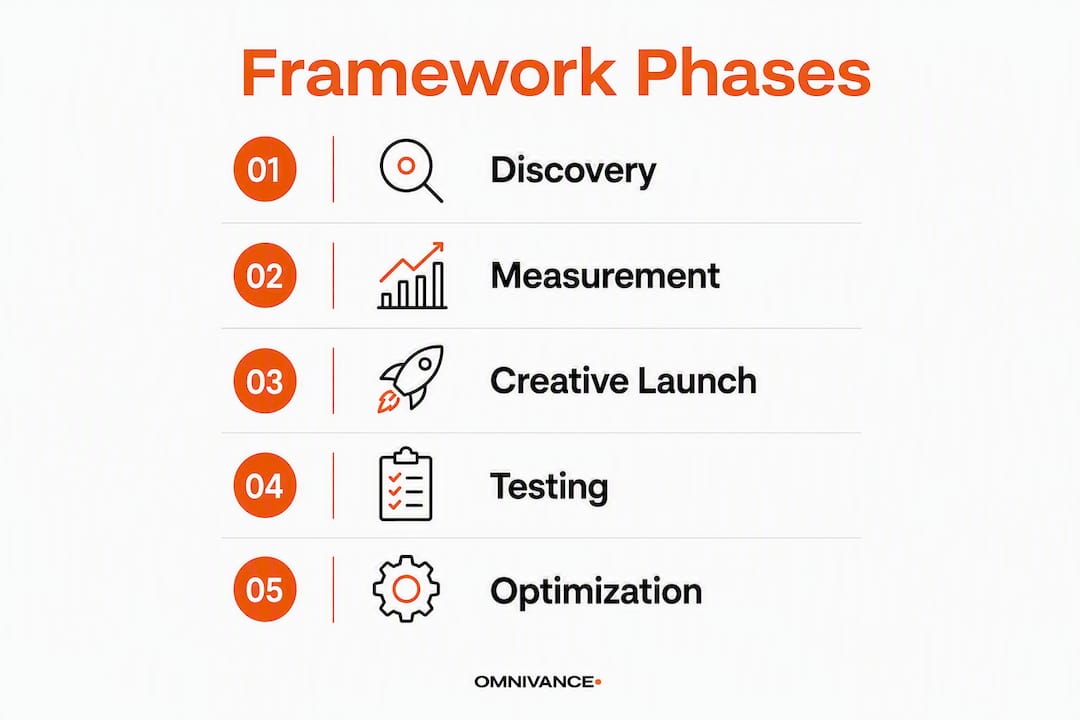
Phase 1: Discovery and economics validation (weeks 1–4) Audit existing data, define CAC and LTV targets, map the funnel, and identify the highest-leverage channel for initial testing. Validate product-market fit and social proof before committing to paid scale.
Phase 2: Measurement and tagging (weeks 3–6) Implement server-side tracking, deploy conversion APIs, standardize UTMs, and define the event taxonomy. Nothing moves forward until the measurement layer is confirmed.
Phase 3: Creative matrix and launch (weeks 5–10) Build a creative testing matrix: at least three to five creative concepts per audience segment, each with a defined hypothesis. Launch with controlled budgets.
Phase 4: Disciplined testing cadence (weeks 8–16) Run structured A/B tests with defined success criteria. Moving from monthly to weekly optimization cycles can improve performance by 3–4x, based on data from over 30,000 marketing engagements. Weekly cadence is the standard.
Phase 5: Optimization and scale (month 4 onward) Reallocate budget to validated channels and creative. Introduce automation for bidding and budget management. Expand to secondary channels only after primary channels are profitable.
| Milestone | Timeline | Expected outcome |
|---|---|---|
| Economics validated, measurement live | Day 30 | CAC target set, tracking confirmed, baseline MER established |
| First creative matrix tested | — | Winning concept identified, initial ROAS data available |
| Weekly optimization cadence running | Day 90 | Performance improving week-over-week, kill rules in place |
| Scale phase begins | — | Profitable primary channel, secondary channel tests underway |
Cost bands (high-level)
Discovery and measurement setup typically runs $5,000–$15,000 as a project. Monthly management for a mid-market program (media plus management) commonly ranges from $8,000–$25,000 depending on channel count and creative volume. Creative production for a testing program adds $3,000–$10,000 per month. These are directional ranges; actual costs vary by market, category, and scope.
Governance rules
- Kill rule: Pause any ad set that spends 2x target CPA without a conversion
- Scale trigger: Increase budget by 20% when ROAS exceeds target by 15% for two consecutive weeks
- Optimization cadence: Weekly review of channel MER, creative performance, and audience overlap
- Budget reallocation: Shift spend from underperforming channels to overperforming ones monthly, not quarterly
What technology stack does a modern performance framework require?
The stack doesn't need to be expensive. It needs to be connected. Data that can't flow between systems creates blind spots that cost more than any tool subscription.
Core tool categories:
- Creative ops and DCO: Smartly.io, Pencil, or AdCreative.ai for dynamic creative testing and variation at scale; see AI tools for marketing automation for a broader category view
- CRM and activation: — HubSpot, Salesforce, or Klaviyo for audience building, lifecycle automation, and CRM-matched ad audiences
A common integration pattern: conversion events fire server-side → captured in the analytics layer → synced to the CDP → matched against CRM records → pushed as custom audiences to ad platforms. That loop closes the gap between ad exposure and actual customer data.
When selecting tools, prioritize four criteria: first-party data ownership (you control the data, not the vendor), API access for custom integrations, native automation features that reduce manual work, and vendor lock-in risk. A tool that owns your audience data or makes export difficult is a liability at scale.
The AI marketing implementation checklist covers how to sequence tool adoption and integration for teams building this stack from scratch.
What do real performance framework results look like?
Two examples from Omnivancemedia's client work illustrate what a properly built framework produces, and how success was measured.
HVAC contractor: $340K in new contracts in 90 days
The challenge was a regional HVAC contractor with no digital measurement infrastructure and inconsistent lead quality from a mix of directory listings and occasional paid search. Omnivancemedia implemented server-side conversion tracking, built a Google Ads search campaign targeting high-intent service queries, and deployed a Meta retargeting layer for website visitors who hadn't converted.
Measurement methodology: inbound calls and form submissions were tracked as primary conversion events, with call recording used to qualify lead quality. Revenue was attributed by matching closed contracts in the CRM against the originating campaign and keyword.
Result: $340,000 in new signed contracts within 90 days of framework launch. CAC was tracked weekly against the contractor's average contract value, confirming a positive LTV-to-CAC ratio from week six onward.
E-commerce brand: $80K to $420K monthly revenue
An e-commerce client was running disconnected paid social and email campaigns with no unified attribution. Monthly revenue had plateaued at $80K. Omnivancemedia consolidated tracking into a single source of truth, built a creative testing matrix across Meta and Google Shopping, and introduced a weekly optimization cadence with defined kill rules and scale triggers.
Measurement methodology: MER was the north-star metric, reviewed weekly. Platform ROAS was tracked per channel but decisions were made on MER, not platform-reported numbers. Creative performance was scored by cost-per-purchase and thumb-stop rate.
Result: Monthly revenue grew from $80,000 to $420,000. The creative testing program identified three winning concepts that drove the majority of incremental revenue, with the optimization cadence catching and reallocating budget from underperformers within days rather than weeks.
What are the most common performance marketing mistakes, and how do you avoid them?
Most programs fail for the same reasons. The mistakes aren't exotic — they're structural.
Top mistakes:
- Treating performance marketing as media buying only. Buying clicks is not a framework. Without business economics, measurement, and creative systems, media buying is just spend.
- Scaling before validating economics. Launching aggressive paid spend into an unvalidated funnel maximizes CAC and minimizes conversion confidence. Validate first, then scale.
- Under-investing in creative testing. Creative is the primary performance variable in paid social. Programs that run one or two creative concepts and never refresh them plateau quickly.
- Ignoring governance. Without kill rules and optimization cadences, budget drifts to underperformers and winners get starved. Ad-hoc tweaks consistently underperform standardized protocols.
- Optimizing platform metrics instead of business metrics. A campaign can show strong platform ROAS while MER is declining. Always reconcile platform data against actual revenue.
Best practices:
- Run a minimum of three to five creative concepts per test, with a defined hypothesis for each
- Set kill rules before launch, not after a campaign underperforms
- Review MER weekly, not monthly
- Separate prospecting and retargeting budgets so neither cannibalizes the other
- Allocate 10–20% of budget to CRO alongside acquisition spend
Pro Tip: Build a creative brief template that includes the audience, the core message, the proof point, and the call to action. Briefs without those four elements produce creative that can't be tested against a hypothesis.
Pro Tip: Sequence your tests: start with audience, then offer, then creative format, then copy. Testing everything simultaneously makes it impossible to know what moved the needle.
What are your immediate next steps to implement a performance framework?
Three actions before anything else:
- Validate your economics. Write down your target CAC, your average LTV, and your current MER. If you don't have these numbers, your first project is pulling them from your CRM and ad platform data.
- Lock your measurement layer. Audit your tracking setup. Confirm server-side events are firing, conversion APIs are connected, and UTMs are consistent. Fix gaps before spending another dollar.
- Run an initial creative test matrix. Brief three to five creative concepts against your highest-intent audience. Set a defined budget, a defined run time, and defined success criteria before launch.
Implementation scoping checklist
| Workstream | Deliverable | Timeline |
|---|---|---|
| Discovery and economics | CAC/LTV model, MER baseline, funnel audit | Weeks 1–3 |
| Measurement and tagging | Server-side tracking, conversion APIs, UTM taxonomy, event taxonomy | Weeks 3–6 |
| Creative program | Brief template, initial test matrix (3–5 concepts), production schedule | Weeks 4–8 |
| Channel launch | Campaign structure, audience segments, budget allocation, kill rules | Weeks 6–10 |
| Ongoing management | Weekly optimization cadence, monthly MER review, quarterly channel audit | Month 3 onward |
When briefing an agency or internal team, use these SOW bullets as your scope baseline:
- Discovery: Funnel audit, economics validation, competitive channel analysis, measurement gap assessment
- Measurement setup: Server-side tracking implementation, conversion API configuration, UTM standardization, reporting dashboard build
- Creative program: Brief development, concept production, A/B test design, creative performance scoring system
- Month-to-month management: Weekly optimization, creative refresh cadence, MER reporting, budget reallocation recommendations, quarterly strategy review
For evaluating agency partners, the digital advertising company selection framework covers the criteria that separate capable partners from expensive ones.
Key Takeaways
A performance marketing framework is a repeatable, measurement-first system that connects marketing spend to business outcomes through defined economics, channel architecture, creative testing, and weekly optimization governance.
| Point | Details |
|---|---|
| Framework vs. campaign | A framework is a continuous operating system; a campaign is a one-off tactic that ends. |
| Validate before you scale | Lock CAC targets, LTV bands, and MER thresholds before committing to paid media spend. |
| Measurement must come first | Server-side tracking, conversion APIs, and UTM hygiene must be in place before aggressive scaling. |
| Weekly cadence outperforms monthly | Moving to weekly optimization cycles can improve performance by 3–4x, based on data from over 30,000 marketing engagements. |
| Omnivancemedia's integrated approach | Omnivancemedia combines paid ads, CRM automation, creative production, and AI-driven reporting into one framework, with verified results including $340K in 90 days for an HVAC contractor. |
Why AI is the control layer your performance framework can't skip
The conventional wisdom says AI is a nice-to-have for performance marketing. That's wrong, and the gap between teams that treat it as optional and those that embed it as infrastructure is widening fast.

Modern auction environments on Google, Meta, and programmatic DSPs operate at a speed and complexity that manual workflows simply can't match. Bid signals shift minute-to-minute. Budget reallocation decisions that take a human analyst a day to process need to happen in hours or less. AI-driven budget reallocation and real-time bidding aren't future capabilities — they're the current baseline for competitive programs.
What most guides miss is that AI's value in a performance framework isn't just speed. It's the ability to hold more variables simultaneously than any analyst can. Creative performance, audience saturation, bid landscape shifts, and conversion signal quality are all moving at once. An AI-enabled control layer tracks all of them and surfaces decisions; a human team acts on those decisions and sets the strategic guardrails.
Privacy changes compound this. As third-party signals degrade, the measurement layer needs to model more and observe less. That requires AI-assisted attribution, modeled conversions, and first-party data pipelines that most teams haven't built yet. The organizations that invest in that infrastructure now will have a structural advantage as signal loss accelerates.
Organizational readiness matters as much as the technology. Teams need defined processes, clean data, and the discipline to act on system recommendations rather than override them based on gut feel. The AI is only as good as the framework it operates within.
Omnivancemedia builds performance frameworks that produce verifiable results
Most businesses that come to Omnivancemedia have the same problem: they're spending on paid media without a framework underneath it. No MER baseline, no creative testing system, no governance. The spend grows; the results don't.
Omnivancemedia's integrated approach combines paid search and social advertising, CRM automation, creative production, and AI-powered reporting into a single system built around your business economics. Not isolated services from separate vendors — one connected framework designed to produce measurable revenue.
The proof is in the results: an HVAC contractor secured substantial new contracts within a few months. An e-commerce client increased monthly revenue substantially after Omnivancemedia rebuilt their measurement layer and creative testing program. Both results were tracked against defined CAC targets and MER benchmarks, not platform vanity metrics.
The starting point is a measurement health check: Omnivancemedia audits your current tracking setup, establishes your MER baseline, and delivers a prioritized roadmap of what to fix first. From there, the full services portfolio covers everything from initial framework build to ongoing weekly optimization. If you're ready to replace ad spend with a system, request your audit and get a clear picture of where your framework stands today.
Useful sources and further reading
| Resource | What it covers |
|---|---|
| Performance Marketing Framework: How to Build a System That Scales | Practitioner-level framework guide covering objective setting, channel sequencing, and optimization governance |
| Performance Marketing: The Complete Practitioner's Guide | Comprehensive definition, channel roles, and the 4-channel growth sequencing model |
| Performance Marketing Strategy: How to Build One That Drives Results | Optimization cadence data, creative testing standards, and governance protocols |
| 10 High-Impact Performance Marketing Strategies | DCO, incrementality testing, and CRO as scaling levers |
| How to Do Performance Marketing: A 2026 Playbook | Server-side tracking, conversion APIs, and AI automation requirements |
| Cookieless Analytics: A Privacy-First Guide for 2026 | Adapting attribution and tracking to a post-cookie environment |
| What is Performance Marketing? — Adobe | Foundational definition and channel overview |
| Marketing Mix and the 4 Ps — Salesforce | Situating performance tactics within product and pricing strategy |
| AI Marketing Implementation Checklist — Omnivancemedia | Step-by-step guide to integrating AI and automation into a performance stack |
| Why First-Party Data Powers AI Marketing — Omnivancemedia | First-party data strategy for attribution, audience building, and signal durability |