What Is Legal Digital Advertising? 2026 Compliance Guide

Legal digital advertising is the practice of creating and distributing online ads that fully comply with applicable laws, regulations, and ethical standards. The industry term for this discipline is "advertising law compliance," and it covers everything from user consent and data privacy to platform verification and disclosure requirements. Frameworks like the GDPR, the FTC guidelines, and the UK's PECR set the legal floor for every campaign you run. Regulators including the ICO and the FTC actively enforce these rules, and penalties for violations can be severe. Understanding what is legal digital advertising is no longer optional for businesses, marketers, or legal professionals.
What key regulations govern legal digital advertising?
Digital advertising regulations fall into three overlapping categories: data privacy law, consumer protection law, and platform-specific policy. Each category carries its own compliance requirements, and most campaigns must satisfy all three simultaneously.
Data privacy law is the most complex layer. The GDPR requires explicit user consent before collecting behavioral data for ad targeting across the EU. The UK's PECR mirrors many GDPR consent requirements for electronic communications. The ePrivacy Directive adds rules for cookies and tracking pixels. Violating any of these can trigger regulatory investigations and significant fines.

Consumer protection law governs what you say in your ads. The FTC requires that all advertising claims be truthful, substantiated, and non-deceptive. Paid placements must be clearly labeled as ads. Testimonials must reflect genuine experiences. These rules apply to Google Ads, Meta campaigns, and any other paid digital channel.
The Digital Services Act (DSA) is the newest major framework. The DSA classifies ad networks as platforms, requiring transparency, user complaint mechanisms, and out-of-court dispute settlement for illegal content in ads. That classification matters because it extends accountability beyond the advertiser to the network itself.
Jurisdictional complexity is a real operational challenge. A campaign targeting users in the EU, UK, and United States must satisfy GDPR, PECR, and FTC rules at the same time. Cross-border campaigns require legal review before launch, not after.
Pro Tip: Map your audience geography before building any campaign. Knowing which jurisdictions apply lets you set consent requirements and disclosure language correctly from day one.
As of may 2026, the UK ICO proposes allowing low-risk online advertising without user consent under PECR while still requiring consent for behavioral targeting and profiling. That distinction between contextual ads and behavioral ads is becoming a critical compliance line for UK marketers.
How do major platforms regulate advertising content and targeting?
Platform policies add a second compliance layer on top of the law. Google Ads, Meta, and Microsoft Advertising each publish their own advertising policies, and violating them can result in account suspension regardless of whether you broke any law.
The most striking recent development involves AI platforms. OpenAI bans advertising for legal services on ChatGPT as of april 2026. Google AI and Microsoft Copilot accept legal ads but impose strict verification and disclosure requirements. That split means legal professionals must choose their AI advertising channels carefully.
| Platform | Legal Ads Allowed | Key Requirements |
|---|---|---|
| ChatGPT (OpenAI) | No | Banned as of april 2026 |
| Google AI | Yes | Verification, disclosure, archive retention |
| Microsoft Copilot | Yes | Verification, ethics alignment, disclosure |
| Google Ads | Yes | License verification for regulated categories |
| Meta Ads | Yes | Special ad category rules, no discriminatory targeting |
Session-aware targeting on AI platforms creates a specific legal risk. Session-aware targeting risks crossing into active solicitation, which violates ethics rules like ABA Model Rule 7.3. The rule prohibits direct solicitation of prospective clients in real time. An ad that responds to a user's live query about a legal problem can look less like advertising and more like solicitation.
For law firms and regulated industries, the ad targeting options available across platforms vary significantly by category. Understanding which targeting methods each platform permits for your industry is a prerequisite for any compliant campaign.
- Google Ads requires license verification for legal, financial, and healthcare advertisers.
- Meta prohibits targeting based on sensitive characteristics including health conditions and legal history.
- Microsoft Advertising requires disclosure labels on all AI-assisted ad placements.
- All major platforms maintain ad archives that regulators can access for compliance review.
What are the ethical and transparency requirements in digital ads?
Ethical compliance in digital advertising goes beyond avoiding fines. It protects your brand reputation and your clients' trust. The FTC and ABA Model Rule 7.1 both require that advertising claims be accurate and non-misleading. Rule 7.1 specifically prohibits false or misleading communications about a lawyer's services.
Disclosure and transparency of paid ads are critical under FTC rules and DSA obligations. Every paid placement must be clearly labeled. Sponsored content that looks like editorial content without a disclosure label violates FTC guidelines and can trigger enforcement action.
Client confidentiality is a separate ethical obligation that intersects with advertising. Retargeting campaigns that use client data, case details, or sensitive intake information as audience signals can breach attorney-client privilege and professional conduct rules. Legal professionals must audit their CRM and ad platform data connections before running any retargeting campaign.
The DSA adds a structural transparency requirement for platforms. Ad networks must comply with obligations for transparency, trusted flaggers, and mitigation of systemic risks. Users must be able to flag illegal ad content, and platforms must provide accessible complaint mechanisms. Advertisers who run campaigns on DSA-regulated platforms benefit from knowing these mechanisms exist, because they can also be used against non-compliant ads.
Pro Tip: Run a quarterly disclosure audit. Pull your top 20 ads and verify that every paid placement carries a visible "Sponsored" or "Ad" label. Regulators treat missing disclosures as willful violations, not oversights.
The Digital Omnibus proposal aims to centralize user consent at the browser level to reduce consent fatigue. That approach could simplify compliance for advertisers but may favor large platforms over smaller publishers. Marketers should monitor this proposal closely because it could change how consent is collected and documented across all campaigns.
What practical steps ensure compliant digital advertising campaigns?
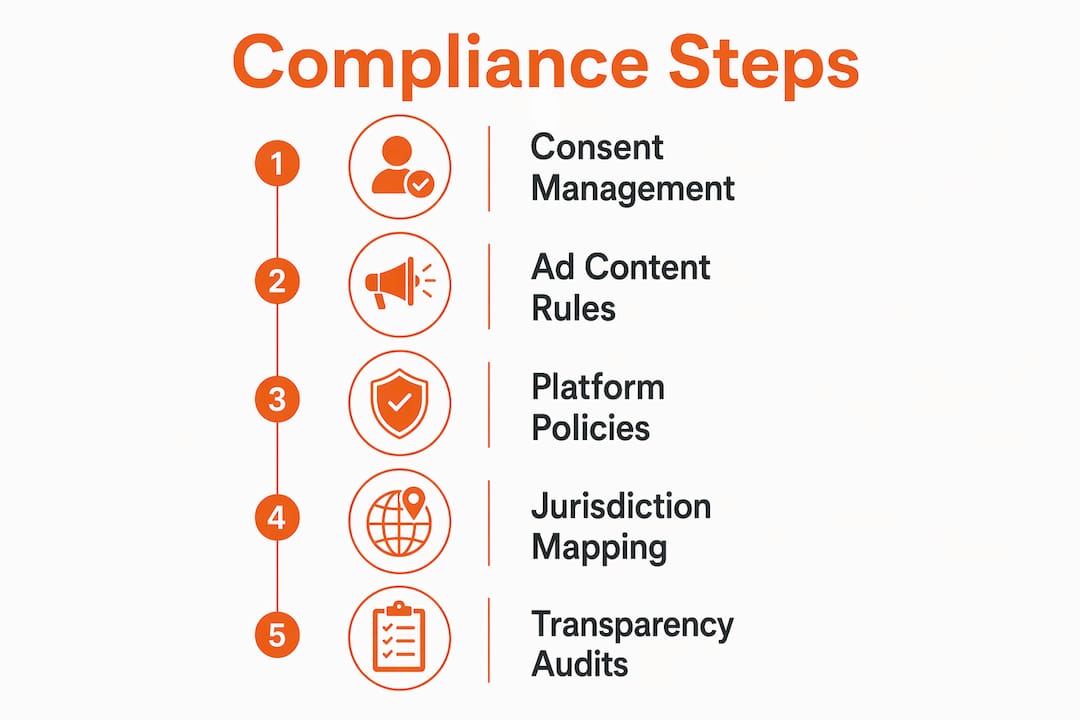
Compliance is an operational system, not a one-time checklist. Businesses that treat it as a process rather than a project avoid the reactive scrambles that follow regulatory changes.
- Conduct a quarterly compliance review. Audit active campaigns against current GDPR, PECR, FTC, and DSA requirements. Regulations update frequently, and a campaign that was compliant six months ago may not be today.
- Assign senior accountability for ad approval. Financial and legal professionals can delegate ad approval duties under regulations, but senior management remains ultimately accountable for compliance. Document who approved each campaign and when.
- Implement consent or pay models for behavioral advertising. Consent or pay models help publishers obtain legally valid consent for behavioral advertising. This approach satisfies GDPR requirements while preserving revenue from users who decline tracking.
- Restrict targeting methods to platform-approved options. Avoid any targeting signal that relies on sensitive personal data. Use contextual targeting as your default and layer behavioral targeting only where consent is confirmed.
- Maintain ad archives and records. Google Ads and Meta both retain ad archives for regulatory review. Keep your own internal records of ad copy, targeting parameters, and approval documentation for at least two years.
| Compliance Area | Required Action | Responsible Party |
|---|---|---|
| Consent management | Implement GDPR-compliant consent banners | Marketing team |
| Ad disclosures | Label all paid placements clearly | Creative and legal review |
| Targeting restrictions | Audit audience segments quarterly | Campaign manager |
| Archive retention | Store ad records for minimum two years | Compliance officer |
| Senior accountability | Document approval chain for each campaign | Senior management |
AI-driven campaign design requires additional care. Microsoft Copilot and similar platforms require careful campaign design to avoid real-time solicitation that conflicts with ethics guidance. Build your AI ad campaigns around passive awareness, not responsive targeting triggered by live user queries.
Key Takeaways
Legal digital advertising requires simultaneous compliance with data privacy law, consumer protection rules, platform policies, and professional ethics codes.
| Point | Details |
|---|---|
| Regulatory layers stack | GDPR, PECR, FTC rules, and DSA obligations all apply at once to most campaigns. |
| Platform policies vary | OpenAI bans legal service ads; Google AI and Microsoft Copilot allow them with strict requirements. |
| Consent is non-negotiable | Behavioral targeting requires explicit user consent; contextual ads may qualify for lower-risk treatment. |
| Senior accountability applies | Management can delegate ad approval but remains legally responsible for compliance outcomes. |
| Transparency is mandatory | All paid placements must carry clear disclosures under FTC rules and DSA obligations. |
The compliance gap most marketers miss
The most common mistake I see is treating compliance as a legal department problem rather than a marketing operations problem. By the time legal reviews a campaign, it has already been built on targeting logic, data sources, and creative claims that may be non-compliant. Fixing it at that stage is expensive and slow.
The smarter approach is to build compliance into the campaign brief. Before you write a single ad, answer three questions: What data are you using to target this audience? What claims are you making in the ad? What disclosure language does the platform require? Those three questions catch the majority of compliance failures before they happen.
The rise of AI advertising platforms makes this even more pressing. Session-aware retargeting on AI platforms can inadvertently breach ethics rules by becoming active solicitation rather than passive advertising. Most marketers building AI campaigns do not realize they are operating near that line until a complaint surfaces.
Proactive compliance also pays commercially. Advertisers with clean compliance records face fewer account suspensions, faster ad approvals, and stronger platform relationships. The DSA's platform rules increase accountability of adtech companies, which means platforms are now motivated to flag non-compliant advertisers before regulators do. Being on the right side of that process is a competitive advantage.
— laya
How Omnivancemedia builds compliant, high-performance ad campaigns
Running ads that convert and stay compliant is harder than most agencies admit. Omnivancemedia builds paid advertising campaigns that satisfy GDPR, FTC, and platform-specific requirements from the first brief, not as an afterthought. Every campaign includes consent-aligned targeting, verified disclosure language, and documented approval workflows.

Omnivancemedia works with businesses in regulated industries including law firms, healthcare providers, and financial services, where advertising law requirements are strictest. The team combines multi-channel paid advertising across Google, Meta, and Microsoft with compliance documentation that holds up to regulatory review. If you are ready to run ads that perform without the legal exposure, explore the full range of digital marketing services Omnivancemedia offers.
FAQ
What is legal digital advertising?
Legal digital advertising is the practice of running online ads that comply with data privacy laws, consumer protection regulations, and platform policies. It requires user consent for behavioral targeting, clear disclosure of paid placements, and accurate advertising claims.
What laws apply to digital advertising in the United States?
The FTC Act governs truthfulness and disclosure requirements for all digital ads in the United States. Additional laws apply by industry, including HIPAA for healthcare and specific state privacy laws like the California Consumer Privacy Act.
Do GDPR rules apply to American businesses?
GDPR applies to any business that targets or processes data from EU residents, regardless of where the business is based. American companies running ads to European audiences must meet GDPR consent and data processing requirements.
What is the difference between contextual and behavioral advertising?
Contextual advertising targets users based on the content of the page they are viewing, without tracking personal data. Behavioral advertising uses personal data and browsing history to target individuals, which requires explicit user consent under GDPR and PECR.
Can law firms advertise on AI platforms like ChatGPT?
OpenAI currently bans legal services advertising on ChatGPT. Google AI and Microsoft Copilot permit legal ads with verification, disclosure requirements, and restrictions on session-aware targeting that could constitute active solicitation under ABA Model Rule 7.3.