What Is an Omnichannel Marketing Stack? 2026 Guide

An omnichannel marketing stack is defined as the connected set of software layers and data tools that deliver a unified customer experience across every channel a business operates. This includes websites, email, SMS, mobile apps, social media, and physical stores. Unlike a simple collection of marketing tools, a true omnichannel stack integrates those channels so customer data, messaging, and behavior signals flow between them in real time. Platforms like Adobe Campaign, Hygraph, and Shopify each represent different layers within this ecosystem. The result is a customer experience that feels continuous, not fragmented, regardless of where or how someone interacts with your brand.
What is an omnichannel marketing stack and how does it work?
An omnichannel marketing stack is the technology ecosystem that connects your marketing channels into one unified customer journey. It is not just about being present on multiple platforms. It is about making those platforms share data, context, and messaging so every interaction builds on the last. A customer who browses your website, abandons a cart, and then receives a relevant SMS reminder is experiencing a functioning omnichannel stack in action.
The stack works through four connected layers. Each layer has a distinct job, and the quality of the connections between them determines whether the stack actually delivers a unified experience or just creates a more expensive version of channel silos.
- Customer Data Platform (CDP): The CDP collects and unifies customer data from every source into a single profile. Tools like Segment or Salesforce Data Cloud pull together web behavior, purchase history, email engagement, and in-store transactions into one record.
- Integration layer: APIs and middleware synchronize data changes across systems in real time. When a customer makes a purchase in a physical store, the integration layer updates the CRM, the email platform, and the loyalty program simultaneously.
- Engagement and orchestration layer: This is where campaigns execute. Platforms like Adobe Campaign or Klaviyo use the unified data to trigger personalized messages across email, SMS, push notifications, and paid ads based on customer behavior.
- Systems of record: CRM, commerce platforms like Shopify, point-of-sale systems, and loyalty platforms store the core business data that feeds every other layer.
Pro Tip: Build the CDP layer first. Adding engagement tools before you have unified customer profiles means every campaign runs on incomplete data, which produces inconsistent experiences no matter how good the execution tools are.
How does omnichannel differ from multichannel marketing?

Omnichannel strategies unify online and offline channels to create continuous brand experiences. Multichannel strategies run channels independently, each with separate messaging and separate data. The difference sounds subtle but produces dramatically different customer outcomes.
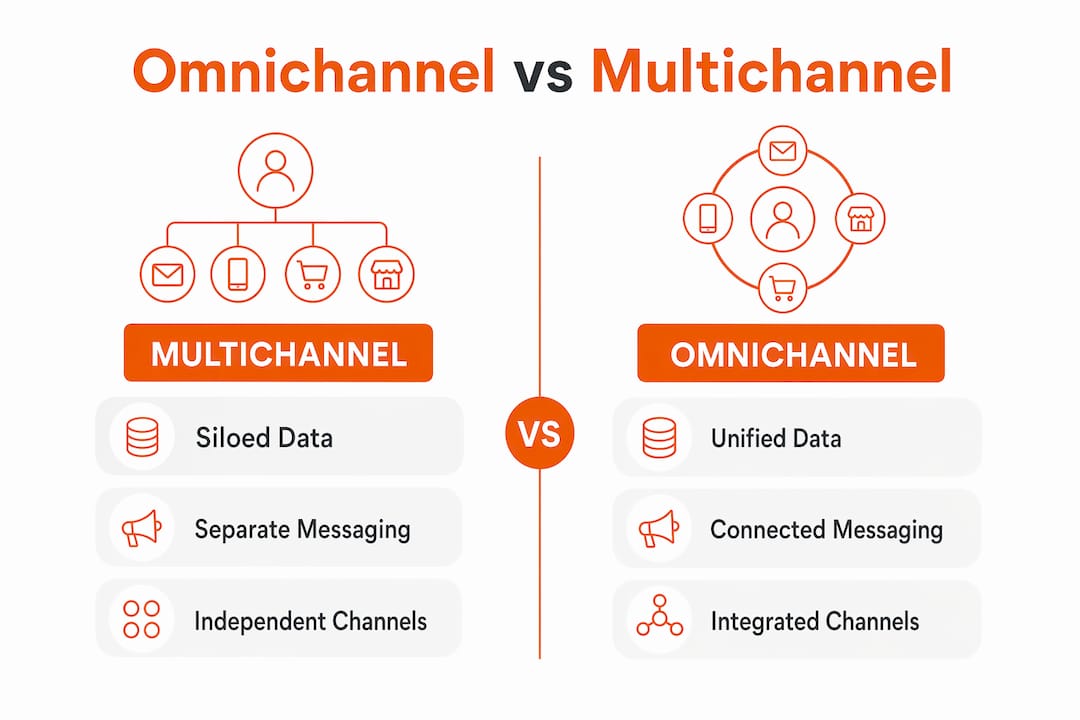
| Factor | Multichannel | Omnichannel |
|---|---|---|
| Data sharing | Siloed per channel | Unified across all channels |
| Customer view | Fragmented by touchpoint | Single profile across touchpoints |
| Messaging | Independent per channel | Consistent and context-aware |
| Trigger logic | Manual or channel-specific | Behavior-driven and cross-channel |
| Customer experience | Disjointed | Continuous and personalized |
A retailer running multichannel marketing might send a promotional email and run a Facebook ad with no connection between them. The customer who already purchased from the email still sees the ad for the same product. An omnichannel stack eliminates that disconnect. The purchase event updates the customer profile, suppresses the ad, and triggers a follow-up message about complementary products instead. That is the practical difference between the two approaches.
The customer-centric view that defines omnichannel also changes how teams measure success. Multichannel teams often optimize each channel in isolation, which creates internal competition for credit. Omnichannel teams measure the full customer journey, which aligns incentives around revenue and loyalty rather than channel-level metrics.
What business benefits come from an omnichannel marketing stack?
The revenue case for omnichannel is well-documented. Omnichannel customers spend 1.5 times more than single-channel buyers and are three times more loyal. That loyalty gap compounds over time because a retained customer costs far less to serve than an acquired one.
The financial impact extends beyond individual customer value. Improving cross-channel experiences can raise sales revenue by 2%–7% and profitability by 1%–2%. Those numbers reflect the combined effect of better personalization, reduced cart abandonment, and more efficient ad spend when channels share data.
Specific benefits include:
- Higher customer lifetime value: Unified profiles let you identify high-value customers early and invest in retention before they churn.
- Better campaign performance: Behavior-triggered messages outperform batch-and-blast campaigns because they reach customers at the right moment with relevant content.
- Reduced ad waste: When your CRM and ad platforms share data, you stop spending money showing acquisition ads to existing customers.
- Faster response to customer signals: Real-time data sync means a support ticket can suppress a promotional campaign automatically, preventing tone-deaf outreach during a service issue.
Retail businesses see some of the clearest gains. Digital marketing for retail that integrates in-store and online data consistently produces higher repeat purchase rates than channel-isolated approaches. The same principle applies to SaaS companies, where product usage data fed into the marketing stack enables lifecycle campaigns that reduce churn and expand accounts.
How to implement an omnichannel marketing stack
Implementation follows a clear sequence. Skipping steps or starting with the wrong layer is the most common reason omnichannel projects stall after the initial tool purchase.
- Build the unified data layer first. Select a CDP and connect every data source to it before touching engagement tools. Unified customer profiles must exist before any personalization or journey orchestration can function correctly.
- Map your integration architecture. Identify every system that holds customer data: your CRM, e-commerce platform, POS, loyalty program, and support tools. Document how data needs to flow between them and select middleware or native APIs that can handle real-time sync.
- Connect your CRM to marketing activities. CRM integration links marketing actions to sales outcomes, giving you full visibility into which campaigns drive revenue and which ones generate clicks that never convert.
- Select engagement and orchestration tools. Adobe Campaign, Klaviyo, and Braze each handle cross-channel orchestration differently. Choose based on the channels your customers actually use, not the channels your team is most comfortable with.
- Implement the measurement loop. Omnichannel automation works as a continuous cycle: collect data, unify profiles, trigger journeys, select the right channel, send, measure, and improve. Build this loop into your operations from day one, not as an afterthought.
- Adopt a composable architecture. Composable omnichannel stacks built with best-of-breed tools connected through APIs give you the flexibility to swap components as your needs evolve without rebuilding the entire stack.
Pro Tip: Avoid the trap of buying an all-in-one suite to simplify integration. Suites often trade flexibility for convenience, and you will eventually hit a ceiling on personalization or channel coverage that requires expensive workarounds.
Common pitfalls include starting with the engagement layer before the data layer is ready, underinvesting in the integration middleware, and treating the stack as a one-time project rather than an evolving system. The marketing technology stack requires ongoing governance as your channel mix and customer base change.
Key Takeaways
An omnichannel marketing stack succeeds when integration quality and unified data come before tool selection and campaign execution.
| Point | Details |
|---|---|
| Definition is specific | An omnichannel stack integrates channels through shared data, not just presence on multiple platforms. |
| CDP comes first | Build unified customer profiles before adding engagement or orchestration tools. |
| Omnichannel beats multichannel | Omnichannel customers spend 1.5 times more and are three times more loyal than single-channel buyers. |
| Integration quality matters most | APIs and middleware that sync data in real time are what separate a true omnichannel stack from a tool collection. |
| Composable architecture wins | Best-of-breed tools connected through APIs give more flexibility than all-in-one suites over time. |
Why integration depth matters more than tool count
The most common mistake I see marketing teams make is treating their omnichannel stack as a shopping list. They buy a CDP, a marketing automation platform, a CRM, and a paid media tool, then declare the stack complete. Six months later, the data is still siloed because nobody invested in the integration layer that makes those tools actually talk to each other.
Customer expectations in 2026 are set by the best experience they have ever had, not the average. When Amazon knows what you browsed and follows up with a relevant recommendation within hours, that becomes the baseline. A brand that sends a promotional email for a product the customer already bought looks careless by comparison. The integration quality between your tools determines whether you clear that bar or fall below it.
I have also seen teams overcorrect by chasing every new channel before the core stack is stable. Adding TikTok ads or connected TV to a stack that cannot share data between email and CRM just creates more noise. The right sequence is always: unify the data, stabilize the integrations, then expand the channel mix. A smaller stack that works is worth more than a large stack that fragments.
The shift toward composable architectures is the right direction for any business planning to grow. Vendor lock-in is a real cost that shows up when your business needs change and your all-in-one suite cannot keep up. Best-of-breed tools with clean APIs give you the ability to upgrade individual components without rebuilding everything. That flexibility compounds in value as your customer base and channel mix evolve.
— laya
How Omnivancemedia builds omnichannel stacks that actually perform
Omnivancemedia works with businesses that are done patching together disconnected tools and ready to build a marketing system where every channel shares data and every campaign responds to real customer behavior. The team combines CRM setup and marketing automation with paid channel management and SEO into one integrated program, not a set of isolated services. Omnivancemedia has helped an e-commerce client grow monthly revenue from $80,000 to $420,000 by connecting the data and execution layers that most agencies leave separate. Whether you operate in retail, SaaS, or professional services, the approach is the same: unified data first, then execution at scale.
FAQ
What is the definition of an omnichannel marketing stack?
An omnichannel marketing stack is the connected set of software and data tools that deliver a unified customer experience across channels like email, SMS, social media, and physical stores. It integrates those channels through shared data rather than running them independently.
What are the core components of an omnichannel stack?
The four core layers are a customer data platform, an integration middleware layer, an engagement and orchestration platform, and systems of record like CRM and commerce tools. Each layer depends on the others to function correctly.
How does omnichannel marketing differ from multichannel marketing?
Multichannel marketing runs each channel independently with separate data and messaging. Omnichannel marketing connects those channels so customer data, context, and messaging are consistent across every touchpoint.
Which tools are commonly used in an omnichannel marketing stack?
Common tools include Segment or Salesforce Data Cloud for CDP, Adobe Campaign or Klaviyo for orchestration, Shopify for commerce, and middleware platforms for API integration. The right combination depends on your channel mix and data volume.
Where should a business start when building an omnichannel stack?
Start with a single customer data platform to unify all customer profiles before adding engagement or automation tools. Building the data layer first prevents the personalization failures that come from running campaigns on incomplete or siloed data.