What Is AI-Driven Marketing? A 2026 Guide

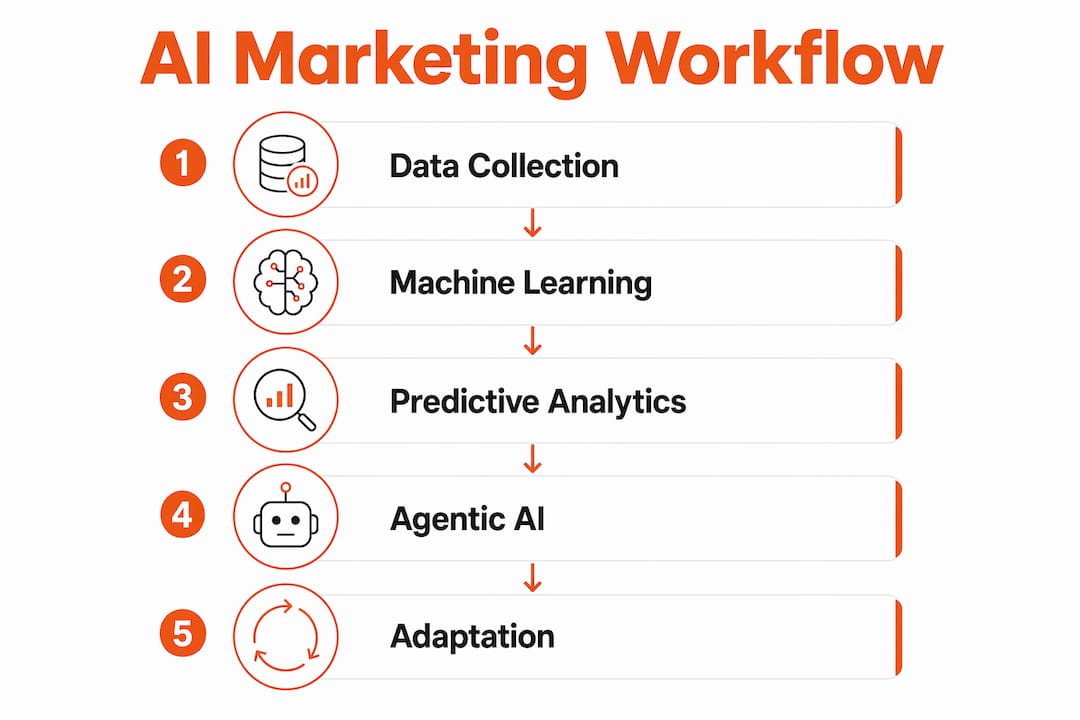
AI-driven marketing is the application of machine learning, predictive analytics, and autonomous AI agents to automate, personalize, and continuously optimize marketing execution at scale. The industry term for this practice is "AI-powered marketing," though both phrases describe the same fundamental shift: marketing moving from discrete campaigns to a connected, adaptive operating system that learns and adjusts in real time. For marketing professionals and business owners, understanding what is AI-driven marketing means understanding how AI replaces manual guesswork with data-driven decisions across every channel, every hour of the day.
What is AI-driven marketing and how does it work?
AI-driven marketing is defined as the use of AI technologies to predict, automate, and personalize marketing decisions faster and more accurately than human teams can manage alone. AI-driven systems predict the optimal timing, message, and channel for each user at speeds that no human team can match. That speed advantage compounds over time, creating a widening performance gap between businesses using AI and those still relying on manual campaign management.
Three core technologies power this approach. Machine learning analyzes historical data to find patterns and improve predictions without being explicitly reprogrammed. Predictive analytics uses those patterns to forecast customer behavior, such as which leads are most likely to convert this week. Natural language processing (NLP) enables AI to read, write, and interpret human language, making it possible to generate ad copy, analyze customer reviews, and power chatbots at scale.

The fourth and most significant technology entering marketing in 2026 is agentic AI. Agentic AI refers to autonomous software agents that can plan, execute, and adjust multi-step marketing tasks without waiting for human approval at each step. Think of an agent that monitors your paid search performance, identifies a drop in conversion rate, adjusts bid strategy, and generates new ad copy, all within the same hour. Competitive advantage now requires unified, connected AI systems rather than isolated experiments.
The critical distinction between old-school marketing automation and true AI-driven marketing is adaptability. Static automation follows fixed rules: "If a user opens an email, send a follow-up in three days." AI-driven systems rewrite those rules continuously based on what the data shows is actually working. That shift from rule-following to pattern-learning is what makes AI-driven marketing a fundamentally different category.
Pro Tip: When evaluating any AI marketing platform, ask whether it adapts its models based on new data or simply executes pre-set rules. Adaptive systems improve over time; rule-based systems plateau.
How does AI reshape marketing workflows and team roles?
The most disruptive impact of AI on marketing is not a new tool. It is a structural change in how marketing functions operate. Marketing is evolving from a series of campaign-based projects into a continuous operating system that integrates insights, content creation, and performance management around the clock. That shift changes what every person on a marketing team actually does each day.
CMO and director-level roles are changing the most. Leaders who once spent time approving individual creative outputs now focus on defining brand standards and setting the guardrails that govern AI-driven workflows. CMOs are evolving into orchestrators of AI-enabled execution rather than managers of individual deliverables. This requires a different skill set: systems thinking, governance design, and the ability to define what "on-brand" means in a way that an AI agent can actually follow.
At the team level, hybrid human-agentic workforces are becoming the standard model. One human strategist can now supervise multiple AI agents, each handling a different campaign component simultaneously. The productivity gain is real, but it requires new skills centered on workflow design and constraint setting rather than manual content creation.
Here is what that role evolution looks like in practice:
- Strategists define audience segments, goals, and brand guardrails that AI agents execute against.
- Analysts shift from pulling reports to interpreting AI-generated insights and flagging anomalies.
- Creatives move from producing every asset to directing AI output, editing for brand voice, and developing the original concepts AI cannot generate.
- Operations leads manage the data pipelines and integrations that keep AI systems accurate and connected.
Pro Tip: Before restructuring your team around AI, read the team training guide from Omnivancemedia. Skipping change management is the fastest way to create internal resistance that kills adoption.
What are the real-world benefits of AI-driven marketing?
The practical applications of AI in digital marketing span every stage of the customer journey. AI-powered actions include site content adaptation, email send-time optimization, and conversational engagement through chatbots. Each of these applications reduces manual effort while improving the relevance of what customers actually see.
The most impactful use cases for business owners and marketing teams include:
- Predictive customer segmentation: AI groups customers by predicted future behavior, not just past purchases. A retail brand can identify customers likely to churn before they leave, then trigger a retention offer automatically.
- Automated ad bidding: AI adjusts bids across Google and Meta in real time based on conversion probability, reducing wasted spend on low-intent audiences.
- Personalized content delivery: AI serves different homepage content, email subject lines, or product recommendations to different users based on their behavior patterns.
- Chatbots and conversational AI: AI-powered chat handles qualification, FAQs, and appointment booking 24 hours a day without adding headcount.
- Campaign performance optimization: AI analyzes campaign data continuously and reallocates budget toward the channels and creatives generating the best results.
The business case for these applications is direct. Faster optimization cycles mean less budget wasted on underperforming ads. Better segmentation means higher conversion rates from the same traffic. Personalized content means longer engagement and higher average order values. These are not theoretical benefits. Omnivancemedia has documented an e-commerce client growing monthly revenue from $80,000 to $420,000 after implementing an integrated AI-powered marketing system across SEO, paid ads, and CRM automation.
What challenges come with implementing AI-driven marketing?
The biggest risk in AI-driven marketing is not that AI will fail. The risk is that marketers will trust it too much, too fast, without the governance structures to catch errors. Misplaced confidence in AI outputs without human oversight creates brand inconsistency and ethical problems that are expensive to fix after the fact.
A second structural risk is the commoditization of content. Generative AI makes content production nearly free, which means every brand using the same models starts sounding the same. Success depends on intentional differentiation and managing AI output through a unified data layer that reflects your specific brand voice and customer knowledge. Without that layer, AI-generated content becomes noise.
Data quality is the foundation that determines whether AI marketing works or fails. AI marketing success depends more on unified, high-quality data infrastructure than on any particular AI model. Fragmented data across disconnected CRMs, ad platforms, and analytics tools produces fragmented AI decisions. Unifying that data is the prerequisite, not an afterthought.
Practical steps for managing these risks include:
- Build a written brand guardrails document before deploying any AI content tools.
- Audit AI-generated outputs weekly during the first 90 days of any new deployment.
- Assign a human reviewer to any AI agent making budget or bidding decisions above a defined threshold.
- Use the AI implementation checklist from Omnivancemedia to structure your rollout with governance built in from day one.
Pro Tip: Treating AI marketing as a set-and-forget system is the most common implementation mistake. Continuous human oversight is what separates brands that improve over time from those that plateau or drift off-brand.
Key Takeaways
AI-driven marketing delivers measurable ROI only when machine learning, unified data, human governance, and clear brand guardrails operate together as a connected system.
| Point | Details |
|---|---|
| Core definition | AI-driven marketing uses machine learning, predictive analytics, NLP, and agentic AI to automate and personalize marketing at scale. |
| Adaptive vs. static | True AI marketing adapts its models from new data; rule-based automation follows fixed logic and plateaus. |
| Team role shift | Human marketers move into strategy, governance, and oversight roles while AI agents handle execution and optimization. |
| Data is the foundation | Unified, high-quality data infrastructure determines AI marketing performance more than any specific AI model. |
| Governance is non-negotiable | Brand guardrails, weekly audits, and human review thresholds prevent brand drift and ethical failures. |
The part most marketers skip until it's too late
I have watched businesses invest heavily in AI marketing tools and then wonder why results are flat six months later. The answer is almost always the same: they built on fragmented data and skipped governance. AI does not fix a broken data foundation. It amplifies whatever is already there, good or bad.
The framing I find most useful is this: AI is an executional force multiplier, and humans are the strategic orchestrators. When those roles are reversed, when humans execute and AI is left to set strategy without guardrails, you get content that sounds generic, campaigns that drift off-brand, and budget that gets optimized toward the wrong goal. I have seen a well-configured AI agent cut cost-per-lead in half within 30 days. I have also seen a poorly governed one spend $40,000 on traffic that never converted because no human caught the targeting error in time.
The businesses that win with AI-driven marketing in 2026 are not the ones with the most tools. They are the ones that invested in clean data, defined what "on-brand" means in writing, and built a team that knows how to supervise AI rather than just use it. That is a management challenge as much as a technology challenge. The future of AI marketing belongs to organizations that treat it that way.
— laya
How Omnivancemedia helps businesses put AI marketing into practice
Omnivancemedia builds integrated AI-powered marketing systems for businesses ready to scale past $500,000 in revenue. Rather than selling isolated services, Omnivancemedia combines SEO, paid advertising, and CRM automation into one connected system designed to maximize ROI across every channel.
The results are documented. A HVAC contractor generated $340,000 in new contracts within 90 days. An e-commerce client grew monthly revenue from $80,000 to $420,000. Omnivancemedia serves SaaS and technology companies, retail brands, and dental practices with AI marketing strategies built around their specific growth goals. If your marketing is fragmented across multiple vendors with no unified system behind it, that is the problem Omnivancemedia solves.
FAQ
What is AI-driven marketing in simple terms?
AI-driven marketing is the use of machine learning and predictive analytics to automate and personalize marketing decisions in real time. It replaces manual campaign management with systems that continuously learn and adjust based on data.
How does AI improve marketing ROI?
AI improves ROI by optimizing ad bids, personalizing content, and reallocating budget toward the highest-performing channels automatically. Faster optimization cycles reduce wasted spend and increase conversion rates from existing traffic.
What is the difference between AI marketing and marketing automation?
Marketing automation follows fixed rules set by humans, such as sending an email after a form submission. AI-driven marketing adapts its own rules based on data patterns, making it more accurate and effective over time.
What are the biggest risks of AI-driven marketing?
The primary risks are over-trusting AI outputs without human oversight, using fragmented data that produces poor decisions, and losing brand voice through undifferentiated AI-generated content. Governance structures and unified data infrastructure mitigate all three.
Do small businesses benefit from AI-driven marketing?
Yes. AI tools for predictive segmentation, automated ad bidding, and chatbots are accessible at price points that work for small businesses. The key requirement is clean, unified customer data, not a large budget.