What Is AEO? The 2026 Guide to AI Search Visibility

Answer Engine Optimization, or AEO, is the practice of optimizing your brand's content and signals so AI-powered answer engines accurately and frequently cite your business in their generated responses. Where traditional SEO chases a high-ranking URL, AEO chases a brand mention inside the answer itself. The goal is not a click. It is presence, trust, and citation frequency across platforms like ChatGPT, Perplexity, and Google AI Overviews.
A quick note on terminology: "AEO" also refers to Authorized Economic Operator, an internationally recognized customs certification program for supply chain security. This article covers the marketing discipline exclusively.
Key things AEO targets for your brand:
- Citation frequency: How often AI systems mention your brand when answering relevant questions
- Citation accuracy: Whether AI engines describe your brand correctly, including positioning and reputation
- Share of voice: What percentage of AI-generated answers in your category include your brand
- Cross-channel authority: Brand mentions across LinkedIn, Reddit, third-party blogs, and review sites, not just your own website
Semrush's 2025 research confirms that visitors arriving from AI-driven search convert at 4.4x the rate of traditional organic traffic. That single figure reframes the entire conversation about where marketing investment belongs.
How AEO differs from traditional SEO
SEO and AEO share the same foundation but pursue fundamentally different outcomes. SEO's goal is a high-ranking URL that earns clicks. AEO's goal is a brand mention inside a synthesized answer, whether or not the user ever visits your site.

The methods diverge just as sharply. SEO relies on keyword density, backlink profiles, and technical factors like crawlability and page speed. AEO, as Optimizely explains, requires structured content, semantic markup, and entity-based optimization so AI models can understand what your content means, not just what it says. You can rank #1 on Google and still be invisible to ChatGPT if your content is not structured for extraction.
That said, AEO builds directly on SEO fundamentals. Without solid site speed, clean architecture, and crawlable pages, AI systems cannot parse your content at all. Think of SEO as the infrastructure and AEO as the layer built on top of it.
Core differences at a glance:
- Primary channel: SEO targets Google, Bing, and Yahoo. AEO targets ChatGPT, Gemini, Perplexity, and Google AI Overviews.
- Success metric: SEO measures SERP rankings and organic clicks. AEO measures citation frequency and share of voice in AI answers.
- Content format: SEO favors web pages and blogs optimized for keywords. AEO favors concise, answer-first content structured for machine extraction.
- Core strategy: SEO uses keywords and backlinks. AEO uses structured data and semantic clarity alongside authoritative third-party mentions.
- User journey: SEO sends users from search to a website click. AEO delivers the answer directly, with a source mention rather than a guaranteed visit.
For a deeper breakdown of how these two disciplines interact in 2026, Omnivancemedia's AEO vs SEO guide covers the strategic integration marketers need now.
Why AEO matters for brand visibility in AI-driven search
The shift is already here. People now ask ChatGPT, Perplexity, and Gemini before visiting company websites. That changes where brand awareness begins, and it changes which brands get considered at all.
The conversion data makes the case plainly. AI search visitors convert at 4.4x the rate of traditional organic visitors, according to Semrush's 2025 study. These users arrive with more context. They have already compared options inside the AI conversation before clicking anywhere.
Stat to know: Visitors from AI-driven search convert 4.4x higher than traditional organic traffic, per Semrush 2025 data, making AI citation one of the highest-intent acquisition channels available.
The impacts on your marketing metrics are concrete:
- Share of voice shifts: Brands absent from AI answers lose consideration before the buyer ever reaches a website.
- Brand authority compounds: Frequent, accurate AI citations build credibility with audiences who trust the AI's judgment.
- Click patterns change: AI citations increase brand authority but can reduce direct web traffic, so click-based metrics alone no longer tell the full story.
- Purchase intent concentrates: AI search users tend to be further along in their decision process, which is why conversion rates run so much higher.
The visibility paradox is real: you may get cited constantly and see web traffic plateau or dip. That is not failure. It means your brand is winning the awareness stage in a channel where the old metrics do not apply.
Key strategies for implementing AEO effectively
The most effective AEO content follows an inverted pyramid structure: answer the question immediately in the first sentence, then support it with structured detail. Semrush's research confirms that content performing best in AI citations answers questions up front, uses structured data, and keeps statements concise and extractable. AI models pull the clearest, most direct answer they can find. Burying your answer in paragraph three is a reliable way to get skipped.
Practical tactics that move the needle:
- Use schema.org structured data to explicitly label your content's meaning, not just its words. FAQ schema, HowTo schema, and Article schema all help AI systems categorize and extract your content accurately.
- Write for entity recognition. AI models connect content to specific entities: people, brands, products, locations. Name your brand, your category, and your key differentiators explicitly and consistently.
- Build authoritative third-party mentions. A 2025 University of Toronto study cited by genpicked.com found that 82–89% of AI citations come from earned media, not from a brand's own website. Press coverage, guest articles, review platforms, and industry directories all feed the signals AI models trust.
- Maintain strong SEO fundamentals. Fast load times, clean site architecture, and crawlable pages remain the prerequisite. Without them, AI cannot parse your content regardless of how well it is written.
- Audit your content for extractability. Short, declarative sentences. Clear headings. No jargon walls. If a sentence requires three reads to understand, an AI will not cite it.
- Distribute brand signals across channels. LinkedIn posts, Reddit threads, YouTube descriptions, affiliate partners, and review sites all contribute to the cross-channel consensus AI engines use to evaluate brand authority.
Pro Tip: Off-page corroboration carries more weight than most marketers expect. Getting your brand accurately described on authoritative third-party sites does more for AI citation frequency than publishing ten new blog posts on your own domain.
For a practical starting point, a free AEO audit tool can show you how well your current site is structured for AI answer engines before you commit to a full content overhaul.
How to measure and track AEO success
Measuring AEO requires a different mindset than measuring SEO. There is no rank tracker that shows your position in a ChatGPT answer. The metrics that matter are citation frequency, citation accuracy, and share of voice across AI platforms.
The core challenge is that AI models update constantly, and the same query can return different answers on different days or in different sessions. Tracking requires repeated, systematic querying rather than a one-time audit.
Practical steps for monitoring AI presence:
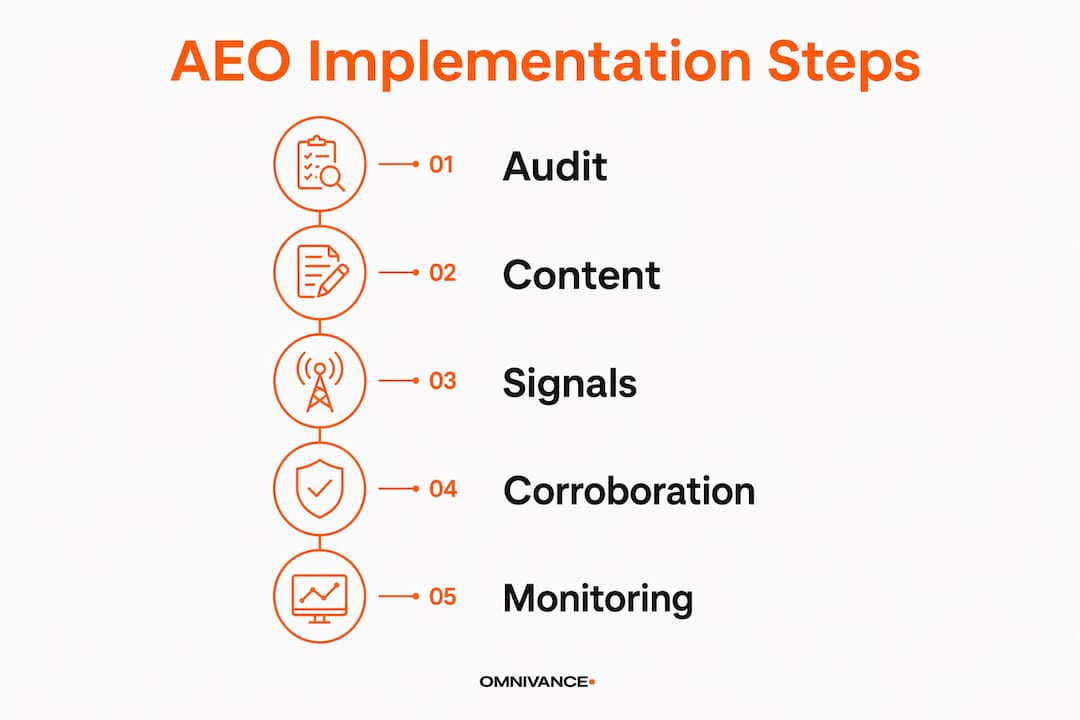
- Run regular query audits. Identify the 20–30 questions your buyers most commonly ask, then query ChatGPT, Perplexity, and Google AI Overviews weekly. Log whether your brand appears, how it is described, and which competitors are cited alongside you.
- Track citation accuracy, not just frequency. If an AI describes your brand incorrectly, that mention can hurt more than help. Monitor the language AI systems use about your brand and address inaccuracies through earned media corrections.
- Use tools built for AI visibility. Platforms like Profound specialize in tracking brand mentions across AI answer engines, giving marketers a structured view of their AI share of voice over time.
- Shift your reporting framework. AEO demands new metrics that value brand citation share and AI presence over traditional click-based ranking success. Build a reporting dashboard that includes AI citation counts alongside organic traffic and conversion data.
- Monitor third-party sources. Since earned media drives the majority of AI citations, track which external sites are generating mentions of your brand and whether those descriptions align with your positioning.
Ongoing monitoring and governance are not optional extras. AI answer outputs change without warning, and a brand that was cited accurately last month may be misrepresented today.
Challenges and emerging considerations in AEO
The terminology alone creates friction. The same discipline goes by AEO, GEO (Generative Engine Optimization), AISO (AI Search Optimization), GSO (Generative Search Optimization), and several other acronyms depending on who is writing about it. Practitioners focus on the shared goal: optimizing for AI-generated answers rather than traditional search rankings. The label matters less than the work.
Current obstacles marketers face:
- No standardized measurement. Unlike Google Search Console for SEO, there is no single authoritative tool for tracking AI citation performance across all platforms. Measurement is still largely manual or platform-specific.
- The visibility paradox. More AI citations can mean fewer direct website visits, which looks like a traffic decline in standard analytics. Brands that do not adjust their success metrics will misread strong AEO performance as a problem.
- Structured data maintenance. Schema markup requires ongoing updates as content changes. Stale or broken structured data can cause AI systems to misrepresent your brand.
- Earned media dependency. Because AI platforms weigh cross-channel signals heavily, brands with thin third-party presence face a steeper climb regardless of how well their own site is optimized.
- Speed of change. Unlike SEO, which evolved over decades, AEO is developing on a compressed timeline. What took years in search optimization is happening in months with AI, requiring continuous adaptation rather than periodic updates.
- Organizational readiness. Most marketing teams are structured around SEO and paid channels. AEO requires cross-functional coordination between content, PR, technical SEO, and brand teams to execute consistently.
The content optimization guide from BabyLoveGrowth covers several of these technical challenges in practical detail for teams building their first AEO workflow.
How to prepare your brand for AI-driven search in 2026
The brands winning in AI search right now did not wait for a perfect playbook. They started with what they had: solid SEO, clear content, and a deliberate effort to build third-party credibility. That combination is still the right starting point.

Enterprise AEO demands integrated processes: monitoring current AI brand representation, followed by content optimization and governance. That sequence matters. You cannot fix what you have not measured, and you cannot govern what no one owns.
Best practices for future-proofing your brand's AI visibility:
- Audit your current AI presence first. Query the major AI platforms with your brand name and your category's top questions. Document what they say and where the gaps are.
- Assign ownership. AEO without a named owner drifts. Assign someone to monitor AI citations, coordinate content updates, and manage earned media strategy.
- Build a content calendar around questions. Identify the exact questions your buyers ask AI systems and create clear, answer-first content for each one.
- Invest in earned media systematically. PR placements, guest contributions, and review generation are not soft brand activities anymore. They are direct inputs into AI citation frequency.
- Combine AEO with your full marketing system. AI visibility drives awareness, but awareness alone does not close deals. Connecting AEO to paid advertising, CRM automation, and conversion-focused content is what turns citations into revenue.
Omnivancemedia's approach demonstrates what integrated execution looks like in practice. An HVAC contractor using Omnivancemedia's combined SEO, paid advertising, and CRM system generated $340K in new contracts within 90 days. An e-commerce client scaled monthly revenue from $80K to $420K. Neither result came from a single channel. AEO works the same way: it feeds the top of a system that needs to convert at every stage.
For brands ready to build that system, Omnivancemedia's full service suite covers AEO, SEO, paid advertising, CRM automation, and creative production as a single integrated program. The AI search and voice SEO service is the natural entry point for teams starting with AI visibility specifically.
Key Takeaways
Answer Engine Optimization is the practice of making your brand citable by AI systems, and it requires structured content, earned media, and ongoing governance to work.
| Point | Details |
|---|---|
| AEO targets citations, not clicks | Success means appearing in AI-generated answers, measured by citation frequency and share of voice. |
| AI search visitors convert at 4.4 times the rate of traditional organic search visitors, according to Semrush 2025 data. | |
| Earned media drives most AI citations | 82–89% of AI citations come from third-party sources, not a brand's own website. |
| SEO is the foundation, AEO is the layer above | Without strong technical SEO, AI systems cannot parse your content regardless of how well it is written. |
| Measurement requires a new framework | Click-based metrics miss the story; track citation frequency, citation accuracy, and AI share of voice instead. |