What Is a Marketing Technology Stack in 2026?

A marketing technology stack is a collection of integrated software tools that marketing teams use to plan, execute, measure, and optimize campaigns across every customer touchpoint. The industry term is "martech stack," and understanding what is marketing technology stack means recognizing it as an architecture, not just a software list. Tools like Salesforce, HubSpot, Adobe Marketo, and Google Analytics form the backbone of most modern stacks, but their value depends entirely on how well they connect and share data. A stack built around integration delivers compounding returns. A stack built around tool accumulation delivers invoices.
What is a marketing technology stack and why does it matter?
A martech stack is defined as a collection of integrated software tools marketers use to plan, execute, manage, and measure marketing campaigns and customer interactions. The word "integrated" is the operative one. Two tools sitting in the same company but not sharing data are not a stack. They are two separate expenses.
The importance of marketing tech becomes clear when you consider what a connected system actually enables. A prospect fills out a form on your website. That action triggers a lead score update in HubSpot, fires a nurture sequence in Marketo, and logs the interaction in Salesforce for the sales team. All of this happens without a human touching a keyboard. That is the promise of a well-built martech stack.

The marketing technology landscape now contains over 15,500 products in 2026, with year-over-year growth of just 0.79%. That near-flat growth signals saturation, not stagnation. Buyers have more choices than they can evaluate, which makes a clear selection framework more valuable than ever.
What are the core components of a marketing technology stack?
Every martech stack, regardless of company size, organizes around four functional pillars: data, engagement, content, and measurement. Organizing tools by these four pillars prevents overinvestment in one area while neglecting another, which is one of the most common and costly stack design mistakes.
Here is how each layer breaks down in practice:
- CRM (Customer Relationship Management): Platforms like Salesforce and HubSpot serve as the single source of truth for customer data, enabling multi-touch attribution and lead scoring across marketing and sales. Without a CRM anchoring the stack, data fragments across every other tool.
- Marketing automation: Tools like Adobe Marketo and HubSpot Marketing Hub orchestrate multi-channel campaigns, lead nurturing sequences, and behavioral triggers. They translate strategy into repeatable, scalable execution.
- Content management systems (CMS): Platforms like WordPress, Contentful, and Webflow handle digital asset creation, publishing, and delivery. A CMS connects to the engagement layer to personalize content based on audience segment or behavior.
- Analytics and attribution: Google Analytics 4, Adobe Analytics, and attribution platforms like Rockerbox track performance across channels and assign revenue credit to the right touchpoints. Without this layer, you are flying blind on budget allocation.
- Customer Data Platforms (CDP): Tools like Salesforce CDP and Segment unify customer data from multiple sources using identity resolution to create persistent, actionable profiles. A CDP sits above the CRM in data sophistication, reconciling known and anonymous identifiers to power personalization at scale.
- Social media management and intent data: Platforms like Sprout Social and intent data providers like Bombora round out the stack for B2B teams, surfacing in-market buyers before they raise their hand.
The right combination depends on your business model, team size, and customer journey complexity. A 10-person SaaS startup does not need the same stack as a 500-person retail brand. What both need is a stack where every tool talks to every other tool.
Why integration and data flow define stack performance
The connected ecosystem model is what separates a high-performing martech stack from an expensive collection of software subscriptions. Fully integrated martech stacks correlate with up to 35% faster revenue growth, according to Adobe research. That number reflects what happens when attribution is accurate, personalization is real-time, and no lead falls through a gap between systems.
Siloed data is the primary enemy of stack performance. When your email platform does not know what your CRM knows, you send re-engagement campaigns to customers who purchased yesterday. When your analytics tool uses different definitions than your CRM, your revenue reports contradict each other in board meetings. These are not hypothetical problems. They are daily realities for teams running disconnected tools.
Scott Brinker's Chiefmartec framework advocates for a universal data layer with governance to maintain consistent definitions, permissions, and metrics across all tools. The concept is straightforward: before data enters any tool, it passes through a shared layer that standardizes field names, identity resolution rules, and access controls. This prevents the metric discrepancies that erode trust in marketing data over time.
APIs and middleware platforms like Zapier, MuleSoft, and Make handle the technical plumbing between tools that do not have native integrations. They are not glamorous, but they are often the difference between a stack that works and one that requires manual data exports every Monday morning.
Pro Tip: Before adding any new tool to your stack, map exactly which data it needs to send and receive, and confirm those integrations exist natively or through a middleware solution. A tool that cannot connect is a liability, not an asset.
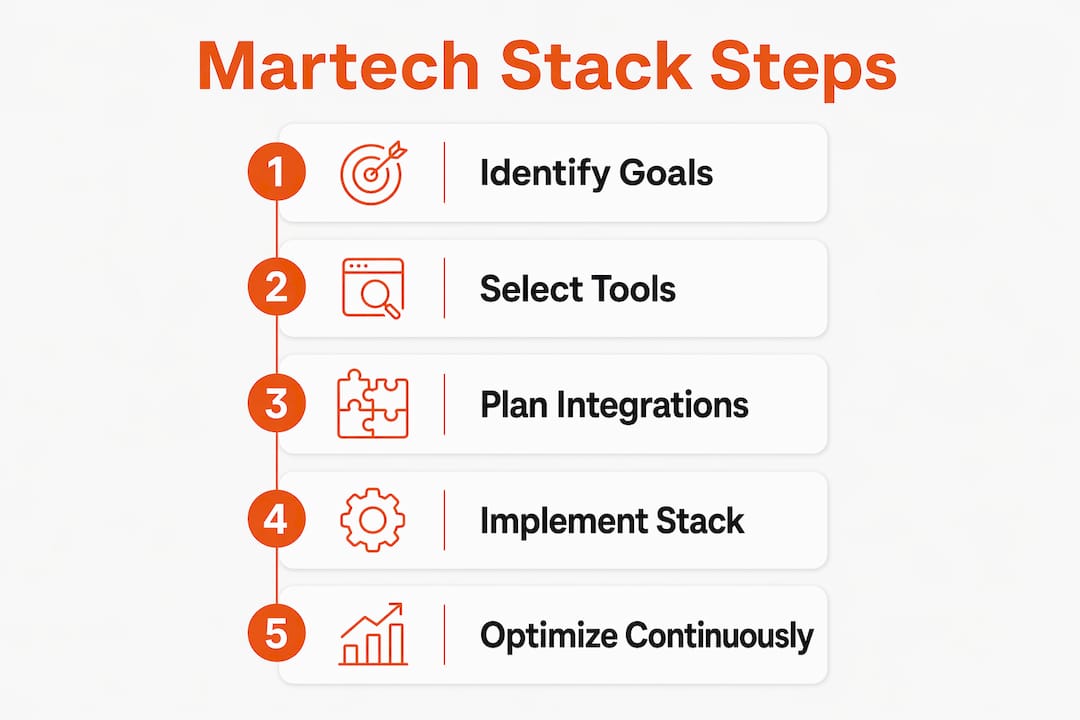
How to build a marketing technology stack aligned with your goals
Building a martech stack that actually works starts with a question most teams skip: what business outcome are we trying to achieve? Starting with tools rather than strategy leads to bloated, disconnected systems that teams abandon within six months. The tool-first approach is the single most common and most expensive mistake in martech.
Follow this sequence instead:
- Define your marketing and business goals. Are you trying to shorten the sales cycle, improve lead quality, increase customer lifetime value, or reduce churn? Each goal points to a different set of technology requirements.
- Audit your current technology. List every tool your team currently pays for, who uses it, how often, and what it connects to. Most audits reveal two or three redundant tools and at least one platform no one has logged into in months.
- Map the customer journey. Identify every stage from awareness to advocacy and note where data is collected, where engagement happens, where content is delivered, and where performance is measured. This map becomes your technology requirements document.
- Prioritize integration capability. When evaluating new tools, treat native integrations and open APIs as non-negotiable requirements, not nice-to-haves. A tool with a weaker feature set but strong integration capability beats a feature-rich tool that operates as an island.
- Build incrementally. Start with the CRM and analytics layer, get those working cleanly together, then add automation and content tools. Trying to implement six platforms simultaneously is a reliable path to failed adoption.
Pro Tip: Use a marketing AI implementation checklist before onboarding any new platform. Mapping workflows and integration points in advance cuts implementation time significantly and prevents the data quality problems that haunt stacks for years.
Scaling stack maturity over time is not optional. A stack that fits a $2M business will not fit a $10M business. Build with future integration needs in mind, even if you do not activate every connection on day one.
What are the common challenges in martech stack adoption?
The activation gap is the most underreported problem in marketing technology. 78% of marketing leaders report their martech stacks do not support business goals effectively. That statistic means most companies are paying for technology they cannot fully use. The gap exists not because the tools are bad, but because the processes and workflows were never redesigned to take advantage of them.
Common challenges break down into five categories:
- Data quality: Garbage in, garbage out. If your CRM contains duplicate records, inconsistent field values, or missing contact data, every tool downstream inherits those problems. Identity resolution in CDPs requires careful management of matching and merge rules to avoid fragmented customer records that corrupt segmentation.
- Tool sprawl: The average enterprise marketing team uses dozens of tools. Each addition increases integration complexity exponentially, not linearly. At a certain point, the overhead of managing connections exceeds the value any single tool adds.
- Vendor lock-in: Some platforms make it deliberately difficult to export data or migrate to competing tools. Evaluating data portability and export capabilities before signing a contract is not paranoia. It is due diligence.
- User adoption: A tool no one uses is a tool that adds no value. Workflow alignment and team training are as important as the technology itself. The best martech stack in the world fails if the team reverts to spreadsheets because the new system feels too complex.
- Governance gaps: Without a designated data steward or governance policy, definitions drift. One team counts a "lead" differently than another, and suddenly your pipeline reports mean nothing.
Addressing these challenges requires treating martech as an ongoing program, not a one-time implementation. Regular stack reviews, quarterly data audits, and incremental rollouts reduce the risk of each challenge compounding into a larger failure. For teams navigating digital marketing challenges in 2026, the solution is almost always process improvement before additional technology.
Key takeaways
A martech stack delivers measurable revenue impact only when tools are architected for integration, governed by consistent data standards, and aligned to specific business goals rather than assembled as a collection of software purchases.
| Point | Details |
|---|---|
| Integration defines value | Connected tools sharing clean data outperform feature-rich but siloed platforms every time. |
| Four pillars structure the stack | Organize tools across data, engagement, content, and measurement to avoid coverage gaps. |
| Strategy before software | Define business goals and map the customer journey before selecting any tool. |
| Activation gap is real | 78% of marketing leaders say their stack does not support business goals, pointing to process failures over technology failures. |
| Governance prevents drift | A universal data layer with consistent definitions and a designated data steward protects stack performance over time. |
Why architecture beats accumulation every time
Most martech conversations I have with marketing leaders start the same way: they list the tools they own and ask which ones to add. That is the wrong question. The right question is whether the tools they already have are actually connected, actually used, and actually tied to a measurable outcome.
I have seen companies running 40-plus tools generate worse attribution data than a competitor running eight tools that share a clean data layer. The number of tools is not the indicator of sophistication. The quality of the connections is.
What marketers consistently underestimate is the cost of complexity. Every new integration point is a potential failure point. Every new platform requires training, governance, and maintenance. The teams that build the most effective stacks are not the ones who adopted every new platform first. They are the ones who said no to tools that did not fit a defined need.
The other thing most articles on this topic skip is the human side of stack design. Technology does not change behavior on its own. If your sales team does not trust the lead scores coming out of your CRM, they will ignore them. If your content team finds the CMS too rigid, they will work around it. Stack design is as much organizational change management as it is software selection.
The AI tools available to marketing teams in 2026 add a new layer of complexity to this picture. AI-powered features inside existing platforms are often more valuable than standalone AI tools, precisely because they operate on data that is already clean and connected. Adding an AI tool to a broken stack does not fix the stack. It adds another broken layer.
Build the architecture first. The tools will follow.
— laya
How Omnivancemedia helps you build a stack that actually performs
Omnivancemedia works with businesses that are done paying for technology that does not deliver results. The team combines CRM setup and marketing automation with paid advertising, SEO, and creative production into a single integrated system, so your tools share data instead of creating silos. Whether you are a SaaS company building your first real stack or a retail brand untangling years of tool sprawl, Omnivancemedia designs the architecture around your specific revenue goals. The results speak directly: an e-commerce client grew from $80K to $420K in monthly revenue, and an HVAC contractor generated $340K in new contracts within 90 days. If you are ready to scale past $500K, explore martech solutions for SaaS and tech companies or connect with the team directly.
FAQ
What is a martech stack in simple terms?
A martech stack is the set of software tools a marketing team uses to manage customer data, run campaigns, create content, and track performance. The tools are most effective when they share data through integrations rather than operating independently.
What are the most important components of a marketing stack?
The core components are a CRM like Salesforce or HubSpot, a marketing automation platform like Adobe Marketo, a content management system, and an analytics tool like Google Analytics 4. Many stacks also include a Customer Data Platform for advanced identity resolution and segmentation.
How many tools should a marketing technology stack include?
There is no universal number. A focused stack of eight to twelve well-integrated tools typically outperforms a sprawling stack of forty loosely connected ones. The right size depends on your team's capacity to manage, train on, and govern each platform.
Why do so many martech stacks fail to deliver ROI?
The activation gap is the primary reason. 78% of marketing leaders report their stacks do not support business goals, usually because tools were selected before workflows were defined and because teams were never trained to use the platforms at full capability.
What is the first step in building a marketing technology stack?
Define your business and marketing goals before selecting any software. Mapping the customer journey and identifying data, engagement, content, and measurement needs gives you a requirements document that drives tool selection rather than the reverse.