Siloed Marketing Teams: A Manager's Diagnostic Checklist

If your paid team is bidding on keywords your SEO team already ranks for, your content team is producing assets your agency just finished, and nobody can agree on what counts as a qualified lead, your marketing teams are siloed. Here is the checklist to confirm it, and three things to do this week.
Quick diagnostic: check which of these you recognize
- Conflicting metrics: paid reports one conversion count, CRM shows another
- Duplicate creative: two teams producing similar assets without knowing it
- Information hoarding: one team guards its data, reports, or contacts
- Paid/organic cannibalization: paid bidding on terms where organic already ranks top three
- Inconsistent messaging: different value propositions across channels in the same campaign
- Competing KPIs: one team optimizes for MQLs, another for revenue, neither talks to the other
- Translator roles: someone spends most of their time relaying information between teams
- "Us vs. them" language: teams refer to each other as obstacles, not partners
- Slow execution: launches take weeks longer than they should because approvals cross team lines
- Data discrepancies: the same metric shows different numbers in different reports
Three things to do this week
- Run a one-week audit: pull the same metric from three different team reports and compare the numbers.
- Pick one metric to unify: blended cost per acquisition or total pipeline influenced is a good starting point.
- Schedule a 15-minute daily sync between paid and organic leads to build a shared keyword map.
Key Takeaways
Siloed marketing teams are most reliably identified by metric discrepancies, duplicate work, and "us vs. them" language, and the fastest fixes are shared artifacts and unified KPIs, not reorganizations.
| Point | Details |
|---|---|
| Start with the audit | Compare the same metric across three team reports; discrepancies confirm the silo. |
| Unify one metric first | Blended CPA or lead-to-revenue lag gives leadership a number they can act on. |
| Quick wins beat restructuring | A shared keyword map and a 15-minute daily sync produce results in week one. |
| Root cause is often structural | Campaign-centric operating models create recurring fragmentation; governance fixes hold longer than process patches. |
| Omnivancemedia's integrated model | Combines SEO, paid, CRM, and creative in one system, removing the structural conditions that generate silos. |
Table of Contents
- What are marketing silos, and why does the type matter?
- Why marketing silos cost more than you think
- How silos form and why they stick around
- 8 symptoms of siloed marketing teams, with diagnostic questions
- 1. Information hoarding
- 2. Duplicate creative and agency spend
- 3. Conflicting KPIs
- 4. Data discrepancies across reports
- 5. Slow execution and missed launch windows
- 6. Translator roles
- 7. Paid and organic cannibalization
- 8. "Us vs. them" language
- How to confirm and measure the problem before you fix it
- Practical strategies to break down silos: a 30/60/90-day plan
- Why silos often run deeper than anyone admits
- The pattern I keep seeing in siloed teams
- Omnivancemedia fixes the fragmentation, not just the symptoms
- Sources
What are marketing silos, and why does the type matter?
A marketing silo exists when teams, tools, or data operate in isolation, producing inconsistent customer experiences and wasted spend. The term covers two distinct problems that look similar on the surface but need different fixes.
Channel silos occur when individual channels (paid search, SEO, email, social) run independently with separate goals, separate reporting, and no shared planning. The cause is usually a channel-specialist hiring model or an agency structure where each vendor owns one lane. The symptom is fragmented customer journeys and paid/organic cannibalization.
Organizational silos go deeper. They form when entire teams or departments have separate leadership, separate budgets, separate technology, and no governance that forces coordination. The cause is usually a campaign-centric operating model or misaligned incentives. The symptom is duplicate work, conflicting KPIs, and the MQL handoff gap between marketing and sales.
| Dimension | Channel silos | Organizational silos |
|---|---|---|
| Scope | Individual channels | Whole teams or departments |
| Root cause | Specialist hiring, agency structure | Campaign model, misaligned incentives |
| Common symptom | Competing bids, fragmented messaging | Duplicate work, conflicting KPIs |
| Typical fix | Shared keyword map, unified calendar | Shared OKRs, governance cadence |
Most organizations have both. The checklist above helps you spot which type is driving the damage.
Why marketing silos cost more than you think
The business case for fixing silos is not subtle. The damage shows up in four places.
Lost revenue is the most direct hit. When paid and organic teams bid against each other, you pay for clicks you could have earned for free. When sales and marketing disagree on what a qualified lead looks like, pipeline leaks at the handoff. When messaging is inconsistent across channels, conversion rates drop because buyers lose confidence in the brand.
Wasted budget compounds the revenue problem. Duplicate agency retainers, redundant creative production, and overlapping tool subscriptions are all common in siloed organizations. A team that hoards information forces other teams to rebuild the same research from scratch.
Brand damage is slower to show up but harder to repair. When a prospect sees three different value propositions across email, paid ads, and a sales deck in the same week, the brand reads as disorganized. Trust erodes before a conversation even starts.
Compliance risk is the least discussed impact. Siloed teams often run campaigns without checking what other teams have already committed to customers, creating inconsistent disclosures or conflicting promotional terms.
Measurement tip: translate silo damage into metrics leadership cares about. Blended CPA, time-to-launch, and lead-to-revenue lag are the three numbers that make the business case fastest.
How silos form and why they stick around
Understanding root causes matters because surface fixes (a new Slack channel, a weekly all-hands) rarely hold if the underlying structure keeps generating fragmentation.
- Campaign-centric operating model: when marketing organizes around campaigns rather than audiences or capabilities, each campaign becomes its own temporary project with its own tech, agency relationships, and data. When the campaign ends, the learning disappears. This model is the single most common structural cause of recurring silos.
- Misaligned incentives and KPIs: if the paid team is measured on click volume and the content team is measured on organic sessions, neither has a reason to coordinate. They are both winning by their own scorecards while the business loses.
- Tech fragmentation: separate tools for each channel mean separate data stores. When no single system holds the full customer picture, teams cannot share what they know even when they want to.
- Procurement patterns: buying tools and agencies channel by channel, campaign by campaign, locks in fragmentation at the contract level. Fixing it later requires renegotiating multiple vendor relationships simultaneously.
- Lack of shared data definitions: if "lead" means something different in the CRM than it does in the marketing automation platform, every report will disagree. That disagreement becomes a political argument rather than a measurement problem.
Pro Tip: Check your last three campaign briefs. If each one lists a separate agency, a separate reporting tool, and a separate success metric with no reference to what other teams are running simultaneously, you have structural silos, not just communication problems.
8 symptoms of siloed marketing teams, with diagnostic questions
The BLUF checklist names the symptoms. This section gives you the questions to ask and the signals to look for when you sit down with each team.
1. Information hoarding
One team controls data, contacts, or research that other teams need but cannot access. The symptom shows up as repeated requests for the same information, or as teams rebuilding research that already exists somewhere else.
Ask: "What data do you wish you had access to that you currently don't?" and "Who do you have to ask to get it?"
Signal: if the answer involves another team's manager rather than a shared system, you have an information access problem.
2. Duplicate creative and agency spend
Two teams produce similar assets without knowing it. A common version: the content team writes a case study while the agency produces a nearly identical one for a paid campaign. Neither team knew the other was working on it.
Ask: "What did you produce last quarter, and who else might have produced something similar?"
Signal: overlapping asset types in separate project management systems, or two line items in the budget for the same deliverable category.
3. Conflicting KPIs
The paid team optimizes for MQL volume. The revenue team cares about closed revenue. The content team tracks organic sessions. None of these metrics connect, so each team can report success while the business underperforms.
Ask: "What does the team you hand leads to measure, and how does your metric connect to theirs?"
Signal: blank stares, or an answer that describes the other team's metric as irrelevant to their own work.
4. Data discrepancies across reports
Pull the same metric from three reports. If the numbers differ and nobody can explain why, you have a data definition problem that is almost always a silo symptom. Improving data quality is a prerequisite for reliable cross-channel measurement, not an optional cleanup task.
Ask: "Where does this number come from, and does it match what sales sees in the CRM?"
Signal: different conversion counts in Google Ads, the marketing automation platform, and the CRM for the same time period.
5. Slow execution and missed launch windows
A campaign that should take two weeks to launch takes six because approvals cross team lines, assets sit in inboxes, and nobody owns the handoff. The delay is not a capacity problem. It is a coordination failure.
Ask: "Walk me through the last launch. Where did it wait, and who was it waiting on?"
Signal: more than two handoff points between teams before a campaign goes live.
6. Translator roles
Someone on the team spends a significant portion of their time relaying information between groups that should be talking directly. This person is often called a "project manager" or "marketing ops lead," but their actual job is compensating for a broken communication structure.
Ask: "Who do you go to when you need to know what another team is working on?"
Signal: one name comes up repeatedly across multiple teams.
7. Paid and organic cannibalization
Your paid team bids on keywords where your organic content already ranks in positions one through three. You pay for clicks you would have received for free, and the two teams have no idea they are competing. A shared keyword map between paid and SEO leads is the fastest fix for this specific symptom.
Ask: "Can you show me the overlap between your top paid keywords and our top organic rankings?"
Signal: any meaningful overlap without a documented rationale for bidding on it.
8. "Us vs. them" language
Teams describe other teams as obstacles, gatekeepers, or black holes. This language signals that collaboration has broken down at a cultural level, not just a process level. It is the hardest symptom to fix because it requires trust, not just a new workflow.
Ask: "How would you describe your working relationship with [other team]?"
Signal: any answer that frames the other team as a source of friction rather than a partner.
What it looks like in the wild: a marketing manager pulls a weekly report and notices that the paid team's conversion count is 40% higher than what the CRM shows for the same period. When she asks both teams to explain the gap, neither can. That is a data discrepancy symptom, and it usually means the teams are using different attribution windows, different lead definitions, or both.
How to confirm and measure the problem before you fix it
Fixing silos without measuring them first is how you end up with a governance initiative that nobody follows. Run this audit before you propose any structural changes.
Step-by-step audit checklist
- Interview one lead from each major team (paid, organic, content, CRM/ops, sales) using the diagnostic questions above.
- Pull the same three metrics (MQL count, cost per acquisition, pipeline influenced) from each team's primary reporting tool.
- Compare the numbers. Document every discrepancy and ask each team to explain it.
- Inventory the tools each team uses. Map which tools share data and which do not.
- Count the number of active agency relationships and the number of separate project management systems.
- Review the last three campaign briefs for shared objectives, shared metrics, and cross-team dependencies.
Metrics to unify first
| Metric | Why it matters | Silo signal |
|---|---|---|
| Blended CPA | Shows true cost across all channels | Paid and organic report separately |
| Lead-to-revenue lag | Reveals handoff friction | Sales and marketing disagree on timing |
| Duplicate asset count | Quantifies wasted creative spend | Two teams produced similar deliverables |
| Cross-channel attribution | Shows which channels actually drive revenue | Each team claims full credit |
A first-party data strategy is the foundation for making these metrics reliable. Without unified data definitions, the numbers will keep disagreeing regardless of how many meetings you hold.
Mini-dashboard for first evidence
Your first silo-detection dashboard needs three things: a side-by-side view of the same metric from different sources, a timeline showing when discrepancies started, and a list of the assets produced in the last 90 days with the team that produced each one. Mismatched numbers and overlapping assets are your two strongest early signals.
Practical strategies to break down silos: a 30/60/90-day plan
The most effective early wins are governance and orchestration fixes, not reorganizations. Shifting from program-centric to audience-centric planning forces cross-team prioritization because every initiative must connect to a specific audience segment and business objective. Disconnected programs become harder to justify.
30/60/90-day plan
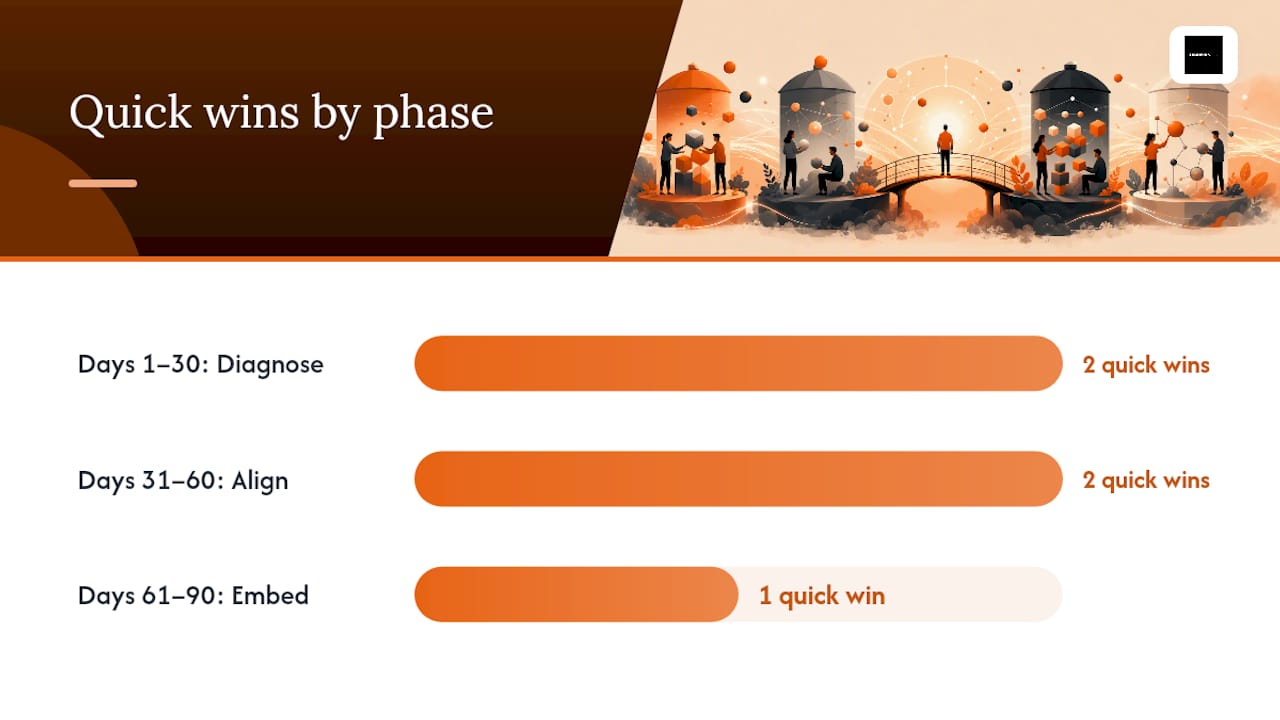
Days 1–30: Diagnose
- Owner: marketing manager or VP of marketing
- Deliverable: completed audit (interviews, metric comparison, tool inventory)
- Quick win: shared keyword map between paid and organic leads; a single live-offers registry that all teams update
Days 31–60: Align
- Owner: marketing manager plus team leads
- Deliverable: one shared OKR for the quarter (example: reduce blended CPA by 15% through coordinated paid/organic keyword strategy)
- Quick win: 15-minute daily handoff sync between paid and content; documented SLA for asset requests (48-hour turnaround, single intake form)
Days 61–90: Embed
- Owner: marketing ops or a designated integration lead
- Deliverable: a single reporting dashboard all teams use; documented data definitions for the five most-argued-about metrics
- Quick win: first cross-team retrospective where teams review what the shared OKR produced
Quick wins vs. long-term initiatives
| Action | Timeline | Owner | Impact |
|---|---|---|---|
| Shared keyword map | Week 1 | Paid + SEO leads | Stops cannibalization immediately |
| Daily 15-min handoff sync | Week 1 | Team leads | Reduces translator role burden |
| Single live-offers registry | Week 2 | Marketing ops | Eliminates conflicting messaging |
| Shared OKR for the quarter | Day 31 | VP of marketing | Aligns incentives structurally |
| Unified reporting dashboard | Day 60 | Marketing ops | Makes discrepancies visible |
| Data definition document | Day 90 | Marketing ops | Prevents future disagreements |
Pro Tip: Governance does not have to mean bureaucracy. A single shared document listing the five most-used metrics and their agreed definitions, reviewed monthly by team leads, prevents more arguments than any new meeting ever will. Keep it short enough that everyone actually reads it.
Executing these strategies requires documented SLAs for handoffs, a governance cadence (monthly metric review, quarterly OKR check-in), and a shared source of truth for live offers and active campaigns. The martech stack you choose to support this matters, but the governance comes first.
Why silos often run deeper than anyone admits
Two research findings are worth knowing before you build your business case.
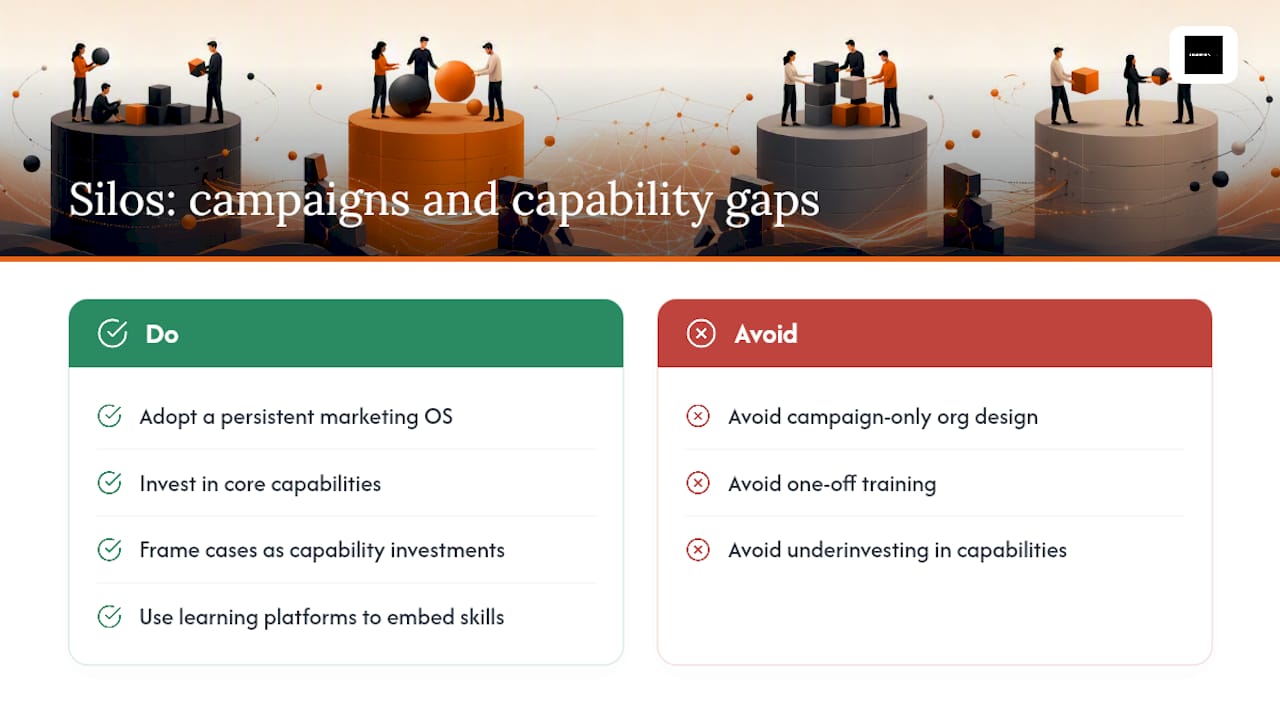
First, silos are often a symptom of organizing marketing around temporary campaigns. The campaign model creates project-based fragmentation across technology, data, and agency work. When a campaign ends, the team disbands, the tools go dormant, and the learning stays locked in a project folder nobody revisits. The next campaign starts from scratch. Moving to a persistent marketing operating system, one where data, tools, and agency relationships are continuous rather than campaign-specific, breaks this cycle.
Second, many marketing organizations underinvest in core capabilities even as requirements shift rapidly. Training, data infrastructure, and hiring lag behind what the organization actually needs. This matters for silos because teams that lack shared skills and shared tools cannot coordinate even when they want to. Capability investment is not a nice-to-have alongside anti-silo work. It is part of the same problem.
The actionable implication: when you build your business case for anti-silo investment, frame it as capability investment, not just process improvement. Leadership responds to capability arguments because they connect to long-term competitive position, not just this quarter's efficiency.
For teams looking to build those capabilities systematically, organizational learning platforms can help embed cross-functional skills at scale rather than relying on one-off training sessions that fade within weeks.
The pattern I keep seeing in siloed teams
The most reliable early signal of a siloed marketing organization is not a technology problem or a reporting problem. It is a language problem. When teams describe other teams as "they" instead of "we," the silo is already cultural, and no dashboard will fix it on its own.
The fastest early win I have seen work consistently is not a new tool or a new org chart. It is a shared artifact: one document, one dashboard, or one weekly ritual that forces two teams to look at the same number together. When an e-commerce client's paid and organic leads started reviewing a shared keyword map every Monday, paid spend on top-ranking organic terms dropped within the first month. The conversation that followed that drop was the first real cross-team conversation either lead had participated in. Omnivancemedia's integrated approach, combining SEO, paid advertising, CRM automation, and creative production inside one system, removes the structural conditions that make those conversations necessary in the first place.
The one-sentence playbook for next week: find the metric your teams argue about most, agree on a single definition, and put it in a shared document everyone can edit.
Omnivancemedia fixes the fragmentation, not just the symptoms

Fragmented marketing teams produce fragmented results. Omnivancemedia's integrated model puts SEO, paid advertising, CRM automation, and creative production inside one system, so the symptoms described in this article, competing bids, duplicate assets, conflicting KPIs, and data discrepancies, do not have structural conditions to grow in. One team. One reporting layer. One set of objectives.
For an established business generating above $500K and spending time managing multiple vendors instead of growing, the difference is concrete: an HVAC contractor generated $340K in new contracts within 90 days, and an e-commerce client grew monthly revenue from $80K to $420K. Those results came from coordination, not from adding more channels.
Review Omnivancemedia's full-service offerings and request a short capabilities review to see where integration would close the gaps your current structure is creating.
Sources
These are the sources most worth sharing when you build your internal business case.
- Connected marketing begins beyond the campaign
- The marketing capability paradox: seven forces eroding your marketing team's effectiveness
- The quiet fix for silos — frontline marketing's biggest self-inflicted problem
- How to improve your data quality
- Your marketing channels are working against each other. Here's how to tell.
- 3 proven strategies to break down marketing silos + execution