SEO for Restaurants: Rank Higher and Fill Tables

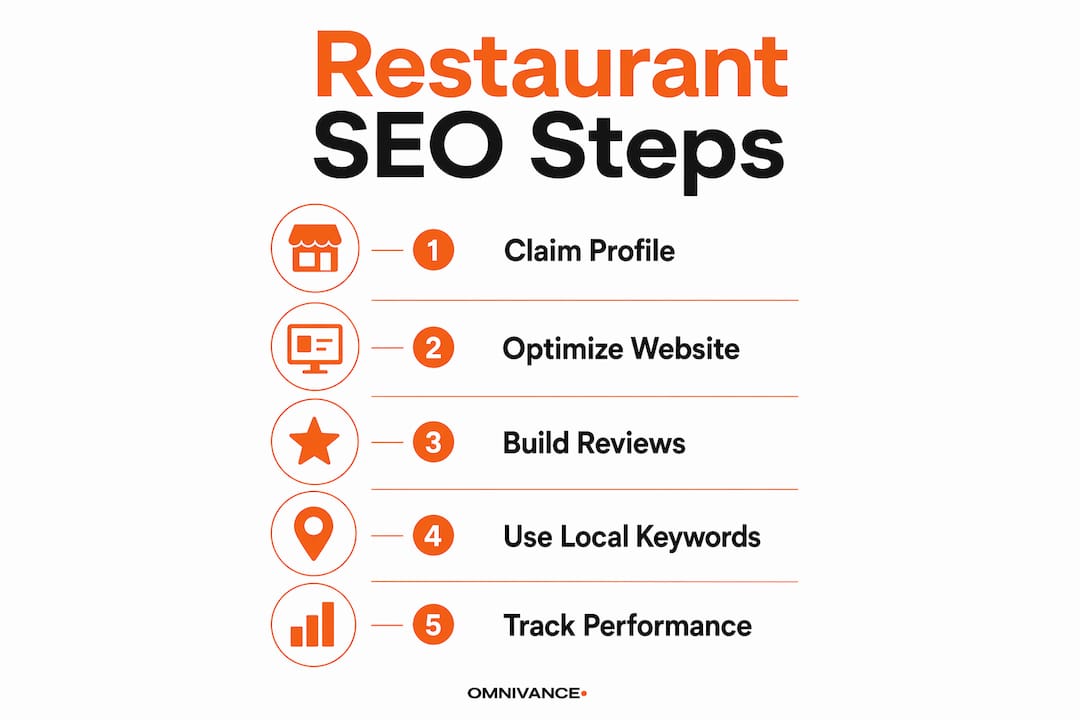
SEO for restaurants is the practice of improving your online presence so local diners find you first when they search on Google, Maps, or AI assistants. 90% of diners research online before visiting a restaurant, and 76% of mobile searchers visit within 24 hours of that search. That gap between a search and a seat is where restaurant SEO lives. The process covers Google Business Profile (GBP) optimization, website structure, review management, and content creation. Done consistently, these four pillars form a compounding loop: better rankings bring more bookings, bookings generate reviews, and reviews push rankings higher.
What is SEO for restaurants, and why does it matter?
Local search engine optimization (local SEO) is the recognized industry term for what most restaurant owners call "restaurant SEO." The two phrases describe the same goal: appearing in the top results when someone nearby searches "best tacos near me" or "Italian restaurant downtown Chicago." Only the top three local results in Google's Map Pack capture most clicks. Restaurants outside those three spots receive minimal traffic regardless of how good the food is.
The stakes are concrete. A restaurant with a complete, active GBP profile ranks higher than one with a sparse, neglected listing. Google treats your profile as a live signal of business health. An incomplete profile tells Google you may not be open, relevant, or trustworthy enough to recommend.

How to optimize your Google Business Profile effectively
Your Google Business Profile is the single most important asset in local restaurant SEO. It controls whether you appear in the Map Pack, what information diners see first, and whether they call, get directions, or book a table directly from search results.
Start with the basics:
- Claim and verify your listing. An unclaimed profile can be edited by anyone and often contains errors.
- Complete every field. Name, address, phone number (NAP), hours, website URL, and holiday hours must be accurate and current.
- Choose the right categories. Select a specific primary category such as "Italian Restaurant" rather than the generic "Restaurant." Add relevant secondary categories like "Pizza Delivery" or "Wine Bar."
- Add high-quality photos. Upload interior shots, food photos, and exterior images. Encourage guests to upload their own photos too, since user-generated images signal active engagement.
- Enable action buttons. Activate "Reserve a Table" and "Order Online" buttons. These convert profile views directly into revenue without requiring a website visit.
- Post weekly updates. Announce specials, seasonal dishes, and events. Google rewards active profiles with better visibility.
- Respond to every review and Q&A. Responses add keyword-rich text to your profile and signal to Google that you are engaged.
Healthy independent restaurants can expect 30–60 daily profile actions, including calls, direction requests, and website clicks, within a year of consistent GBP management. Those actions are direct purchase-intent signals, meaning each one represents a diner who was close to choosing your restaurant.
Pro Tip: Set a recurring calendar reminder every Monday to post a GBP update. Restaurants that post weekly consistently outperform those that post monthly, even when the weekly posts are simple photos of a daily special.
How to build a local SEO-friendly restaurant website
Your website works alongside your GBP, not instead of it. Google cross-references both to confirm your business is legitimate and locally relevant. A well-built website also captures diners who click through from your profile or find you through a direct search.
NAP consistency and local keywords
NAP consistency across your website and all online listings is the foundation of local SEO trust. Even a small discrepancy, like "St." on your website and "Street" on Yelp, can confuse Google and lower your rankings. Use the exact same business name, address, and phone number everywhere.
Weave local keywords naturally into your page titles, meta descriptions, headers, and menu descriptions. "Authentic wood-fired pizza in Brooklyn" works far better than "great pizza." Pair your cuisine type with your city, neighborhood, or landmark throughout the site.
Menu pages and structured data
Never publish your menu as a PDF. PDFs are invisible to search engines. Instead, build HTML menu pages with individual dish names, descriptions, and ingredients. A dish description like "slow-braised short rib with roasted garlic mashed potatoes" targets long-tail searches and gives Google more content to index.
Restaurant and LocalBusiness schema markup lets your hours, ratings, and menu items appear directly in search results as rich snippets. This markup also makes your restaurant more likely to be recommended by AI assistants like Google's AI Overview and voice search tools.
Speed and mobile performance
Mobile site speed under 3 seconds is not optional. Google's Core Web Vitals measure loading performance, and a slow menu page causes visitors to leave before they even see your food. Most diners search on their phones while standing nearby, so a site that loads in 4 or 5 seconds loses them to a faster competitor.
A well-designed website also reduces bounce rates, which signals to Google that visitors find your content useful. Prioritize a clean layout, readable fonts, and a prominent "Reserve" or "Order" button on every page.
Pro Tip: If you have multiple locations, create a separate page for each one with unique content, its own NAP, and location-specific schema. Never copy and paste the same content across location pages.
How do reviews affect restaurant search rankings?
Review quantity, velocity, and recency are among the top local ranking factors for restaurants. A restaurant with 80 recent reviews outranks one with 800 outdated reviews. Recency matters because Google treats fresh reviews as proof that your business is still active and relevant.
Here is a practical process for building review volume:
- Automate review requests. Send a text or email to every diner within an hour of their visit. Automated review requests consistently outperform in-person asks because servers forget, feel awkward, or simply run out of time during a busy shift.
- Target a 4.5-star average or higher. Diners filter by rating, and Google favors businesses with strong, consistent scores.
- Aim for at least 2 new reviews per week. Velocity matters as much as total count. A steady stream of new reviews signals ongoing activity.
- Respond to every review. Thank positive reviewers by name and address negative reviews professionally. Your response is public and adds keyword signals to your profile.
- Spread across platforms. Google reviews carry the most weight for rankings, but Yelp, TripAdvisor, and DoorDash reviews build broader trust and reach diners on different platforms.
The language diners use in reviews also matters. When a reviewer writes "best gluten-free pasta in Austin," that phrase becomes a ranking signal for exactly that search query. Responding with similar language reinforces it further.
Pro Tip: Print a QR code that links directly to your Google review page and place it on every table, receipt, and takeout bag. The easier you make it, the more reviews you collect.
For a deeper look at managing your restaurant's reputation across platforms, the online reputation guide for SMBs covers the full process step by step.
Creating content that attracts nearby diners
Content creation is where restaurants with strong local SEO pull ahead of competitors who only manage their GBP. Publishing relevant, locally focused content builds topical authority and targets search queries that a profile alone cannot capture.
Effective content strategies for restaurants include:
- Local guides and neighborhood content. Write a post about "the best date night spots in [your neighborhood]" and include your restaurant. This targets informational searches and builds inbound links.
- Seasonal menu announcements. Publish a page or blog post every time you update your menu. Use dish names and local context in the title, such as "Fall harvest menu at [Restaurant Name] in [City]."
- Long-tail keyword pages. Create pages targeting specific occasions, like "private dining for corporate events in [City]" or "best brunch spots near [Landmark]." These queries have lower competition and high purchase intent.
- Internal linking. Link your blog posts to your menu pages, reservation page, and location pages. This strengthens your site structure and passes authority to the pages that convert visitors into customers.
- Conversational answers. AI voice assistants and Google's AI Overview favor direct, conversational answers. Write FAQ sections on your pages that answer questions like "Does [Restaurant Name] take reservations?" or "Is [Restaurant Name] good for large groups?"
Consistent content paired with weekly GBP updates creates a compounding effect. Each new piece of content adds another entry point for search traffic. Over 3–9 months, this compounds into significantly broader visibility across dozens of local queries. For a full picture of how content fits into restaurant digital marketing, the complete guide covers every channel in detail.
How do you track and improve restaurant SEO performance?
Tracking performance closes the loop between your SEO efforts and real business results. Without measurement, you cannot know which tactics fill tables and which waste time.
Focus on these metrics:
- GBP insights. Monitor direction requests, phone calls, website clicks, and booking button taps monthly. These are the clearest signals of purchase intent from your profile.
- Map Pack rankings. Use rank tracking tools to monitor where your restaurant appears for priority queries like "[cuisine] restaurant [city]" and "restaurants near me." Aim for the top three positions.
- NAP citation audits. Check your business listings across Google, Yelp, TripAdvisor, Apple Maps, and Bing Places every quarter. Fix any inconsistencies immediately.
- Website traffic and conversions. Track how many visitors come from organic search, how long they stay, and whether they click your reservation or order button.
- Review velocity. Count new reviews per week across all platforms. A drop in velocity is an early warning sign that your review request process has broken down.
Expect fast wins in 4–8 weeks from GBP improvements and review generation. Broader ranking gains from website optimization and content compound over 3–9 months. Local SEO is a looping system: optimization drives bookings, bookings enable reviews, and reviews improve rankings, which drives more bookings.
Pro Tip: Connect your point-of-sale or CRM data to your GBP and website analytics. When you can trace a direction request to an actual table turn, you know exactly what your SEO investment is worth.
For restaurants competing in dense local markets, the local SEO strategies guide breaks down the tactics that win in high-competition environments.
Key Takeaways
Effective restaurant SEO is a continuous loop of profile optimization, website improvements, review generation, and content creation that compounds into measurable revenue growth over time.
| Point | Details |
|---|---|
| Google Business Profile is the priority | A complete, active GBP is the single most important factor in local search rankings. |
| NAP consistency protects your rankings | Even minor address discrepancies across listings lower your position in local results. |
| Recent reviews outrank old ones | A restaurant with 80 fresh reviews outranks one with 800 outdated reviews. |
| Mobile speed determines visibility | Pages that load in over 3 seconds lose visitors and drop in Google's rankings. |
| SEO results compound over time | Expect early wins in 4–8 weeks and significant growth after 3–9 months of consistent effort. |
The SEO loop most restaurant owners never close
Most restaurant owners treat SEO as a setup task. They claim their GBP, upload a few photos, and wait. That approach gets you a baseline, but it does not fill tables.
What I have seen work, consistently, is treating local SEO as an operating system rather than a one-time project. Every week, something gets updated: a GBP post goes live, a review request goes out, a menu page gets a new dish description. None of these actions is dramatic on its own. Together, they create a compounding advantage that is very hard for a competitor to close quickly.
The part most owners miss is capturing walk-in guest data at the point of entry. If someone walks in without a reservation, you have no way to follow up, request a review, or bring them back. A simple tablet at the host stand or a Wi-Fi sign-in captures that contact. That one change closes the attribution loop and turns anonymous foot traffic into a measurable, marketable audience.
Automating review requests is the other lever that changes the math. When every diner gets a text within an hour of leaving, review volume grows without adding work for your staff. More reviews mean better rankings, which means more diners, which means more reviews. That is the loop. The restaurants that run it consistently are the ones that dominate their local Map Pack.
— laya
How Omnivancemedia helps restaurants rank and grow
Omnivancemedia builds the full SEO system for restaurants so owners can focus on running their kitchen. Their CRM setup and marketing automation handles review requests, booking follow-ups, and guest re-engagement automatically, without adding work for your front-of-house team.
Their zero-click SEO services are built specifically for AI-powered search and voice assistants, the platforms where more diners are finding restaurants in 2026. Omnivancemedia integrates GBP management, website optimization, and automated customer engagement into one connected system. Restaurants working with Omnivancemedia gain measurable improvements in Map Pack rankings, review velocity, and direct bookings without juggling multiple vendors.
FAQ
What is the most important factor in restaurant local SEO?
Your Google Business Profile is the most critical factor. A complete, verified, and actively managed profile drives direction requests, calls, and bookings directly from search results.
How long does SEO take to work for a restaurant?
Expect early improvements in 4–8 weeks from GBP and review optimizations. Broader ranking gains from website content and citations compound over 3–9 months of consistent effort.
Why do reviews matter so much for restaurant rankings?
Review quantity, recency, and average rating are top local ranking factors. A restaurant with 80 recent reviews outranks one with 800 old reviews because Google treats fresh reviews as proof of ongoing relevance.
Should my restaurant menu be a PDF or a web page?
Always use HTML menu pages, not PDFs. Search engines cannot read PDF content, so a PDF menu is invisible to Google and misses every keyword opportunity your dishes could rank for.
How does schema markup help a restaurant's search visibility?
Restaurant schema markup lets your hours, ratings, and menu items appear as rich snippets directly in search results. It also increases the likelihood that AI assistants recommend your restaurant in voice and chat searches.