SEO for Real Estate Agents: Your 2026 Growth Guide

SEO for real estate agents is the practice of optimizing your website, listings, and online profiles so buyers and sellers find you first when they search for homes or agents in your area. SEO drives over 53% of traffic to real estate agent websites, making it the single largest source of qualified leads. That number matters because organic visitors arrive with intent. They are already searching for what you sell. The agents who understand local SEO, Answer Engine Optimization (AEO), and structured content will consistently outrank those who rely on portals and referrals alone.
What does SEO for real estate agents actually require?
Real estate SEO is not generic website optimization. It combines hyperlocal keyword targeting, technical site architecture, Google Business Profile (GBP) management, and compliance with regulations like the Fair Housing Act and NAR guidelines. Each of these elements feeds the others. A technically sound site with weak local content ranks poorly. A content-rich site with duplicate MLS pages gets penalized. The agents who win in organic search treat all four pillars as one connected system.

How to structure your real estate website for SEO
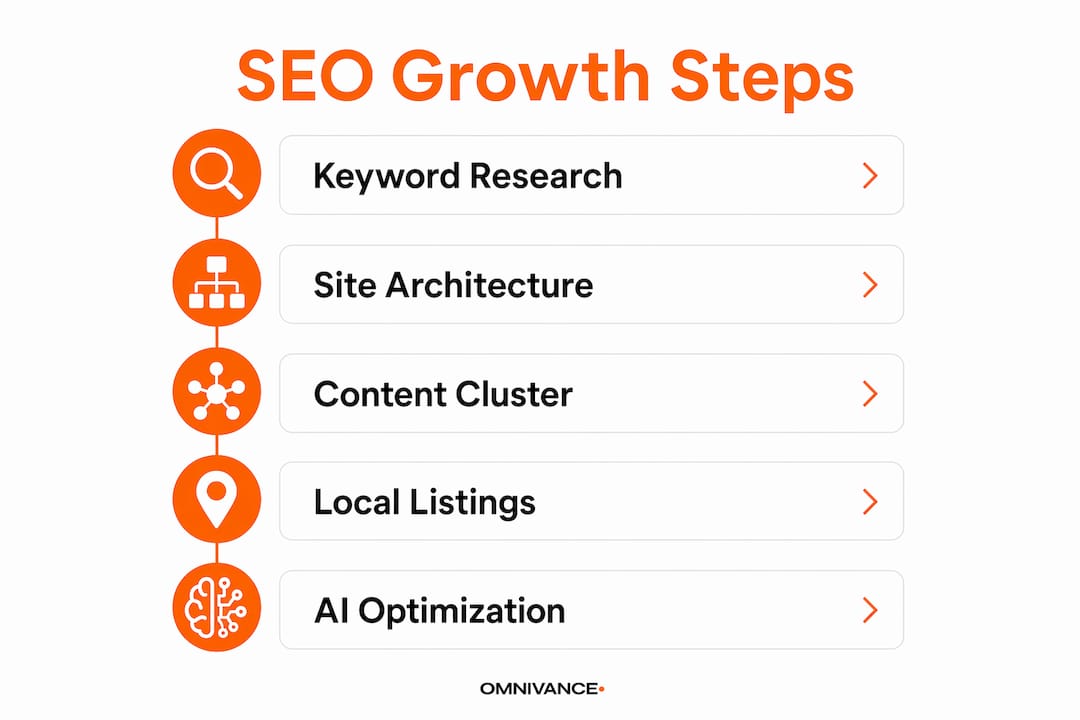
Your website architecture determines which pages Google indexes and ranks. A well-built real estate site uses a clear hierarchy:
- Homepage: Establishes your brand, service area, and primary keyword focus. Lead with your city or metro name in the title tag and H1.
- Buyer and seller pages: Dedicated pages for each audience segment, organized by location. "Selling a home in Austin" and "Buying a home in Austin" are separate pages with separate intent.
- Neighborhood and city pages: These are your highest-value SEO assets. Custom local content ranks better than MLS duplicate content every time. Write original market data, school district summaries, and commute details for each area you serve.
- School district and lifestyle pages: Buyers search "homes near Jefferson Elementary" and "best neighborhoods for families in Denver." These informational pages capture early-funnel traffic.
- IDX/MLS listing pages: Set most IDX pages to noindex to avoid duplicate content penalties. Let your original neighborhood pages carry the SEO weight instead.
Pro Tip: Apply RealEstateListing, RealEstateAgent, and LocalBusiness schema markup to your key pages. Schema tells Google exactly what your content is, which increases your chances of earning rich snippets in search results.
Compliance considerations belong in your site architecture plan from day one. Fair Housing Act language restrictions and required disclosures affect your copy. Agents who ignore this risk both legal exposure and ranking drops when flagged phrases trigger regulatory filters.
Which keywords and content topics should realtors prioritize?
Keyword selection for real estate follows a simple rule: go hyperlocal and go specific. Generic terms like "homes for sale" are dominated by national portals. Your opportunity lives in the long tail.
- City and neighborhood terms: "3-bedroom homes in Midtown Atlanta" or "condos for sale in Capitol Hill Seattle" signal high purchase intent and face far less competition than broad terms.
- ZIP code and school zone queries: Buyers filter by school district constantly. Pages targeting "homes in 78701 zip code" or "houses near Westlake High School" capture this traffic directly.
- Market update content: Monthly or quarterly posts on median prices, days on market, and inventory levels attract both readers and backlinks. Hyperlocal content clusters that include market updates, school guides, and lifestyle details compound long-term SEO value and earn authority links.
- Buyer and seller guides: "How to make an offer in a seller's market" or "What to expect at closing in Texas" answer real questions at the research stage of the funnel.
- Answer Engine Optimization (AEO) content: AEO targets AI assistant answers by structuring content around specific local questions. Write a clear question as an H2 or H3, then answer it in two to three direct sentences. This format gets extracted by ChatGPT, Perplexity, and Google's AI Overviews.
Pro Tip: Avoid compliance-trigger phrases in your copy. Terms that imply neighborhood demographics or steering violate Fair Housing Act standards. Stick to objective data: price ranges, square footage, school ratings, and commute times.
Content marketing for real estate agents works best when organized into topic clusters. One pillar page on "Living in [City]" links to supporting pages on neighborhoods, schools, transit, and market trends. This structure signals topical authority to Google and keeps visitors on your site longer. For more ideas on building these clusters, content marketing for agents offers a practical breakdown of formats that perform well in 2026.
How does Google Business Profile drive local SEO results?
Your Google Business Profile is the fastest path to appearing in the local map pack. The map pack shows three businesses above organic results for searches like "real estate agent near me." Agents in that pack get the majority of local clicks.
- Claim and verify your GBP with your exact business name, address, and phone number (NAP). Inconsistent NAP across directories confuses Google and suppresses your local rankings.
- Write a detailed business description that includes your service focus, geographic areas, and specialties. Mention specific neighborhoods and cities you serve.
- Upload photos consistently. GBP profiles with 100+ photos get 520% more calls than average profiles. Post listing photos, neighborhood shots, and team images regularly.
- Request reviews with geographic context. Ask clients to mention the neighborhood or city in their review. Reviews with local geographic terms reinforce local SEO signals and improve your visibility in that area.
- Respond to every review. Reference the location in your response. "Thank you for trusting us with your home sale in Buckhead" tells Google your business is active and relevant in that area.
- Maintain 15 or more local citations. Directories like Zillow, Realtor.com, Yelp, and local chamber sites should all show identical NAP data.
What role do AI and structured data play in real estate SEO?
AI-powered search engines, including Google's AI Overviews and tools like Perplexity, now answer many real estate queries directly without sending users to a website. Getting cited in those answers requires content formatted the way AI engines prefer.
Structured HTML tables with market data improve your chances of being cited by AI search engines. A neighborhood page that displays median sale price, average days on market, school rating, and median commute time in a clean table gives AI engines exactly the data they need to pull an answer.
| Data Point | Why AI Engines Favor It |
|---|---|
| Median sale price by ZIP code | Answers specific buyer price queries directly |
| Average days on market | Signals market pace for seller-intent searches |
| School district ratings | Captures family-focused buyer queries |
| Commute time to downtown | Answers lifestyle and location questions |
FAQ schema is the second major tool. Mark up your most common buyer and seller questions with FAQ structured data. When Google sees this markup, it can display your questions and answers directly in search results as rich snippets. This increases your click-through rate even when you rank in position three or four.
Pro Tip: Add original analysis to your market data pages. AI engines favor content that interprets data, not just lists it. One sentence explaining what a rising median price means for buyers in that neighborhood makes your page more citable than a raw data table alone.
SEO for real estate is evolving from traditional blogging to AEO, where the goal is to be the source AI tools quote. Agents who format content for both human readers and AI extraction will hold a significant advantage over those still writing generic blog posts.
What SEO mistakes do real estate agents most often make?
Most agents lose organic rankings to the same set of avoidable errors.
- Indexing all MLS pages. IDX feeds generate thousands of near-identical listing pages. Google sees this as duplicate content and penalizes the entire site. Use noindex tags on individual listing pages and let your original neighborhood content rank instead.
- Ignoring GBP. An unclaimed or incomplete Google Business Profile leaves the map pack open to competitors. This is the highest-leverage local SEO action available to any agent.
- Inconsistent NAP data. If your phone number on Yelp differs from your website, Google reduces confidence in your business data. Audit all citations at least twice a year.
- Thin, generic content. A 300-word blog post titled "Tips for Home Buyers" ranks nowhere. Detailed, location-specific guides with original data outperform generic content by a wide margin.
- Compliance-risky language. Marketing copy must avoid flagged phrases and follow Fair Housing Act and NAR standards. Violations create legal risk and can trigger manual ranking penalties.
- No internal linking strategy. Agents publish neighborhood pages and never link them to each other. Internal links distribute authority across your site and help Google understand your content structure.
Agents who treat SEO as a one-time website setup rather than an ongoing content and technical practice consistently fall behind competitors who publish original local data, maintain their GBP, and update their site architecture as search behavior changes.
For a broader view of how digital marketing for agents fits together beyond SEO, the 15 proven real estate strategies guide from Omnivancemedia covers the full channel mix that generates qualified leads in 2026.
Key Takeaways
Effective real estate SEO requires combining hyperlocal content, technical site structure, GBP optimization, and AI-ready formatting into one connected system that builds compounding organic visibility over time.
| Point | Details |
|---|---|
| Noindex MLS pages | Set IDX listing pages to noindex and let original neighborhood content carry your rankings. |
| Build hyperlocal content clusters | Market updates, school guides, and lifestyle pages earn authority links and compound over time. |
| Optimize Google Business Profile | Profiles with 100+ photos receive dramatically more calls; respond to every review with location context. |
| Use structured data and HTML tables | Tabular market data and FAQ schema increase AI citation chances and earn rich snippets. |
| Stay compliant | Fair Housing Act and NAR language rules affect both legal standing and search rankings. |
What I've learned about real estate SEO that most guides won't tell you
The agents I see winning in organic search are not the ones with the biggest budgets. They are the ones who treat their neighborhood pages like local journalism. They publish median price updates every month. They write about the new coffee shop on Main Street and what it signals about a neighborhood's trajectory. They answer the exact questions their clients ask during consultations and turn those answers into structured content.
The compliance piece is where most agents get nervous and pull back. That nervousness costs them. The Fair Housing Act does not prevent you from writing great local content. It prevents you from steering. Learn the difference, and you gain a content advantage over every competitor who avoids the topic entirely.
AI search is not a future concern. It is the current reality. I have watched agents lose featured snippet positions because their content was written for humans but not structured for machine extraction. The fix is not complicated. Write a clear question, answer it in two sentences, then expand with data in a table. That format works for both audiences.
The agents who will dominate local search in the next three years are building content libraries right now. They are not waiting for a perfect website or a bigger team. They are publishing one original neighborhood guide per month, keeping their GBP active, and letting the compound effect of consistent local content do the work. That is the sustainable path. Everything else is noise.
— laya
How Omnivancemedia helps real estate agents grow through SEO
Real estate agents who want to move faster than the compound content curve can work with a team that has already built the system.

Omnivancemedia combines AI-powered SEO services with local content strategy, GBP management, and CRM automation into one integrated program built for service professionals. The team understands the compliance constraints that make real estate marketing different from other industries, and builds content that ranks without triggering regulatory risk. Agents who want a complete digital marketing approach covering SEO, paid ads, and lead automation can see the full service offering and request a strategy session directly through the Omnivancemedia website.
FAQ
What is SEO for real estate agents?
SEO for real estate agents is the process of optimizing your website, Google Business Profile, and content so buyers and sellers find you in organic search results. It focuses on local keywords, structured content, and technical site health.
How does local SEO differ from general SEO for agents?
Local SEO targets geography-specific searches like "real estate agent in [city]" and optimizes your Google Business Profile to appear in the map pack. General SEO focuses on broader keyword rankings without the geographic intent signals that drive real estate leads.
Why should I noindex my IDX listing pages?
IDX feeds generate thousands of near-identical pages that Google treats as duplicate content. Setting those pages to noindex protects your site's overall authority and lets your original neighborhood content rank instead.
What is Answer Engine Optimization in real estate?
AEO structures content so AI search tools like Google's AI Overviews and Perplexity can extract and cite your answers. Use clear question headings, two-sentence direct answers, and HTML tables with local market data to qualify for AI citations.
How many local citations does a real estate agent need?
Maintaining consistency across 15 or more local directories, including Zillow, Yelp, and local chamber sites, gives Google enough data points to confirm your business information and improve your local rankings.