SEO for Plumbers: Rank Higher and Get More Calls
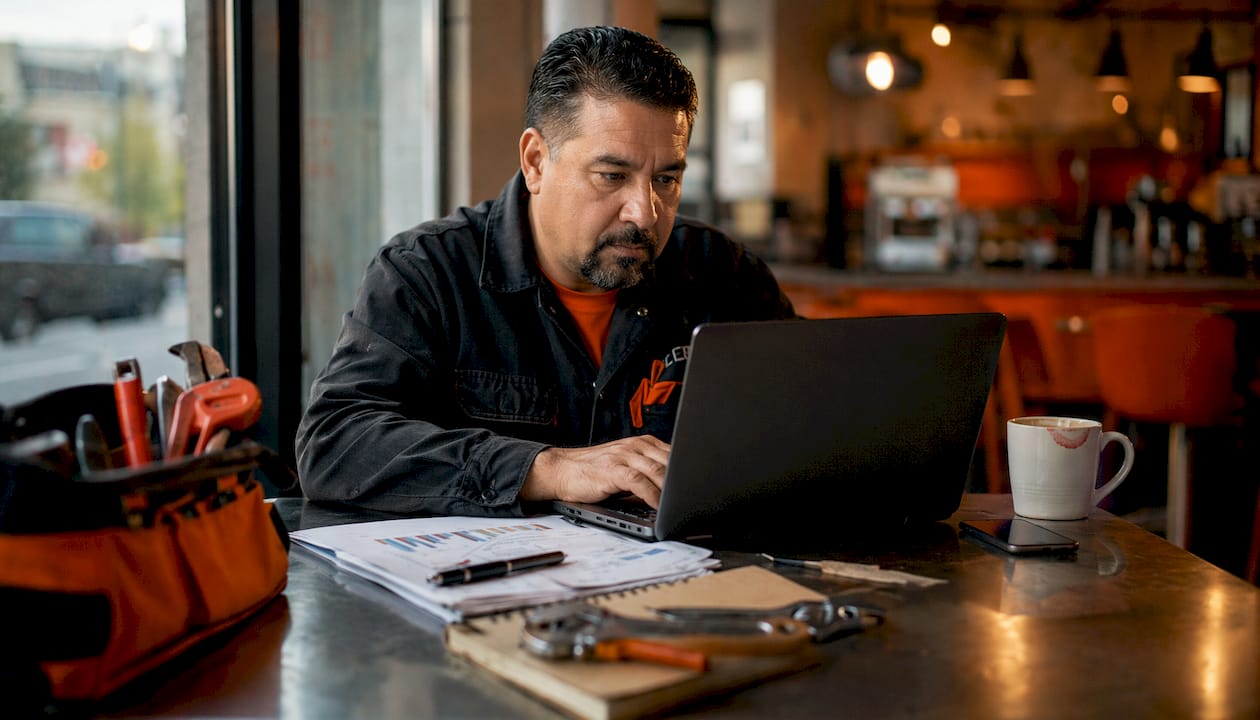
SEO for plumbers is the practice of optimizing your plumbing business's online presence so local customers find you first when they search for services like "emergency plumber near me" or "drain cleaning Chicago." The industry term is local search engine optimization, and it covers everything from your Google Business Profile to the structure of your service pages. Plumbers who apply these techniques consistently generate more inbound calls, more booked jobs, and less dependence on paid ads. This guide covers the full picture for 2026, including the emerging field of Answer Engine Optimization (AEO), which puts your business in front of AI-powered search results.
How does SEO for plumbers actually work?
Plumbing SEO strategies work by sending Google clear, consistent signals that your business serves a specific area and performs specific services. Google weighs three main factors for local results: relevance, distance, and prominence. Distance is a fixed factor you cannot control. Relevance and prominence are where your SEO work pays off. A plumber in Austin who has a fully optimized Google Business Profile, detailed service pages, and strong reviews will consistently outrank a competitor who has none of those things, even if the competitor is physically closer to the searcher.
The standard framework for local SEO for plumbers includes four pillars: Google Business Profile optimization, on-page website SEO, reputation management, and technical site health. In 2026, a fifth pillar has become critical: AEO, or Answer Engine Optimization. AEO prepares your content to appear inside AI-generated answers on platforms like Google AI Overviews and ChatGPT. Plumbers who ignore AEO are already losing visibility to competitors who have adopted it.

How to set up your Google Business Profile for plumbing
Your Google Business Profile (GBP) is the single most important asset in local plumbing SEO. It controls whether you appear in the Google Maps local pack, which sits above organic results and captures the majority of clicks for service searches.
Start with these steps:
- Claim and verify your listing. Go to Google Business Profile and verify ownership by postcard, phone, or video.
- Set your primary category to "Plumber." Generic categories like "Home Services" dilute your relevance signals.
- Add service areas by ZIP code and neighborhood. Precise service area settings tell Google exactly where to show your business in local results.
- List every service with keyword-rich descriptions. Write "water heater installation," "sewer line repair," and "emergency drain cleaning" as separate line items, not one generic entry.
- Add emergency hours if you offer them. An HVAC and plumbing company in Nashville saw a 31% increase in after-hours call volume after adding emergency hours to their GBP. That one field change drove measurable revenue.
- Upload real photos. Show your trucks, your team, and completed jobs. Stock photos signal inauthenticity to both Google and potential customers.
- Use attributes. Mark your business as licensed, insured, and any other applicable attributes. A strong GBP with accurate attributes builds trust signals that improve your ranking.
- Respond to every review. Responses show Google your profile is actively managed, which is a positive ranking signal.
Pro Tip: Write your GBP business description in the first person and include your top two or three service keywords naturally. Avoid stuffing a list of services into the description field. Google reads it as spam.
What keywords should plumbers target on their website?
Keyword research for plumbers follows a simple formula: service plus location. "Water heater repair Denver," "emergency plumber Bucktown," and "sewer inspection Phoenix" are the kinds of phrases that convert because the searcher already knows what they need and where they need it.
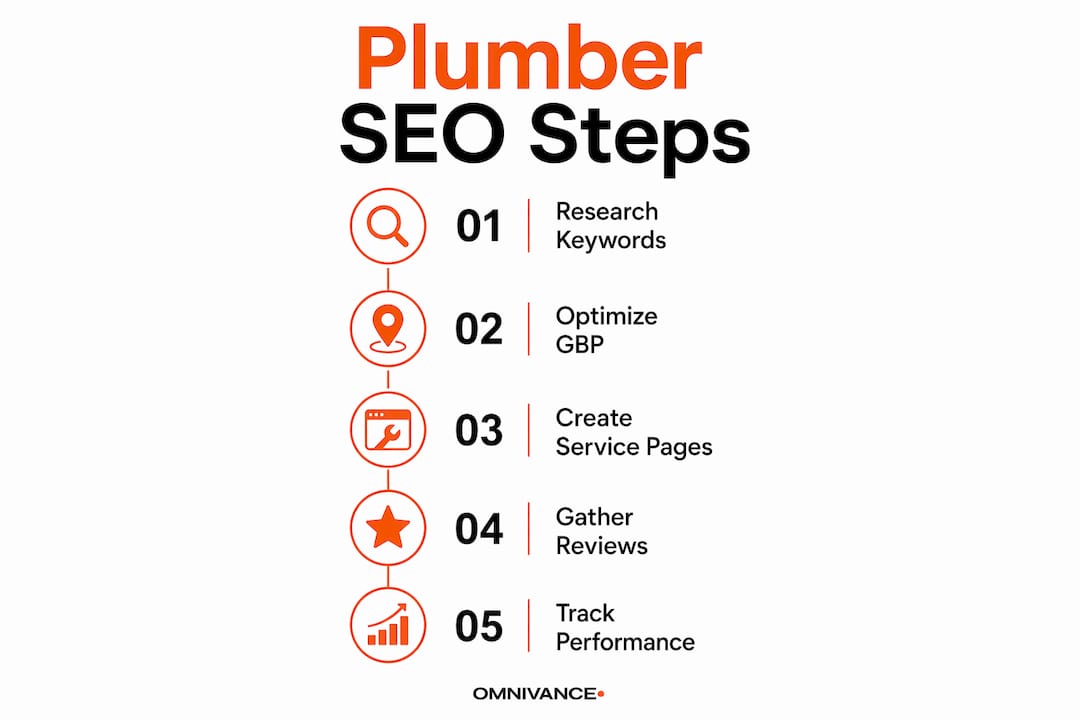
Build your keyword list by combining your core services with every city, neighborhood, and ZIP code you serve. Then create a dedicated page for each combination that matters. A Chicago plumber who built neighborhood-specific service pages with real project photos and local testimonials increased organic search visibility by 74% in five months. That result came from specificity, not volume.
How to structure your service pages
Follow this structure for every service page:
- H1 heading with service and location. Example: "Drain Cleaning in Lincoln Park, Chicago."
- Opening paragraph that answers the searcher's question directly. State what you do, how fast you respond, and what it typically costs.
- Service details section. Explain the process, common causes, and what customers should expect.
- Local proof. Include a testimonial from a customer in that neighborhood, a photo from a job in that area, or a reference to a local infrastructure detail like aging clay pipes common in older Chicago neighborhoods.
- Clear call to action with your phone number. Place it above the fold and repeat it at the bottom.
- LocalBusiness and Service schema markup. This structured data tells search engines exactly what your page covers and where you operate.
Pro Tip: Avoid copying the same paragraph across multiple location pages and swapping only the city name. Google's spam filters actively suppress thin "doorway" pages in 2026. Write at least one unique section per page that references something specific to that location.
| Page type | What makes it rank | Common mistake |
|---|---|---|
| Service page | Detailed process, pricing range, FAQ section | Too short, no local proof |
| Location page | Neighborhood references, local testimonials, photos | Templated copy with only city name swapped |
| Blog post | Answers a specific homeowner question | No internal links to service pages |
For broader context on marketing for home service contractors, the same location-plus-service structure applies across trades.
How do reviews and citations affect plumber SEO?
Reviews are one of the strongest local search trust signals. BrightLocal's 2026 survey confirms reviews rank among the top factors influencing both local rankings and consumer decisions. The quality and specificity of a review matters as much as the star rating.
A review that says "Mike fixed our burst pipe in Andersonville at 11 PM and charged a fair price" gives Google three useful signals: the service type, the neighborhood, and the quality of service. A review that says "great job" gives Google nothing. Train your team to ask customers for specific feedback after every job.
Build your citation presence across these platforms:
- Google Business Profile (primary)
- Yelp (high domain authority, widely trusted)
- Angi (formerly Angie's List, strong in home services)
- Nextdoor (hyper-local, high conversion intent)
- Better Business Bureau
- Local chamber of commerce directories
Consistent NAP data across all of these directories is non-negotiable. NAP stands for Name, Address, and Phone number. If your business name appears as "Joe's Plumbing LLC" on Google and "Joes Plumbing" on Yelp, AI systems and Google both interpret the inconsistency as a trust problem. Audit your citations quarterly and correct any discrepancies immediately.
For additional tactics on AI-driven social media that complement your local SEO, the same consistency principles apply across every platform where your business appears.
What is AEO and how do plumbers use it in 2026?
Answer Engine Optimization (AEO) is the practice of structuring your content so AI systems like Google AI Overviews and ChatGPT can extract and cite your business as the answer to a local query. It sits alongside traditional SEO, not in place of it. The underlying principle is simple: AI systems pull answers from content that is clearly structured, locally specific, and factually consistent across multiple sources.
Here is how to apply AEO to your plumbing website:
- Add FAQ schema to every service page. Write questions the way homeowners actually ask them. "How much does it cost to replace a water heater in Dallas?" is better than "Water heater replacement cost."
- Answer questions in the first sentence. AI systems favor answer-first content that delivers the key fact before any context or background.
- Create proprietary local content. Publish a cost guide with your actual pricing ranges by neighborhood. Include your average response time by ZIP code. This kind of data is unique to your business and builds authority with AI systems that other generic pages cannot replicate.
- Write an AI-readable GBP description. Use complete sentences. State your service area, your top three services, and your differentiator (licensed, 24/7, family-owned) in the first two sentences.
- Implement FAQ schema with local specificity. FAQ schema with locally relevant questions can surface your business in Google AI Overviews within eight weeks of implementation.
Pro Tip: Use the AEO vs. SEO vs. GEO framework to understand which optimization layer applies to each piece of content you create. Not every page needs all three, but your core service pages should target all of them.
The distinction between AEO and traditional SEO matters for plumbers because AI-powered results now appear above the standard local pack on many high-intent queries. A plumber who ranks third in traditional results but appears in the AI Overview for "emergency plumber near me" captures the click.
How do you track plumbing SEO performance?
Tracking plumbing SEO performance requires more than checking your overall Google ranking. You need a local keyword grid: a spreadsheet that tracks your ranking for each service-plus-location combination across your service area. Check phrases like "emergency plumber city]" and "water heater repair [neighborhood]" monthly. [Local keyword grids reveal exactly which areas are performing and which need more content or citation work.
Pro Tip: Use Google Search Console to identify which queries already send you traffic. Sort by impressions to find keywords where you appear but do not yet rank in the top three. Those pages need stronger local proof and internal links.
| SEO element | Healthy signal | Warning sign |
|---|---|---|
| GBP profile views | Increasing month over month | Flat or declining for 60+ days |
| Review velocity | 2+ new reviews per month | No new reviews in 90 days |
| Service page rankings | Top 5 for primary service terms | Page 2 or lower for core keywords |
| Website load speed | Under 3 seconds on mobile | Over 5 seconds on mobile |
| NAP consistency | Identical across all directories | Variations in name or phone format |
Technical SEO elements like fast page load times, mobile-friendly design, and secure HTTPS connections directly affect your rankings. Google favors websites that load quickly and work well on phones. Most plumbing service calls start with a mobile search, so a slow or broken mobile experience costs you jobs before you ever answer the phone.
Avoid these common mistakes that kill plumbing SEO results: using the same templated service area page for every city, letting your GBP go unmanaged for months, and ignoring negative reviews. Each of these signals to Google that your business is not actively serving the area.
Key Takeaways
Plumbing businesses that combine Google Business Profile optimization, hyper-local service pages, consistent citations, and AEO-ready content generate significantly more inbound leads than those relying on any single tactic alone.
| Point | Details |
|---|---|
| GBP is your foundation | Set precise service areas, add emergency hours, and upload real job photos to maximize local pack visibility. |
| Location-specific pages win | Build unique service pages per neighborhood with local proof, not templated copy with a swapped city name. |
| Reviews drive rankings | Ask customers to mention the service and neighborhood in their review to maximize trust signals. |
| AEO is now required | Add FAQ schema with locally specific questions to appear in AI-powered results within weeks. |
| Track by location and service | Use a local keyword grid monthly to find ranking gaps before they cost you leads. |
Why most plumbers are still leaving leads on the table
The plumbers I see winning in search right now are not the ones with the biggest budgets. They are the ones who treat their service area like a map of real neighborhoods, not a radius on a settings page. When I audit a plumbing website and find 12 identical location pages with only the city name changed, I know exactly why that business is not getting calls from those areas. Google knows the difference between a page written for a neighborhood and a page written to game a ranking system.
The shift toward AI-powered search makes this even more consequential. AI systems do not just read your website. They cross-reference your GBP, your reviews, your citations, and your content to decide whether you are the credible local answer to a homeowner's question. A plumber with a detailed Wicker Park service page, three Wicker Park customer reviews, and a GBP that lists Wicker Park as a service area will appear in AI results for that neighborhood. A plumber with a generic "Chicago" page will not.
The good news is that most of your competitors have not figured this out yet. The window to build a dominant local presence before AI search fully matures is open right now, but it will not stay open indefinitely. The plumbers who build hyper-local, AI-ready content in 2026 will hold those positions for years.
— laya
How Omnivancemedia helps plumbers grow with SEO
Omnivancemedia builds integrated SEO programs specifically for plumbing and home service businesses. The approach combines local SEO, AI-optimized content, and service page architecture into a single system designed to generate consistent inbound leads.
Omnivancemedia's full-service SEO offerings include Google Business Profile management, location page development, FAQ schema implementation, and monthly performance tracking. For plumbers ready to move beyond basic website presence and into AI-powered search visibility, Omnivancemedia's specialized SEO services cover the full AEO and GEO layer that most agencies do not touch. The firm's HVAC contractor results, including $340K in new contracts within 90 days, reflect what happens when local SEO and AI optimization work together inside one coordinated program.
FAQ
What is the most important SEO factor for plumbers?
Your Google Business Profile is the single most important factor for local plumbing SEO. Accurate service areas, complete attributes, and consistent review activity directly influence your position in the Google Maps local pack.
How long does plumbing SEO take to show results?
Most plumbers see measurable ranking improvements within 60–90 days of consistent optimization. FAQ schema implementation can surface your business in Google AI Overviews within eight weeks.
What keywords should a plumber target first?
Start with your highest-revenue service combined with your primary city. "Emergency plumber [city]" and "water heater replacement [city]" are high-intent phrases that convert at a strong rate.
How do I get more Google reviews as a plumber?
Ask every customer directly after the job is complete. Send a follow-up text with a direct link to your Google review page. Request that they mention the specific service and neighborhood to maximize the SEO value of each review.
What is AEO and does it matter for plumbers?
AEO, or Answer Engine Optimization, structures your content so AI systems like Google AI Overviews can cite your business as the local answer. It matters because AI-generated results now appear above the standard local pack on many high-intent plumbing searches.