SEO for HVAC Companies: 2026 Local Ranking Guide

SEO for HVAC companies is the process of optimizing your digital presence to rank prominently in local search results and the Google Map Pack, directly capturing emergency and seasonal service calls before competitors do. The industry term is "local search engine optimization," and it covers everything from your Google Business Profile to the service pages on your website. Map Pack improvements typically appear within 30–90 days, while organic leads surpass Google Ads spend after 6–12 months. HVAC searches carry extreme urgency. Conversion windows for repair calls are often under one hour, which means Map Pack presence drives more revenue than any blog post ever will. Google Business Profile signals, service-specific pages, and review management form the three pillars of effective HVAC search engine optimization.
How do I optimize my Google Business Profile for HVAC SEO?

Your Google Business Profile (GBP) is the single most powerful tool for HVAC local SEO strategies. GBP signals contribute 32% of your local ranking weight, second only to proximity. Getting it right is not optional.
Step-by-step GBP setup for HVAC contractors
-
Select the correct primary category. Use "HVAC Contractor" as your primary category year-round. Seasonal category shifts to "Heating Contractor" in winter or "Air Conditioning Contractor" in summer can capture peak demand searches. Add secondary categories like "Furnace Repair Service" and "Air Conditioning Repair Service" to cover more query types.
-
Configure your service area correctly. Set your GBP as a service-area business and hide your physical address. Showing a home address or warehouse triggers suspension risk and confuses customers expecting a storefront.
-
Write a complete business description. Include your specialties, certifications (NATE, EPA 608), emergency hours, and service area cities. Aim for 700–750 characters. Mention trust signals like years in business and manufacturer authorizations.
-
Upload photos weekly. Profiles with active photo uploads signal freshness to Google. Post images of completed jobs, your team, branded vehicles, and equipment. Label file names with location and service keywords before uploading.
-
Post weekly GBP updates. Use the Posts feature to share seasonal offers, maintenance tips, and completed project highlights. Weekly activity tells Google your profile is actively managed.
-
Answer every Google Q&A question. Seed your own Q&A section with common customer questions and answer them yourself. This controls the narrative and adds keyword-rich content directly to your profile.
Pro Tip: Ask your technician to request a review from the customer before packing up tools. On-site review requests produce higher review volume and velocity than automated post-job emails, and velocity is what moves your Map Pack ranking.
What website content should HVAC companies create to rank locally?
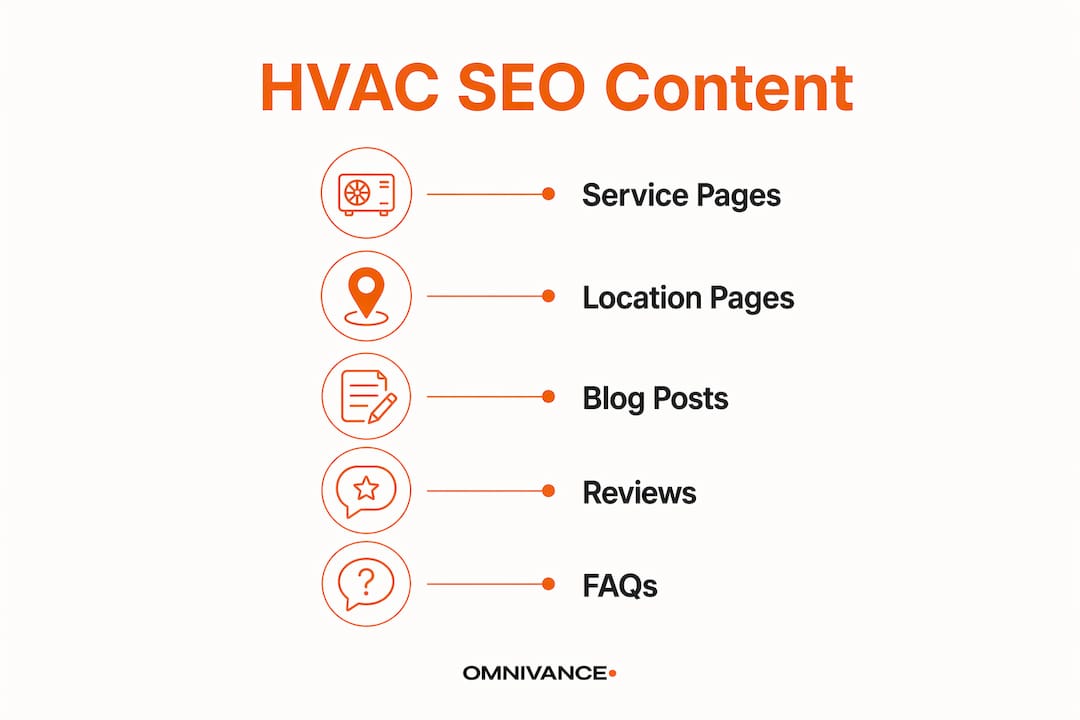
Your website content strategy determines whether you rank for high-value service queries in each city you serve. Generic "HVAC services" pages do not rank. Specific, location-tied service pages do.
-
Create one page per service. Build dedicated pages for AC repair, furnace installation, heat pump service, duct cleaning, and maintenance agreements. Each page should be 600–1,000 words, structured with a clear H1, a process outline, pricing transparency, and a FAQ section.
-
Build location pages for every city you serve. A page titled "AC Repair in City Name]" with local references, neighborhood names, and city-specific testimonials outranks a generic service page every time. [Dedicated service-and-city pages with schema markup and local testimonials are the foundation of strong local rankings.
-
Add schema markup to every page. Implement LocalBusiness, Service, FAQ, and Review schema. Schema markup helps Google understand your content and powers rich results and AI answer boxes. Use Google's Rich Results Test to verify implementation.
-
Maintain a seasonal content calendar. Publish furnace tune-up content in september and october. Publish AC maintenance content in march and april. Preparing content 1–3 months before peak season captures demand before competitors react.
Pro Tip: Follow a solid on-page SEO checklist for every new service or location page you publish. Consistent structure across pages compounds your ranking authority faster than one-off optimizations.
| Page Type | Primary Goal | Minimum Word Count |
|---|---|---|
| Service page (e.g., AC Repair) | Rank for service queries | 600 words |
| Location page (e.g., AC Repair in Dallas) | Rank for city-specific queries | 700 words |
| FAQ page | Capture voice and AI search | 400 words |
| Seasonal content (e.g., Fall Tune-Up) | Capture demand peaks | 500 words |
How do reviews and local citations impact HVAC rankings?
Review signals account for 16–20% of local ranking weight, and a minimum 4.3-star rating is required to compete in most markets. That threshold is not a suggestion. Profiles below 4.3 stars rarely appear in the top three Map Pack results.
Review velocity matters more than total volume. Earning 15–20 new reviews monthly outperforms a profile that collected 200 reviews in one week and then went quiet. Google reads consistent, recent activity as a trust signal. A dormant profile with 500 reviews loses ground to an active profile with 80.
Responding to reviews also affects rankings. Aim for an 80%+ response rate across all reviews, positive and negative. Responses show Google and prospective customers that your business is engaged.
Citations, meaning consistent listings of your business name, address, and phone number (NAP) across directories, support Google's trust signals. Maintain accurate listings across at least 26 key directories, including Google, Yelp, Angi, HomeAdvisor, BBB, and industry-specific directories like ACCA. NAP inconsistencies across directories confuse Google's local algorithm and suppress rankings.
Pro Tip: Build a direct review link using Google's review URL shortener and text it to customers immediately after the technician's on-site review request. A two-step ask, verbal then text, dramatically increases follow-through.
What technical SEO and backlinks help HVAC companies dominate search?
Technical SEO creates the foundation that content and reviews build on. Without it, even great content underperforms.
-
Pass Core Web Vitals. Google's mobile-first indexing means a slow mobile site loses ranking ground, especially during peak HVAC seasons when search volume spikes and load speed directly affects bounce rate.
-
Fix broken links and duplicate content. Duplicate city pages with swapped city names and identical body text trigger ranking penalties. Each location page must contain genuinely unique content.
-
Implement full schema coverage. LocalBusiness, Service, Review, and FAQ schema each serve a different function. Together, they increase your chances of appearing in AI-generated answer boxes and voice search results.
-
Build local backlinks from authoritative sources. Links from local news outlets, manufacturer dealer directories (Carrier, Trane, Lennox), and community organizations carry strong local relevance signals.
-
Sponsor local organizations. Sponsoring a youth sports league or a Habitat for Humanity build earns a backlink from a .org domain with genuine community authority. These links cost less than a single Google Ads day budget and last for years.
The digital marketing for contractors playbook mirrors this approach across trades. HVAC companies that treat backlink building as a quarterly habit consistently outrank those that treat it as a one-time task.
How long does HVAC SEO take and what does it cost?
Timelines and budgets are where most HVAC owners get surprised. Setting accurate expectations upfront prevents wasted spend and premature strategy changes.
| Milestone | Typical Timeline |
|---|---|
| Map Pack visibility improvement | 30–90 days |
| Service page rankings (long-tail) | 4–9 months |
| Head term authority (e.g., "AC repair [city]") | 12–24 months |
| Organic leads surpassing Google Ads spend | 6–12 months |
Monthly SEO retainers for residential HVAC companies range from $800 for budget-tier single-location campaigns to $3,500 for standard multi-location programs. Premium campaigns reach $5,500 per month. Commercial HVAC SEO combined with account-based marketing runs $8,000–$12,000 monthly.
SEO and Google Ads work best together, not as substitutes for each other. Ads capture immediate seasonal demand while SEO builds the long-term authority that reduces your cost per lead over time. Running both in parallel is the most efficient path to growth.
Pro Tip: Responding to inbound leads within 1 minute increases conversion probability by 391%. Waiting just 5 minutes drops your chances by 80%. Your SEO investment is only as good as your lead response process.
Key Takeaways
Effective HVAC search engine optimization requires combining Google Business Profile optimization, targeted service and location pages, consistent review velocity, and technical site health to dominate local search results.
| Point | Details |
|---|---|
| GBP is your top local ranking lever | Optimize primary category, service areas, photos, and posts to capture 32% of ranking weight. |
| Service and location pages drive organic leads | Build one dedicated page per service-city combination with schema markup and local content. |
| Review velocity beats review volume | Earn 15–20 new reviews monthly through on-site technician requests for sustained ranking gains. |
| Technical SEO enables content to perform | Fix Core Web Vitals, duplicate content, and schema gaps before scaling content production. |
| SEO and paid ads belong together | Run Google Ads for immediate leads while SEO builds authority that lowers long-term cost per lead. |
What I've learned after watching HVAC companies win and lose at local SEO
The HVAC companies I've seen dominate their markets share one habit: they treat their Google Business Profile like a storefront window, not a set-it-and-forget-it checkbox. They post weekly, respond to every review within 24 hours, and have their technicians ask for reviews before the service van leaves the driveway. That discipline compounds faster than any technical fix.
The biggest mistake I see is HVAC owners pouring budget into blog content about "how air conditioners work" while their Map Pack listing sits half-complete. Informational blog traffic does not convert emergency service calls. A homeowner whose AC fails at 7 PM on a Friday is not reading a blog. They are clicking the first Map Pack result with strong reviews and a phone number. Win that moment first, then build content authority.
Seasonality also catches companies off guard. HVAC SEO is not a flat-line effort. You need to publish furnace content in september, AC content in march, and maintenance content in between. Agencies that do not understand HVAC seasonality will miss these windows every year.
Finally, ranking is only half the job. Responding to leads within one minute is the other half. I have watched companies with top Map Pack rankings lose jobs to competitors ranked third, simply because they were slower to answer the phone. Own the ranking and the response process equally.
— laya
How Omnivancemedia helps HVAC companies grow through search
HVAC contractors working with Omnivancemedia have generated results like $340K in new contracts within 90 days. That outcome comes from treating SEO, paid ads, and CRM automation as one connected system, not three separate vendors.
Omnivancemedia's HVAC and contractor SEO services cover Google Business Profile optimization, service and location page builds, schema implementation, review management, and local backlink programs. Flexible service tiers fit single-location residential contractors and multi-location commercial operations alike. If you are ready to build a local search presence that generates leads without paying for every click, see the full digital marketing services Omnivancemedia offers for HVAC businesses.
FAQ
What is the most important factor in HVAC local SEO?
Proximity to the searcher is the single largest ranking factor at 55%, followed by Google Business Profile signals at 32%. Optimizing your GBP is the highest-leverage action you can take.
How many reviews does an HVAC company need to rank in the Map Pack?
There is no fixed number, but a minimum 4.3-star rating is required to compete in most markets. Consistent velocity of 15–20 new reviews per month matters more than total review count.
Should HVAC companies use Google Ads or SEO?
Both. SEO and Google Ads complement each other: Ads deliver immediate seasonal leads while SEO builds long-term authority that reduces cost per lead over time.
How long before HVAC SEO produces real results?
Map Pack improvements typically appear in 30–90 days. Organic leads from service page rankings take 4–9 months, and head-term authority for competitive queries takes 12–24 months.
What does HVAC SEO cost per month?
Monthly retainers range from $800 for budget single-location campaigns to $5,500 for premium multi-location programs. Commercial HVAC SEO with account-based marketing runs $8,000–$12,000 monthly.