SEO for Dentists: Rank Higher and Get More Patients

SEO for dentists is the process of optimizing your online presence so local patients find your practice first when they search on Google, Bing, or AI-powered platforms like Microsoft Copilot. Dental SEO, the industry's standard term for this discipline, covers everything from your Google Business Profile to your service pages to the structured data your website sends to search engines. Google Business Profile optimization carries 32% of Local Pack ranking weight, making it the single highest-return activity you can do. Reviews account for another 24% of that weight, and recent reviews are weighted 2.3 times more after Google's march 2026 update. If you run a dental practice and you are not actively managing these two assets, you are handing patients to the practice down the street.
What are the foundational SEO steps every dental practice must do first?
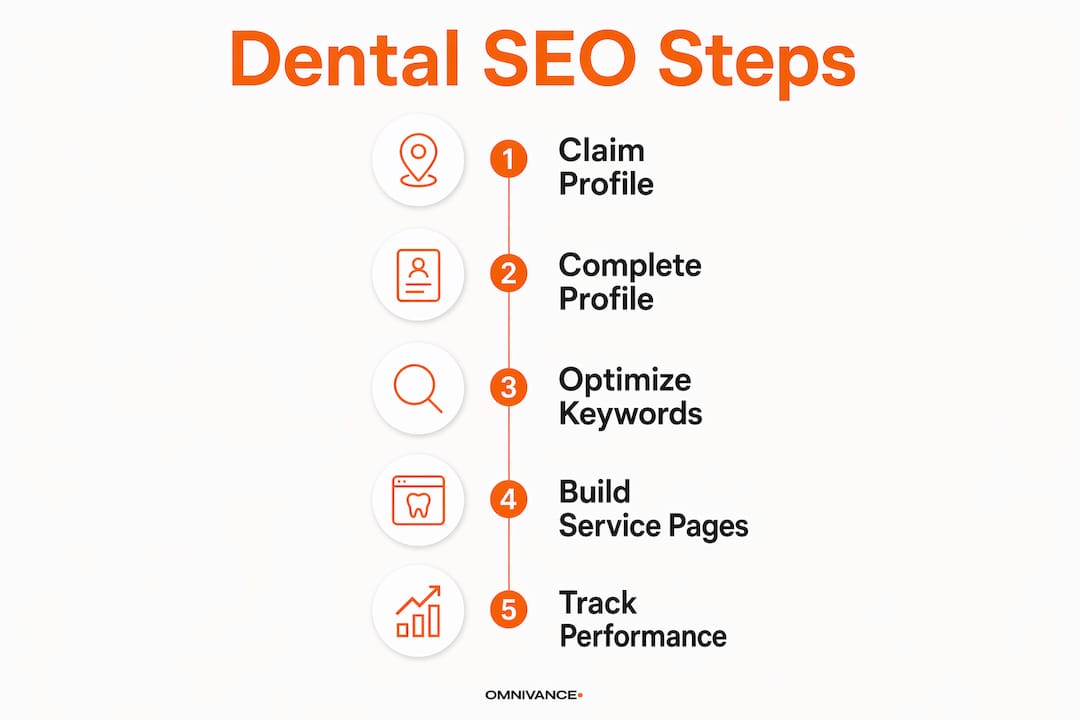
Your Google Business Profile is the most important asset in local dental SEO. GBP optimization drives about 68% of clicks on local "dentist near me" searches. That number alone tells you where your first hour of effort should go.
Start by claiming and fully completing your profile. Select the most specific primary category, typically "Dentist," and add secondary categories for specialties like "Cosmetic Dentist" or "Pediatric Dentist." Fill in every service you offer, your hours, your website URL, and your phone number. Upload at least 10 photos of your reception area, treatment rooms, and staff. Practices with more photos consistently earn more profile views and direction requests.

NAP consistency is the next non-negotiable step. NAP stands for Name, Address, and Phone number. Consistent NAP across your website, GBP, and top directories prevents ranking dilution caused by conflicting information. A single digit off in your phone number across 15 directories signals unreliability to Google's algorithm.
Building a steady stream of patient reviews is equally critical. Ask for reviews at checkout, via text follow-up, or through your patient management system. Respond to every review, positive or negative, within 48 hours. Google reads your responses as engagement signals. A practice with 200 reviews and a 4.8 rating will consistently outrank one with 40 reviews and a 4.9 rating.
- Claim and fully complete your Google Business Profile with accurate categories and services
- Upload at least 10 practice photos to your GBP listing
- Audit NAP consistency across your website and top 20 directories
- Request reviews at every patient touchpoint and respond promptly
- Check your GBP insights monthly to track impressions, clicks, and calls
Pro Tip: Set a recurring monthly calendar reminder to review your GBP insights. Track direction requests and phone calls separately. If calls drop while impressions hold steady, your phone number or hours may have a data error somewhere in your citation network.
How to create dental service pages that convert patients
Service pages with geo-targeted keywords and FAQ schema are among the most effective patient converters in dental SEO. The reason is simple: a patient searching "dental implants Austin TX" has already decided they want the procedure. Your page just needs to confirm you are the right provider.
Build a separate page for every major procedure you offer. Teeth whitening, dental implants, Invisalign, root canals, and pediatric cleanings each deserve their own URL. Use the procedure name plus your city in the page title and the first H1 heading. For example: "Dental Implants in Chicago, IL: Restore Your Smile at [Practice Name]."
Write a direct answer paragraph of 40–60 words under each major heading. This format feeds Google's AI Overviews and featured snippets directly. If a patient asks "How long do dental implants last?" your page should answer that in plain language within the first two sentences of the relevant section, not buried in paragraph five.
Highly optimized service pages combine keyword targeting with transparent pricing, insurance acceptance details, patient testimonials, and internal links to related pages. That combination builds topical authority and reduces the friction that stops patients from booking.
| Page element | Why it matters |
|---|---|
| Geo-targeted title tag | Matches the exact search query patients type |
| Direct answer paragraph | Feeds AI Overviews and featured snippets |
| FAQ with schema markup | Captures voice search and "People Also Ask" boxes |
| Pricing and insurance info | Reduces pre-call anxiety and increases booking intent |
| Internal links to related pages | Builds topical clusters and passes authority across the site |
Pro Tip: Dental searches spike 83% in january as patients activate new insurance benefits. Publish or update insurance-specific landing pages in december so they are indexed and ranking before the surge hits.
What local backlink and citation strategies improve dental SEO rankings?
Backlinks from relevant local sources outperform generic directory links by a wide margin. Ten relevant local links produce more ranking improvement than 100 generic ones. Quality and relevance are the only metrics that matter here.
The best sources for dental backlinks fall into four categories:
- Local healthcare directories: Healthgrades, Zocdoc, and the American Dental Association member directory all carry authority and relevance.
- Community organizations: Sponsoring a local youth sports team or school event often earns a link from the organization's website. These links are local, relevant, and trusted.
- Local media: A quote in a local news article about oral health trends or a community event earns a high-authority link that most practices never pursue.
- Dental associations: State dental society membership pages frequently link to member practice websites. If yours does not, ask.
Avoid submitting your practice to hundreds of generic business directories. Low-quality links from irrelevant sites can dilute your prominence score. Fix citation inconsistencies before you build new links. A citation audit using tools like BrightLocal or Whitespark will surface conflicting NAP data across the web.
Create location-specific pages if you serve multiple neighborhoods or suburbs. A page titled "Family Dentist Serving [Neighborhood Name]" targets hyper-local searches that your main homepage will never rank for. These pages also give you a natural reason to reach out to neighborhood associations and community blogs for links.
Pro Tip: When you sponsor a local event, always ask the organizer to link to your website from the event page. Most will say yes without hesitation, and that link carries far more weight than a generic directory listing.
How to optimize for AI-driven dental search
AI-referred sessions are up 527% year over year, making AI citation optimization a real priority for dental practices in 2026. Google AI Overviews and Microsoft Copilot now pull directly from structured, cited content. If your website lacks schema markup, you are invisible to these systems.
Schema.org provides the markup types your dental website needs. Add DentalClinic and LocalBusiness schema to your homepage and contact page. Add FAQPage schema to every service page that includes a question-and-answer section. Add HowTo schema to any procedural content, such as "How to prepare for a root canal." Add AggregateRating schema to display your review score directly in search results.
Beyond schema, the content structure itself matters. AI-driven search optimization requires structured, authoritative content with verifiable citations. Write content that answers specific patient questions in the first sentence of each section. Avoid burying answers in long paragraphs. AI systems parse the first direct answer they find and cite it.
| Schema type | Where to apply it |
|---|---|
| DentalClinic / LocalBusiness | Homepage and contact page |
| FAQPage | All service pages with Q&A sections |
| HowTo | Procedural content and patient preparation guides |
| AggregateRating | Any page displaying patient review scores |
| Service | Individual procedure pages |
Build topical clusters by linking related pages together. A dental implants page should link to your bone grafting page, your financing page, and your before-and-after gallery. This cluster structure signals depth of expertise to both traditional search algorithms and AI systems parsing your site's knowledge graph.
How to measure and maintain dental SEO success
Tracking SEO success requires measuring GBP impressions, calls, new patient bookings, keyword rankings, and AI citation presence every month. Rank alone tells you nothing about revenue. A practice ranking third for "dentist near me" but converting 15 new patients per month beats one ranking first but converting four.
Set up call tracking on your organic landing pages. Assign a unique phone number to your website traffic so you can separate SEO-generated calls from walk-ins, referrals, and paid ads. Connect Google Analytics to your booking system if possible. The goal is a direct line from search impression to booked appointment.
- Monitor GBP impressions, direction requests, and phone calls monthly
- Use call tracking to link organic traffic to actual patient bookings
- Track keyword rankings for your top 10 procedure and location combinations
- Check AI citation appearances in Google AI Overviews and Bing Copilot quarterly
- Review your citation consistency across directories every six months
Most single-location practices break even on SEO investment within 6–9 months. By month 18, cost per new patient drops to under $100 with a phased professional approach. That trajectory is only possible if you measure consistently and adjust based on real patient data, not just rankings.
A phased SEO approach prevents the most common failure mode in dental SEO: attempting too many strategies at once. Start with GBP and reviews. Add service page content in month two or three. Layer in schema markup and backlink building after your foundational assets are solid.
Key Takeaways
Dental SEO succeeds when you build foundational assets first, create geo-targeted content that answers patient questions directly, and measure results by new patient bookings rather than rankings alone.
| Point | Details |
|---|---|
| GBP is your top priority | Google Business Profile carries 32% of Local Pack ranking weight. |
| Reviews drive rankings and trust | Recent reviews are weighted 2.3x more after Google's 2026 update. |
| Service pages convert patients | Separate pages per procedure with geo-targeted titles and FAQ schema capture high-intent searches. |
| Local backlinks beat volume | Ten relevant local links outperform 100 generic directory submissions. |
| Phase your SEO investment | Start with GBP and reviews, then content, then schema and backlinks for sustained ROI. |
Why dental SEO is infrastructure, not a marketing tactic
I have worked with enough service businesses to say this clearly: dental practices that treat SEO as a one-time project always plateau. The ones that treat it as patient acquisition infrastructure, something they maintain and measure like a piece of clinical equipment, are the ones that dominate their local market within 18 months.
The shift that most practice owners miss is the difference between prominence and tricks. Stuffing keywords into a homepage title tag is a trick. Building 200 authentic reviews, maintaining NAP consistency across 30 directories, and publishing a procedure page that answers the exact question a patient typed at 11 PM on a Tuesday. That is prominence. Google rewards it because patients reward it.
AI search has made this even more true. When a patient asks Microsoft Copilot "who is the best dentist for implants in [city]," the answer comes from structured, verified, cited content. Practices without schema markup and direct-answer content simply do not appear. The digital marketing for dentists strategies that worked in 2022 are not enough in 2026.
My honest recommendation: do not try to do everything at once. Pick your three highest-margin procedures. Build excellent pages for each. Get your GBP to 100% completion. Then ask every satisfied patient for a review. Do those three things consistently for six months before you touch anything else. The compounding effect is real, and it is more durable than any paid ad campaign you will ever run.
— laya
How Omnivancemedia helps dental practices grow with SEO
Dental SEO works best when every piece connects: your GBP, your service pages, your reviews, your schema, and your patient follow-up system. Most practices manage these in silos and wonder why results stall.
Omnivancemedia builds integrated dental SEO and marketing systems that treat patient acquisition as a single connected process. From phased SEO implementation to CRM automation that follows up with leads before they book elsewhere, every service is designed to reduce your cost per new patient and grow your practice revenue. Omnivancemedia has helped businesses across service industries generate measurable results within 90 days. Dental practices ready to scale past $500K in annual revenue get a plan built around their specific procedures, market, and growth goals.
FAQ
What is dental SEO and how does it differ from general SEO?
Dental SEO is the practice of optimizing a dental website and Google Business Profile to rank in local search results for procedure and location-specific queries. It differs from general SEO by prioritizing Local Pack rankings, patient reviews, and geo-targeted service pages over broad organic traffic.
How long does SEO take to work for a dental practice?
Most single-location dental practices see meaningful results within 3–6 months and reach SEO investment breakeven within 6–9 months. Cost per new patient continues to drop through month 18 with consistent effort.
How many Google reviews does a dental practice need to rank?
There is no fixed number, but review recency matters more than volume after Google's 2026 update. A steady flow of new reviews every month outperforms a large but stagnant review count.
What schema markup does a dental website need?
Dental websites need DentalClinic, LocalBusiness, FAQPage, AggregateRating, and Service schema at minimum. These types help Google and AI platforms like Microsoft Copilot parse and cite your content accurately.
Does SEO replace paid ads for dental patient acquisition?
SEO and paid ads serve different timelines. Paid ads generate immediate calls while SEO builds compounding visibility over months. The most cost-effective dental practice growth strategy uses both, then reduces ad spend as organic rankings mature.