SEO for Accountants: Win More Clients in 2026

SEO for accountants is the targeted practice of optimizing your accounting firm's online presence to rank higher in search engines and attract quality client leads. The discipline covers both traditional organic search optimization and local SEO for accounting firms, and it now extends into AI-powered platforms that answer client questions directly. Firms that treat search engine optimization as a long-term investment, not a one-time task, consistently outperform competitors who rely on referrals alone. Effective SEO builds compounding growth over time, while paid advertising stops the moment you stop paying. The emergence of Generative Engine Optimization (GEO) adds a new layer: your content must be structured so AI systems cite your firm, not just rank it.
How do accountants identify and target the right SEO keywords?
Keyword research for accounting firm SEO starts with understanding how potential clients actually search. Most clients use one of three intent types: informational ("how do I file a tax extension"), local ("tax accountant in Denver"), or commercial ("best CPA firm for small business"). Each intent type requires a different content response.

The most reliable starting point is Google Autocomplete. Type "tax accountant" into Google and note every suggestion that appears. These are real queries from real people. Google Keyword Planner adds search volume data so you can prioritize which terms to target first.
Focus on localized, service-specific phrases over broad terms. "Accountant" is too competitive for most firms. "Small business bookkeeping in Austin" or "payroll services for restaurants in Chicago" targets clients who are ready to hire. These longer phrases, called long-tail keywords, convert at a higher rate because they match specific needs.
- Target city-level phrases: "tax preparation in [city]" and "CPA firm near [neighborhood]"
- Build service-specific pages around terms like "QuickBooks setup," "BAS lodgement," and "IRS audit representation"
- Use question-based keywords for blog content: "what is the difference between a CPA and a bookkeeper"
- Check competitor pages for keyword gaps using free tools like Google Search Console
- Prioritize conversion potential over raw search volume
Content targeting client questions increases site relevance and authority over time. A page answering "how much does a CPA cost for a small business" attracts a visitor who is already evaluating their options.
Pro Tip: Use Google's "People Also Ask" boxes to find question-based keywords. Each question in that box is a potential blog post or FAQ section that can rank independently.
What are the best practices for creating SEO-friendly accounting service pages?
Generic service pages hurt your rankings. A single "Services" page listing tax prep, payroll, and bookkeeping in three bullet points tells Google almost nothing. Dedicated, in-depth service pages for each offering give Google the specificity it needs to rank your firm for niche searches.
Each service page should answer the most common client questions about that service. Structure the content with clear H2 and H3 headings, factual answers, and links to authoritative sources like the IRS or your state CPA board. This approach satisfies Google's E-E-A-T standards (Experience, Expertise, Authoritativeness, Trustworthiness) and positions your content for AI citations.
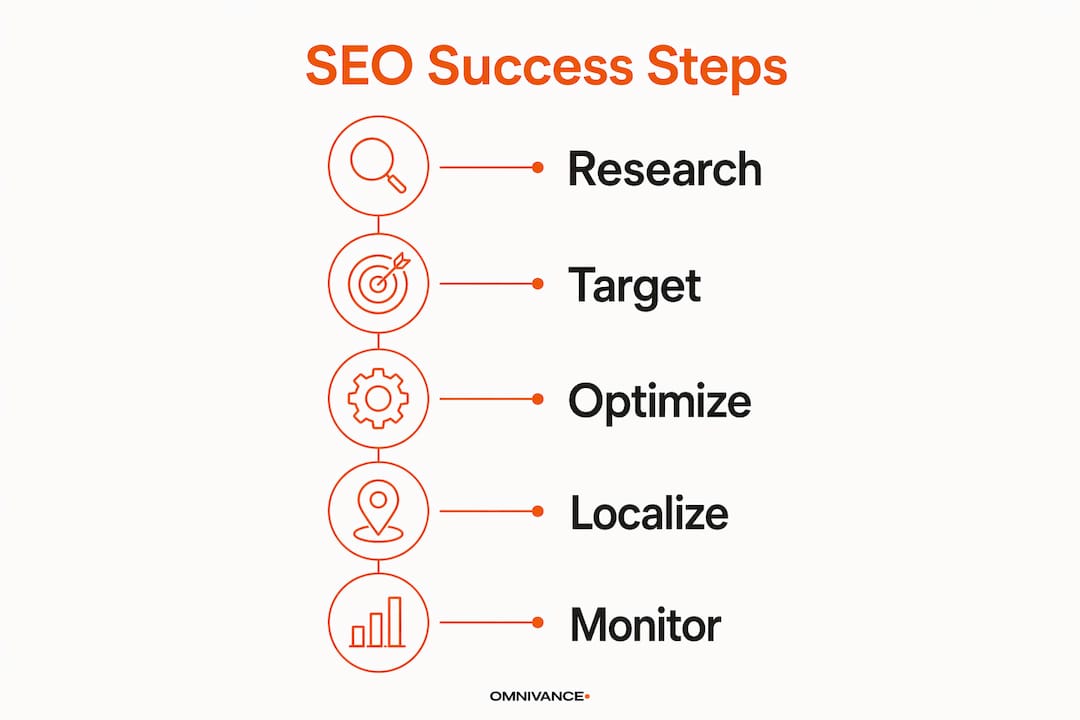
Building pages that rank and convert
Follow this sequence when building or rebuilding service pages:
- Write a clear page title that includes the service and location: "Tax Preparation Services in Phoenix, AZ."
- Open with a direct answer to the client's core question about that service.
- Include your firm's credentials, CPA license numbers, and years of experience.
- Add a FAQ section at the bottom using real client questions.
- Implement AccountingService schema and FAQ schema markup in the page code.
- Link to related service pages and relevant blog posts.
- Update the page at least once per year to reflect current tax laws or regulatory changes.
AccountingService schema markup increases your chances of appearing in rich results and AI-generated answers. Schema is code added to your page that tells search engines exactly what your business does, where it operates, and who runs it.
Pro Tip: Include your CPA license number and a link to your state board's verification page on every service page. This single addition signals professional credibility to both Google and prospective clients.
Location-specific pages matter if you serve multiple cities. A firm covering Dallas, Fort Worth, and Plano should have a separate optimized page for each city. Duplicate content across these pages is a common mistake. Each page needs unique copy, local references, and city-specific schema.
| Page type | Primary purpose | Key SEO element |
|---|---|---|
| Core service page | Rank for service-specific queries | Detailed content, schema markup |
| Location page | Rank for city-level searches | NAP data, local schema, map embed |
| Blog post | Capture informational queries | Question-based headings, internal links |
| FAQ page | Target voice and AI search | Structured Q&A, FAQ schema |
How can accountants optimize their local SEO and Google Business Profile effectively?
Local SEO for accounting firms is the fastest path to new client calls. Most people searching for an accountant want someone nearby. Google's local pack, the three business listings that appear above organic results, captures a large share of those clicks.
Claiming and fully completing your Google Business Profile (GBP) is the first step. Optimizing your Google Business Profile with correct categories and consistent NAP (name, address, phone number) directly boosts local search visibility. Select "Accounting Firm" or "Tax Preparation Service" as your primary category, then add relevant secondary categories.
- Verify your GBP listing through Google's postcard or phone verification process
- Add your full service area, office hours, and a keyword-rich business description
- Upload at least 10 photos: office exterior, interior, team headshots, and any awards
- Post weekly updates about tax deadlines, service announcements, or firm news
- Respond to every review, positive or negative, within 48 hours
Reviews are a direct ranking factor. Nearly 98% of consumers read online reviews before choosing a service provider. That number means your review count and average rating affect both your rankings and your conversion rate. Maintaining a steady cadence of reviews outperforms occasional bulk spikes. Ask satisfied clients for a review at the end of each engagement, not just during tax season.
Beyond GBP, build citations on reputable directories. List your firm on Yelp, the AICPA directory, your state CPA society's member directory, and local Chamber of Commerce sites. Every citation that matches your GBP name, address, and phone number strengthens your local authority.
Embed a Google Map on your contact page and add LocalBusiness schema to your website's homepage and location pages. These technical signals confirm your physical presence to Google's local algorithm.
Which technical SEO aspects should accounting firms prioritize?
Technical SEO is the foundation that makes all your content work. A well-written service page on a slow, broken website will not rank. Google measures site performance through Core Web Vitals, a set of metrics covering load speed, visual stability, and interactivity.
Google prioritizes mobile-responsive sites, and slow speed or broken navigation directly lowers your rankings. Run your site through Google's PageSpeed Insights tool to identify specific issues. Common fixes include compressing images, enabling browser caching, and removing unused JavaScript.
- Fix all broken links using Google Search Console's Coverage report
- Eliminate duplicate content by using canonical tags on similar pages
- Create an XML sitemap and submit it to Google Search Console
- Use HTTPS across every page, not just the homepage
- Ensure your navigation is simple enough that any page is reachable within three clicks
Google Search Console and Google Analytics together give you the full picture of your SEO performance. Search Console shows which queries trigger your pages and flags technical errors. Google Analytics shows what visitors do after they arrive, which pages they exit from, and whether they fill out your contact form.
Track three core metrics every month: organic sessions, keyword rankings for your target phrases, and lead conversions from organic traffic. These three numbers tell you whether your SEO investment is working.
Pro Tip: Set up a Google Search Console property for both the www and non-www versions of your site. Then confirm which version Google indexes. Mismatched versions cause duplicate content issues that silently drain your rankings.
How to integrate Generative Engine Optimization into your accounting SEO strategy
Generative Engine Optimization (GEO) is the practice of structuring content so AI platforms like Google's AI Overviews, ChatGPT, and Perplexity cite your firm in their answers. It differs from traditional SEO in one key way: the goal is not just a ranking but a direct citation in an AI-generated response. GEO is transforming digital marketing for professional services, and accounting firms that adapt early will hold a significant advantage.
Firms with 15 or more topic-specific pages outperform those with a single general page in AI citations. That means content breadth matters as much as content depth. Content formatted with clear questions and direct, verifiable answers is preferred by AI systems when generating responses.
- Write every FAQ answer as a complete, standalone sentence that makes sense without context
- Link to official sources: IRS publications, AICPA standards, and state tax authority pages
- Include author bios with CPA credentials and years of experience on every page
- Build content clusters: one pillar service page linked to five to ten supporting Q&A articles
- Monitor your firm's appearance in AI Overviews by searching your target queries in Google and noting which sources are cited
The AEO vs SEO vs GEO distinction matters here. Answer Engine Optimization (AEO) targets voice search and featured snippets. GEO targets AI-generated answers. Both require the same underlying content structure: short, factual, credentialed, and linked to authoritative sources.
Key Takeaways
Accounting firm SEO requires consistent investment in local presence, service-specific content, and AI-ready formatting to generate sustainable client leads.
| Point | Details |
|---|---|
| Local SEO comes first | Claim and fully complete your Google Business Profile before tackling complex technical work. |
| Service pages beat generic pages | Each core service needs its own dedicated page with schema markup and factual Q&A content. |
| Reviews drive rankings and trust | Nearly 98% of consumers read reviews; ask for them consistently after every client engagement. |
| GEO requires structured content | Firms with 15+ topic-specific pages earn more AI citations than those with a single general page. |
| Measure three metrics monthly | Track organic sessions, keyword rankings, and lead conversions to confirm SEO progress. |
What I've learned from watching accounting firms get SEO wrong
Most accounting firms I've seen start SEO by chasing the wrong things. They spend months on technical audits before they've written a single strong service page. They target "accountant" as a keyword when they should be targeting "small business CPA in [their city]." The technical work matters, but it amplifies content that already exists. If the content is thin, faster load times change nothing.
The other pattern I see constantly is treating SEO as a project with an end date. A firm hires someone, runs a three-month campaign, sees modest results, and stops. SEO ROI typically starts compounding after 12–18 months of consistent effort. Stopping at month three is like canceling a retirement account because it hasn't made you rich yet.
The firms that win are the ones where a practitioner is visibly involved in the content. A page written by "the marketing team" ranks lower than a page with a named CPA author, a license number, and a link to their state board profile. Google's systems and AI platforms both reward that signal. Consistent, factual content authored by credentialed practitioners is the single most durable SEO advantage an accounting firm can build.
My honest advice: start with your Google Business Profile and your top three service pages. Get those right before touching anything else. The quick wins from local SEO will generate calls while your longer-term content strategy builds authority. Measure everything from day one so you can show the return when someone asks whether SEO is worth it.
— laya
How Omnivancemedia helps accounting firms grow through SEO
Accounting firms that want results without managing five separate vendors have a clear alternative. Omnivancemedia combines SEO for accounting firms with paid advertising, CRM automation, and content production into one coordinated system. That means your service pages, Google Business Profile, schema markup, and AI-ready content all work together rather than pulling in different directions.
Omnivancemedia's approach covers the full range of online marketing for accountants, from zero-click SEO built for AI search to structured data implementation and content clusters designed to earn citations. The results speak for themselves: an e-commerce client grew monthly revenue from $80K to $420K using the same integrated system. Accounting firms ready to scale their client base can request a consultation through Omnivancemedia's services page.
FAQ
What is SEO for accountants?
SEO for accountants is the process of optimizing an accounting firm's website and online profiles to rank higher in search engine results and attract new client leads organically. It includes keyword targeting, local SEO, content creation, and technical site improvements.
How long does accounting firm SEO take to show results?
SEO typically begins generating measurable ROI after 12–18 months of consistent effort, though local SEO tactics like Google Business Profile optimization can produce results within weeks.
What keywords should accountants target?
Accountants should target localized, service-specific phrases like "tax accountant in [city]" or "small business CPA near me" rather than broad terms like "accountant," which are too competitive for most firms.
How does Google Business Profile affect local SEO?
A fully completed Google Business Profile with correct categories, consistent NAP data, and regular reviews directly improves your firm's visibility in Google's local pack, which appears above organic results for location-based searches.
What is GEO and why does it matter for accountants?
Generative Engine Optimization (GEO) is the practice of structuring content so AI platforms cite your firm in their generated answers. Firms with 15 or more topic-specific pages earn significantly more AI citations than those with a single general page.