The Role of AI in Campaign Optimization: 2026 Guide

How AI is redefining campaign optimization for modern marketers
AI-driven campaign optimization is the practice of using machine learning, predictive analytics, and natural language processing to automate and continuously improve advertising decisions in real time. The result: campaigns that adjust bids, reallocate budgets, test creatives, and refine audience targeting faster than any human team can manage manually. This is not a marginal efficiency gain. AI-driven bidding reduces wasted ad spend by approximately 37% while boosting ROI by 50% compared to manual methods.
The shift from manual to AI-managed campaigns is fundamentally about what gets optimized. Traditional campaign management chases surface metrics: clicks, impressions, cost-per-click. AI systems, when set up correctly, optimize toward actual business outcomes: pipeline, revenue, customer lifetime value. That distinction changes how you build campaigns from the ground up.
Here is what AI brings to the table in practice:
- Automated bidding and budget pacing that adjusts in real time based on conversion probability signals
- Predictive audience modeling that identifies high-value segments before they convert
- Dynamic creative optimization (DCO) that tests and serves the best-performing ad variants automatically
- Cross-channel attribution that maps the actual customer journey across touchpoints
- Natural language processing (NLP) for ad copy generation, keyword expansion, and sentiment analysis
- Multivariate A/B testing at a scale no manual workflow can replicate
- Anomaly detection that flags performance drops before they compound into budget waste
Understanding the role of AI in marketing strategies goes beyond knowing what these capabilities are. It means knowing how they connect into a system that learns, adapts, and compounds performance over time.
Table of Contents
- How AI-driven campaign optimization actually works
- What marketers actually gain from AI in their campaigns
- Practical use cases of AI across digital campaigns
- Challenges and real considerations before you implement AI
- Expert perspectives on where AI campaign optimization is heading
- Omnivancemedia puts AI-powered campaign optimization to work for your business
- Key Takeaways
How AI-driven campaign optimization actually works
The mechanics behind AI campaign optimization start with data ingestion. AI systems pull signals from ad platforms, CRMs, website analytics, and third-party data sources simultaneously, building a continuously updated picture of what is working and what is not. This is not batch processing at the end of the day. It is real-time learning that feeds directly into bidding and targeting decisions.
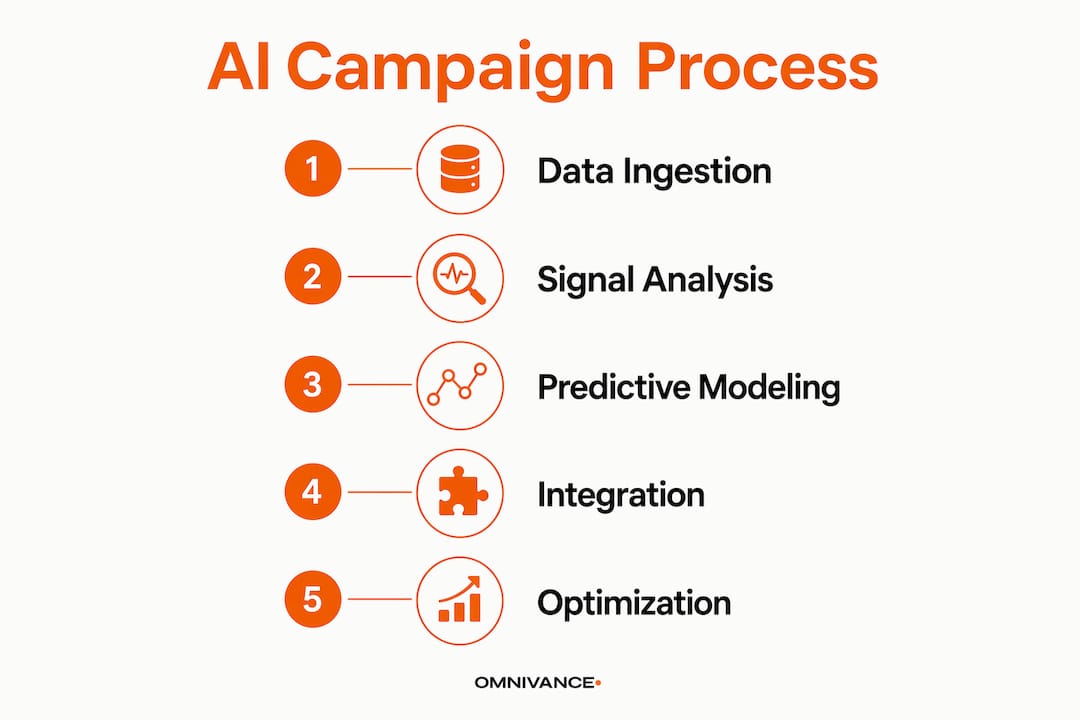
Predictive modeling sits at the core of the process. The system analyzes historical conversion patterns, user behavior sequences, and contextual signals (time of day, device, location, content environment) to forecast which impressions are most likely to drive a desired outcome. Bids are then set at the impression level, not the campaign level, which is where the efficiency gains actually come from.

The creative side works differently than most marketers expect. Rather than picking a winner from two or three ad variants, AI platforms like Google's Performance Max or Meta's Advantage+ test combinations of headlines, images, and calls to action across thousands of permutations. AI marketing platforms automate testing of 3.7 times more content variations per campaign than manual workflows, which compresses the time it takes to find a high-performing creative from weeks to days.
The operational workflow breaks down like this:
- Data ingestion: Continuous pull from ad platforms, CRM, analytics, and first-party data sources
- Signal processing: Machine learning models identify patterns across millions of data points
- Predictive scoring: Each impression or audience segment receives a conversion probability score
- Automated decision-making: Bids, budgets, and creative selections adjust based on real-time scores
- Feedback loop: Outcomes feed back into the model, improving future predictions
- Human review layer: Marketers set guardrails, review anomalies, and adjust strategic parameters
Integration with existing marketing platforms is where many teams hit friction. AI optimization tools need clean, unified data to function well. A CRM that does not sync with your ad platform, or a conversion tracking setup that misattributes revenue, will teach the AI to optimize for the wrong thing. The AI implementation checklist most teams skip is the data audit that should happen before any AI tool goes live.
What marketers actually gain from AI in their campaigns
The benefits are concrete, and the numbers back them up. Creative optimization with AI yields 38% higher click-through rates and 32% lower cost per click versus static creatives. Those are not marginal improvements. At scale, they represent significant budget reallocation from underperforming placements to high-converting ones.
Targeting accuracy is where AI creates the widest gap versus manual methods. Human campaign managers segment audiences based on demographic assumptions and historical intuition. AI models segment based on behavioral signals, purchase intent indicators, and lookalike patterns derived from actual converters. The difference shows up in cost per acquisition, not just click rates.
Key benefits, stated plainly:
- Reduced wasted spend: AI eliminates low-probability impressions that manual campaigns routinely fund
- Faster creative cycles: What used to take weeks of A/B testing compresses into days
- Better business alignment: AI optimizes toward revenue and pipeline when given the right goal parameters
- 24/7 optimization: No human team monitors and adjusts campaigns at 2 AM; AI does
- Personalization at scale: Dynamic ads adapt messaging to individual users without manual segmentation work
- Compounding performance: Models improve over time as they accumulate campaign-specific data
81% of Chief Marketing Officers plan to increase AI tool budgets by a median of 47% in the next 12 months. That level of commitment from the C-suite reflects something beyond enthusiasm for new technology. It reflects measurable returns that justify reallocation from traditional methods.
Practical use cases of AI across digital campaigns
85% of companies currently use AI-based marketing tools, with nearly three-quarters of campaigns having some AI-powered functionality. The use cases span every stage of the campaign lifecycle.

Automated bidding is the most widespread application. Google's Smart Bidding and Meta's automated bidding systems use machine learning to set bids at the auction level, adjusting for hundreds of contextual signals in milliseconds. Marketers set the target (CPA, ROAS, conversion volume) and the system handles execution.
Dynamic creative optimization goes further. Rather than serving one ad to all users, DCO systems assemble ads from component parts (headline, image, offer, CTA) and serve the combination most likely to resonate with each individual user based on their behavioral profile.
Audience segmentation and lookalike modeling use first-party data from CRMs and website behavior to build predictive audience segments. These models identify users who share behavioral patterns with existing customers, often surfacing high-value prospects that manual segmentation would miss entirely.
Additional use cases worth knowing:
- Budget pacing and reallocation: AI shifts budget in real time toward channels and placements delivering the best returns
- Cross-channel attribution: Machine learning models map the actual contribution of each touchpoint to a conversion, moving beyond last-click attribution
- Conversational marketing and AI assistants: NLP-powered chatbots qualify leads and personalize messaging within ad experiences
- Predictive churn modeling: AI identifies customers at risk of disengaging, triggering retention campaigns before revenue is lost
- Agentic advertising: Emerging AI systems that research, compare, and transact autonomously on behalf of consumers, requiring marketers to optimize for machine comprehension rather than human search behavior alone
For teams running AI in social media advertising, the platform-native tools (Meta Advantage+, TikTok Smart Performance Campaigns) are the fastest entry point. They require less technical setup than third-party AI layers while still delivering meaningful automation benefits.
Challenges and real considerations before you implement AI
The technology works. The failure points are almost always organizational, not algorithmic.
Data quality is the first and most common blocker. AI systems learn from the data you feed them. If your CRM data is incomplete, your conversion tracking is misconfigured, or your first-party data lives in disconnected silos, the AI will optimize confidently toward the wrong outcomes. Successful AI campaign optimization requires unified, clean data and clear, business-driven goal-setting. That is not a technical requirement. It is a strategic one.
The black-box problem is real and underappreciated. Most AI optimization platforms do not explain why they made a specific decision. A bid went up on a Tuesday afternoon in a specific zip code because the model predicted higher conversion probability. You will not see that reasoning. Human oversight remains crucial to ensure brand safety, creative quality, and that optimization aligns with strategic goals rather than proxy metrics.
Consumer skepticism about AI-generated advertising is a growing concern. Research shows that consumer skepticism about AI-generated ads can be mitigated when brands demonstrate leadership focused on the greater good. Transparency about AI use in advertising is not just an ethical nicety. It is becoming a trust signal that affects campaign performance.
Key challenges to plan for:
- Skill gaps: Most marketing teams lack the technical fluency to audit AI decisions or configure goal parameters correctly
- Governance gaps: Without clear policies on AI use, teams make inconsistent decisions about automation boundaries
- Over-reliance on platform AI: Native platform tools optimize for platform-level metrics, which do not always align with business outcomes
- Attribution complexity: Multi-touch attribution models require clean cross-channel data that most organizations do not have
- Ethical exposure: Automated targeting can inadvertently discriminate or violate privacy regulations if not actively governed
Pro Tip: Set your AI optimization goals at the business outcome level, not the media metric level. If you tell a bidding system to maximize conversions and your conversion event is a form fill rather than a qualified lead, you will get a lot of form fills from people who will never buy. Define the outcome you actually want, then work backward to the proxy metric the AI can optimize toward.
Expert perspectives on where AI campaign optimization is heading
The most important reframe in AI advertising right now is this: AI is not a bidding tool. It is connective infrastructure that links media, measurement, creative, and customer experience into a single learning system. That distinction matters because it changes how you resource, govern, and measure AI's contribution to your marketing operation.
Targeting and content generation are the top AI-powered functions delivering clear KPI improvements for advertisers and agencies today. But the trajectory points toward something more autonomous. Agentic advertising, where AI systems research, compare, and complete transactions on behalf of consumers, is moving from concept to early deployment. When an AI agent is the one making a purchase decision, the ad creative and the brand's structured data need to be legible to machines, not just appealing to humans.
Statistic: 85% of companies now use AI-based marketing tools, yet the gap between adoption and strategic mastery remains wide. Most teams are using AI tactically. The ones pulling ahead are using it as a strategic decision layer.
The governance question is becoming urgent. As AI systems gain more autonomy over budget allocation, creative selection, and audience targeting, the need for independent measurement frameworks and clear parameter-setting grows proportionally. Marketers who treat AI as a set-and-forget tool will find it optimizing confidently toward outcomes that look good in a dashboard but do not move the business. The teams winning with AI in 2026 are the ones who train their teams on AI marketing tools and build human review into the workflow as a structural requirement, not an afterthought.
Omnivancemedia puts AI-powered campaign optimization to work for your business
Most businesses running paid advertising are leaving money on the table, not because they lack AI tools, but because those tools are running on fragmented data, misaligned goals, and creative assets that were never built for machine optimization.
Omnivancemedia takes a different approach. Rather than layering AI onto isolated channels, the integrated system connects paid advertising, SEO, CRM automation, and creative production into a single performance engine. The AI optimization layer has clean data to learn from, business-outcome goals to optimize toward, and human strategists reviewing every major decision. That is how an HVAC contractor generated $340K in new contracts within 90 days, and how an e-commerce client grew monthly revenue from $80K to $420K. If your business is ready to scale past $500K, see the full service offering and get a strategy session with the Omnivancemedia team.
Key Takeaways
AI-driven campaign optimization delivers measurable ROI gains when built on unified data, business-outcome goals, and human oversight rather than platform automation alone.
| Point | Details |
|---|---|
| AI bidding outperforms manual methods | AI-driven bidding reduces wasted ad spend by approximately 37% while boosting ROI by 50% compared to manual methods. |
| Creative testing scales dramatically | AI platforms test 3.7x more content variations per campaign, compressing creative optimization from weeks to days. |
| Data quality determines AI effectiveness | Unified, clean data and business-focused goal parameters are prerequisites for AI optimization to work correctly. |
| Human oversight is non-optional | Brand safety, creative quality, and strategic alignment require human review built into the AI workflow as a structural layer. |
| Omnivancemedia integrates AI across channels | Omnivancemedia connects paid ads, SEO, CRM, and creative into one AI-powered system with verified revenue results. |