Marketing for Plumbers: 2026 Strategies That Actually Work

Most plumbing businesses don't have a lead problem. They have a conversion problem. A significant portion of leads are lost every month to missed calls, slow follow-up, and zero re-engagement, and most owners respond by buying more ads. That's the wrong move. Fix what's leaking first, then turn up the flow.
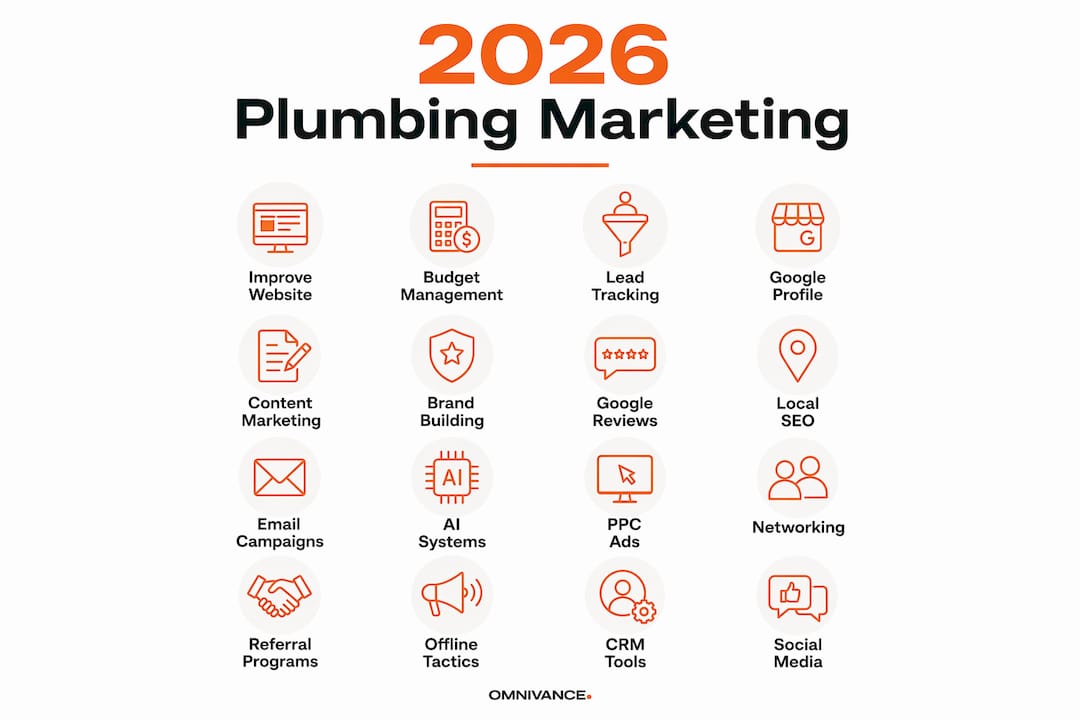
The highest-return activities for a plumbing business, ranked by cost per booked job, are:
- Fix conversion first: Missed-call text-back systems can recover 20–30% of missed calls that would otherwise go to a competitor, often within 15 seconds of a missed call.
- Google Business Profile: Free, compounds over time, and the top 3 Map Pack positions capture 40–60% of clicks for local plumbing searches.
- Referral automation: 77% of plumbing jobs come from referrals or repeat customers, yet almost no shop has a system for them.
- Past customer re-engagement: Your existing database is the cheapest source of new bookings you have.
- Google Local Services Ads (LSAs): Pay per lead, not per click, with bookings arriving within 24–72 hours of launch.
- Organic SEO and content: Slowest to build, strongest long-term compounder.
- Multi-channel presence: Reputation management, email, social media, and offline tactics all reinforce each other.
Every section below covers one of these layers in depth, with specific tactics you can act on this week.
1. Your plumbing website needs to be mobile-friendly and built to convert
8 out of 10 U.S. consumers search online weekly for local businesses, and the majority of those searches happen on a phone. If your website loads slowly, looks broken on a small screen, or buries your phone number three scrolls deep, you're losing jobs before anyone even calls.
A converting plumbing website has a few non-negotiable elements:
- Click-to-call button visible above the fold on mobile, ideally floating as the user scrolls
- Clear service descriptions with location names woven in naturally ("water heater repair in Austin")
- Booking form or quote request on the homepage, not buried in a contact page
- Customer testimonials with real names and specific job details
- Fast load time: pages that take more than three seconds to load bleed visitors
Beyond structure, your site needs to earn trust before the phone rings. Consumers treat your digital presence as a proxy for professionalism. A clean, well-organized site signals that you run a tight operation. A cluttered, outdated one signals the opposite, regardless of how good your actual work is.
For SEO, every service page should target a specific keyword plus a location. "Emergency plumber in Denver" and "drain cleaning Denver" are different pages, not the same page with two keywords crammed in. Each page needs a unique headline, at least 300 words of original content, and a photo from an actual job in that area.

Pro Tip: Install Google Analytics and Microsoft Clarity (free heatmap tool) on your site. Clarity shows exactly where visitors stop scrolling and where they click. Two hours reviewing that data will tell you more about your conversion problem than any agency audit.
2. How to set and manage your plumbing marketing budget
The standard starting point is allocating 5–10% of gross revenue to marketing, with newer businesses spending closer to 10% to build momentum and established shops dropping toward 5% once organic channels compound. The percentage matters less than where the dollars go.
A practical budget split for a plumbing business generating $500K–$1M annually:
- Free channels (time investment, not cash): Google Business Profile maintenance, referral program management, review requests, and basic social media posting
- Paid acquisition: Google Local Services Ads and PPC campaigns, typically the largest cash line item
- Content creation: Blog posts, short videos, and email campaigns, either done in-house or outsourced
- Reputation tools: CRM software, review automation, and call tracking subscriptions
The metric that matters is cost per booked job, not cost per click or cost per lead. An LSA lead at $85 that converts to a $600 job is a better investment than a PPC click at $12 that never answers the phone. Track every channel against booked revenue, not vanity metrics.
Shift budget quarterly based on performance data. If LSAs are producing booked jobs at $90 and your organic SEO is generating calls at effectively zero cost, the right move is to maintain the SEO investment and test whether increasing the LSA budget produces proportional returns. Referral incentives at $25–$50 per acquired customer consistently outperform paid channels on a cost-per-job basis, so that line should never be the first cut.
3. Lead tracking and call tracking give you real numbers, not guesses
You can't improve what you don't measure. Most plumbing businesses have a rough sense of where calls come from ("mostly Google, I think") but no actual data. That gap costs real money because budget decisions get made on instinct instead of evidence.
Call tracking software assigns unique phone numbers to each marketing channel. A caller from your LSA ad dials one number; a caller from your website dials another; a caller from a direct mail piece dials a third. Every call gets logged, recorded, and attributed. You see exactly which channels produce calls, which calls convert to booked jobs, and which ones go to voicemail and disappear.
Key steps to build a working tracking system:
- Assign unique tracking numbers to every channel: LSAs, PPC, website, direct mail, and your GBP listing
- Integrate call tracking with your CRM so every lead has a complete history from first contact to completed job
- Set up missed-call text-back to recover calls that go unanswered. A text that fires within 15 seconds of a missed call keeps the lead warm while you finish the job you're on
- Review call recordings weekly to identify where your team loses bookings on the phone
- Build a simple weekly report: calls received, calls answered, jobs booked, revenue attributed per channel
ServiceTitan's platform handles call tracking, job attribution, and campaign ROI reporting in one place, which is why it's widely used by mid-size plumbing operations that need clean data across multiple technicians and service areas.
Pro Tip: Set up an automated follow-up sequence for every new lead: an immediate SMS acknowledgment, a follow-up call attempt within 30 minutes, and a second text if the call goes unanswered. Most plumbing shops that add this sequence see a measurable lift in booked jobs within the first two weeks, without spending a dollar more on advertising.
4. How to fully optimize your Google Business Profile
Your Google Business Profile is the single highest-ROI free tool available to a plumbing business. Complete, optimized profiles receive 70% more location visits and 50% more purchase consideration than incomplete ones. For a plumber, that translates directly to inbound calls from homeowners searching "emergency plumber near me" or "water heater repair today."
Getting into the top 3 Map Pack positions is the goal. That block of three results appears above every organic listing and most paid ads, and it captures 40–60% of clicks for local plumbing searches. Here's what moves the needle:
- Complete every field: business name, phone number, website URL, service areas, hours (including emergency hours), and a keyword-rich business description
- Add service categories: primary as "Plumber," secondary as "Emergency Plumber," "Drain Cleaning Service," "Water Heater Installation Contractor," and any other relevant categories
- Upload photos weekly: your van with logo, team members, completed jobs, and equipment. Profiles with regular photo activity outperform static ones
- Post updates: most plumbers skip this entirely. A weekly post about a seasonal service or a recent job keeps your profile active and pushes it above competitors
- Enable Google Messaging: someone searching at 10 PM who can send a message and get a response within five minutes is up to 100 times more likely to book than someone who gets no reply until morning
- Respond to every review: positive and negative, within 24 hours
Review velocity, meaning how frequently new reviews arrive, is one of the strongest ranking signals for the Map Pack. A business with 200 reviews and 10 new ones per month consistently outranks a business with 500 reviews and none in the past six months.
5. Content marketing builds trust and organic traffic over time
How-to videos and problem-solving blogs do two things simultaneously: they improve your search rankings by answering questions people actually type into Google, and they build the kind of trust that makes a homeowner call you instead of the next result. Consistent publishing of educational content attracts organic search traffic and nurtures leads who aren't ready to call yet.
Content ideas that work specifically for plumbing businesses:
- "What to do if your pipes freeze" (seasonal, high search volume in winter months)
- Before-and-after job videos posted to YouTube and embedded on your website
- "How to shut off your main water valve" (simple, genuinely useful, earns trust immediately)
- Customer testimonial videos filmed on-site after a completed job
- "Signs your water heater needs replacing" (targets homeowners in the research phase)
- Local case study posts: "We replaced a 40-gallon tank in a 1960s home in [neighborhood]" with photos
The SEO benefit compounds. A blog post answering "why does my toilet keep running" earns search traffic indefinitely once it ranks. Pair your content with your email list and social media to amplify reach without additional production cost. A single how-to video can become a YouTube post, an Instagram reel, a Facebook post, and a section of your next email newsletter.
For video production that looks professional without requiring a film crew, short-form vertical videos shot on a smartphone work well on Instagram and TikTok. Authenticity matters more than production value in the trades.
6. Building a brand that people actually remember
Most plumbing companies look identical: blue and white logo, a van with a wrench graphic, a tagline about reliability. That's not a brand. That's camouflage. The plumbing businesses that dominate their local markets have a visual identity and a voice that people recognize before they read the company name.
Practical branding steps for a plumbing business:
- Pick two or three brand colors and use them everywhere: van wrap, website, uniforms, invoices, social media graphics. Consistency is what makes a brand feel established
- Write a one-sentence brand promise that says something specific. "We answer every call, show up on time, and clean up when we leave" is more memorable than "quality service you can trust"
- Name your service area in your brand: "Austin's Plumber" or "Denver's Emergency Plumbing Pros" ties your identity to geography and helps with local SEO simultaneously
- Use real photos of your team on your website and social media. Homeowners hire people, not logos
- Apply your brand to every customer touchpoint: the text message they receive after booking, the email confirmation, the invoice, and the follow-up review request should all look and sound like the same company
Disruptive doesn't mean loud. It means being the one business in your market that does something consistently that competitors don't. Showing up in a clean, branded uniform and sending a post-job summary text is memorable in an industry where many technicians arrive in unmarked trucks and never follow up.
7. Getting Google reviews and managing your reputation
People don't hire plumbers. They hire plumbers with reviews. A business with 80 four-star reviews and a recent five-star from last week will beat a business with 200 reviews and nothing new in four months, both in rankings and in the mind of a homeowner comparing options.
The timing of your review request matters more than the wording. Ask within two hours of job completion, while the customer's satisfaction is fresh. A text message works better than an email for this because it gets opened faster.
Effective review management practices:
- Automate review requests through your CRM so every completed job triggers a text with a direct link to your Google review page. Automated review request systems integrated into CRM increase response rates above 60%
- Respond to every review within 24 hours: thank positive reviewers by name and mention the specific service. For negative reviews, acknowledge the issue, apologize without being defensive, and offer to resolve it offline
- Never argue with a negative review publicly. One measured, professional response to a one-star review often impresses potential customers more than the five-star reviews around it
- Track your review velocity monthly. If new reviews slow down, your Map Pack ranking will follow
Podium is a widely used platform for automating review requests and managing responses across Google, Facebook, and other platforms from a single dashboard, which saves time for owner-operators who can't monitor five different inboxes.
8. Local SEO and geo-targeting for plumbing businesses
Location-specific pages with unique content consistently outperform generic city-wide pages in local search results. A page titled "Drain Cleaning in Scottsdale, AZ" with 400 words of original content, local photos, and a testimonial from a Scottsdale customer will rank above a page that says "We serve the greater Phoenix area" every time.
Steps to build a strong local SEO foundation:
- Create one page per service per location for your primary service areas. If you serve five cities and offer eight services, that's 40 potential pages, each targeting a specific search
- Include neighborhood names and landmarks in your content where natural. "We serve the Biltmore area, Arcadia, and central Phoenix" signals geographic relevance to Google
- Target "near me" and long-tail queries in your page content: "emergency plumber open now," "water heater repair same day," "slab leak detection cost"
- Build local citations: your business name, address, and phone number (NAP) must be identical across Google, Yelp, Angi, the Better Business Bureau, and every local directory. Inconsistencies hurt rankings
- Earn local backlinks: a mention from your local Chamber of Commerce, a neighborhood news site, or a community organization carries more local SEO weight than a generic directory link
For a detailed step-by-step process, a local SEO checklist covers the citation, on-page, and link-building steps that move rankings in competitive markets.
9. Email marketing campaigns that generate repeat business
Targeted email marketing can yield $40 in revenue per $1 spent when campaigns are segmented and automated properly. For a plumbing business, the list is built from every customer interaction: website quote requests, completed jobs, referrals, and phone inquiries.
Email campaign ideas that work for plumbing businesses:
- "We Miss You" campaign: sent to customers who haven't booked in 12–18 months, with a seasonal offer or a reminder about annual maintenance
- Unsold estimate follow-up: a sequence of two or three emails to customers who received a quote but didn't book, addressing common objections and offering a limited-time incentive
- New homeowner welcome: targeted to customers who recently moved, offering a whole-home plumbing inspection at a discounted rate
- Seasonal maintenance reminders: water heater flush in fall, pipe insulation check before winter, sump pump test in spring
- Post-job check-in: sent three to four weeks after a major job to ask about satisfaction and request a review
Segmentation is what separates effective email from spam. ServiceTitan's Marketing Pro allows segmentation by ZIP code, equipment age, date of last service, and customer type, so a message about water heater maintenance only goes to customers whose units are more than eight years old. That specificity drives open rates and bookings.
Track open rates, click rates, and, most importantly, booked jobs attributed to each campaign. If a campaign generates opens but no calls, the offer or the call-to-action needs work.
10. How AI-powered marketing systems accelerate plumbing business growth
Fragmented marketing, where one vendor handles SEO, another runs ads, and a third manages your CRM, creates gaps that cost you leads. When a prospect fills out a form at 9 PM and doesn't get a response until the next morning, that job goes to whoever called back first. Integrating lead response, follow-up, and booking into a single automated system closes that gap.
Omnivancemedia builds exactly this kind of integrated system for plumbing and HVAC businesses. The approach combines organic SEO, paid advertising, CRM automation, and creative production into one coordinated program, so every channel feeds the same pipeline and every lead gets an immediate, consistent response regardless of the time of day. An HVAC contractor using Omnivancemedia's system generated $340K in new contracts within 90 days. The mechanism wasn't a single tactic. It was the combination of high-intent paid traffic, fast automated lead response, and a reputation management system that kept reviews flowing.
Key capabilities an integrated AI-powered marketing system delivers for plumbers:
- Instant lead response automation: an SMS fires within seconds of a form submission or missed call, keeping the lead engaged while you're on a job
- Multi-touch follow-up sequences: automated texts and emails continue until the lead responds, so nothing slips through
- Centralized CRM: every lead, every call, every job, and every review lives in one place with full attribution back to the originating channel
- Campaign performance reporting: cost per booked job by channel, updated in real time, so budget decisions are based on data
- Reputation management integration: post-job review requests fire automatically, keeping review velocity high without manual effort
For plumbing businesses ready to move past juggling multiple vendors, Omnivancemedia's marketing and CRM automation services are built specifically for this kind of integrated growth.
11. PPC advertising strategies built for plumbing services
Pay-per-click advertising on Google puts your business at the top of search results the moment someone types "burst pipe repair" or "emergency plumber near me." Unlike organic SEO, PPC produces calls within hours of launch. The tradeoff is that it stops the moment the budget runs out, so it works best as a complement to organic channels, not a replacement.
For plumbing PPC, the highest-converting campaigns share a few characteristics. Emergency keywords ("emergency plumber," "24-hour plumber," "burst pipe repair") carry the highest intent and the best close rates. Broad keywords like "plumbing tips" attract researchers, not buyers, and waste budget fast.
Practical PPC setup for plumbers:
- Use exact match and phrase match keywords for your highest-value services. Avoid broad match until you have enough conversion data to identify which search terms actually book jobs
- Set location targeting tightly to your actual service area. Paying for clicks from a city you don't serve is a straightforward budget leak
- Write ad copy that matches the search intent: if someone searches "emergency plumber open now," your ad headline should say "Emergency Plumber Available Now" with your phone number in the ad
- Use call extensions and location extensions so the phone number and address appear directly in the ad
- Run ads during your operating hours unless you have after-hours coverage. Paying for clicks at 2 AM when nobody answers the phone is money wasted
Google Local Services Ads sit above traditional PPC ads in search results and charge per lead rather than per click. For most residential plumbing businesses, LSAs should be the first paid channel tested before traditional PPC, because the cost structure is more predictable and the Google Guaranteed badge increases click-through rates significantly. For multi-channel paid advertising that combines LSAs, Google Ads, and Meta retargeting, working with a specialist who understands the plumbing market prevents the common mistake of running all three channels with no coordination between them.
12. Networking and building partnerships with local businesses
The referral network a plumbing business builds with other local contractors is one of the most underused growth channels in the trades. Real estate agents, property managers, general contractors, and HVAC technicians all encounter plumbing problems regularly and need a trusted plumber to refer. One strong relationship with a property manager who oversees 50 units can generate a steady stream of work that no ad campaign can replicate.
Start with the businesses whose customers overlap most directly with yours. General contractors need plumbers for new construction and renovation projects. HVAC companies encounter water heater and boiler issues that fall outside their scope. Home inspectors flag plumbing problems that homeowners then need to fix. Each of these is a natural referral source.
How to build these partnerships:
- Introduce yourself in person to three to five local contractors per month. A short visit to drop off business cards and offer reciprocal referrals costs nothing
- Join your local Chamber of Commerce and attend at least one event per quarter. The relationships built there compound over years
- Offer priority scheduling to referring partners. A contractor who knows their clients will get a same-day response will send every plumbing job your way
- Follow up with a thank-you every time a referral partner sends a job. A handwritten note or a small gift card goes further than an email
Property managers are a particularly valuable segment. A manager overseeing 30 rental units needs a reliable plumber on call. Offering a dedicated contact number and a guaranteed response time turns a single relationship into a recurring revenue stream.
13. Referral programs that turn happy customers into your sales team
77% of plumbing jobs start with a referral or a repeat customer, yet most plumbing businesses have no formal system for generating them. The customers who already trust you are your cheapest and most effective marketing channel. A referral incentive at $25–$50 per acquired customer costs a fraction of what a paid ad lead costs, and referred customers tend to be easier to close and more loyal long-term.
A referral program doesn't need to be complicated. The basics:
- Make the ask explicit: after every completed job, tell the customer directly that you'd appreciate a referral and that you offer a discount or gift card for every friend or neighbor they send your way
- Give customers a referral card or a unique link they can share. The easier you make it, the more referrals you get
- Automate the follow-up: a text sent two days after job completion, thanking the customer and reminding them of the referral offer, keeps the program top of mind
- Track referral sources in your CRM so you know which customers are your best advocates and can reward them accordingly
- Offer double-sided incentives: the referring customer gets a discount, and the new customer gets one too. Both parties have a reason to act
The businesses that generate the most referrals aren't necessarily the ones with the best incentives. They're the ones who do exceptional work, follow up consistently, and make the referral process frictionless.
14. Offline marketing tactics that still produce real results
Direct mail and local event sponsorships get dismissed as old-fashioned, but in the plumbing industry they reach a segment of homeowners who don't spend much time on social media and respond better to something physical in their mailbox than a banner ad they scroll past.
Direct mail works best when it's targeted. A postcard campaign sent to homeowners within your service area whose homes are more than 15 years old, timed around seasonal maintenance (water heater checks in fall, pipe insulation before winter), produces a measurable response rate. The message should be specific: a named service, a clear offer, and a phone number that's easy to read.
Offline tactics worth testing:
- Targeted postcards to specific ZIP codes or neighborhoods, especially after completing a job in that area ("We just replaced a water heater two streets over. Here's a neighbor discount.")
- Local event sponsorships: youth sports leagues, school fundraisers, and community festivals put your name in front of families who own homes in your service area
- Yard signs at job sites with the homeowner's permission. A sign in a front yard generates calls from neighbors who see your work firsthand
- Truck and van wraps: a well-designed vehicle wrap is a moving billboard that generates calls in every neighborhood you drive through
- Door hangers distributed in the immediate area after completing a job, while your brand is already visible on the street
Combining offline and digital works better than either alone. A homeowner who sees your yard sign, then finds your Google profile with 90 reviews, is far more likely to call than one who encounters either touchpoint in isolation.
15. CRM tools give plumbing businesses a real operational edge
A customer relationship management system is the operational backbone that makes every other marketing tactic more effective. Without a CRM, leads fall through the cracks, follow-ups get forgotten, and you have no clear picture of which customers are worth re-engaging. With one, every interaction is logged, every follow-up is automated, and your marketing data is actually usable.
ServiceTitan is the most widely adopted CRM in the plumbing and HVAC space. It handles dispatching, invoicing, call tracking, marketing campaign attribution, and customer history in one platform. For smaller operations, Podium offers a more focused tool centered on customer communication, review management, and payment collection, without the full field management complexity of ServiceTitan.
What a CRM does for your marketing specifically:
- Tracks every lead from source to booked job, so you know exactly which channel produced which revenue
- Automates follow-up sequences for new leads, unsold estimates, and past customers due for maintenance
- Triggers review requests automatically after job completion, keeping your review velocity consistent
- Segments your customer list for targeted email campaigns by service type, location, equipment age, or last service date
- Provides reporting on cost per booked job by channel, technician close rates, and campaign ROI
The plumbing-specific CRM and automation services that Omnivancemedia configures for clients go beyond basic contact management. They connect paid ad campaigns, organic lead sources, and post-job follow-up into a single system where nothing gets lost and every dollar of marketing spend is accounted for.
16. Social media marketing tailored to plumbing businesses
Social media isn't where most homeowners find a plumber for the first time. It's where they confirm their decision after finding you on Google. That distinction changes how you should use it. The goal isn't to go viral. It's to show up consistently enough that when someone who already knows your name checks your Facebook or Instagram, they see an active, credible business.
Facebook is the most effective platform for residential plumbing businesses because the demographic skews toward homeowners. Instagram works well for visual content like before-and-after photos. TikTok and YouTube are worth investing in if you're willing to produce short educational videos consistently, because that content also improves your SEO.
What actually works on social media for plumbers:
- Before-and-after photos of completed jobs, with a brief description of the problem and the fix
- Short how-to videos: "How to unclog a drain without chemicals" builds trust and gets shared
- Customer testimonial posts with permission, using the customer's first name and the specific service
- Seasonal tips: "Three things to check before the first freeze" performs well every fall
- Behind-the-scenes content: a day-in-the-life video of your team builds the human connection that makes people choose you over an anonymous competitor
Post three to four times per week on your primary platform rather than spreading thin across five platforms with inconsistent content. Consistency beats frequency, and frequency beats perfection.
Ready to stop losing leads and start building a system that compounds?
Omnivancemedia works with plumbing and HVAC businesses that are ready to move past fragmented marketing and build a system where every channel feeds the same pipeline. The approach combines SEO, paid advertising, CRM automation, and creative production into one coordinated program with full attribution reporting, so you always know which dollar of marketing spend produced which booked job.
If your business is generating revenue and you're ready to scale past $500K without juggling five different vendors, Omnivancemedia's integrated approach is built for exactly that stage.
Key Takeaways
The most effective marketing strategy for plumbers starts with fixing conversion before adding new acquisition channels, because 30–40% of leads are lost to missed calls and slow follow-up before any new ad spend can help.
| Point | Details |
|---|---|
| Fix conversion before buying leads | Missed-call text-back systems can recover 20–30% of leads lost to voicemail before new ad spend makes sense. |
| Google Business Profile drives free leads | Top 3 Map Pack positions capture 40–60% of clicks for local plumbing searches at zero ad cost. |
| Referrals are your cheapest channel | 77% of plumbing jobs come from referrals or repeat customers; a formal program costs $25–$50 per acquired customer. |
| Email marketing returns $40 per $1 spent | Segmented campaigns targeting past customers and unsold estimates generate repeat bookings at low cost. |
| CRM integration ties everything together | Tools like ServiceTitan and Podium connect lead tracking, review automation, and campaign attribution in one system. |