Marketing for Financial Advisors: Your 2026 Growth Guide

Marketing for financial advisors is the deliberate integration of compliant, measurable strategies that build trust and generate qualified leads consistently. Unlike general business marketing, advisor marketing operates inside a regulatory framework set by the SEC and FINRA, which shapes every piece of content you publish. The advisors who grow fastest treat marketing as a system, not a series of one-off campaigns. They combine SEO, paid ads, LinkedIn, and referrals into a channel mix calibrated to their client niche, budget, and growth targets. This guide breaks down what actually works in 2026, from channel selection to compliance to building a plan that compounds over time.
What are the most effective marketing channels for financial advisors?
The highest-return channel for financial advisors over a 24-month horizon is SEO. SEO takes 3–9 months to produce ranking content, but the compounding traffic it generates outperforms paid channels on a cost-per-lead basis once it matures. That delay means SEO rewards advisors who commit early and publish consistently.
Paid social, specifically Meta (Facebook) ads, fills the short-term gap. Meta ads achieve 8–15% close rates on qualified leads with a cost per lead of $40–$150 when paired with a qualifying offer and a nurture sequence. That close rate is only possible when ads drive prospects into a structured follow-up process, not directly to a booking page. Most advisors waste their ad budget by skipping the nurture step entirely.

LinkedIn is the strongest organic channel for reaching business owners and executives. Publishing personal voice posts 3–5 times weekly builds the kind of trust that cold outreach never can. LinkedIn's targeting also supports outbound prospecting for advisors who specialize in a specific industry or income bracket.
Referrals remain the highest-quality lead source in financial services. The problem is that most advisors treat referrals as passive. Systematizing referrals digitally, through a book funnel or a structured partner program, turns a sporadic source into a predictable one. You can learn more about organic lead generation approaches that complement referral systems without relying on paid spend.
Key channel comparison:
- SEO: Highest ROI over 24 months, slow start, requires consistent content publishing
- Meta ads: Fast leads, $40–$150 CPL, requires qualifying offer and nurture sequence
- LinkedIn: Best for executive and business owner niches, organic and outbound
- Referrals: Highest trust and close rate, best systematized through digital assets
- Google Ads: High intent traffic, higher CPL than Meta, works well for life-event keywords
How do regulatory compliance requirements impact financial advisor marketing?
Compliance is not optional, and it is not just a legal formality. SEC Rule 206(4)-1 and FINRA Rule 2210 require every marketing asset to pass a pre-publication review and be archived for up to five years. That includes emails, social posts, paid ads, and direct messages. Advisors who treat compliance as an afterthought face campaign delays, regulatory risk, and content that has to be pulled after launch.
The practical effect on marketing is significant. Every campaign launch requires a review cycle before anything goes live. Content must avoid performance guarantees, unsubstantiated claims, and testimonials that do not meet the SEC's updated marketing rule standards. Disclosures must appear in the right format and placement. This slows cadence but raises quality.
The less obvious benefit is competitive. Compliance acts as a filter that discourages less-prepared firms from marketing aggressively. Advisors who build compliant content systems gain a durable advantage because their competitors simply cannot keep up. Compliance is a moat, not just a constraint.
Compliance checklist for financial advisor marketing:
- Pre-publication review for all content, ads, and social posts
- Five-year archiving of all marketing communications
- No performance guarantees or misleading historical returns
- Required disclosures on all client-facing materials
- Testimonials must meet SEC marketing rule standards
- Record retention for DMs and email campaigns
Pro Tip: Build your compliance review into your content calendar as a fixed step, not a last-minute check. A two-week review buffer before any campaign launch prevents scrambles and keeps your publishing cadence intact.
For advisors running paid social, understanding compliant paid social advertising practices before launching a campaign saves significant rework later.
What are the key elements of a successful financial advisor marketing plan?
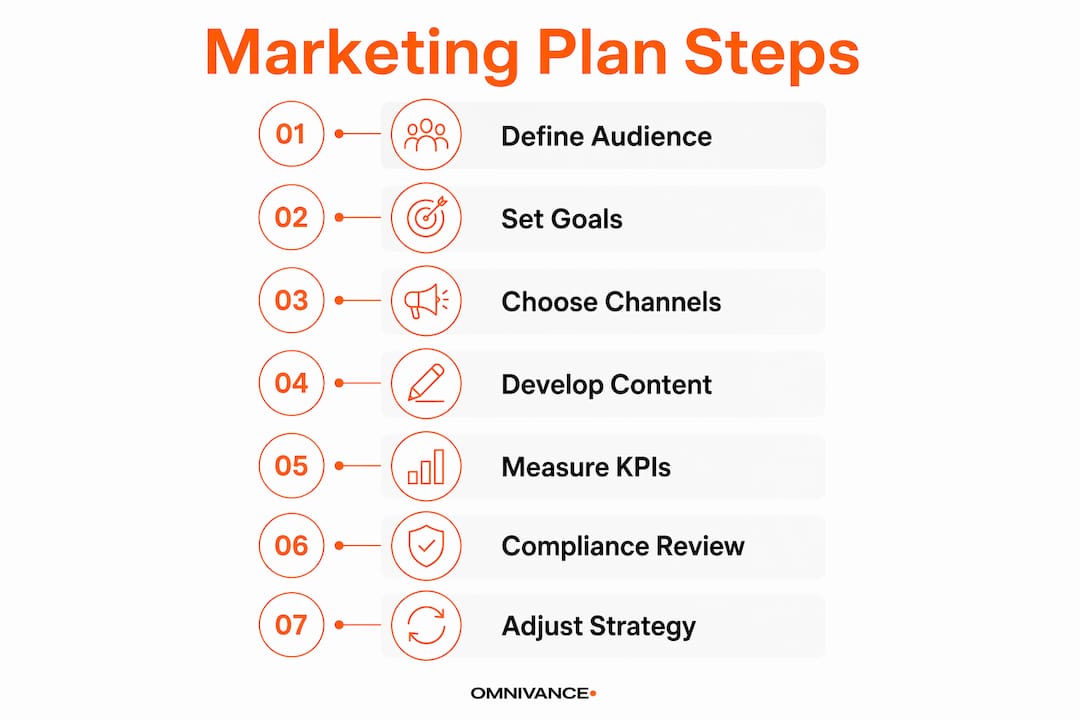
A marketing plan for a financial advisor does not need to be long. A focused five-page plan covering your ideal client profile, channel mix, budget, KPI scorecard, and quarterly review schedule outperforms a 40-page document that never gets executed. Length is not the goal. Clarity and commitment are.
Building your KPI scorecard
Your scorecard should track 8–10 metrics. The most useful ones for advisors are cost per lead (CPL), client acquisition cost (CAC), booked discovery calls, call-to-close rate, email open and click rates, website organic traffic, and paid ad return on ad spend. Each metric tells you something different. CPL tells you channel efficiency. CAC tells you whether your close process is working. Tracking both together shows you where the funnel breaks.
Choosing your channel mix
The standard structure is one primary channel, one secondary channel, and one supporting channel. A common combination is Google Ads or Meta as the primary, email nurture as the secondary, and LinkedIn content as the supporting channel. Marketing plans should use a 60/40 to 70/30 split between channels that capture immediate leads and channels that build long-term brand equity. Spreading budget across five channels with no primary focus is the most common mistake advisors make.
Quarterly review and recalibration
Set a fixed quarterly review date. Pull your KPI scorecard, compare actuals to targets, and adjust channel spend or content focus based on what the data shows. Monthly check-ins keep you on track between quarters. Marketing strategy should be filtered against your client journey stage, budget, and team capacity at every review cycle. A plan that ignores capacity constraints fails in execution, not in strategy.
How to create an integrated marketing system that converts
Scattered tactics do not build a practice. Successful conversion requires unifying marketing, sales, and service into a single funnel where each stage feeds the next. An advisor who runs great ads but has no nurture sequence loses most of the leads they paid for. An advisor with strong SEO but no discovery call process wastes organic traffic.
The connective tissue of any advisor marketing system is email. A well-built email sequence moves a prospect from first contact through education, trust, and booking without requiring manual follow-up at every step. Sequences should be triggered by behavior, not just time. A prospect who downloads a retirement planning guide gets a different sequence than one who clicks on a tax strategy article.
Elements of an integrated advisor marketing system:
- Lead capture: landing pages with a qualifying offer (guide, webinar, or book)
- Nurture: automated email sequences segmented by prospect interest
- Qualification: application or discovery call booking with pre-screening questions
- Follow-up: CRM-tracked touchpoints for prospects who do not book immediately
- Service integration: onboarding that reinforces the marketing promise
You can explore how a marketing funnel for advisors connects each of these stages into a unified client experience.
Pro Tip: Plan your channel time horizons before you commit budget. Paid ads produce leads in weeks. SEO takes months. Referral systems take quarters. A system that accounts for all three horizons avoids the panic that kills most advisor marketing programs.
What are practical digital marketing tactics advisors can use today?
The fastest SEO wins for advisors come from life-event keywords, not location-based terms. Advisor websites ranking for city-based keywords often target low-volume searches. Keywords tied to life events, such as "what to do with a 401k after leaving a job" or "how to invest an inheritance," capture prospects at the exact moment they need advice. That intent converts at a higher rate than someone searching for a generic local advisor.
On LinkedIn, the format that builds the most trust is the personal opinion post. Share a position on a market trend, a lesson from a client situation (anonymized), or a counterintuitive take on a common financial belief. Posts that start with a strong opinion and end with a question generate the most engagement. Consistency matters more than virality. Three posts per week, published for six months, builds more credibility than one viral post.
The book funnel is the most underused tactic in financial advisor marketing. A book funnel converts 8–15% of visitors to discovery calls, compared to 2–5% for a standard lead magnet. A short, well-written book on a specific financial topic positions you as the authority in your niche and gives referral partners a tangible asset to share with their clients. The book does the pre-qualification work before the prospect ever speaks to you.
For paid ads, driving traffic to trust-building content rather than a direct booking page consistently improves lead quality. A video sales letter, a webinar registration, or a book download warms the prospect before they enter your calendar. Advisors who send cold ad traffic directly to a "schedule a call" page see lower conversion and higher CPL. You can review Facebook ads for financial advisors to understand how to structure campaigns that actually convert.
Practical tactics you can start this week:
- Publish two life-event SEO articles targeting high-intent keywords
- Write three LinkedIn opinion posts and schedule them across the week
- Outline a 60-page book on your niche topic and map it to a landing page
- Audit your current ad campaigns and redirect traffic to a content asset
- Build a five-email nurture sequence for new leads who do not book immediately
Key Takeaways
Effective financial advisor marketing requires a compliant, integrated system that combines the right channel mix with consistent execution and measurable KPIs.
| Point | Details |
|---|---|
| SEO is the long-term anchor | SEO delivers the highest ROI over 24 months but requires 3–9 months of consistent publishing before results appear. |
| Compliance is a competitive advantage | SEC Rule 206(4)-1 and FINRA Rule 2210 filter out less-prepared competitors, rewarding advisors who build compliant systems. |
| A five-page plan beats a 40-page document | Focus your annual plan on ICP, channel mix, budget, and an 8–10 metric KPI scorecard reviewed quarterly. |
| Integration converts, tactics alone do not | Unifying lead capture, email nurture, and discovery call booking into one funnel prevents lead loss at every stage. |
| Book funnels outperform standard lead magnets | A book funnel converts 8–15% of visitors to calls, versus 2–5% for typical lead magnets, and pre-qualifies prospects automatically. |
What I've learned after watching advisors market the wrong way
The most common mistake I see financial advisors make is treating marketing as a sprint. They run ads for 60 days, see inconsistent results, and conclude that digital marketing does not work for their practice. What they actually proved is that 60 days is not enough time for any channel to mature.
The second mistake is treating compliance as the enemy of marketing. Advisors who internalize compliance as a discipline produce better content. They make fewer unsubstantiated claims. They write with more precision. Their content builds more trust because it is more honest. The advisors who fight compliance at every step produce content that is either watered down by last-minute edits or pulled after launch.
The third pattern I keep seeing is the "more channels" trap. An advisor hears that LinkedIn works, so they add LinkedIn. They hear that podcasts work, so they add a podcast. Six months later they have five channels, none of them executed well, and no clear data on what is actually driving leads. One primary channel, executed with discipline, beats five channels executed poorly every time.
The advisors who grow consistently share one trait: they measure everything and adjust based on data, not instinct. A KPI scorecard reviewed monthly is not bureaucracy. It is the difference between a marketing program that compounds and one that flatlines.
— laya
How Omnivancemedia supports financial advisor growth
Financial advisors who want to grow their practice without managing five separate vendors need a system that connects SEO, paid ads, CRM automation, and content production into one accountable program.
Omnivancemedia builds integrated financial services marketing programs designed specifically for advisors who are ready to scale. The approach combines SEO and paid advertising with CRM integration and compliance-aware content production, all tracked through a live KPI dashboard. Every channel feeds the same funnel, and every result is measured against your acquisition targets. If you are ready to replace scattered tactics with a system that compounds, Omnivancemedia is built for that conversation.
FAQ
What is the best marketing channel for financial advisors?
SEO delivers the highest ROI over a 24-month horizon, while Meta ads produce faster leads at $40–$150 CPL with a qualifying offer and nurture sequence. Most advisors benefit from running both in parallel.
How does FINRA Rule 2210 affect financial advisor marketing?
FINRA Rule 2210 requires all marketing content to be fair, balanced, and not misleading, with pre-publication review and archiving for up to five years. This applies to ads, social posts, emails, and direct messages.
How many KPIs should a financial advisor track in their marketing plan?
A focused marketing plan tracks 8–10 KPIs, including cost per lead, client acquisition cost, booked discovery calls, and close rate. Tracking fewer metrics misses key funnel breakdowns; tracking more creates noise.
What is a book funnel and why does it work for advisors?
A book funnel uses a short, niche-specific book as a lead magnet that converts 8–15% of visitors to discovery calls, compared to 2–5% for standard lead magnets. It pre-qualifies prospects and gives referral partners a tangible asset to share.
How long does it take for financial advisor marketing to produce results?
Paid ads produce leads within weeks. SEO takes 3–9 months to rank new content. Referral and LinkedIn systems typically take 3–6 months of consistent effort before generating predictable volume.