Marketing for Accountants: Your 2026 Growth Guide

Marketing for accountants is the practice of building a clear brand, using digital channels, and running predictable client acquisition systems that attract, convert, and retain ideal clients. Most accounting firms treat marketing as an afterthought. That is the single biggest reason they stay flat while competitors grow. High-growth accounting firms invest about 2.1% of revenue in marketing, nearly double the rate of slower-growing peers, and see revenue increases of 38.5%. That gap is not luck. It is the direct result of treating accounting firm marketing as a core business function rather than a seasonal expense.
What are the most effective digital marketing channels for accountants?
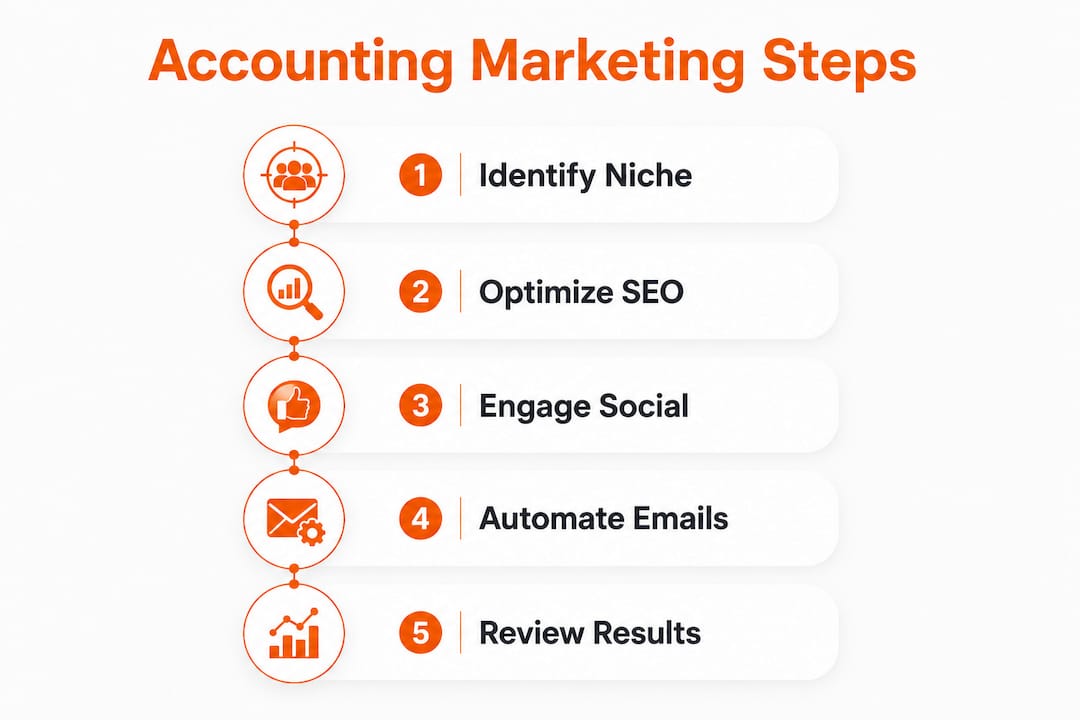
Digital marketing for accountants works best when channels are chosen based on where clients actually search, not where it is easiest to post. The right mix covers search visibility, relationship building, and lead conversion.
Search engine optimization and GEO
SEO remains the foundation of any accounting firm's online presence. SEO and GEO (Generative Engine Optimization) complement each other by structuring website content with clear definitions, FAQs, and direct answers that rank on Google and appear in AI-powered search results simultaneously. GEO is the practice of formatting content so AI platforms like ChatGPT and Perplexity pull your firm's answers into their responses. Firms that ignore GEO in 2026 are invisible to a growing share of prospective clients who start their search with an AI tool. A complete guide to local search optimization covers the technical steps for accountants specifically.

LinkedIn and social media for accounting
LinkedIn is the highest-return social platform for B2B accounting firms. It connects you directly with business owners, CFOs, and decision-makers who hire accountants. Posting weekly on topics like tax planning, cash flow management, or industry-specific compliance builds authority faster than any paid ad. Social media for accounting does not require daily posting. Consistent, expert content published twice a week outperforms daily generic posts every time.
Content marketing and blogging
Accounting firms that blog regularly are 13 times more likely to see positive ROI, provided the content demonstrates genuine expertise. That statistic points to a clear standard: frequency alone does not work. Each post must answer a real question your ideal client is already asking. Topics like "how to structure payroll for an S-corp" or "what records do I need before tax season" attract high-intent readers who are already in buying mode.
Email marketing and paid advertising
Email nurture sequences convert leads who are not ready to book immediately. A five-email sequence sent over three weeks, covering a specific pain point relevant to your niche, consistently outperforms a single follow-up call. For paid advertising, traffic converts best when routed to dedicated landing pages aligned with the specific service being advertised, not to your homepage.
- SEO and GEO for organic and AI search visibility
- LinkedIn for B2B relationship building and thought leadership
- Blogging to attract high-intent search traffic
- Email sequences to nurture leads over time
- Paid ads with service-specific landing pages for fast lead generation
Pro Tip: Write one detailed blog post per month targeting a question your best clients asked you in the last 90 days. That single post will outperform five generic "tax tips" articles every time.
How can accounting firms differentiate themselves to attract premium clients?
Accounting firms with a strong, clear differentiator are nearly three times more likely to grow faster than firms using generic positioning. Generic language like "trusted advisor" or "full-service CPA firm" does not communicate value. It blends you into the background.
Choosing a niche that pays
The most effective differentiation strategy is niche specialization. A firm that positions itself as the accounting partner for e-commerce sellers on Shopify speaks directly to a specific audience with specific problems. That firm wins against a generalist every time, even if the generalist has more experience. Other high-value niches include construction contractors, medical practices, real estate investors, and restaurant groups. Each niche has distinct tax challenges, cash flow patterns, and compliance needs that a specialist can address with precision.
Packaging your services clearly
Flagship service packages simplify the client decision. Instead of listing 12 services on a menu, a firm might offer three clearly named packages: a "Startup Foundations" package for new businesses, a "Growth Partner" package for established firms, and a "CFO Advisory" package for scaling companies. Clear packaging removes friction from the sales process and signals that you understand where clients are in their growth.
Building trust through proof
Trust signals close deals in accounting. Client testimonials, case studies showing specific outcomes, and detailed team bios all reduce the perceived risk of hiring a new firm. A bio that mentions 12 years working with restaurant groups is more persuasive than one that lists credentials alone. Video testimonials perform especially well because they are harder to fake and easier to believe.
- Define one primary niche and build your website, content, and messaging around it
- Create two or three named service packages with clear deliverables and pricing ranges
- Replace generic positioning language with specific outcomes you deliver
- Add client testimonials with names, industries, and measurable results
- Write team bios that highlight relevant industry experience, not just credentials
What is the role of local SEO and online reputation in attracting local clients?
Local SEO is the fastest path to new clients for most accounting firms. The top three Google Business Profile map results capture 67% of all clicks from local searches. If your firm is not in that top three, you are invisible to the majority of people searching for an accountant near them.
Steps to dominate local search
- Claim and fully complete your Google Business Profile. Add your services, hours, photos, and a keyword-rich description. Incomplete profiles rank lower and convert worse.
- Build consistent NAP citations. Your Name, Address, and Phone number must match exactly across every directory: Yelp, Bing Places, Apple Maps, and industry-specific directories like CPA.com. Inconsistencies confuse search engines and reduce your ranking. A local business listing guide covers the full process for 2026.
- Generate reviews systematically. Ask every satisfied client for a Google review within 48 hours of completing their work. A simple text message with a direct link removes all friction.
- Create location-specific service pages. A page titled "Small Business Accounting in Austin, TX" ranks for local searches that a generic services page never will.
- Respond to every review. Responding to reviews, including negative ones, signals to Google and to prospective clients that your firm is active and accountable.
Over 80% of business owners research online before hiring an accountant. That means your online reputation is your first impression in most cases. A firm with 40 five-star reviews and a complete Google Business Profile will win the click over a firm with better credentials and no reviews.
Pro Tip: Set a calendar reminder for the first Monday of each month to check your Google Business Profile for unanswered questions, outdated hours, and new reviews. Fifteen minutes of monthly maintenance protects your local ranking.
How do marketing automation and AI enhance client acquisition for accountants?
Effective digital marketing treats client acquisition as a predictable system integrating content, reviews, and automated follow-ups, rather than sporadic tactics. Automation makes that system run without requiring your attention every day.
High-growth accounting firms succeed with a lean tech stack focused on six core functions: website, CRM, email automation, analytics, scheduling, and social publishing. That is the full list. Firms that add tools beyond these six core functions typically see diminishing returns and increased complexity. A marketing automation checklist helps firms implement each function without overcomplicating the process.
AI tools can automate routine marketing tasks such as scheduling, content drafting, and lead qualification. This frees accountants to focus on client work rather than marketing administration. Practical applications include AI-generated first drafts of blog posts that you review and personalize, chatbots on your website that qualify leads before they book a call, and automated email sequences triggered by specific actions like downloading a tax guide.
- Use a CRM to track every lead and automate follow-up reminders
- Set up an email sequence that triggers when someone fills out your contact form
- Use AI writing tools to draft blog content, then edit for accuracy and voice
- Add a scheduling tool like Calendly to remove friction from booking consultations
- Connect your analytics to a simple monthly dashboard tracking leads, bookings, and client value
The most common mistake firms make is overbuilding their tech stack before they have a consistent lead flow. Start with a website, a CRM, and an email tool. Add complexity only when the basics are working.
Pro Tip: Build one automated email sequence before tax season that sends three emails over two weeks to every lead who did not book. Most accountants lose 40% of their leads simply because they never followed up a second time.
What seasonal planning considerations optimize marketing ROI for accounting firms?
Accounting has natural buying cycles, and your marketing calendar should reflect them. Tax season from january through april is the highest-intent period for individual and small business clients. Paid ad spend during this window delivers the strongest return because search volume is at its peak and prospects are actively looking to hire.
The post-tax season window from may through july is underused by most firms. This is the ideal time to collect reviews from satisfied clients, launch advisory service offers, and run content campaigns targeting business owners planning for the second half of the year. A 5% increase in client retention can boost long-term revenue by 25–95%. Retention campaigns run in the off-season cost far less than new client acquisition and deliver compounding returns.
| Channel | Time to First Results | Best Measurement Metric |
|---|---|---|
| Local SEO | 3–6 months | Calls and direction requests from Google Business Profile |
| Content marketing | 4–8 months | Organic traffic and lead form submissions |
| Paid advertising | 2–4 weeks | Cost per booked consultation |
| Email nurture | 1–3 weeks | Reply rate and booking conversion |
| Referral program | 1–2 months | Number of referred leads per quarter |
Set your marketing budget as a percentage of revenue, not as a fixed dollar amount. Firms targeting growth should allocate at least 2% of revenue to marketing. Measure success by bookings, client lifetime value, and retention rate. Tracking follower counts or website visits without connecting them to revenue is a waste of time.
- Run paid ads from january through april 15 for maximum tax season ROI
- Collect reviews and launch advisory offers from may through july
- Allocate at least 2% of annual revenue to marketing if growth is the goal
- Measure marketing by bookings and client value, not traffic or impressions
- Plan a quarterly content calendar tied to the tax and fiscal year calendar
Key Takeaways
Accounting firm marketing works when it combines niche positioning, consistent digital visibility, and automated client acquisition systems built around measurable outcomes.
| Point | Details |
|---|---|
| Invest consistently in marketing | High-growth firms allocate 2.1% of revenue to marketing and grow 7 times faster than those that do not. |
| Niche specialization drives growth | Firms with a clear differentiator are nearly three times more likely to grow faster than generalists. |
| Local SEO is the fastest win | The top three Google Business Profile results capture 67% of local search clicks. |
| Automate follow-up and lead nurture | A lean six-function tech stack handles acquisition without overwhelming the firm. |
| Measure what drives revenue | Track bookings, client lifetime value, and retention, not vanity metrics like followers or page views. |
What I have learned from watching accounting firms market themselves
The firms that grow fastest are not the ones with the biggest budgets. They are the ones that stopped treating marketing as something they do when they have spare time. Every high-performing accounting firm I have observed runs marketing like a system, not a series of one-off experiments.
The shift to AI-powered search is real and it is happening now. Firms that structure their website content with clear headings, direct answers, and FAQ sections are already appearing in AI-generated responses. Firms that do not are losing visibility they do not even know they are losing. This is not a future concern. It is a 2026 problem.
The other pattern I keep seeing is neglect of local SEO. Accountants spend money on social media ads while their Google Business Profile sits incomplete with three reviews from 2021. Local SEO costs almost nothing to maintain and delivers some of the highest-quality leads available to a firm. Fix that before spending a dollar on paid ads.
The hardest truth is this: consistent follow-up wins more clients than any clever campaign. Most firms lose leads not because the prospect chose a competitor, but because nobody followed up after the first contact. One automated email sequence would recover a significant portion of those lost opportunities. Build the system first. Then scale what works.
— laya
How Omnivancemedia helps accounting firms build predictable client growth
Accounting firms that want consistent lead flow need more than a website refresh. They need an integrated system where SEO, paid advertising, and CRM automation work together.

Omnivancemedia builds exactly that for accounting firms. From AI-ready SEO services that position your firm in both Google and AI search results, to paid advertising campaigns built around high-intent local searches, to CRM and automation setup that turns every lead into a followed-up opportunity, Omnivancemedia handles the full system. You focus on clients. The marketing runs in the background. View the full range of accounting marketing services and book a consultation to see what a connected system looks like for your firm.
FAQ
What is the best marketing channel for accounting firms?
Local SEO and Google Business Profile optimization deliver the highest-quality leads for most accounting firms, since the top three map results capture 67% of all local search clicks. Pair local SEO with a LinkedIn content strategy for B2B client acquisition.
How much should an accounting firm spend on marketing?
High-growth accounting firms invest about 2.1% of annual revenue in marketing. Firms targeting aggressive growth should treat this as a minimum, not a ceiling.
How long does SEO take to work for accountants?
Organic SEO typically produces measurable results within 3–6 months for local terms and 6–12 months for competitive national terms. Paid advertising delivers leads within 2–4 weeks and works well alongside SEO during the ramp-up period.
What is GEO and why does it matter for accountants?
GEO (Generative Engine Optimization) is the practice of structuring website content so AI platforms like ChatGPT and Perplexity surface your firm's answers in their responses. Firms that apply GEO principles alongside traditional SEO gain visibility in both search environments simultaneously.
How do accounting firms get more online reviews?
Ask every satisfied client for a Google review within 48 hours of completing their work, and send a direct link to your Google Business Profile review page. Systematic asking, not occasional reminders, is what builds a strong review count.