Local SEO New Jersey: Strategies That Win in 2026

Local SEO in New Jersey is the practice of optimizing your business's online presence to rank prominently in local search results and Google Maps, connecting you with nearby customers who are actively searching for your services. New Jersey's dense, competitive market means generic digital marketing rarely cuts through. Businesses that apply targeted local search optimization in NJ, built on Google Business Profile, accurate citations, and hyper-local content, consistently outrank those relying on broad statewide approaches. This guide covers every core technique, from foundational setup to Generative Engine Optimization (GEO), the emerging standard that is reshaping how AI-powered search engines rank local businesses in 2026.
What does local SEO New Jersey actually require to start?
Every effective local SEO effort in New Jersey starts with three non-negotiable foundations: a verified Google Business Profile (GBP), consistent NAP citations, and the right tracking tools.
Google Business Profile is the single most powerful local ranking factor, and it must be optimized and managed continuously for local SEO success. Verification for NJ businesses typically requires a postcard, phone call, or video verification through Google. Once verified, every field matters: business category, service areas, hours, photos, and the Q&A section all influence how Google ranks you in the local pack.

NAP consistency means your Name, Address, and Phone number appear identically across every directory, website, and social profile. A single discrepancy between your GBP listing and your Yelp page signals unreliability to Google. For New Jersey businesses, this includes local directories like NJ.com, county Chamber of Commerce sites, and industry-specific platforms.
Essential tools for NJ business owners include:
- Rank trackers that monitor Google Maps positions by zip code or city (BrightLocal and Whitespark both offer this)
- Citation checkers that audit NAP consistency across dozens of directories
- Review management platforms that alert you to new reviews and help you respond quickly
Pro Tip: Claim your listing on your county Chamber of Commerce directory and NJ.com before building citations elsewhere. These carry strong local authority and signal geographic relevance to Google.
| Tool category | Primary use |
|---|---|
| Rank tracker | Monitor local pack and Maps positions by NJ city or zip |
| Citation checker | Identify and fix NAP inconsistencies across directories |
| Review platform | Track, respond to, and generate customer reviews |
| Analytics tool | Measure traffic, conversions, and content performance |
How to execute local SEO strategies in New Jersey's competitive market
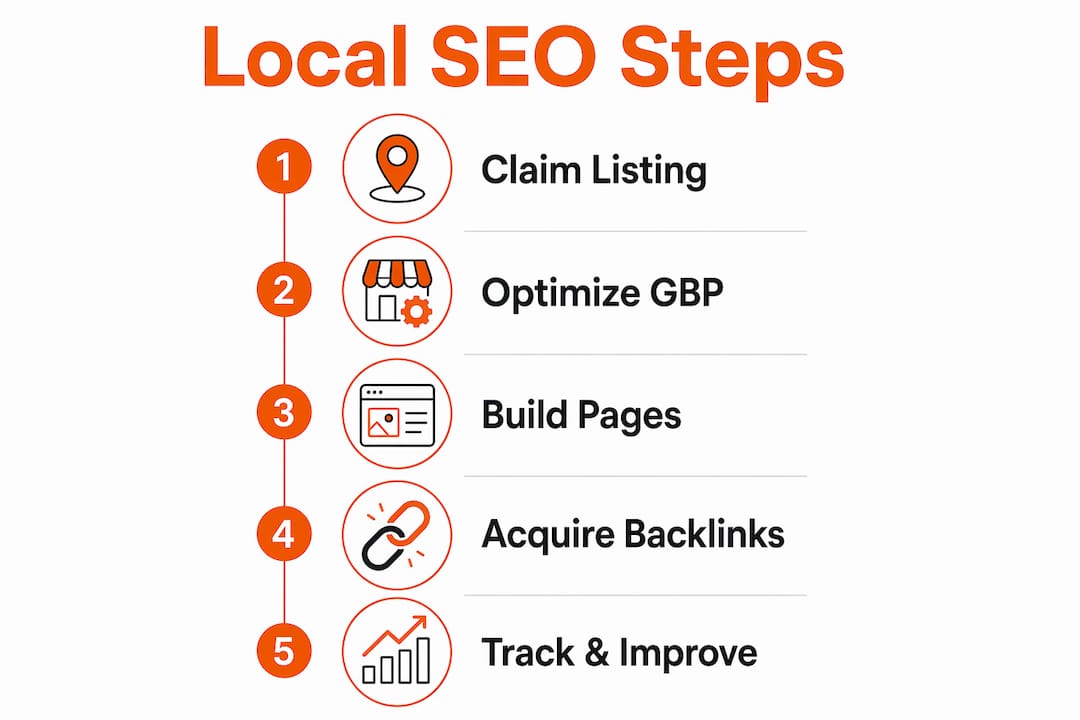
New Jersey's market is one of the most saturated in the country. Winning here requires more than a complete GBP profile. You need a layered strategy that combines on-page optimization, local citations, backlinks, and content built for specific municipalities.
Optimize your Google Business Profile for NJ
Your GBP category selection directly affects which searches trigger your listing. Choose the most specific primary category available, then add secondary categories. Upload at least 10 photos showing your location, team, and work. Post weekly updates using local terms like neighborhood names or nearby landmarks. Google Business Profile is the most powerful local ranking factor, so treat it as a living asset, not a one-time setup.
Build municipality-specific landing pages
Generic content claiming to serve all of New Jersey is consistently outperformed by city or neighborhood-specific pages that reference local landmarks, regulations, and testimonials. A plumber in Bergen County should have separate pages for Hackensack, Paramus, and Teaneck, each mentioning local permit requirements or well-known landmarks nearby. This level of specificity tells Google exactly where you operate and builds relevance for those searches.
Execute a citation-building plan
Build citations in this order:
- Verify your GBP listing completely
- Submit to the top 50 general directories (Yelp, Apple Maps, Bing Places)
- Add your business to NJ-specific directories: NJ.com, NJBiz, and your county Chamber site
- Target industry-specific directories relevant to your trade
- Audit all listings quarterly for NAP accuracy
Acquire local backlinks
Local backlinks from sponsorships, local news features, and Chamber of Commerce affiliations improve local SEO trustworthiness and rankings. Sponsor a local event in your town, get featured in a NJ.com article, or join your municipal business association. Each of these generates a backlink from a geographically relevant, trusted source.
Structure content for GEO
Generative Engine Optimization (GEO) is the 2026 standard where businesses must become recognized as a "Source of Truth" by AI through structured data, expert bios, and local citations. Write content that directly answers common customer questions with clear pricing, timelines, and comparisons. AI answer engines like ChatGPT and Perplexity pull from content that is specific, factual, and well-cited. A page that explains exactly what a roof replacement costs in Montclair, NJ, with local contractor references, will outperform a vague service page every time.
Pro Tip: Add a structured FAQ section to every location page. AI search engines prioritize content that directly answers questions, and this format increases your chances of being cited in AI-generated answers.
How do you measure local SEO success and improve over time?
Tracking the right metrics separates businesses that grow from those that spin their wheels. For New Jersey local businesses, the most telling numbers are Google Maps rank by city, call volume from GBP, and organic traffic to location pages.
Google Maps rankings typically respond within 30–60 days while organic rankings and lead growth strengthen significantly after 3 months. This timeline means you should not judge a local SEO campaign by its first-month results. Set a 90-day review point as your first real performance checkpoint.
Key metrics to track monthly:
- GBP insights: views, direction requests, website clicks, and calls directly from your listing
- Local pack rank: your position for primary keywords in each target city or zip code
- Organic traffic: sessions to location-specific pages from Google Search
- Conversion rate: calls, form fills, or bookings generated from local search traffic
Local SEO retainers for single-location NJ businesses typically range from $300 to $1,500 per month, with 3–6 months needed to see positive ROI. Understanding this timeline helps you budget realistically and avoid abandoning a campaign before it gains traction. For context on whether the investment makes sense for your business, the SEO ROI breakdown for small businesses shows where local search typically delivers the strongest returns.
Pro Tip: Set up call tracking with a local NJ area code number on your GBP listing. This lets you attribute phone leads directly to local search and calculate a real cost per lead.
Common mistakes that stall NJ local SEO progress:
- Writing one page targeting "all of New Jersey" instead of individual city pages
- Ignoring AI-powered search updates and failing to structure content for GEO
- Letting GBP photos and posts go stale for months at a time
- Failing to respond to negative reviews, which signals poor customer engagement to Google
What local SEO challenges are unique to New Jersey?
New Jersey presents specific obstacles that businesses in less dense states simply do not face. Understanding them is the first step to building a strategy that actually works here.
Population density and market saturation mean you are often competing against dozens of businesses offering identical services within a few miles. High population density in New Jersey requires fast, direct answers in SEO content, favoring businesses that provide clear pricing, timelines, and comparisons. Vague content gets ignored. Specific content gets ranked.
Hyper-local content gaps are the most common missed opportunity. Many NJ businesses write one service page and expect it to rank across the entire state. Municipality-specific landing pages referencing landmarks and local rules consistently outrank generic content. A dental practice in Hoboken needs a page that mentions the PATH train proximity, local parking challenges, and Hoboken-specific insurance norms, not a page that says "serving all of Hudson County."
AI-driven search evolution is the biggest shift in 2026. Maintaining robust About Us pages, verified author bios, and local NJ citations from trusted sources greatly improves entity authority in AI-driven search. Google and AI answer engines now evaluate whether your business is a credible, identifiable entity, not just a keyword-stuffed webpage.
"SEO is evolving toward GEO in 2026, where your position as a trusted 'Source of Truth' in local markets matters more than traditional keyword tactics." Source: Barten Media
To build strong entity status in NJ:
- Write a detailed About Us page with named team members and credentials
- Add verified author bios to all blog posts and location pages
- Get cited by local NJ news outlets, community organizations, and trade associations
- Use Schema markup to identify your business type, location, and service area to search engines
For a broader look at how NJ digital marketing strategies connect local SEO with paid advertising and content, the full picture matters when you are competing in a dense market.
Key Takeaways
Local SEO in New Jersey requires municipality-specific content, a fully optimized Google Business Profile, consistent citations, and GEO-aligned content structure to compete effectively in one of the country's most saturated local markets.
| Point | Details |
|---|---|
| Google Business Profile | Optimize every field, post weekly, and treat GBP as an ongoing asset, not a one-time task. |
| Municipality-specific pages | Build separate landing pages for each city or neighborhood you serve, referencing local landmarks and rules. |
| Citation consistency | Keep NAP identical across all directories, including NJ-specific sources like NJ.com and county Chamber sites. |
| GEO and entity status | Add verified author bios, structured FAQs, and local citations to build credibility with AI search engines. |
| Realistic ROI timeline | Budget for 3–6 months before expecting strong lead growth; Maps visibility typically improves within 30–60 days. |
Why most NJ businesses are still leaving local search money on the table
After working with local businesses across New Jersey, the pattern I see most often is not a lack of effort. It is effort aimed at the wrong level of specificity. Business owners spend months building a website that says "serving all of New Jersey" and wonder why they rank for nothing. The state has 564 municipalities. Google does not reward ambiguity.
The second mistake I see constantly is treating local SEO as a setup task rather than an ongoing system. GBP posts go stale. Citations drift. Reviews pile up without responses. The businesses that dominate local search in NJ are not necessarily the ones with the biggest budgets. They are the ones that show up consistently, update their content regularly, and build real relationships with local media and community organizations.
GEO is not a future concern. It is already affecting which businesses get cited in AI-generated answers right now. If your About Us page does not name your team, if your blog posts have no author bios, and if no local NJ news outlet has ever mentioned your business, you are invisible to AI search. That gap will only widen. The businesses investing in entity-building and structured content today will own their local markets by the end of 2026.
Start with one city page done right. Then build from there. The compounding effect of hyper-local content is real, and it is one of the few SEO strategies where a small NJ business can genuinely outrank a national chain.
— laya
How Omnivancemedia helps New Jersey businesses rank locally
New Jersey's local search market rewards businesses that combine technical precision with genuine local authority. Omnivancemedia builds exactly that kind of presence for NJ businesses, from Google Business Profile optimization and citation management to municipality-specific content creation and GEO implementation.
Omnivancemedia's integrated approach connects local SEO services with paid advertising, CRM automation, and content production, so your local search wins translate directly into booked appointments and closed revenue. The team has helped an HVAC contractor generate $340,000 in new contracts within 90 days by combining local search visibility with a system that captures and converts leads. If you are ready to build a local presence that compounds over time, view all services and request a customized NJ SEO plan.
Technical SEO essentials for NJ local business websites
Technical SEO is the foundation that lets everything else, GBP, citations, and content, actually perform. If your site is slow or broken on mobile, strong local signals will not save your rankings.
- Mobile-first is non-negotiable. Google indexes the mobile version of your site first. In a state where most "near me" searches happen on phones in traffic or on foot, a poor mobile experience costs you leads daily.
- Page speed affects rankings and conversions. A one-second delay in load time can cut conversions by roughly 7%. Run Google PageSpeed Insights and fix what it flags.
- Install SSL (HTTPS). It is a confirmed ranking signal and a baseline trust requirement, especially if you collect any customer information.
- Implement local business schema. Structured data tells Google your business type, location, hours, and service area, and it powers the rich snippets that lift click-through rates. This is also the same structured data that helps AI answer engines recognize you as a credible entity.
- Keep a clean site structure and URLs. Every page should be reachable within three clicks of the homepage, and URLs should be descriptive (
/plumbing-services-newark, not/page1). - Submit an XML sitemap to Google Search Console and update it as you add location pages.
- Fix broken links and maintain accessibility. Add alt text, use a proper heading hierarchy, and audit for broken links quarterly. Accessible sites work for more people and are favored by Google.
Pro Tip: Prioritize mobile page speed on your municipality landing pages first. Those pages capture the highest-intent "near me" traffic, so a fast load directly protects your most valuable leads.
Turning reviews into a local ranking system
Reviews influence both your local pack ranking and your conversion rate. Google weighs review quantity, velocity (how consistently new reviews arrive), and diversity, so a business with 4.8 stars across 200 reviews will typically outrank one at 4.2 stars with 50, all else equal.
- Build a repeatable request process. Train staff to ask satisfied customers right after delivering great service, and send a direct link to your Google review page so there are no extra steps.
- Respond to every review, positive and negative. Reference something specific the customer said. Public responses signal active engagement to both Google and prospective customers.
- Handle negatives professionally. Acknowledge, apologize where appropriate, and move the resolution offline. Never argue. Prospects judge you by how you handle criticism, and a few well-answered 4-star reviews read as more authentic than an all-5-star wall.
- Never buy reviews. Google detects unnatural patterns and can suspend your profile.
- Go beyond Google. Yelp, Facebook, and industry platforms (OpenTable, Avvo, Healthgrades) all feed your overall reputation and reach different customers.
- Treat review trends as operational feedback. Repeated mentions of long wait times are an operations problem to fix, not just a reputation issue to manage.
Pro Tip: Monitor every platform from a single review dashboard. Response speed is a ranking and trust factor, and you cannot respond quickly to reviews you never see.
Advanced link building and citation tactics for NJ
Beyond Chamber listings and event sponsorships, a few higher-leverage tactics build durable local authority in a saturated market.
- Seed the data aggregators first. Neustar Localeze, Acxiom, Factual, and Infogroup feed data to hundreds of downstream directories, so a correct listing here multiplies your citation reach automatically.
- Standardize your NAP format everywhere. Pick one convention for "Street" vs. "St.", suite numbers, and phone formatting, then use it identically across every listing. Ten perfectly consistent citations beat fifty conflicting ones, and duplicate listings should be removed aggressively.
- Create linkable assets. A New Jersey industry report, a comprehensive local guide, or a useful tool earns natural links other NJ sites want to reference.
- Use HARO to earn press links. Answer journalist queries through Help a Reporter Out; quoted experts typically get a link back, building both authority and credibility.
- Reclaim unlinked brand mentions. Find sites that name your business without linking, and politely ask them to make it a clickable link.
- Guest post on relevant local blogs your customers already read, with a natural link back.
Local search trends to prepare for beyond GEO
GEO is the defining shift of 2026, but several adjacent changes are reshaping how NJ customers find local businesses.
- Voice search keeps growing for local queries. Structure content around natural-language questions like "where's the best Italian restaurant near me?"
- Visual search lets customers photograph a product or storefront and find similar options nearby, so high-quality, properly tagged images matter more than ever.
- Google local inventory and product listings let retailers show what is in stock before a customer visits, driving more foot traffic to businesses that keep listings accurate.
- Video content consistently out-engages text. Short videos of your team, work, and community involvement help you stand out in a crowded NJ market and give AI engines more signals to draw from.
FAQ
What is local SEO and why does it matter for NJ businesses?
Local SEO is the process of optimizing your online presence to appear in geographically relevant search results and Google Maps. For New Jersey businesses, it directly connects you with nearby customers who are ready to buy.
How long does local SEO take to show results in New Jersey?
Google Maps rankings typically improve within 30–60 days. Organic rankings and consistent lead growth generally take 3–6 months to build meaningfully.
How much does local SEO cost for a New Jersey small business?
Local SEO retainers for single-location NJ businesses typically range from $300 to $1,500 per month, depending on competition level and the scope of services included.
What is GEO and how does it affect local SEO in NJ?
Generative Engine Optimization (GEO) is the practice of structuring content so AI-powered search engines recognize your business as a credible local authority. In 2026, it is a core component of any effective NJ SEO strategy.
Why does hyper-local content outperform general New Jersey content?
Search engines reward specificity. Pages targeting individual municipalities with local landmarks, regulations, and testimonials consistently outrank pages that claim to serve all of New Jersey.
Recommended
- Local SEO for New Jersey Businesses: Complete Guide for 2026 | Omnivance Media
- Local SEO for New Jersey Businesses | Omnivance Media
- NJ Small Business Digital Marketing Guide | Omnivance Media
- 2026 Digital Marketing Pricing Guide for New Jersey Businesses: What You Should Actually Pay | Omnivance Media