Legal Paid Social Advertising Explained for Marketers

Legal paid social advertising is the practice of running paid promotions on social media platforms in full compliance with applicable advertising laws, platform rules, and disclosure requirements. The regulatory environment governing these campaigns has grown significantly more complex, with bodies like the FTC in the United States, the ASA in the United Kingdom, and platforms like Meta and TikTok each enforcing distinct standards. Marketers who treat compliance as an afterthought face ad rejections, account suspensions, and public enforcement actions. This guide breaks down the legal frameworks, platform rules, and practical compliance challenges every marketing professional needs to understand before launching a paid social campaign.
What laws and regulations govern paid social advertising?
The legal framework for paid social advertising rests on two primary pillars: government regulators and platform policies. In the US, the FTC's Endorsement Guides set the standard. In the UK, the ASA enforces the CAP Code. Both operate independently, and campaigns that run across borders must satisfy both simultaneously.
The FTC requires clear and conspicuous disclosures whenever a material connection exists between an advertiser and an endorser. A material connection includes cash payments, free products, services, or any other benefit. The FTC focuses on consumer perception at the exact moment the ad impression forms, meaning a disclosure buried in a hashtag pile or hidden below a caption fold does not meet the standard.

The UK's ASA enforces the CAP Code with equal force. UK ASA disclosure requirements extend beyond cash payments to cover gifted products, free access, and any commercial benefit. The ASA can require ads to be withdrawn and publicly name offenders. That public naming creates reputational risk well beyond the immediate campaign.
Recent FTC enforcement illustrates the real stakes. The 2026 FTC settlement with TruHeight targeted false height growth claims in paid social ads, emphasizing that advertisers must substantiate every claim and avoid incentivized reviews that mislead consumers. That case signals the FTC is actively monitoring social ad content, not just influencer posts.
Key legal obligations for paid social campaigns include:
- Substantiation: Every claim in an ad must be backed by evidence before the ad runs.
- Material connection disclosure: Any financial or non-financial benefit to an endorser must be disclosed clearly.
- Non-deception: Ad content cannot create a false impression, even through omission.
- Cross-border compliance: Multinational campaigns must meet the strictest applicable standard across all jurisdictions.
Pro Tip: When running campaigns across the US and UK simultaneously, default to the stricter of the two standards. A single prominent, in-medium disclosure strategy satisfies both regulators more efficiently than building separate compliance workflows for each market.
How do platform rules like Meta's Special Ad Categories affect compliance?
Platform rules add a second layer of compliance on top of government regulations. Meta's Special Ad Categories represent the most consequential platform requirement most marketers encounter.
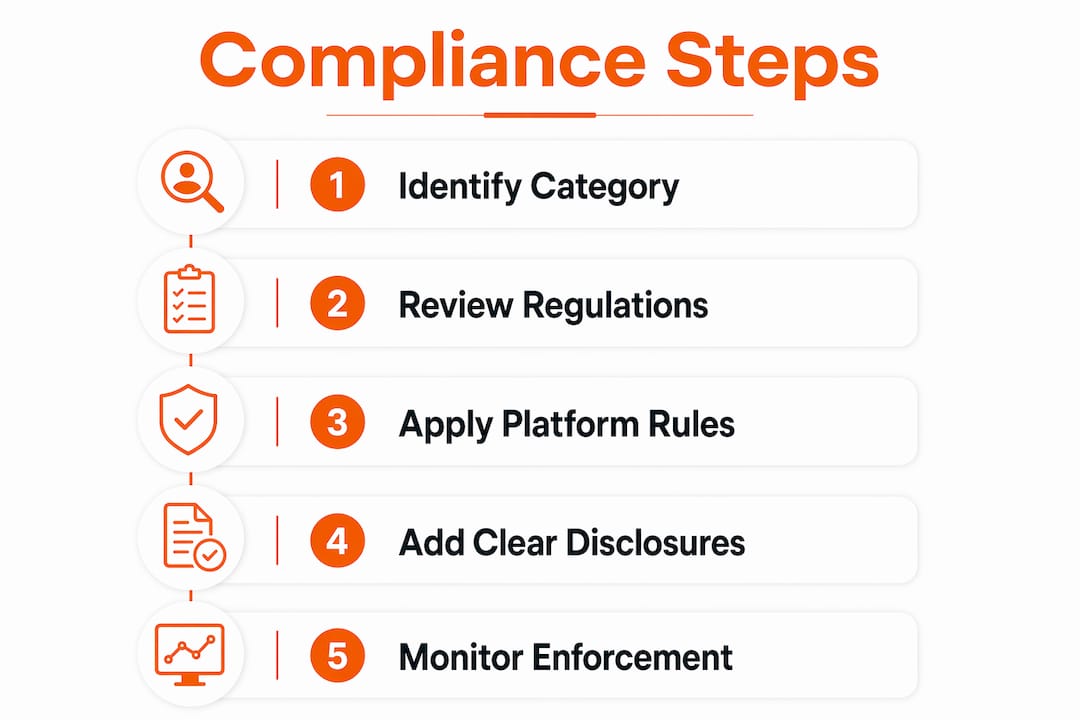
Meta classifies ads in four sensitive areas as Special Ad Categories: credit, housing, employment, and political or social issues. Misclassifying a campaign in any of these areas leads to ad pauses, rejections, and potential account-level restrictions. Correct classification restricts certain targeting options, including age, gender, ZIP code, and behavioral filters, to reduce the risk of discriminatory ad delivery.
The compliance obligation does not stop at toggling a campaign setting. Meta's Special Ad Category rules apply globally and require that the entire campaign setup aligns, including ad creative, landing page content, and targeting logic. An ad that correctly declares a Special Ad Category but links to a landing page making discriminatory implied promises can still trigger enforcement.
The table below compares disclosure tools across major platforms and their legal sufficiency:
| Platform | Built-in disclosure tool | Legally sufficient alone? | Recommended supplement |
|---|---|---|---|
| Paid Partnership label | No | Add #ad in caption | |
| TikTok | Branded Content toggle | No | Add verbal disclosure in video |
| YouTube | Paid promotion checkbox | No | Add verbal and on-screen text |
| Meta (Facebook) | Branded Content tag | No | Add explicit caption disclosure |
Platform disclosure tools like Instagram's Paid Partnership label and TikTok's Branded Content toggle are helpful but insufficient on their own. The FTC's "hard to miss" standard requires brands to supplement platform tools with explicit caption tags like #ad and, on video platforms, verbal disclosures within the content itself.
Pro Tip: Treat platform disclosure tools as a floor, not a ceiling. Build explicit in-ad and in-caption disclosures into your creative brief so compliance is baked in before production, not patched on afterward.
What practical challenges do marketers face with paid social advertising legalities?
Understanding the rules is straightforward. Applying them consistently across live campaigns is where most marketing teams struggle. Four specific challenges create the most compliance risk.
-
Disclosure visibility at scale. Disclosures that look prominent on a desktop preview can disappear on a mobile feed. The FTC evaluates disclosure clarity from the perspective of the average viewer at the moment of impression. Testing ad creative across device types and screen sizes before launch is not optional.
-
Influencer and creator compliance. Brands are legally responsible for disclosures made by influencers they pay or gift. Influencer compliance requires written agreements that specify disclosure language, placement, and timing. Verbal agreements leave brands exposed when a creator posts without a disclosure.
-
Cross-border enforcement gaps. A campaign running across the US, UK, and EU faces three distinct regulatory frameworks. Cross-border disclosure strategy should default to the strictest applicable standard, with localization only for jurisdiction-specific legal terminology or required disclaimers. Trying to tailor disclosures to each market separately multiplies the risk of missing one.
-
Indirect compliance risks in ad workflows. Reviewing only ad copy without examining the full funnel creates downstream compliance problems. Remarketing sequences, lead nurture emails, and landing page messaging can each introduce legal exposure that the original ad creative did not. Legal review must cover the entire customer journey, not just the initial ad unit.
Thailand's approach illustrates where global regulation is heading. Starting november 1, 2026, Thailand requires social media platforms to verify advertiser identity for all social ads and retain that data for at least 90 days after the relationship ends. That kind of identity verification requirement is likely to spread to other markets, adding another layer of pre-campaign compliance work.
What are best practices for building compliant paid social campaigns?
Compliance and campaign performance are not competing goals. The marketers who build compliance into their workflow from the start run faster, cleaner campaigns with fewer disruptions.
Effective compliance practice starts before creative production. Classify every campaign correctly against Meta's Special Ad Categories before briefing the creative team. Misclassification discovered after launch forces a rebuild. For law firm ad targeting and financial services campaigns, Special Ad Category classification is almost always required and should be the default assumption.
Key practices for compliant paid social campaigns:
- Audit the full funnel. Review ad creative, landing pages, remarketing sequences, and lead nurture flows together. Compliance gaps in any stage create liability for the whole campaign.
- Use explicit disclosures in every format. Add #ad or "Paid Partnership" language directly in captions and verbally in video content. Do not rely on platform toggle tools alone.
- Substantiate every claim before launch. If a claim cannot be backed by evidence, remove it from the ad. The FTC's enforcement record shows that unsubstantiated claims in paid social ads draw active scrutiny.
- Standardize influencer contracts. Include specific disclosure language, placement requirements, and approval rights in every creator agreement.
- Run regular compliance audits. Platform policies and regulatory guidance update frequently. Schedule quarterly reviews of active campaigns against current FTC, ASA, and platform standards.
Marketing teams in regulated industries like financial services face additional disclosure requirements specific to their sector. Building a compliance checklist tailored to your industry reduces the risk of missing a requirement that a generic workflow would not catch.
Key Takeaways
Legal paid social advertising requires combining government regulatory compliance, platform-specific rules, and full-funnel disclosure practices before any campaign goes live.
| Point | Details |
|---|---|
| FTC and ASA set the baseline | Both regulators require clear, prominent disclosures for any material connection in paid social ads. |
| Platform tools are not enough | Instagram, TikTok, and YouTube built-in labels must be supplemented with explicit in-ad disclosures. |
| Meta Special Ad Categories are mandatory | Credit, housing, employment, and political ads require correct classification or face account-level penalties. |
| Full-funnel review is required | Compliance must cover remarketing, landing pages, and lead nurture flows, not just the ad creative. |
| Cross-border campaigns need one standard | Default to the strictest applicable jurisdiction to manage multinational campaigns efficiently. |
Why compliance is the competitive edge most marketers ignore
Most marketing teams treat legal compliance as a legal department problem. That framing is the source of most compliance failures I see. By the time legal reviews a campaign, the creative is locked, the budget is committed, and the launch date is fixed. Compliance becomes a checkbox instead of a design principle.
The marketers who consistently avoid enforcement actions build compliance into the brief, not the approval process. They know which campaigns trigger Meta's Special Ad Categories before the campaign manager opens the platform. They have influencer contract templates ready before outreach begins. They test disclosure visibility on mobile before the creative director signs off.
Regulator scrutiny is increasing, not decreasing. The FTC's TruHeight action in 2026 and Thailand's new advertiser verification requirements both signal that governments are paying closer attention to paid social advertising than they were three years ago. Platforms are tightening their own enforcement in parallel. The cost of non-compliance is rising.
The brands that treat compliance as a competitive advantage will run cleaner campaigns, face fewer disruptions, and build more durable audience trust. The brands that treat it as overhead will keep paying the price in paused campaigns, rejected ads, and public enforcement actions. The choice is structural, not tactical.
— laya
How Omnivancemedia builds compliant paid social campaigns
Running paid social ads that perform and comply with every applicable rule requires more than a checklist. Omnivancemedia integrates compliance into every stage of campaign strategy, from initial classification and creative production to targeting setup and full-funnel review.

Omnivancemedia's paid advertising services cover Meta, TikTok, YouTube, and multi-channel campaigns, with built-in compliance workflows for Special Ad Categories, FTC disclosure standards, and cross-border regulatory requirements. The team also handles video production and creative assets with disclosure language built into the brief. For businesses ready to run paid social campaigns without the legal risk, Omnivancemedia provides the integrated expertise to get it right from day one.
FAQ
What is legal paid social advertising?
Legal paid social advertising is the practice of running paid promotions on social media platforms in full compliance with applicable advertising laws, platform policies, and disclosure requirements. It covers FTC and ASA standards, platform-specific rules like Meta's Special Ad Categories, and truthful claim substantiation.
When does Meta's Special Ad Category apply?
Meta's Special Ad Category applies to campaigns involving credit, housing, employment, and political or social issues. Misclassifying these campaigns leads to ad rejections, pauses, and potential account suspensions.
Are platform disclosure labels enough to satisfy the FTC?
Platform disclosure tools like Instagram's Paid Partnership label and TikTok's Branded Content toggle are not sufficient on their own. The FTC requires disclosures that are hard to miss, meaning brands must add explicit caption tags like #ad and verbal disclosures in video content.
How should brands handle cross-border paid social campaigns?
Brands running campaigns across multiple countries should default to the strictest applicable regulatory standard. A single prominent, in-medium disclosure strategy satisfies both FTC and ASA requirements more efficiently than building separate compliance workflows for each market.
What compliance risks exist beyond the ad creative itself?
Remarketing sequences, lead nurture emails, and landing pages can each create legal exposure independent of the original ad. Practitioners must audit the full customer journey, including all post-click touchpoints, to prevent inadvertent compliance violations.