How to Allocate Your Law Firm Advertising Budget

Allocating a law firm advertising budget effectively means investing between 7% and 15% of gross annual revenue, split across SEO, paid acquisition, brand building, and channel testing. The exact percentage depends on your firm's growth stage, practice area, and competitive market. Firms that treat marketing spend as a fixed line item rather than a growth lever consistently underperform. Only about 47% of law firms use a formal annual marketing budget, which means the majority are spending reactively rather than by design. This guide gives you a data-backed framework to spend with purpose.
How to allocate law firm advertising budget effectively by growth stage
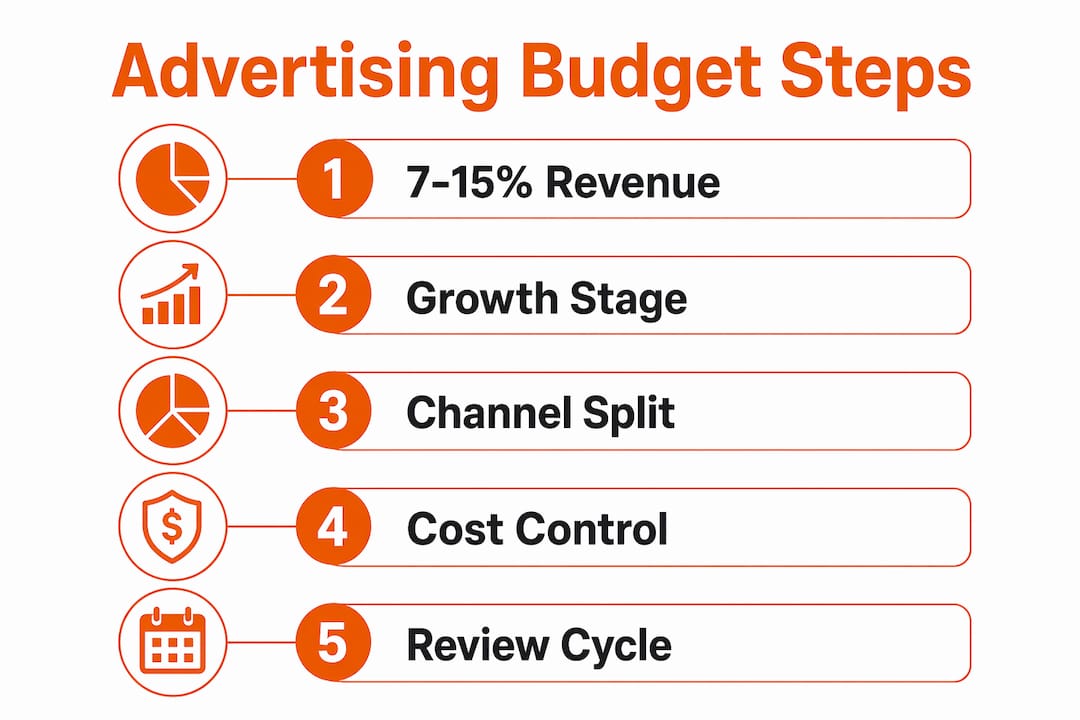
The right law firm marketing budget starts with a percentage of gross revenue, not a dollar figure pulled from last year's spend. Firms in maintenance mode spend 7–10% of gross revenue on marketing. Growth-focused firms spend 10–15%. Firms entering new markets or competing aggressively spend 15% or more. That range exists because marketing is not a fixed cost. It scales with ambition.
Practice area shapes budget size as much as growth stage does. Personal injury firms often require $20,000 to $150,000+ monthly because high case values justify aggressive spend. Estate planning and family law firms operate effectively at $3,000 to $15,000 monthly, where referrals and efficiency matter more than volume. The table below maps typical monthly spend by practice area and growth mode.

| Practice Area | Maintenance Mode | Growth Mode |
|---|---|---|
| Personal injury | $20,000–$50,000 | $75,000–$150,000+ |
| Family law | $3,000–$6,000 | $8,000–$15,000 |
| Estate planning | $2,500–$5,000 | $6,000–$12,000 |
| Criminal defense | $4,000–$8,000 | $10,000–$20,000 |
| Immigration law | $3,500–$7,000 | $9,000–$18,000 |
These ranges are starting points, not ceilings. A personal injury firm in a major metro market will push past the upper end of the growth column. A solo estate planning attorney in a mid-size city may find the lower end of maintenance mode more than sufficient.
Key factors that push your budget higher:
- High competitor ad spend in your metro area
- A new firm with no existing brand recognition
- A practice area with long sales cycles requiring repeated touchpoints
- Expansion into a new geographic market or service line
How should law firms split their budget across marketing channels?
Channel allocation is where most firms make their biggest mistakes. A common and well-tested framework splits the budget as follows: 40–50% to paid acquisition, 20–30% to brand building and traditional media, 15–20% to SEO and content marketing, and 10–15% to testing new channels. Each bucket serves a different function in the client acquisition pipeline.
Paid acquisition, including Google Ads and Local Services Ads, generates leads now. SEO generates leads for years. Organic search leads cost approximately $456 each, compared to $784 for paid search leads. That cost gap widens over time as your SEO investment compounds. Paid traffic stops the moment you stop spending. SEO keeps producing. Learn more about how paid search campaigns and SEO work together for law firms.
The 60/40 rule offers a useful lens for the long view. 60% of your budget toward long-term brand equity — SEO, content, and reputation — and 40% toward short-term activation like Google Ads and Local Services Ads. Firms that ignore brand building and chase only short-term channels pay increasingly high prices for leads as competition intensifies.
Pro Tip: Track Cost Per Signed Case (CPSC) as your primary KPI, not clicks or impressions. A channel generating 500 clicks but zero signed cases is burning budget. A channel generating 10 clicks and 3 signed cases is your priority.
The most common channel allocation mistake is spreading a limited budget too thin. Budgets under $8,000 per month spread across too many channels produce mediocre results everywhere. Dominating 2–3 channels produces measurable ROI and builds momentum. Pick your highest-intent channels first, fund them properly, and expand only after they perform.
Channels to prioritize by intent level:
- Highest intent: Google Search Ads, Local Services Ads, SEO
- Mid intent: YouTube pre-roll, display retargeting, email nurture
- Brand building: Podcast sponsorships, community sponsorships, PR
What tools and metrics support disciplined budget management?
Budget discipline requires a tracking system, not just a spreadsheet. Cost Per Signed Case is the metric that connects marketing spend to actual revenue. Channels not tied directly to signed cases should carry smaller experimental budgets until they prove their contribution. Vanity metrics like page views and social followers tell you nothing about client acquisition.
CRM platforms like Salesforce, Clio Grow, or HubSpot give you the attribution data to connect a signed client back to the original marketing touchpoint. Without proper CRM and marketing automation, you are guessing which channels work. With it, you can see exactly which campaigns drove consultations and which drove signed retainers.
Quarterly budget reviews are the mechanism that turns a static plan into a growth system. Review your CPSC by channel every 90 days. Reallocate budget from underperforming channels to those producing signed cases at the lowest cost. This quarterly cadence prevents the common trap of funding a channel for 12 months out of habit rather than performance.
A disciplined quarterly review process looks like this:
- Pull CPSC data for every active channel from your CRM.
- Rank channels by CPSC from lowest to highest.
- Identify any channel spending below its minimum effectiveness threshold.
- Reallocate budget from the bottom two performers to the top two.
- Set a 90-day test budget for one new channel you have not yet tried.
Pro Tip: Before cutting a channel, check whether it is funded above its minimum effectiveness threshold. PPC requires $1,500 to $2,000 monthly in competitive markets to generate enough data to evaluate fairly. Underfunded channels look ineffective even when the channel itself is sound.
SEO deserves special treatment in your review cycle. SEO should be evaluated over a 6–18 month horizon, not 90 days. Early lead metrics from SEO can be misleading. Sustained investment unlocks compounding lead flow that paid channels cannot replicate. Cutting SEO after three months because it has not yet produced signed cases is one of the most expensive mistakes a law firm can make.
How do firm size and market conditions change your budget strategy?
Smaller firms and solo practitioners face a specific constraint: limited budgets demand tighter focus. A firm spending $4,000 per month should put the majority into SEO and one paid channel, not five channels at $800 each. Dominating a few channels creates measurable ROI and builds momentum that a scattered approach never achieves.
New firms entering a market face a different problem. They have no brand recognition, no referral base, and no organic search presence. New firms should spend 15–20% of projected revenue on marketing in their first 12–18 months to build visibility fast. That higher initial spend is not waste. It is the cost of entering a market where established firms already own the top search positions and the referral networks.
Competitive market density changes the math on every channel. A family law firm in a mid-size market with few competitors can generate cases at $200 CPSC through SEO alone. The same firm in a major metro market may need $600 CPSC through a combination of SEO and Google Ads just to stay competitive. Knowing your market's competitive density before setting your budget prevents you from underfunding the channels that actually move the needle.
Budget strategy by firm profile:
| Firm Profile | Recommended Focus | Budget Range |
|---|---|---|
| Solo/small, established market | SEO + 1 paid channel | 7–10% of revenue |
| Mid-size, growth mode | SEO + Google Ads + LSAs | 10–15% of revenue |
| New firm, any market | Paid acquisition heavy | 15–20%+ of revenue |
| Large firm, competitive metro | Full channel mix | 12–18% of revenue |
Long-term brand equity investments reduce lead acquisition costs over time and create durable competitive advantages. Firms that build brand authority through consistent SEO and content spend less per signed case every year. Firms that rely only on paid acquisition spend more per signed case every year as competition increases.
Key Takeaways
Firms that allocate their law firm advertising budget effectively by growth stage, channel, and practice area consistently acquire clients at lower cost than firms that spend reactively.
| Point | Details |
|---|---|
| Budget by revenue percentage | Spend 7–10% in maintenance mode and 10–15% or more when targeting growth. |
| Dominate fewer channels | Budgets under $8,000 per month work best when concentrated in 2–3 high-intent channels. |
| Track Cost Per Signed Case | CPSC is the only metric that connects marketing spend directly to revenue. |
| Apply the 60/40 rule | Put 60% toward long-term brand equity and 40% toward short-term paid activation. |
| Review quarterly | Reallocate budget every 90 days based on CPSC data, not habit or assumption. |
Why I think most law firms are solving the wrong budget problem
Most law firm marketing conversations start with the wrong question. Partners ask "How much should we spend?" when the real question is "Where does each dollar produce a signed case?" I have seen firms with $50,000 monthly budgets lose to competitors spending $15,000, simply because the smaller firm tracked CPSC religiously and the larger firm did not.
The firms that consistently win are not the ones with the biggest budgets. They are the ones with the most disciplined reallocation habits. They fund SEO for 12 months without flinching, even when early metrics look flat. They cut paid channels that produce clicks but not cases. They test one new channel per quarter with a capped experimental budget. That discipline compounds over time in ways that raw spend never can.
The 60/40 brand-to-activation split is the insight most firms resist. Paid ads feel productive because the results are immediate and visible. SEO feels slow because the payoff is delayed. But SEO is mathematically favored over a 12-month horizon, and the gap widens every year you sustain the investment. The firms I have watched build durable client pipelines all made the same choice: they committed to brand equity early and treated paid activation as a supplement, not the foundation.
Budget allocation is not a one-time decision. It is a quarterly discipline. The firms that treat it that way stop asking how much to spend and start asking how to spend better.
— laya
Omnivancemedia's approach to law firm marketing budgets
Law firm marketing managers who want to stop guessing and start measuring have one core need: an integrated system that connects every dollar spent to every case signed.

Omnivancemedia builds exactly that for law firms. The team combines legal SEO services with paid advertising campaigns and CRM attribution into one connected system, so you always know your CPSC by channel. Omnivancemedia's clients see results like $340,000 in new contracts within 90 days because every budget dollar is tracked, tested, and reallocated based on performance. If your firm is ready to move from reactive spending to a data-driven marketing budget, explore Omnivancemedia's full services to see how the system works.
FAQ
What percentage of revenue should a law firm spend on marketing?
Most law firms should invest between 7% and 15% of gross annual revenue on marketing. Maintenance-mode firms spend 7–10%, while growth-focused firms spend 10–15% or more.
What is Cost Per Signed Case and why does it matter?
Cost Per Signed Case (CPSC) measures how much you spend to acquire one signed client. It is the most direct metric connecting your marketing budget to actual revenue, making it more useful than clicks or impressions.
How many marketing channels should a law firm use?
Law firms with budgets under $8,000 per month should focus on 2–3 high-intent channels. Spreading a limited budget across too many channels produces weak results on every platform.
Is SEO or paid advertising better for law firms?
Both serve different functions. Organic search leads cost approximately $456 each versus $784 for paid search leads, making SEO more cost-efficient over time. Paid ads generate immediate leads but stop producing the moment you stop spending.
How often should a law firm review its marketing budget?
Law firms should conduct a formal budget review every 90 days. Quarterly reviews allow you to reallocate funds from underperforming channels to those producing signed cases at the lowest cost.