Generative Engine Optimization: Your 2026 Strategy Guide

What is generative engine optimization and how does it differ from SEO?
Generative engine optimization (GEO) is the practice of structuring web content so that AI-powered search engines, those built on large language models like Google's AI Overviews and Perplexity, cite your content when synthesizing answers to user queries. Research published in the ACM SIGKDD Conference proceedings demonstrates that GEO methods can boost content visibility by 30–40% in generative engine responses. That is the core promise, and it is meaningfully different from anything traditional SEO delivers.
Traditional SEO optimizes for a ranked list of blue links. GEO optimizes for citation inside a synthesized answer. The distinction matters because generative engines do not show ten results and let users pick. They write a response, pull from multiple sources, and embed citations inline. Your goal shifts from "rank on page one" to "get quoted in the answer."
Key differences between GEO and traditional SEO:
- Visibility metric: SEO measures ranking position; GEO measures citation frequency, citation position, and how much of your content appears in the AI's response.
- Algorithm transparency: Traditional search ranking signals are partially documented; generative engine algorithms are proprietary and largely opaque, requiring black-box optimization approaches.
- Content signals: Keywords still matter in GEO, but semantic relevance, authoritative citations, and structured answers carry more weight.
- Terminology: Practitioners also use the terms answer engine optimization (AEO), AI SEO, and large language model optimization (LLMO) for overlapping concepts, though no academic consensus on distinctions existed as of early 2026. For a clear breakdown of how these terms compare, see this AEO vs. SEO vs. GEO explainer.
Core strategies that actually improve your GEO performance
The most effective GEO methods require minimal structural overhaul but demand a shift in how you think about content quality. The ACM SIGKDD research identified three top-performing tactics: adding relevant statistics, incorporating credible quotations, and citing authoritative sources. Together, these produced a 30–40% relative improvement on position-adjusted visibility metrics.
Practical GEO strategies to apply now:
- Add citations and statistics to your content. Pages that reference verifiable data give AI systems concrete, attributable material to pull from. Bare claims without sourcing get skipped.
- Use question-based headings. Pages with question-format headings see a 31% higher citation rate in AI search results. Structure your H2s and H3s around the exact questions your audience types.
- Write direct, specific answers. Pages that directly address specific queries earn higher citation rates than pages that bury the answer in general prose.
- Maintain technical crawlability. Crawlable, well-structured sites remain the foundation. If a generative engine cannot index your page, it cannot cite it.
- Build consistent brand mentions. AI systems treat unlinked brand mentions as trust signals, so authentic digital branding across platforms reinforces your authority.
- Support text with multimodal content. Images, charts, and videos do not replace written content in GEO, but they signal depth and completeness to AI crawlers evaluating page quality.
Pro Tip: Human oversight is the part most marketers skip. AI tools can draft and restructure content efficiently, but a person needs to review every output for brand voice, factual accuracy, and strategic fit. AI content optimization works best as a human-guided process, not a fully automated one.
Why GEO matters for your business in 2025 and 2026
AI-powered search is not a future scenario. It is the current default for a growing share of queries, and the gap between businesses that have adapted and those that have not is widening fast.
Visibility impact: Incorporating citations, quotations, and relevant statistics improves visibility in generative engine responses by 30–40%, according to ACM SIGKDD research. Pages with question-based headings see a 31% higher citation rate in AI results.
The competitive advantage here is still accessible. Most businesses are still running pure traditional SEO playbooks. Adapting content for AI citation now, before the market saturates, gives early movers a measurable edge. For a deeper look at how AI-driven search is reshaping visibility strategies across the industry, the shift in user behavior is already well documented.
GEO also expands where you can be found. Traditional SEO visibility lives inside Google's blue-link results. GEO visibility extends to ChatGPT, Perplexity, Google AI Overviews, Microsoft Copilot, and any other platform that synthesizes answers from the web. That is a materially larger surface area for brand exposure.

How to implement GEO effectively: a practical workflow

Getting GEO right is less about new tools and more about disciplined content practices applied consistently. Start with an audit, then build from there.
Step-by-step implementation:
- Audit existing content for AI-readiness. Identify pages that answer specific questions but lack citations, statistics, or clear structure. These are your highest-priority rewrites.
- Restructure headings as questions. Convert generic section titles into direct questions your audience asks. This alone can lift citation rates meaningfully.
- Add sourced data and quotations. Every factual claim should point to a named, credible source. Generative engines favor content that is verifiable.
- Check technical SEO fundamentals. Google's documentation is explicit: optimizing for generative AI search is optimizing for the search experience, and foundational SEO principles remain effective. Fix crawl errors, improve page speed, and confirm proper indexing.
- Avoid ineffective shortcuts. Google has confirmed that special AI markup files like llms.txt and artificial content chunking do not improve generative AI visibility. Skip those and focus on content quality.
- Refresh content on a regular schedule. AI systems favor current, accurate information. Set a quarterly review cycle for your highest-traffic pages.
- Monitor AI performance reports. Track how often your brand and content appear in AI-generated answers, then iterate based on what citation patterns you observe.
For teams building out these workflows, Omnivancemedia's guide on training teams on AI marketing tools covers the human side of making this work at scale.
How GEO and traditional SEO work together
GEO does not replace SEO. It extends it. Google's official guidance frames it plainly: "optimizing for generative AI search is optimizing for the search experience, and thus still SEO." The foundational work, quality content, clean site architecture, authoritative backlinks, stays fully relevant.
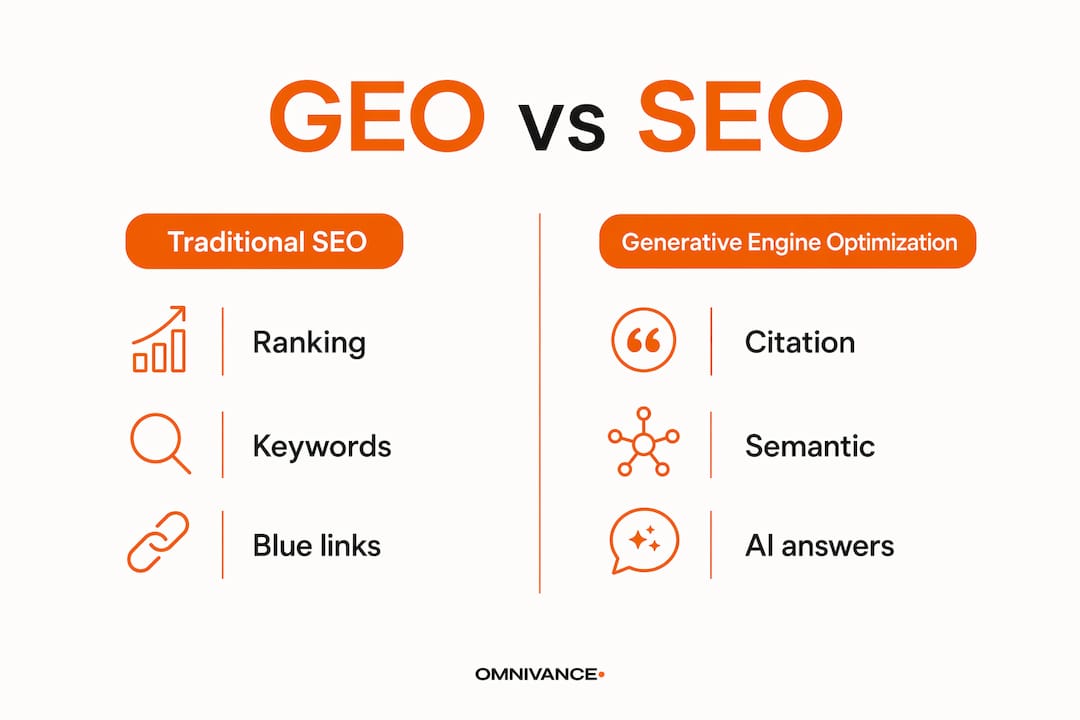
What GEO adds is a layer of content strategy focused on how AI systems extract and present information. That requires domain-specific tuning because the ACM SIGKDD research showed GEO strategy effectiveness varies by topic area. A legal services page needs different citation structures than a product review page.
| Focus area | Traditional SEO | Generative engine optimization |
|---|---|---|
| Primary goal | Rank in search results | Get cited in AI answers |
| Key signals | Keywords, backlinks, page authority | Semantic relevance, citations, structured answers |
| Visibility metric | Search ranking position | Citation frequency and position in AI response |
| Algorithm | Partially documented | Proprietary, black-box |
| Content format | Keyword-optimized pages | Question-based, citation-rich, authoritative |
| Measurement | Organic traffic, ranking reports | AI citation tracking, brand mention monitoring |
The practical integration approach: run your existing SEO program unchanged, then layer GEO practices onto your most important pages. Question-based headings, added citations, and direct answers cost little to implement and serve both traditional and AI search simultaneously.
Common challenges when implementing GEO
The biggest obstacle most marketers hit is the black-box problem. You cannot see inside a generative engine's ranking logic the way you can study a traditional search algorithm. That means you are optimizing for signals, not confirmed rules, and results take time to appear in citation tracking.
Content quality at scale is the second friction point. GEO rewards depth, specificity, and sourced claims. Producing that across hundreds of pages requires either significant editorial investment or a well-supervised AI-assisted workflow. Teams that automate without oversight produce content that looks thorough but lacks the verifiable substance AI systems actually cite.
Attribution is also harder. When a user gets an AI-generated answer, they may not click through to your site at all. Traditional traffic metrics undercount GEO impact, which makes it difficult to justify the investment without dedicated citation monitoring tools.
Finally, the terminology confusion around GEO, AEO, and AI SEO leads some teams to treat them as separate programs requiring separate budgets. They are not. The underlying content practices overlap heavily, and treating them as one integrated effort is more efficient.
Future trends shaping generative engine optimization
The shift toward semantic relevance as the primary GEO signal is already underway. By early 2026, practitioners had moved well past keyword placement toward content that demonstrates genuine topical authority through structure, sourcing, and specificity.
Monetization of AI search results is the next major variable. OpenAI and Google have both begun integrating paid placements into conversational AI interfaces. Organic GEO and paid AI visibility will likely develop into parallel tracks, similar to how organic SEO and paid search coexist today.
Multimodal AI search, where engines process images, audio, and video alongside text, will expand GEO beyond written content. Brands with strong video and visual asset libraries will have citation opportunities that text-only publishers cannot match. The 2026 digital marketing landscape is already reflecting this shift in how marketers allocate content production budgets.
How to measure whether your GEO efforts are working
Measuring GEO requires different tools and different thinking than traditional SEO reporting. Organic traffic alone will not tell you whether your content is being cited in AI answers.
Key metrics to track:
- AI citation frequency: How often does your brand or content appear in AI-generated responses for your target queries? Dedicated tools now monitor brand mentions across ChatGPT, Perplexity, and Google AI Overviews.
- Citation position: Where in the AI response does your content appear? Earlier citations generally carry more influence on the user.
- Brand mention volume: Unlinked brand mentions across the web feed AI trust signals. Track these separately from backlinks.
- Organic traffic from AI referrals: Some AI platforms pass referral data. Monitor these sessions as a distinct channel in your analytics.
- Content freshness score: Track how recently your cited pages were updated. Stale content loses citation priority over time.
Pair these metrics with a quarterly content audit. Pages that drop in citation frequency usually need updated statistics, clearer question-based structure, or stronger sourcing.
Key Takeaways
Generative engine optimization requires authoritative, citation-rich, question-structured content to earn visibility inside AI-generated answers, not just traditional search rankings.
| Point | Details |
|---|---|
| GEO vs. SEO | GEO targets citation in AI answers; SEO targets ranked positions in search result pages. |
| Top visibility tactics | Adding citations, quotations, and statistics improves AI visibility by 30–40% per ACM SIGKDD research. |
| Question-based headings | Pages with question-format headings earn a 31% higher citation rate in AI search results. |
| Avoid ineffective shortcuts | Google confirms that AI markup files and content chunking do not improve generative AI visibility. |
| Omnivancemedia | Omnivancemedia integrates GEO, SEO, and paid advertising into one system, helping businesses scale visibility across both traditional and AI-powered search. |
Omnivancemedia helps you get cited where it counts
Most agencies still optimize for page-one rankings while AI search quietly captures a growing share of your audience's attention. Omnivancemedia builds the kind of content infrastructure that earns citations in AI-generated answers and drives traffic from traditional search at the same time, without splitting your budget across multiple vendors.

The results speak for themselves: an HVAC contractor generated $340K in new contracts within 90 days, and an e-commerce client grew monthly revenue from $80K to $420K. That comes from combining AI-optimized SEO, paid advertising, CRM automation, and creative production into one coordinated system. If your business is ready to grow past $500K and you want AI search working for you instead of around you, see what Omnivancemedia offers and take the next step.