E-Commerce Email Automation: A Revenue-Focused Guide

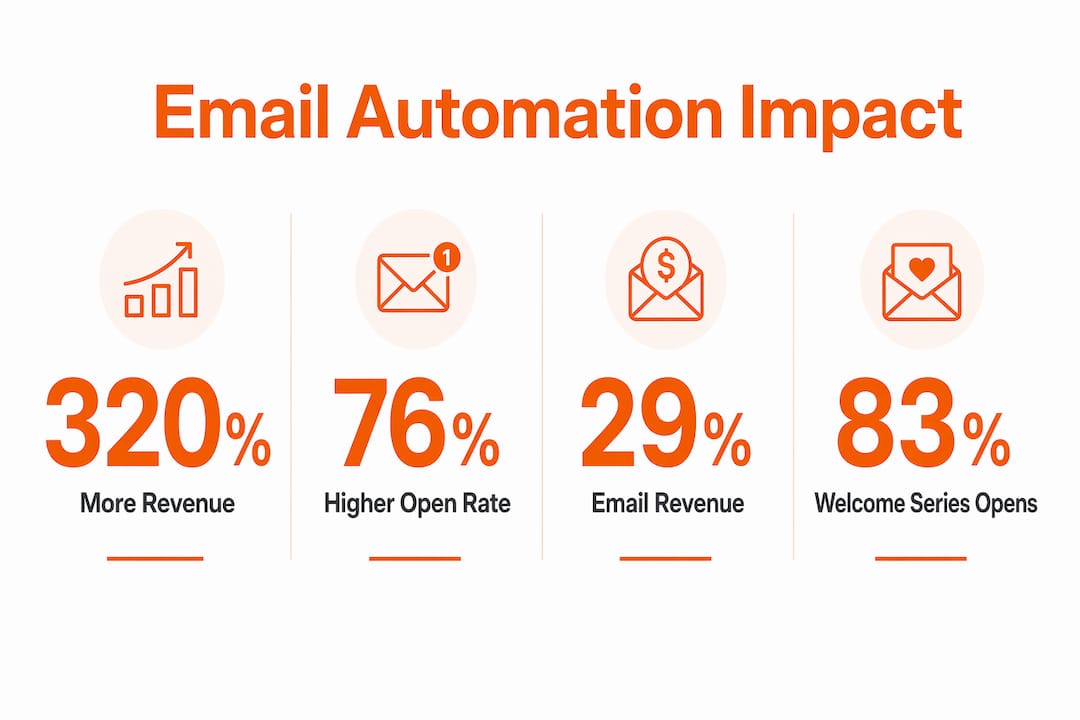
E-commerce email automation is defined as the practice of sending behavior-triggered emails to customers automatically, without manual effort, based on actions they take in your store. This is the industry's standard term for what marketers also call "automated email workflows" or "triggered email sequences." Automated flows generate 29% of all email revenue while accounting for just 2% of total email sends. That ratio is the core argument for automation: a small slice of your email volume does the heavy lifting. When built correctly, core sequences like welcome series, abandoned cart flows, and post-purchase emails account for 25–40% of total store revenue.
What is e-commerce email automation and how does it work?
E-commerce email automation is a rules-based system that monitors customer behavior and sends targeted messages when specific conditions are met. A customer signs up, abandons a cart, or makes a purchase. The platform detects that action and fires a pre-built email sequence without anyone pressing send.
Automation platforms use workflows and triggers to deliver drip campaigns, welcome series, and cart reminders at scale. A trigger is the event that starts the sequence. A workflow is the conditional logic that determines what happens next. For example, if a customer opens email one but does not click, the workflow sends a different follow-up than it would for someone who clicked through.

Segmentation sits at the center of this system. The platform splits your audience by behavior, purchase history, or lifecycle stage, then routes each group into the right sequence. Automated emails are more timely, personal, and effective than standard scheduled campaigns because the message arrives exactly when the customer's intent is highest.
Pro Tip: Set your trigger delays carefully. An abandoned cart email sent 1 hour after abandonment consistently outperforms one sent 24 hours later, because purchase intent drops sharply with time.
Which automated email flows drive the most revenue?
Not all flows perform equally. These six sequences produce the majority of revenue in a well-built e-commerce email program.
-
Welcome series. The welcome series has the highest revenue per recipient of any flow. Welcome email open rates can exceed 83%, compared to a 20–25% average for general campaigns. Send three to five emails over the first week, introduce your brand story, and make a first-purchase offer.
-
Abandoned cart recovery. Cart abandonment flows recover 3–5% of lost revenue. A three-email sequence works best: send the first within one hour, the second at 24 hours, and the third at 72 hours with a small incentive.
-
Post-purchase series. This flow starts after a confirmed order. It covers shipping updates, product education, review requests, and a cross-sell recommendation. Done well, it increases repeat purchase rates and builds long-term loyalty.
-
Browse abandonment. A customer views a product page but does not add to cart. A single email sent within two hours, featuring the viewed product and related items, recovers a meaningful share of that lost intent.
-
Win-back campaigns. Inactive customers cost you deliverability if you keep emailing them without a plan. Win-back flows targeted by customer lifetime value improve retention by sending tailored offers to lapsed buyers most likely to return.
-
VIP and loyalty flows. These reward your highest-value customers with early access, exclusive offers, or personalized recommendations. They protect your best relationships and increase average order value.
| Flow | Primary trigger | Revenue impact |
|---|---|---|
| Welcome series | New subscriber sign-up | Highest revenue per recipient |
| Abandoned cart | Cart left without purchase | Recovers 3–5% of lost sales |
| Post-purchase | Confirmed order | Drives reviews and repeat purchases |
| Browse abandonment | Product page view, no add-to-cart | Recovers high-intent window shoppers |
| Win-back | 90+ days of inactivity | Re-engages lapsed buyers by LTV |
Pro Tip: Build your welcome series before any other flow. It reaches customers at peak interest and sets the tone for every future interaction. Get this one right first.
How do triggers and workflows power automated sequences?
A trigger is any customer action your platform can detect. Common triggers include submitting an email sign-up form, adding an item to a cart, completing a purchase, or visiting a specific product category three times in one week. Each trigger starts a workflow.
A workflow is a decision tree. It checks conditions, such as whether the customer has purchased before, what their average order value is, or whether they opened the last email, and then routes them to the right message. This is what separates automation from a simple scheduled newsletter. The system responds to behavior rather than a calendar.
Segmentation makes workflows more precise. You can split a post-purchase flow into two branches: one for first-time buyers and one for repeat customers. First-time buyers get onboarding content and a review request. Repeat customers get a loyalty reward and a higher-value cross-sell. The same trigger produces two very different experiences based on purchase history.
Integration with your e-commerce platform is what makes this possible at scale. Your store passes order data, browse data, and customer attributes to your email platform in real time. That data feeds the trigger conditions and personalizes the email content dynamically. For a deeper look at connecting these systems, CRM integration with email marketing explains how to map customer journey stages to specific automation triggers.
What are the measurable benefits of email automation?
The performance gap between automated flows and manual campaigns is not subtle. Triggered emails produce a 76% higher open rate and a 152% higher click-through rate compared to broadcast campaigns. That difference comes from timing and relevance. A triggered email arrives when the customer is already thinking about your product.
Revenue impact is equally clear. Automated sequences generate 320% more revenue than manual sends. Email marketing returns an average of $42 for every $1 spent, and that figure rises for brands using AI-driven behavioral segmentation. The math favors automation at every stage of the funnel.
Customer lifetime value also improves. Post-purchase flows that deliver product education and timely cross-sells increase the probability of a second purchase. Win-back campaigns extend the active customer window. Each flow compounds the value of your existing customer base rather than relying entirely on new acquisition.
List quality determines how much of this potential you actually capture. A disengaged list suppresses open rates, damages sender reputation, and reduces deliverability. Maintaining sub-90-day recency thresholds and separating transactional emails from marketing traffic protects your sender score and keeps your flows performing.
How does AI improve e-commerce email automation?
AI changes email automation from a static rules engine into a system that learns and adapts. Standard automation fires a trigger when a condition is met. AI-assisted automation predicts the best time to send, the most relevant product to feature, and the message format most likely to convert for each individual customer.
AI enables lifecycle mapping by aligning email content with each customer's current journey stage. A customer who just made their third purchase is in a different stage than someone who signed up last week. AI reads those signals and adjusts the flow accordingly, without you manually creating a new segment every time.
The contrast with batch-and-blast methods is significant. Batch-and-blast emails damage engagement because they ignore behavior and send the same message to everyone. AI-segmented triggered emails outperform them on every metric because the message is relevant to the recipient's actual behavior.
Practical AI applications in e-commerce email automation include:
- Send-time optimization. The platform analyzes when each subscriber historically opens emails and schedules delivery at that individual's peak window.
- Dynamic content blocks. Product recommendations inside the email update based on the customer's most recent browse or purchase behavior.
- Churn prediction. AI flags customers showing early signs of disengagement before they hit the 90-day inactivity threshold, triggering a win-back sequence earlier.
- Subject line testing. AI runs multivariate tests across subject line variants and automatically shifts send volume toward the best performer.
Pro Tip: Start with send-time optimization before building complex AI personalization. It requires no new content and produces measurable open rate gains within the first two weeks.
For teams adopting AI tools across their marketing stack, training your team on AI marketing tools covers the practical steps to build internal capability without disrupting existing workflows.
Key takeaways
E-commerce email automation drives 25–40% of store revenue through behavior-triggered sequences that outperform manual campaigns on every measurable metric.
| Point | Details |
|---|---|
| Automation drives outsized revenue | Automated flows generate 29% of email revenue from just 2% of total sends. |
| Welcome series comes first | It has the highest revenue per recipient and sets the tone for all future emails. |
| Triggers beat schedules | Triggered emails produce 76% higher open rates than broadcast campaigns. |
| List quality is non-negotiable | Sub-90-day recency thresholds protect deliverability and keep flows performing. |
| AI multiplies automation results | Send-time optimization and dynamic content lift conversions without extra content creation. |
What I've learned from watching e-commerce brands get this wrong
Most e-commerce businesses underinvest in the welcome series and overinvest in promotional campaigns. The welcome series is the highest-converting flow you will ever build, and most stores treat it as a single "thanks for signing up" email. That is a significant missed opportunity.
The second pattern I see repeatedly is treating automation as a set-it-and-forget-it system. Flows degrade. Products go out of stock. Offers expire. A cart abandonment email featuring a discontinued product actively damages trust. Auditing your flows every 90 days is not optional if you want them to keep performing.
Deliverability is the silent killer of email programs. Brands that grow their lists aggressively without pruning inactive subscribers watch their open rates fall and their revenue per send drop. The fix is not more emails. It is a cleaner list with tighter engagement thresholds. Sending 3–5 campaigns per week to tiered segments with 6–8 core flows, as the data supports, only works when your list is healthy enough to receive them.
The brands I have seen scale email revenue fastest share one habit: they integrate their CRM data with their email platform before building any flows. Without that integration, your triggers are guessing. With it, every sequence responds to real purchase history, real browse behavior, and real lifecycle stage. That is the difference between automation that earns 25% of revenue and automation that earns 40%.
— laya
How Omnivancemedia helps e-commerce brands build email automation that scales
Omnivancemedia works with e-commerce businesses that are ready to move beyond disconnected marketing tools and build a system where every channel reinforces the others. Email automation is most effective when it connects directly to your CRM, your paid advertising data, and your customer lifecycle model.
Omnivancemedia's CRM and marketing automation services cover the full setup: trigger architecture, flow design, segmentation strategy, and platform integration. The results are measurable. One e-commerce client grew monthly revenue from $80,000 to $420,000 after Omnivancemedia integrated their CRM with a full automation program. For retail and e-commerce businesses looking to build that kind of system, digital marketing for retail stores outlines the specific services available.
FAQ
What is e-commerce email automation in simple terms?
E-commerce email automation is a system that sends targeted emails to customers automatically when they take specific actions, like signing up, browsing a product, or abandoning a cart. No manual sending is required once the workflows are built.
How much revenue can automated email flows generate?
Automated flows generate 29% of all email revenue while accounting for just 2% of total email sends. Optimized core sequences typically account for 25–40% of total store revenue.
What is the most effective automated email flow?
The welcome series has the highest revenue per recipient of any flow, with open rates that can exceed 83%. It should be the first automation any e-commerce store builds.
How do triggered emails differ from regular email campaigns?
Triggered emails fire based on customer behavior, while regular campaigns send to a list on a fixed schedule. Triggered emails produce a 76% higher open rate and a 152% higher click-through rate than broadcast campaigns.
How does AI improve automated email workflows?
AI adds send-time optimization, dynamic product recommendations, and churn prediction to standard rule-based automation. These capabilities increase open rates and conversions without requiring additional content creation.