Digital Marketing for Dentists: 2026 Growth Guide

Digital marketing for dentists is the practice of using local SEO, Google Business Profile optimization, patient reviews, website content, and automated communication tools to increase new patient acquisition and retention. Between 73% and 77% of patients start their dentist search online, which means your digital presence is your first impression. The top 3 Map Pack positions capture roughly 72% of all local search clicks. That concentration of attention makes local search dominance the single most important factor in growing a dental practice today.
How does local SEO and Google Business Profile optimization drive patient leads?
Local SEO is the process of making your practice appear prominently when patients search for dental services near them. It is the highest-return investment in online marketing for dentists because it captures patients who are already ready to book.
Your Google Business Profile (GBP) is the centerpiece of local SEO. GBP optimization drives 25–40% of new patient inquiries, while organic SEO contributes another 20–30%. Together, they account for the majority of new patient traffic without paid advertising.
An optimized GBP requires:
- Consistent NAP data. Your name, address, and phone number must match exactly across every directory and your website.
- Accurate service categories. Choose primary and secondary categories specific to your dental specialties, such as "cosmetic dentist" or "pediatric dentist."
- Detailed service descriptions. Write clear descriptions for each procedure you offer. Patients and Google both read them.
- Updated photos. Practices with recent, high-quality photos receive significantly more profile views than those without.
- Active review responses. Responding to every review, positive or negative, signals to Google that your profile is well-managed.
- Current business hours. Outdated hours are one of the fastest ways to lose a patient's trust before they ever call.
Pro Tip: Post a new photo or update to your GBP at least once per week. Google rewards active profiles with higher local rankings, and the effort takes less than five minutes.
The SEO strategies that place practices in the top Map Pack positions follow a consistent pattern: complete profiles, consistent citations, and a steady flow of fresh reviews. Practices that treat their GBP as a living asset rather than a one-time setup consistently outperform those that do not.
| GBP Signal | Impact on Local Ranking |
|---|---|
| Consistent NAP citations | High: builds trust with Google's local algorithm |
| Review volume and recency | High: directly influences Map Pack position |
| Service category accuracy | Medium: helps match practice to relevant searches |
| Photo frequency | Medium: increases profile engagement and views |
| Response to reviews | Medium: signals active management to Google |
What role do patient reviews and online reputation play in dental marketing success?
Reviews are not just social proof. They are a direct ranking factor in local SEO and a primary conversion driver in the Map Pack.
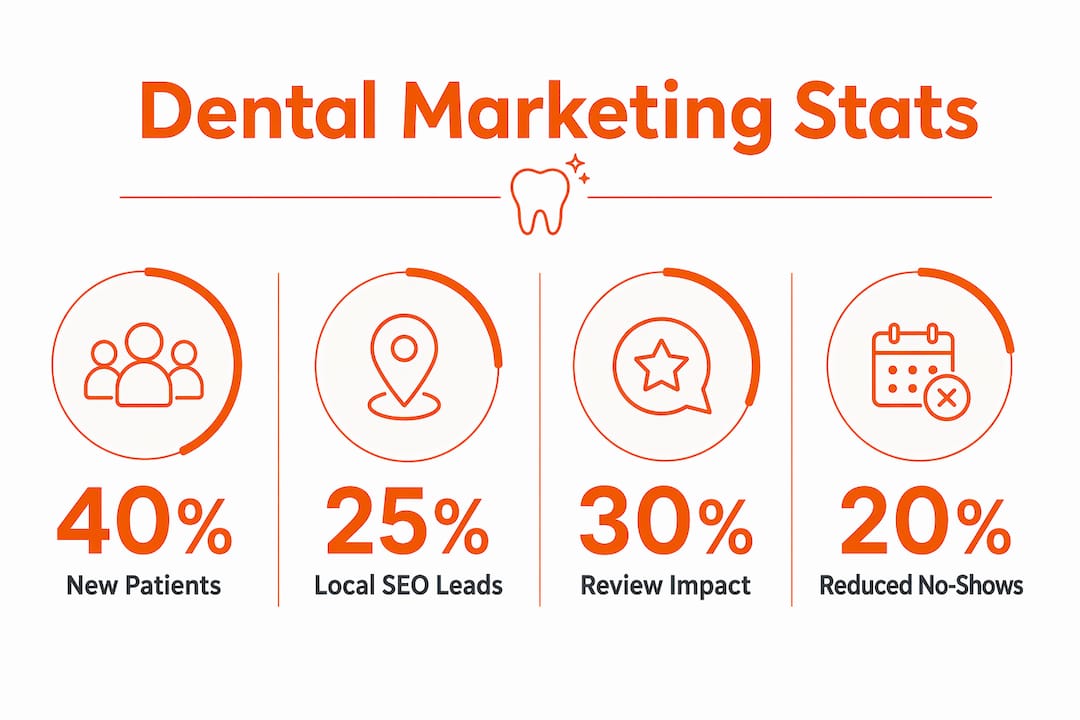
A dental practice with 120 reviews at 4.8 stars converts Map Pack visitors at about twice the rate of a practice with 30 reviews at 4.9 stars. That finding challenges the instinct to chase a perfect score. Volume and authenticity matter more than perfection. Patients trust a large body of real feedback over a small set of flawless ratings.
Building review velocity requires a repeatable system:
- Ask every patient at checkout, not just satisfied ones. A simple verbal request paired with a text message link converts at a much higher rate than a sign in the waiting room.
- Send a follow-up SMS or email within two hours of the appointment. Timing matters because the experience is still fresh.
- Respond to every review within 24 hours. Thank positive reviewers by name and address negative feedback professionally without sharing clinical details.
- Never offer incentives for reviews. Google's policies prohibit it, and patients can tell when reviews feel transactional.
Pro Tip: Set up a Google review shortlink using your GBP dashboard and add it to your appointment confirmation texts. Patients are far more likely to leave a review when the path is one tap away.
Reviews with high volume and good but not perfect ratings build more trust than a handful of five-star scores. Authenticity reads clearly to prospective patients, and it reads clearly to Google's ranking algorithm as well. Practices that treat reputation management as an ongoing operational task rather than a marketing campaign consistently maintain stronger local positions.
How can a mobile-friendly website improve patient acquisition and AI search visibility?
Your website is your digital front door. A slow, hard-to-navigate site loses patients before they ever read your service descriptions.

Mobile-first design is non-negotiable. The majority of dental searches happen on smartphones, and Google indexes the mobile version of your site first. A site that loads in under three seconds and displays a clear "Book an Appointment" button above the fold converts significantly better than one that buries contact information. Web design for dentists must prioritize speed, clarity, and frictionless scheduling above visual complexity.
AI-driven search increasingly surfaces practices based on website authority signals, not just keyword density. That shift changes what good content looks like. Thin pages stuffed with keyword phrases perform worse than detailed service pages that answer real patient questions. A page on dental implants should explain the procedure, recovery timeline, candidacy criteria, and cost range in plain language.
Strong content for a dental website includes:
- Individual service pages for every procedure, each with at least 500 words of original, patient-focused content.
- FAQ sections on each service page that address the questions patients actually ask, not the ones that sound impressive.
- Before-and-after galleries with patient consent, which build trust and support cosmetic service pages.
- Doctor bio pages that convey credentials and personality, because patients choose dentists they feel they can trust.
Pro Tip: Structure your service pages using the same question-and-answer format that AI search tools use to generate summaries. Pages written this way are more likely to appear in AI-generated responses, which is where AI search visibility is heading in 2026.
Content marketing for dental clinics also builds long-term organic traffic. A blog post answering "how long do veneers last" or "what causes tooth sensitivity" attracts patients at the research stage and positions your practice as a credible source before they ever search for a dentist.
What operational digital marketing tools reduce no-shows and increase patient retention?
Acquiring a new patient costs far more than retaining an existing one. Operational digital tools protect that investment by keeping scheduled patients in their chairs and bringing lapsed patients back.
Automated appointment reminders sent 48 hours and 2 hours before a visit reduce no-show rates by 20–30%. That reduction directly protects the revenue generated by your marketing spend. A practice spending $3,000 per month on ads cannot afford to lose a third of booked appointments to no-shows.
The highest-ROI tool in dental marketing is the automated recall workflow. Recall campaigns built on clinical timelines, such as a six-month hygiene reminder triggered by the last visit date, produce 20:1 to 50:1 ROI by reactivating existing patients without additional advertising spend. The math is straightforward: reactivating a patient who already trusts your practice costs a fraction of acquiring a new one.
A practical recall and retention system works in four steps:
- Segment your patient list by last visit date and treatment type. Hygiene patients, orthodontic patients, and cosmetic patients each need different messaging.
- Automate the first touchpoint via SMS, since text messages have a significantly higher open rate than email for appointment reminders.
- Follow up by email for patients who do not respond to the SMS within 48 hours. Include a direct booking link.
- Flag unresponsive patients for a personal phone call from your front desk after two automated attempts.
Pro Tip: Connect your recall workflows to your practice management software so reminders trigger automatically based on clinical timelines. CRM automation built around treatment-specific intervals produces far better results than generic monthly email blasts.
Digital marketing for medical practices and dental clinics alike shows that retention tools consistently outperform acquisition campaigns on a per-dollar basis. The practices that grow fastest combine both.
What paid advertising and social media strategies complement organic efforts for dentists?
Organic SEO builds long-term visibility, but it takes time. Paid advertising fills the gap immediately, especially for new practices or new service launches.
Google Ads capture high-intent patient searchers and generate bookings within days of campaign launch. A patient searching "emergency dentist near me" or "Invisalign consultation" is ready to book. Paid search puts your practice at the top of those results before your organic ranking has time to build. For multi-channel paid advertising that covers both search and social, the combination consistently outperforms either channel alone.
Facebook Ads serve a different function. They work best for retargeting website visitors, building local community awareness, and reaching older demographics who are less likely to search actively but respond well to social ads. Facebook Ads represent roughly 15–30% of paid social spend in dental marketing budgets. That allocation reflects their role as a brand-building and retargeting tool rather than a direct-response channel.
Dentist social media strategies on Instagram and Facebook should follow a consistent content mix:
- Patient education posts explaining procedures in plain language, which build authority and generate shares.
- Behind-the-scenes content showing your team and office environment, which reduces patient anxiety about dental visits.
- Before-and-after results with patient consent, which are the highest-performing content type for cosmetic dental services.
- Community involvement posts that connect your practice to local events and organizations, reinforcing your local presence.
| Channel | Best use case | Timeline to results |
|---|---|---|
| Google Ads | High-intent searches, new patient bookings | Days |
| Facebook Ads | Retargeting, brand awareness, older demographics | Weeks |
| Visual services, younger demographics, organic reach | Weeks to months | |
| Local SEO | Sustained new patient flow, Map Pack visibility | Months |
Digital advertising for dentists works best when paid and organic channels reinforce each other. Patients who see your Google Ad, visit your website, and then encounter your Facebook retargeting ad convert at a much higher rate than those who see only one touchpoint.
Key takeaways
Dental practices that combine local SEO, review management, a content-rich website, automated recall workflows, and paid advertising consistently outgrow those relying on any single channel.
| Point | Details |
|---|---|
| Local SEO and GBP dominate | GBP drives 25–40% of new patient inquiries; top 3 Map Pack captures ~72% of clicks. |
| Review volume beats perfect ratings | 120 reviews at 4.8 stars converts at twice the rate of 30 reviews at 4.9 stars. |
| Recall workflows deliver the highest ROI | Automated recall campaigns produce 20:1 to 50:1 ROI by reactivating existing patients. |
| Website content must answer real questions | AI search surfaces practices with detailed, authoritative content over keyword-stuffed pages. |
| Paid ads fill the gap organic SEO cannot | Google Ads generate bookings within days; Facebook Ads support retargeting and awareness. |
What I've learned watching dental marketing shift toward AI mediation
The most significant change in dental marketing right now is not a new ad format or a social platform. It is the growing role of AI in mediating patient discovery. When a patient asks an AI assistant to recommend a dentist nearby, the answer does not come from the highest bidder. It comes from the practice with the most authoritative digital presence, the most complete GBP, and the richest website content.
That shift rewards dentists who have invested consistently in their digital foundation and penalizes those who treated marketing as a switch they could turn on when the schedule got slow. The practices I see winning in 2026 are not necessarily spending more. They are spending more deliberately, with every channel connected to the others.
The uncomfortable truth about dental marketing is that most of the work is operational, not creative. Responding to reviews, updating your GBP, sending recall reminders, and publishing one useful blog post per month are not glamorous tasks. But they compound. A practice that does those things consistently for 18 months builds a local digital presence that is genuinely difficult for a competitor to displace.
The dentists who struggle are usually the ones waiting for a single campaign to fix a structural problem. No ad spend compensates for a GBP with outdated hours, a website that loads in six seconds on mobile, or a review profile that has not grown in two years. Fix the foundation first. The paid campaigns work much better when you do.
— laya
How Omnivancemedia helps dental practices grow online
Dental practices that want to grow past the point where referrals alone sustain the schedule need a system, not a collection of disconnected tactics.
Omnivancemedia builds that system for dental practices. The approach combines dental SEO and paid advertising with CRM automation and content production, all managed under one roof. That means your GBP optimization, Google Ads, recall workflows, and website content work together rather than pulling in different directions. Omnivancemedia's results across industries include an e-commerce client growing monthly revenue from $80,000 to $420,000 and a contractor generating $340,000 in new contracts within 90 days. The same integrated methodology applies directly to dental patient acquisition. See the full range of dental marketing services and find out what a connected strategy can do for your practice.
How do you structure high-converting PPC campaigns for high-value procedures?
Organic SEO and paid search both put your practice in front of ready-to-book patients, but a Google Ads campaign only pays off when the execution beneath the ad is right. The economics work because of lifetime value: a click for "dental implants near me" might cost $15–40, but a single patient booking a $4,000 implant case justifies a hundred or more of those clicks.
Target procedure-specific, high-commercial-intent keywords rather than broad terms. "Emergency dentist near me," "dental implants [city]," and "cosmetic dentist [neighborhood]" attract patients ready to act, while a bare keyword like "dentist" or "dental care" burns budget on students, job seekers, and people outside your service area. Someone searching "how much do veneers cost" is further down the decision path than someone searching "what are veneers," and your keyword list should reflect that.
Your ad copy has to speak to the three barriers that stop people from booking: pain, cost, and fear. Headlines that address them directly — "Same-Day Emergency Appointments Available," "Dental Implants — Free Consultation," "Sedation Dentistry for Anxious Patients" — outperform generic practice branding.
Where the campaign is won or lost is after the click:
- Dedicated landing pages, never the homepage. Each advertised procedure needs its own page covering the procedure, cost range, before-and-after photos, testimonials, and one clear call to action. Sending implant clicks to a general homepage wastes the spend.
- A prominent phone number. Many patients prefer to call for high-value procedures. Put the number at the top of every landing page.
- Call tracking. Use unique tracking numbers per campaign so you can see which ads actually generate booked calls, not just clicks.
- Tight location targeting. Restrict campaigns to your real service radius. A Princeton practice should not pay for clicks from Philadelphia patients who will never make the drive.
- Dayparting. Weight ad delivery toward hours when your front desk can answer the phone. Overnight clicks convert poorly.
- Remarketing. Ads that follow previous website visitors around the web convert at roughly double the rate of cold traffic, because those patients have already researched you and need only a nudge.
Pro Tip: Tilt your budget toward your most profitable procedures. Campaigns for implants, veneers, and Invisalign — cases in the $3,000–$8,000 range — deserve more spend than routine-cleaning campaigns. Keep a smaller new-patient-cleaning campaign running as a loss leader that introduces patients to the practice, but let the high-value procedures carry the budget.
How do you measure marketing ROI with real unit economics?
Most practices waste budget because they track vanity metrics. Website visits and follower counts feel good but do not predict growth. The numbers that matter connect directly to revenue: new-patient acquisition cost, patient lifetime value, and the ratio between them.
New-patient acquisition cost (CAC) is total marketing spend divided by new patients acquired in the same period. Spend $5,000 in a month and gain 25 new patients, and your CAC is $200. On its own that figure means nothing — it only matters relative to what a patient is worth.
Patient lifetime value (LTV) is average annual revenue per patient multiplied by average retention in years. A patient generating $650 a year who stays eight years is worth $5,200.
The LTV:CAC ratio is the single most important marketing metric for a practice. A healthy dental ratio is 15:1 or higher — every patient returns at least fifteen times what you spent to acquire them. If the ratio slips below 10:1, you are either overspending on acquisition or underdeveloping lifetime value, and both need attention.
Measure ROI by channel rather than lumping all spend together, and look past surface metrics:
- Cost per appointment booked beats cost per click or per lead. A $50-per-click campaign that produces $300-per-appointment beats a $10-per-click campaign that costs $400 per appointment because the traffic converts.
- Show rate by source. If Instagram-acquired patients no-show at 40% while Google Search patients no-show at 15%, the search traffic is more valuable even at a higher click cost.
- Procedure mix by source. Patients arriving through cosmetic content tend to book higher-value cases than those arriving through general searches.
- Attribution windows. Patients rarely book on the first visit; a 30-day window captures the research-then-book pattern most dental patients follow.
Pro Tip: Report to your partners monthly in revenue terms, not traffic terms: "We spent $6,000, acquired 28 new patients, ten completed treatment plans worth $34,000, and the remaining eighteen are scheduled for an estimated $11,000." Framing marketing as an investment with a measurable return ends the budget argument before it starts. As a starting benchmark, practices that grow allocate roughly 5–8% of gross revenue to marketing, with newer practices in competitive markets often investing at the higher end to gain share.
How do you choose the right dental marketing agency?
Most practices eventually need outside help, because mastering Google Ads and technical SEO is not why anyone became a dentist. The wrong agency spends your budget on ineffective tactics and hides behind pretty reports; the right one becomes a growth partner delivering new patients at a predictable cost.
Insist on dental-specific experience. Healthcare marketing requires understanding HIPAA, patient-privacy concerns, and the long decision journey for high-value procedures. Ask for case studies from actual dental clients with real numbers on acquisition cost and ROI — "increased traffic" and "improved engagement" are meaningless.
Treat ranking guarantees as a red flag. No one controls Google's algorithm, so no one can guarantee first-page rankings. Ethical agencies frame rankings as goals, not promises.
Demand reporting transparency. Monthly reports should show spend by channel, new patients attributed to each channel, cost per new patient, procedures booked, and estimated revenue. An agency that will not show this is hiding weak results. Ask, too, who actually runs your account day to day — many firms win the contract with senior strategists and hand execution to juniors.
Read the contract and the pricing model. Confident agencies typically offer 3–6 month terms rather than locking you into 12 months with steep termination fees. Common pricing structures:
| Pricing model | Typical range | Best fit |
|---|---|---|
| Monthly retainer | $2,000–$8,000 | Full-service, multi-channel management |
| Percentage of ad spend | 15–20% of spend | PPC management |
| One-time setup fee | $1,500–$5,000 | Strategy, account build, initial audit |
Pro Tip: Before signing, get on a call with the people who will actually manage your account, not just the closer. Communication cadence and cultural fit matter as much as technical skill — you want a partner who can adjust campaigns within 24–48 hours when your schedule or strategy changes.
FAQ
What is the most effective digital marketing channel for dentists?
Local SEO and Google Business Profile optimization deliver the highest return for most dental practices. The top 3 Map Pack positions capture roughly 72% of local search clicks, making GBP the single most valuable asset in a dental marketing strategy.
How many Google reviews does a dental practice need?
Volume matters more than a perfect score. A practice with 120 reviews at 4.8 stars converts at about twice the rate of one with 30 reviews at 4.9 stars. Aim for consistent review growth rather than chasing a specific number.
How much should a dental practice spend on paid advertising?
Budget allocation depends on practice size and growth goals, but Facebook Ads typically represent 15–30% of paid social spend in dental marketing. Google Ads should be the primary paid channel for practices focused on immediate new patient bookings.
Do automated appointment reminders actually reduce no-shows?
Automated reminders sent 48 and 2 hours before a visit reduce no-show rates by 20–30% in dental settings. That reduction directly protects the revenue generated by marketing spend on new patient acquisition.
How does AI search affect dental practice visibility?
AI-driven search surfaces practices based on website authority and GBP completeness rather than keyword density alone. Practices with detailed service pages, well-managed reviews, and complete profiles maintain stronger visibility as AI mediates more patient searches.