Digital Marketing for Contractors: 2026 Growth Guide

Digital marketing for contractors is the practice of using online tools, including local SEO, Google Ads, and reputation management, to attract qualified leads and convert them into paying clients. Contractors who treat their online presence as a core business system, not an afterthought, consistently outpace competitors who rely on word-of-mouth alone. The gap between a contractor with a Google Business Profile ranking in the top three local results and one buried on page two is measured in thousands of dollars of monthly revenue. This guide covers the specific strategies that move the needle in 2026, from hyperlocal search tactics to paid ad structures built for high-intent buyers.
How does digital marketing for contractors generate local leads?
Google Business Profile is the single most valuable organic lead generation asset for local contractors. When a homeowner searches "roof repair near me" at 9 PM on a Tuesday, the three businesses that appear in the local map pack capture the overwhelming majority of calls. Getting into that map pack requires a fully built-out profile, consistent NAP (name, address, phone) data across the web, and a steady stream of recent reviews.
The most overlooked GBP tactic is creating dedicated service pages and service-area pages. A roofing contractor in Dallas should not have one generic page. They need separate pages for roof replacement, storm damage repair, and gutter installation, plus individual pages targeting Plano, Frisco, and Allen. Hyperlocal service-area pages capture "near me" searches at the neighborhood level, where competition is thinner and buyer intent is highest.
Practical GBP maintenance matters as much as the initial setup. Post project photos weekly. Answer every question in the Q&A section before a stranger does. Use the "services" section to list every trade you perform, with keyword-rich descriptions.
- Add your primary service category and at least three secondary categories.
- Upload at least 10 photos of completed projects before going live.
- Set your service area to the specific zip codes you actually serve, not a 50-mile radius.
- Respond to every review, positive or negative, within 48 hours.
- Use Google Posts to announce seasonal promotions or new service offerings.
Pro Tip: Set a recurring calendar reminder every Monday to upload two new project photos to your GBP. Profiles with fresh photo activity rank higher and convert better than static ones.
What local SEO tactics work best for contractors?
Local SEO fundamentals deliver the highest return on investment among all marketing activities for contractors. The foundation is a fast, mobile-friendly website built around clear calls to action. Speed and mobile usability matter more than visual design. A site that loads in under three seconds on a phone and puts a "Call Now" button above the fold will outperform a beautiful but slow site every time.
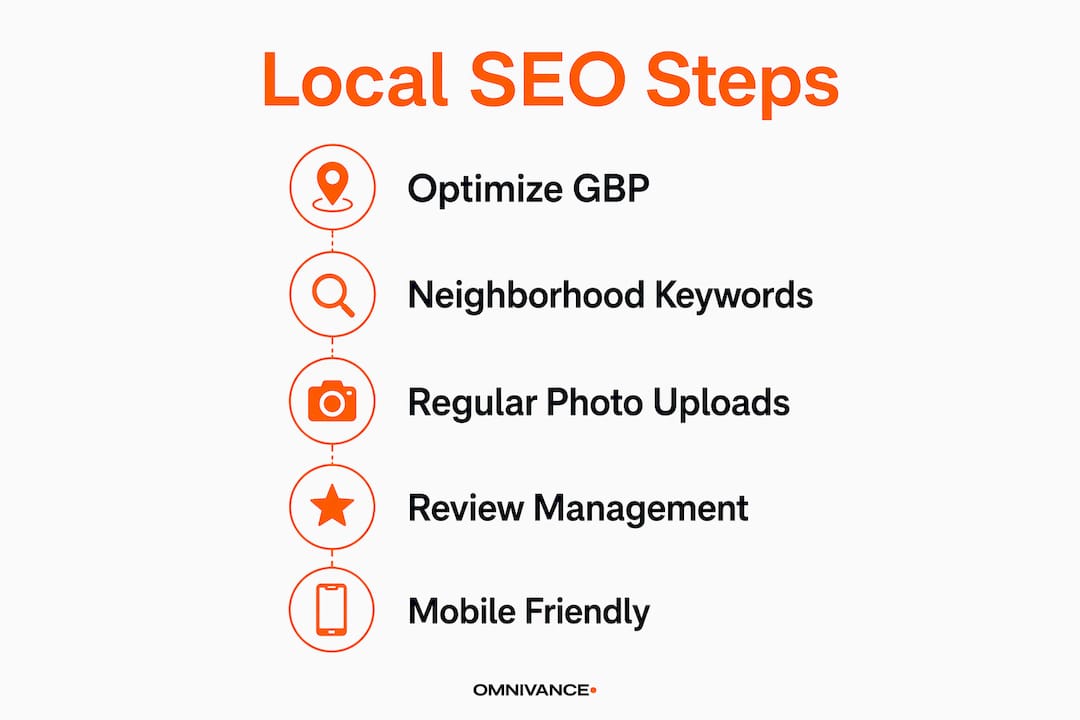
Keyword targeting for contractors works best at the neighborhood level. Instead of targeting "plumber in Chicago," target "plumber in Lincoln Park" and "emergency plumber in Wicker Park." These longer, more specific phrases attract buyers who are closer to making a decision. Neighborhood-level targeting also faces less competition, which means lower cost and faster ranking.
Review management functions as the currency of local SEO. Google's ranking algorithm weighs review quantity, recency, and response rate. A contractor with 80 reviews averaging 4.8 stars will consistently outrank a competitor with 20 reviews averaging 5.0 stars. Building a system to ask for reviews after every completed job is not optional. It is the work.
Core local SEO priorities for contractors
- Build a mobile-first website with a click-to-call button visible without scrolling.
- Write a unique title tag and meta description for every service and city page.
- Create a dedicated page for each service you offer in each city you serve.
- Build citations on directories like Yelp, Angi, and the Better Business Bureau.
- Ask for a Google review within 24 hours of job completion while satisfaction is highest.
| SEO element | Impact level | Time to results |
|---|---|---|
| Google Business Profile | Very high | 4–8 weeks |
| Service and city pages | High | 8–16 weeks |
| Review volume and recency | High | Ongoing |
| Mobile site speed | Medium-high | Immediate |
| Directory citations | Medium | 6–12 weeks |
When should contractors use paid digital advertising?
Paid advertising fills the gap while organic SEO builds momentum. The right ad format depends on the service type. Call-only campaigns work best for emergency services like burst pipes or storm damage because they send the user directly to a phone call. There is no landing page to load, no form to fill out. The lead calls immediately, which is exactly what a homeowner in a crisis wants to do.

For premium services like full kitchen remodels or whole-home HVAC replacement, household income targeting on Google Ads prevents wasted spend. Targeting the top 10%–20% income brackets in your service area means your ads reach homeowners who can actually afford a $25,000 project. Running the same ads to every income bracket burns budget on clicks that never convert.
Negative keywords are the most underused tool in contractor ad accounts. Negative keywords filter out searches like "DIY roofing" or "roofing contractor jobs" that will never produce a paying customer. Auditing your search term report weekly and adding negatives is the fastest way to cut wasted spend without reducing lead volume.
Pro Tip: Run Local Service Ads (Google's pay-per-lead product) alongside standard Google Ads. LSAs show above regular paid ads and include a "Google Guaranteed" badge, which significantly increases trust and call-through rates for contractors.
Social media ads work differently from search ads. They interrupt users who are not actively searching. Facebook and Instagram ads perform best for contractors when used for retargeting, showing ads to people who already visited your website but did not call. Cold social traffic rarely converts for high-ticket contracting services.
How do reviews and reputation management affect contractor leads?
Reputation management is the part of contractor online marketing that most tradespeople underestimate until they lose a job to a competitor with better reviews. Automated review generation systems outperform simple manual requests. A text message sent automatically two hours after job completion, with a direct link to your Google review page, converts at a far higher rate than a verbal ask at the door.
Video testimonials add a layer of trust that written reviews cannot match. A 60-second video of a satisfied homeowner standing in front of their new deck costs almost nothing to produce and can be used on your website, in Google Posts, and in social media ads. Online reviews directly drive revenue for local businesses, and video testimonials amplify that effect by making the social proof visible and personal.
Building a feedback loop into your workflow closes the gap between job completion and review generation. The system works like this: job is marked complete in your CRM, an automated text goes out requesting a review, and a follow-up is triggered if no review appears within five days. This is not complicated to set up, but it requires treating marketing as an operational system rather than a one-time task.
- Use a CRM or field service app to trigger review requests automatically at job close.
- Send the review request via text, not email. Text open rates are dramatically higher.
- Include a direct link. Never ask someone to "find us on Google."
- Respond to every negative review professionally and offer to resolve the issue offline.
- Share your best reviews as social media posts to extend their reach.
How should contractors budget and measure marketing ROI?
Contractors under $5 million in annual revenue should allocate 7%–8% of revenue to marketing. That benchmark comes from Small Business Administration guidance and construction industry standards. A contractor doing $1 million in revenue should plan to spend $70,000–$80,000 per year on marketing, which breaks down to roughly $6,000–$7,000 per month.
Prioritize channels that produce direct phone calls and form submissions before investing in brand awareness. For most contractors, that means Google Business Profile optimization and local SEO first, Google Ads second, and social media third. Brand awareness campaigns on social media make sense only after the high-intent channels are fully funded and performing.
CRM integration and marketing automation tie every marketing dollar to a specific outcome. When a lead comes in, your CRM should record the source, whether it was a Google search, a paid ad, or a referral. Over 90 days, you will see clearly which channels produce the highest-value jobs, not just the most calls. That data drives smarter budget decisions.
- Set up call tracking numbers for each marketing channel to identify lead sources.
- Record every lead in a CRM with the source, job type, and estimated value.
- Review your cost per lead by channel every 30 days.
- Cut or reduce spend on channels with a cost per lead above your target.
- Reinvest savings into the channels producing the lowest cost per acquired customer.
Key Takeaways
Contractors who treat digital marketing as an operational system, not a creative project, generate more leads, close more jobs, and scale faster than those who rely on referrals alone.
| Point | Details |
|---|---|
| Google Business Profile first | GBP is the highest-ROI lead channel for local contractors and should be fully built before spending on ads. |
| Hyperlocal pages win searches | Create dedicated pages for each service and each city to capture high-intent "near me" searches. |
| Reviews are a ranking signal | Automate review requests at job completion to build volume, recency, and trust consistently. |
| Budget 7%–8% of revenue | Contractors under $5M should allocate this percentage to marketing, prioritizing high-intent channels first. |
| Track leads to revenue | Use CRM automation to connect every marketing dollar to a specific job outcome and adjust spend accordingly. |
What most contractors get wrong about digital marketing
The biggest mistake I see contractors make is treating marketing as a creative problem when it is actually an operational one. They spend weeks debating logo colors and website fonts while their Google Business Profile sits half-finished with three reviews from 2021. The contractors who grow fastest are the ones who build systems: a review request goes out after every job, a CRM records every lead, and a weekly check on ad spend catches waste before it compounds.
The second mistake is running ads without call tracking. If you do not know which ad produced which phone call, you are flying blind. I have audited contractor ad accounts where 40% of the budget was going to keywords that produced zero calls. That money was not lost to bad luck. It was lost to a missing system.
Hyperlocal targeting is where I see the biggest untapped opportunity. Most contractors target their entire metro area when they should be targeting the three or four zip codes where their best jobs come from. Narrowing your ad targeting and your SEO content to those specific neighborhoods cuts cost and increases relevance at the same time. The contractors who figure this out early build a dominant local presence that is very hard for competitors to dislodge.
— laya
How Omnivancemedia supports contractor growth online
Contractors who want to grow past $500,000 in annual revenue need more than a website and a Google listing. They need a connected system where SEO, paid ads, CRM automation, and creative production work together.

Omnivancemedia builds exactly that for contractors and tradespeople. The team combines local SEO services with paid advertising management and CRM automation into one coordinated program. Omnivancemedia has helped an HVAC contractor generate $340,000 in new contracts within 90 days using this integrated approach. If you are ready to stop guessing which marketing channel is working, the full services overview shows exactly how each piece fits together.
What does contractor Google Ads cost per lead?
Google Ads delivers the fastest results of any channel, often generating calls within 24 hours of launch, but the economics vary widely by trade and market. In competitive markets, here is what contractors should expect to pay per lead:
| Trade | Typical cost per lead |
|---|---|
| Landscapers | $30–$80 |
| Electricians | $40–$100 |
| Plumbers | $45–$120 |
| HVAC contractors | $50–$150 |
| Roofing contractors | $60–$200 |
| General contractors | $80–$250 |
Emergency services (burst pipe, no heat in winter) cost more per click but convert at higher rates because the homeowner will hire someone today. Installation jobs (new system, roof replacement) have cheaper clicks but longer sales cycles.
Your conversion rate is what determines true cost per customer. If 25% of leads become paying jobs, a $100 cost per lead means roughly $400 to acquire a customer, which is easily profitable when your average job value is $3,000 or more. Budget at least $1,500–$2,000 per month to gather enough data to optimize; anything less spreads spend too thin across days and times to learn from.
How should contractors use organic social media?
Social media for contractors is not about going viral. It is about staying visible with homeowners in your service area so you are the first name they think of when something breaks.
Facebook remains the most valuable platform because your core demographic, homeowners aged 35 to 65, uses it daily. Post three to four times a week with a mix of completed projects, team introductions, seasonal tips, and testimonials. Before-and-after photos consistently outperform everything else; show the corroded pipe next to the new install, not just the polished finished shot.
- Neighborhood Facebook groups are a goldmine. Join the groups for the towns you serve, answer questions genuinely, and you will get tagged when someone asks for a recommendation.
- Instagram works when your work is visually impressive, such as remodeling, landscaping, or custom builds. Use daily stories to show projects in progress.
- LinkedIn is underrated for commercial contractors. If you serve businesses, property managers, or facilities, share case studies and project updates where decision-makers can see them.
- Video beats static posts on every platform, and phone-quality clips are fine.
Avoid the most common mistake: auto-posting identical content to every platform. Each audience expects a different style, so customize the message per channel.
Which website elements convert visitors into leads?
Your website is often the last stop before a homeowner decides to call, so it has to close the gap between interest and action.
- Phone number in the header on every page, large enough to tap on mobile, with a sticky header that keeps it visible as visitors scroll.
- A service-area page listing every town and zip code you cover, which answers the visitor's first question ("do they come to my area?") and supports local SEO.
- Social proof throughout, including Google reviews on the homepage, photo testimonials, and logos of certifications and manufacturers you are certified with.
- A dedicated page per service that explains what is included, how long it takes, and what to expect, answering the questions a homeowner would ask on a sales call.
- An about page with team photos and bios so homeowners know who will show up at their door.
- Project galleries organized by service type, with before-and-after sets and captions describing the problem you solved.
- A blog answering the questions customers actually research, such as "how long should an HVAC system last?", to pull in free organic traffic.
How should contractors allocate budget by business size?
The 7%–8% of revenue benchmark sets the total; how you split it changes as you grow.
Solo operators and small crews ($250k–$500k): $1,000–$2,000/month. Lock down local SEO and your Google Business Profile first, then add $500–$1,000 in Google Ads for immediate leads. Keep social organic and free.
Established businesses ($500k–$2M): $2,500–$5,000/month. Split roughly $1,000–$1,500 to SEO, $1,500–$2,500 to Google Ads, plus modest Facebook ads, review tooling, and a CRM. Scale paid spend aggressively while cost per acquisition stays profitable and begin building a sustainable organic channel.
Growing companies ($2M–$5M): $5,000–$10,000/month. Fund SEO and content ($2,000–$3,000), Google Ads ($3,000–$5,000), social ads, remarketing, and video production. Organic should now generate meaningful lead volume, with paid filling high-value gaps.
Large operations ($5M+): $10,000–$25,000+/month. Run a comprehensive SEO program, multiple ad campaigns, social advertising, ongoing content, and reputation and PR/link-building work to dominate every service term across every area.
Whatever the tier, track return on ad spend relentlessly: if $3,000 in Google Ads produces $30,000 in booked revenue, that is a 10x return, and you should keep increasing budget until returns start to diminish.
How do contractors build local links?
Local backlinks strengthen the authority signals that help you rank, and they are easy for contractors to earn:
- Sponsor a Little League team or community event and request a link from their site.
- Join your local Chamber of Commerce for a directory link and referral exposure.
- Partner with complementary businesses such as real estate agents, interior designers, and property managers who can link to you.
Quality matters far more than quantity here; a handful of relevant, local links outperforms dozens of low-value directory listings.
FAQ
What is the most effective digital marketing channel for contractors?
Google Business Profile combined with local SEO delivers the highest return on investment for most contractors. These channels capture buyers who are actively searching for a contractor right now, which means conversion rates are significantly higher than social media or display advertising.
How much should a contractor spend on digital marketing?
Contractors under $5 million in annual revenue should allocate 7%–8% of revenue to marketing, based on Small Business Administration benchmarks. A contractor earning $500,000 per year should budget roughly $35,000–$40,000 annually for marketing activities.
Do contractors need paid ads if they already rank on Google?
Paid ads and organic rankings serve different purposes. Organic rankings build long-term visibility, while paid ads like Google Local Service Ads capture high-intent leads immediately and fill gaps while SEO builds. Running both together produces the most consistent lead flow.
How do reviews affect a contractor's Google ranking?
Google uses review quantity, recency, and response rate as ranking signals for local search results. A contractor with more recent, high-rated reviews consistently outranks competitors with fewer or older reviews, even when other SEO factors are equal.
What is a call-only ad and when should contractors use it?
A call-only ad is a Google Ads format that sends users directly to a phone call instead of a website. Contractors offering emergency services like plumbing or electrical repair should use call-only ads because they remove friction and connect the homeowner to a live person immediately.