Client Testimonial Strategy Best Practices for Marketers

Here are the eight moves that separate a testimonial program that converts from one that just fills a page: capture within 24–48 hours of a win, ask the right customers first, use structured prompts instead of open-ended requests, match format to channel, get written consent before publishing, tag every asset for reuse, place testimonials at friction points in the funnel, and measure lift with a UTM plus CRM tag. Each move is covered in depth below.
Quick-start checklist:
- Capture fast. Ask soon after a clear positive outcome while the result is fresh.
- Pick your best customers first. Prioritize recent wins with measurable outcomes and strong category fit.
- Use structured prompts. Give three guided questions (situation, change, recommendation) instead of a blank request.
- Match format to context. Video for high-trust buys, short quote for checkout and micro-conversion points, case study for enterprise sales.
- Get written consent. Approve final text or video with the customer before publishing.
- Tag every asset. Label by industry, service, outcome, and funnel stage so you can pull the right proof fast.
- Place at friction points. Homepage hero, pricing page, checkout, demo follow-up email.
- Measure the lift. UTM tags plus CRM deal-stage tracking tell you which testimonials actually close business.
Key Takeaways
A strong client testimonial strategy requires specific attribution, structured collection, systematic tagging, and consistent measurement to turn client feedback into a repeatable revenue asset.
| Point | Details |
|---|---|
| Ask within 24–48 hours | Request testimonials right after a clear win to maximize response rate and result quality. |
| Use structured prompts | Three guided questions (situation, change, recommendation) produce specific, usable quotes. |
| Tag every asset | Label by industry, service, outcome, and funnel stage so you can pull the right proof for any pitch. |
| Measure with UTM plus CRM | Track which testimonials appear in closed-won deals to prove ROI and prioritize the best assets. |
| Omnivancemedia integrates the full program | Omnivancemedia connects testimonial creative, CRM automation, and paid media into one tracked system. |
Table of Contents
- Why client testimonial strategy best practices move the needle
- What testimonial formats should you use and when?
- Which customers should you ask, and when?
- How do you request and capture testimonials effectively?
- How should you design and place testimonials for maximum impact?
- What legal and consent rules apply to U.S. testimonials?
- How do you activate testimonials across channels?
- How do you measure testimonial impact and run simple experiments?
- What mistakes undermine testimonial programs?
- How do you build a system that scales testimonial collection?
- The trade-off most teams get wrong
- Omnivancemedia builds the system behind your testimonials
- Sources
Why client testimonial strategy best practices move the needle
Testimonials do one specific job: they reduce the risk a buyer feels before committing. That risk reduction shows up as shorter sales cycles, higher conversion rates, and fewer "let me think about it" stalls. The effect is strongest in B2B, high-ticket services, and complex purchase decisions where the buyer cannot easily verify quality before signing.
The U.S. Small Business Administration is direct about what makes a testimonial actually work: it must be authentic, relatable, and specific about how the business helped. A quote from "John D." that says "great service!" does almost nothing. A quote from "Maria Chen, VP of Operations at Ridgeline Manufacturing" that says "we cut our onboarding time from six weeks to nine days" does a lot.
The SBA also notes that testimonials land hardest when the person giving them resembles the prospect. A mid-market law firm reading a testimonial from another mid-market law firm trusts it more than one from a Fortune 500 company. That match between testimonial source and target buyer is the single most underused lever in most programs.
For B2B buyers especially, social proof functions as a proxy for due diligence. When a prospect cannot easily audit your work before buying, a credible, attributed testimonial from a peer does a significant portion of that work for them.
What testimonial formats should you use and when?
Format choice is a strategic decision, not an aesthetic one. The wrong format in the wrong context can actually reduce trust.
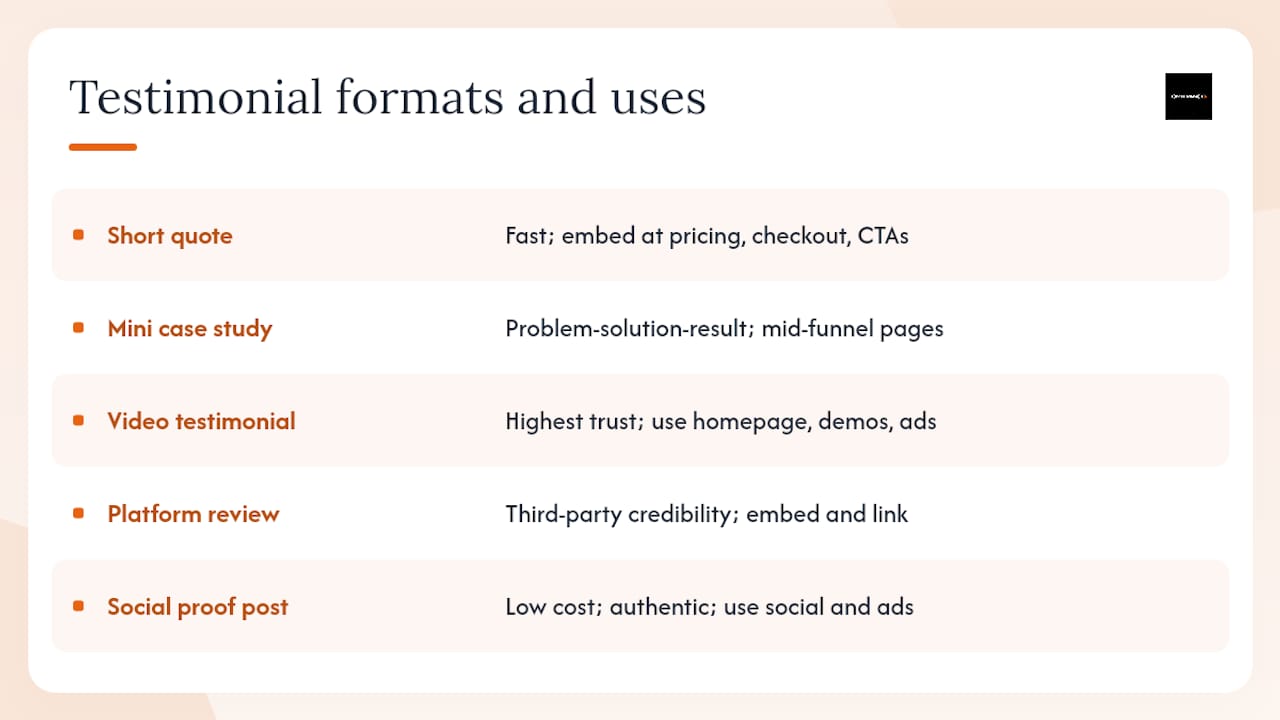
Short quote (1–3 sentences): The workhorse. Fast to produce, easy to embed anywhere, and effective at micro-conversion points like pricing pages, checkout flows, and email CTAs. The weakness is that short quotes can feel thin without strong attribution and a specific result.
Mini case study (200–400 words): Pairs a short quote with a brief problem-solution-result narrative. Works well on product feature pages, sales decks, and mid-funnel landing pages where the buyer is evaluating but not yet ready to commit. Long-form case studies go further for enterprise deals.
Video testimonial (60–120 seconds): The highest-trust format for emotional, high-consideration purchases. A buyer watching a real person describe a real outcome registers differently than reading the same words. Use video on homepage heroes, demo request pages, and paid ad creative. The production bar is lower than most teams think — a well-lit Loom or Zoom recording beats a polished but stilted studio shoot.
Platform review snippet (Google, G2, Capterra): Carries third-party credibility because the reader knows you did not write it. Embed screenshots or widgets on your site, and link to the live review so skeptics can verify. Note that Google excludes self-serving review stars for reviews about your own business from rich snippets, so focus on on-page conversion rather than expecting review stars in organic search results.
Social proof post: A screenshot of a LinkedIn comment, a tweet, or a tagged Instagram post. Low production cost, high authenticity signal. Best used in social feeds, email nurture, and retargeting ads where informal tone fits.
Quick format rules of thumb: Use video when the purchase is emotional or the price is high. Use short quotes at every friction point in the funnel. Use mini case studies when the buyer needs to understand the mechanism, not just the outcome. Use platform review snippets when third-party credibility matters more than message control. For brand storytelling across channels, the narrative arc of a mini case study often outperforms a polished quote.
Which customers should you ask, and when?
Not all testimonials carry equal weight. The goal is a portfolio that covers two distinct jobs: anchor testimonials from high-credibility customers that impress prospects, and representative testimonials from customers who look like your typical buyer.
Anchor customers are well-known brands, recognized names in a vertical, or customers with unusually strong, measurable results. One anchor testimonial from a recognizable company can do more work than ten generic ones. Prioritize these first.
Representative customers match the industry, company size, or role of your target buyer. The SBA makes this point clearly: a prospect trusts a testimonial more when the person giving it resembles them. If you sell to dental practices, a testimonial from a dental practice matters more than one from a retail chain, even if the retail result was bigger. For vertical-specific proof, see how this plays out in digital marketing for dentists.
Selection criteria to prioritize asks:
- Recency: wins from the last 6–12 months carry more weight than older ones.
- Outcome size: the more specific and impressive the result, the more persuasive the testimonial.
- Segment relevance: does this customer match a high-priority target segment?
- Willingness: customers who already said something positive in an email or call are the easiest asks.
Timing in the customer journey: The best windows are right after a milestone delivery, at renewal, after a successful implementation, or following a positive support interaction. Asking during onboarding is too early. Asking a year after the project ended is too late. Map your customer journey and mark the two or three natural "peak satisfaction" moments — those are your ask windows.
How do you request and capture testimonials effectively?
The single biggest mistake in testimonial collection is the blank-page ask: "Would you mind writing us a testimonial?" Most customers want to help but do not know what to write, so they procrastinate or produce something vague. The fix is structured prompts.
Praising recommends three questions that reliably produce problem-solution-result quotes:
- What was the situation or challenge you were facing before working with us?
- What changed after working with us, and what specific results did you see?
- Who would you recommend us to, and why?
Email request template (copy-ready):
Subject: Quick favor — your experience with [Company]
Hi [First Name],
I'm glad [specific result or milestone] went well. Would you be willing to share a few words about your experience? It only takes 5 minutes.
Three quick questions to guide you:
- What challenge were you facing before we worked together?
- What changed, and what specific results did you see?
- Who would you recommend us to?
Reply here or use this short form: [link]. I'll send you the final version for approval before we publish anything.
Thank you, [Your Name]
Subject line options: "Quick favor — your experience with [Company]" / "Can I quote you on that?" / "30 seconds to help [Company] grow?"
Capture channels by situation:
- Email + short form: Best for most B2B contexts. Low friction, easy to track.
- Interview (15 minutes by phone or Zoom): Best for video testimonials or detailed case studies. Record with permission, then transcribe and edit.
- Co-write: You draft based on what the customer told you in a call or email, then send it for approval. Fastest path to a polished quote.
- SMS prompt: Works well for service businesses with mobile-first customers. Keep the ask to one sentence and link to a short form.
- In-app or post-purchase prompt: Automated trigger after a key action (order delivered, project closed, milestone hit). Best for volume.
Pro Tip: Personalize the ask with a specific reference to the customer's result. "You mentioned your team saved 12 hours a week" outperforms a generic "we hope you're happy with our service" every time. Response rates climb when the customer feels seen, not surveyed.
Follow up with a three-touch cadence: initial ask, a gentle nudge at day 5, and a final close at day 10. After that, let it go. Chasing harder damages the relationship.
On incentives: non-paid asks produce more credible testimonials and carry no FTC disclosure risk. If you offer something (a gift card, a discount), you must disclose it. When in doubt, skip the incentive and invest in a better ask.
How should you design and place testimonials for maximum impact?
A testimonial buried in a footer or dropped on a generic "testimonials page" with no context is a wasted asset. Placement and editorial treatment determine whether a testimonial converts or just decorates.
The anatomy of a high-converting testimonial block:
- Pull quote: The single most compelling sentence, set in larger type. Do not make the reader hunt for the good part.
- Attribution: Full name, title, company, and a headshot or company logo. The SBA and QuickSprout both emphasize that traceable, verifiable attribution is what separates a credible testimonial from one that feels fabricated.
- Supporting metric: If the testimonial includes a number, pull it out visually. "Reduced close time by 40%" in bold next to the quote does more work than the same figure buried in a paragraph.
- Link to full case study: When one exists, link it. Skeptical buyers click through.
Length and tone by context:
- Homepage hero: 1–2 sentences, strong result, full attribution. No room for backstory here.
- Product feature block: 2–4 sentences that speak directly to the feature's benefit.
- Pricing page: Short, outcome-focused. Address the "is it worth it?" question directly.
- Sales deck: A mini case study slide with problem, solution, and result. Give the prospect something to share internally.
Accessibility and SEO: Add transcripts for video testimonials and alt text for headshot images. For structured data, know that Google does not show review-star rich results for self-serving testimonials on your own site. Prioritize on-page conversion over chasing rich snippets.
What legal and consent rules apply to U.S. testimonials?
Testimonials are marketing claims, and the FTC treats them as such. Getting this wrong is not a minor administrative issue; it can result in enforcement action and reputational damage.
Written consent is non-negotiable. Before publishing any testimonial, get explicit written approval of the final text or video. A simple email confirmation works: "Here is the final version we plan to use. Please reply to confirm you approve." Keep that record.
FTC endorsement rules in plain terms:
- Testimonials must reflect the honest opinion of the person giving them.
- If the result in the testimonial is not typical, you must disclose what a typical customer can expect.
- Any material connection between the endorser and your business (payment, free product, employment) must be clearly disclosed.
- The FTC's endorsement guides are the primary reference for U.S. marketers.
Attribution checklist:
- Full name (not "J.D." or "Anonymous" unless anonymization is genuinely necessary)
- Job title and company
- Link to customer's website or LinkedIn profile where permitted
- Date or approximate timeframe of the result
When to anonymize: If a customer is in a regulated industry (healthcare, finance, legal) or requests privacy, anonymize but keep the industry and role ("Director of Operations, mid-size healthcare group"). Never fabricate attribution details.
State recording law caution: Before recording a phone call or video interview for testimonial use, confirm the customer's consent. Several U.S. states require all-party consent for recorded conversations.
For teams working with public-sector clients, procurement and disclosure rules add another layer. Regulations is the authoritative destination for federal guidance that may intersect with government-client testimonial use cases.
How do you activate testimonials across channels?
Collecting testimonials and publishing them is the easy part. The real ROI comes from systematic reuse. Salesforce describes testimonials as "story anchors" and pushes marketers to weave them into every channel rather than leaving them on a static page.
Channel map:
- Homepage hero: One anchor testimonial with a strong result and full attribution. Rotate quarterly.
- Pricing page: Short outcome quote that answers "is it worth it?" Place it near the CTA.
- Demo request / contact page: A testimonial from a customer who was initially skeptical. Addresses the last objection before the form.
- Email nurture sequences: Drop a relevant testimonial into the third or fourth email of a sequence. Match the testimonial's industry to the recipient's. For detailed email sequence examples, this e-commerce email guide shows how social proof fits naturally into automated flows.
- LinkedIn posts: Screenshot a strong quote with attribution and post it as an image. Tag the customer (with permission) for organic reach.
- Paid ad creative: A 30–60 second video testimonial clip or a static quote card. Video testimonials in paid social typically outperform product-only creative for high-consideration offers.
- Sales outreach: A one-sentence quote from a customer in the same industry as the prospect, dropped into a follow-up email. Specific and relevant beats generic every time.
Simple reuse workflow:
- Capture testimonial (email, interview, or co-write).
- Tag it: industry, service type, outcome type, funnel stage, format.
- Upload to a shared asset library (Google Drive, Notion, or your CRM's content library).
- Assign to active campaigns based on tags.
- Track performance with UTM parameters and CRM deal-stage data.
- Review and refresh the library quarterly.
Funnel sequencing: At awareness, use social proof posts and short quotes in content. At consideration, use mini case studies and video clips. At decision, use detailed case studies, pricing-page quotes, and sales-deck testimonials. The proof should get more specific and more credible as the buyer moves closer to a decision.
For a B2B content program that integrates testimonials at each stage, the B2B content marketing strategy guide covers the full architecture.
How do you measure testimonial impact and run simple experiments?
Most teams publish testimonials and never check whether they work. That is a fixable problem with a small measurement setup.
Practical metrics to track:
- CTA click-through rate on pages with testimonials vs. without
- Demo request or lead form conversion rate on pages with testimonials
- Lead-to-MQL conversion lift for email sequences that include testimonials
- Time-to-close for deals where a sales rep used a testimonial vs. those where they did not
Tagging approach: Assign each testimonial asset a UTM content tag (e.g., utm_content=testimonial-chen-manufacturing) and a CRM content tag. When a lead converts after engaging with that asset, the CRM records the touchpoint. Over 90 days, you can see which testimonials appear most often in closed-won deals.
Simple A/B test ideas:
| Test | Variable A | Variable B | Measurement window |
|---|---|---|---|
| Hero module | Short quote + attribution | No testimonial | 30 days, conversion rate |
| Pricing page | Outcome-focused quote | Generic satisfaction quote | 30 days, CTA CTR |
| Email sequence | Testimonial in email 3 | No testimonial in email 3 | 60 days, demo request rate |
| Ad creative | Video testimonial clip | Product-only image | 14 days, cost per lead |
Run one test at a time per channel. A 30-day window is usually enough for pages with moderate traffic. For paid ads, 14 days and a minimum of 500 impressions per variant gives a readable signal.
What mistakes undermine testimonial programs?
Vague quotes with no attribution. "Great company, highly recommend!" from "Sarah M." converts nobody. Fix: use structured prompts to get specific results, and require full attribution before publishing.
Stale testimonials. A testimonial from four years ago signals that you have not won a notable client recently. Fix: set a quarterly review cadence and retire testimonials older than 18–24 months unless they are genuinely exceptional.
Over-polished copy. When a testimonial reads like marketing copy, buyers sense it. Fix: edit lightly for clarity, but preserve the customer's voice and phrasing. Imperfect language is a trust signal.
No measurement. Publishing testimonials without tracking their impact means you cannot improve the program or justify the investment. Fix: implement the UTM plus CRM tagging described above before the next testimonial goes live.
Fake or unverifiable testimonials. QuickSprout is explicit on this: no testimonials are better than fabricated ones. A single exposed fake destroys the credibility of every real one on the page.
Ignoring negative or neutral feedback. A lukewarm review or a critical comment is data. Use it to identify service gaps, and when a customer raises a concern that you resolved, follow up and ask if they would share the updated experience. A "we had a rough start but they fixed it" testimonial is often more persuasive than a uniformly glowing one.
Collecting only one type. A page of identical short quotes from similar customers looks curated. Mix formats, industries, company sizes, and outcomes to show range.
How do you build a system that scales testimonial collection?
A deliberate testimonial strategy turns client feedback into a repeatable sales asset. Praising.ai frames it well: categorize and tag testimonials so you can pull industry- and service-specific proof for pitches without scrambling.
Full email template (copy-ready):
Subject: Can I quote you on that?
Hi [First Name],
Seeing [specific result] come together for your team was genuinely satisfying. I'd love to share your story with other [industry] businesses facing the same challenge.
Would you answer three quick questions? It takes about 5 minutes:
- What was the main challenge before we started working together?
- What specific results have you seen since?
- Who would you recommend us to, and why?
Reply here or use this form: [link]. I'll send you the final version for your approval before anything goes live.
Thanks, [Your Name]
Consent checklist:
- Written approval of final text or video (email confirmation is sufficient)
- Full attribution confirmed: name, title, company
- Disclosure noted if any incentive was offered
- Recording consent obtained if the testimonial was captured on a call or video
Testimonial asset governance table:
| Format | Best channel | Required metadata | Typical length |
|---|---|---|---|
| Short quote | Pricing page, email, ad | Name, title, company, result | 1–3 sentences |
| Mini case study | Product page, sales deck | Name, title, company, challenge, result | 200–400 words |
| Video clip | Homepage, paid ad, demo page | Name, title, company, transcript | 60–120 seconds |
| Platform review | Site embed, sales outreach | Review platform, date, rating | 2–5 sentences |
| Social proof post | Email nurture, social feed | Platform, date, handle (with permission) | 1–3 sentences |
Lightweight governance workflow:
- Owner: One person owns the testimonial backlog and quarterly review.
- Cadence: Review and refresh the asset library every 90 days.
- Backlog: Maintain a running list of customers to ask, ranked by priority criteria.
- Approval step: No testimonial goes live without written customer sign-off.
The trade-off most teams get wrong
The conventional wisdom says to collect as many testimonials as possible. In practice, ten mediocre testimonials do less work than two exceptional ones. The effort-to-impact ratio in testimonial programs is steep: the first anchor testimonial from a credible, well-attributed customer with a specific result is worth more than the next twenty generic quotes combined.
Where to invest first when resources are limited: spend your energy on one or two customers who had genuinely strong outcomes and who resemble your best target buyers. Get those testimonials right, place them at the highest-friction points in your funnel, and measure the lift before building out the full program.
The authenticity-versus-polish tension is real. Lightly edited, natural-sounding testimonials consistently outperform ones that have been scrubbed into marketing copy. The goal is clarity, not perfection. If a customer says "honestly, I was skeptical at first," keep it. That sentence does more trust-building work than a paragraph of praise.
One more thing teams underestimate: the governance step. A testimonial program without a quarterly review becomes a graveyard of stale quotes. The cadence does not need to be elaborate. A 30-minute review every 90 days, one owner, and a simple backlog is enough to keep the program alive and current.
Omnivancemedia builds the system behind your testimonials
Collecting a great testimonial is one thing. Turning it into a conversion asset across paid ads, email sequences, landing pages, and SEO content is another job entirely, and most marketing teams do not have the bandwidth to do both well.
Omnivancemedia integrates testimonial-driven creative production with CRM automation and paid media so your best client proof reaches the right buyer at the right moment in the funnel, tracked from first impression to closed deal. The HVAC contractor who generated $340K in new contracts in 90 days and the e-commerce client who grew significantly in monthly revenue both benefited from this integrated approach, where testimonials were not a sidebar but a core conversion asset built into every channel. If you want a program that does the same, see what Omnivancemedia offers and request a diagnostic review.
Sources
- Customer Testimonials: Maximize Their Marketing Impact | U.S. Small Business Administration
- How To Get Testimonials and Use Them the Right Way | Salesforce
- How to use testimonials the right way | QuickSprout
- Praising
- Customer testimonial page examples and SEO guidance | HubSpot
A note on recording consent: Before recording any phone or video testimonial, confirm the customer's consent explicitly. Several U.S. states require all-party consent. When in doubt, have legal review your recording and release process before you scale it.
Recommended
- Director's Cut: Christopher Nolan-Inspired Storytelling Techniques for Brand Content Marketing | Omnivance Media
- Insights & Strategy | Omnivance Media Group Blog | Omnivance Media
- Marketing for Accountants: Your 2026 Growth Guide | Omnivance Media
- Celebrity Endorsement Marketing: How to Leverage Influencer Partnerships in Your Brand Strategy | Omnivance Media