Build Your Law Firm's Local SEO Presence in 2026

Building a law firm local SEO presence means optimizing your online assets to rank in local search results and the Google Local Pack, where 44% of local searchers click a listing compared to only 29% who interact with organic results. That gap is the difference between a phone that rings and one that doesn't. The three core pillars driving local rankings are prominence, relevance, and proximity. Your Google Business Profile sits at the center of all three.
What are the primary law firm local SEO ranking factors?
Google Business Profile signals account for 32% of all local pack ranking factors for law firms. That makes GBP optimization the single highest-leverage activity in any local SEO strategy for lawyers. The remaining weight is distributed across review signals, on-page SEO, and link signals.
Here is how the primary law firm local SEO ranking factors break down:
- Google Business Profile signals (32%): Profile completeness, category accuracy, NAP consistency, and posting activity all feed this bucket.
- Review signals (~20%): Total count, recency, velocity, and your response rate each contribute. A firm with 50 reviews earned over six months outranks one with 200 stale reviews.
- On-page SEO signals (~15–19%): Location-specific content, title tags, and schema markup on your website reinforce what your GBP claims.
- Link signals (~11–15%): Backlinks from local news outlets, bar associations, and legal directories build domain authority and prominence.
- Behavioral signals: Click-through rate, calls from the listing, and direction requests tell Google your profile is relevant to real searchers.
Proximity accounts for roughly 55% of overall ranking decisions. That figure sounds alarming, but proximity is largely outside your control. The practical implication is clear: firms must maximize every controllable factor, especially prominence and relevance, to compete against firms physically closer to a searcher.
E-E-A-T (Experience, Expertise, Authoritativeness, and Trustworthiness) also shapes how Google evaluates your firm as an entity. Consistent information across your website, GBP, and third-party directories signals entity coherence. Inconsistent phone numbers or addresses across listings erode that trust signal fast.
How to optimize your Google Business Profile for local rankings
Your GBP listing is your most direct path to the local pack. Follow these steps to build a profile that ranks and converts.
- Claim and verify your listing. An unverified profile cannot rank. Complete Google's verification process by postcard, phone, or video, depending on what Google offers your firm.
- Use your exact registered legal name. Adding keywords to your GBP business name violates Google's guidelines and risks suspension. "Smith & Associates" is correct. "Smith & Associates Best DUI Lawyer Chicago" is a policy violation.
- Select the most specific primary category. Primary category specificity is the single most weighted GBP factor for ranking. "Personal Injury Attorney" outperforms "Lawyer" for personal injury searches every time. Choose the category that matches your highest-value practice area.
- Link to a dedicated location page, not your homepage. Your GBP website URL should point to a page built specifically for that office location. A homepage dilutes the local relevance signal.
- Maintain NAP consistency. Your Name, Address, and Phone number must be identical across your GBP, website, and every directory listing. Even minor variations, like "St." versus "Street," create entity confusion for Google.
- Build review velocity. Request reviews from clients immediately after case resolution. A steady stream of new reviews signals an active, trusted firm.
- Respond to every review. Responding to reviews, both positive and negative, demonstrates engagement and professionalism. Google treats response rate as a quality signal.
- Use GBP posts, Q&A, and photos. Weekly posts, answered Q&A entries, and updated photos keep your profile active and give Google fresh signals to process.
Pro Tip: Set a calendar reminder to audit your GBP every 30 days. Google sometimes auto-suggests edits from third parties, and those changes can silently overwrite your verified information.
What website and content strategies strengthen local SEO for attorneys?
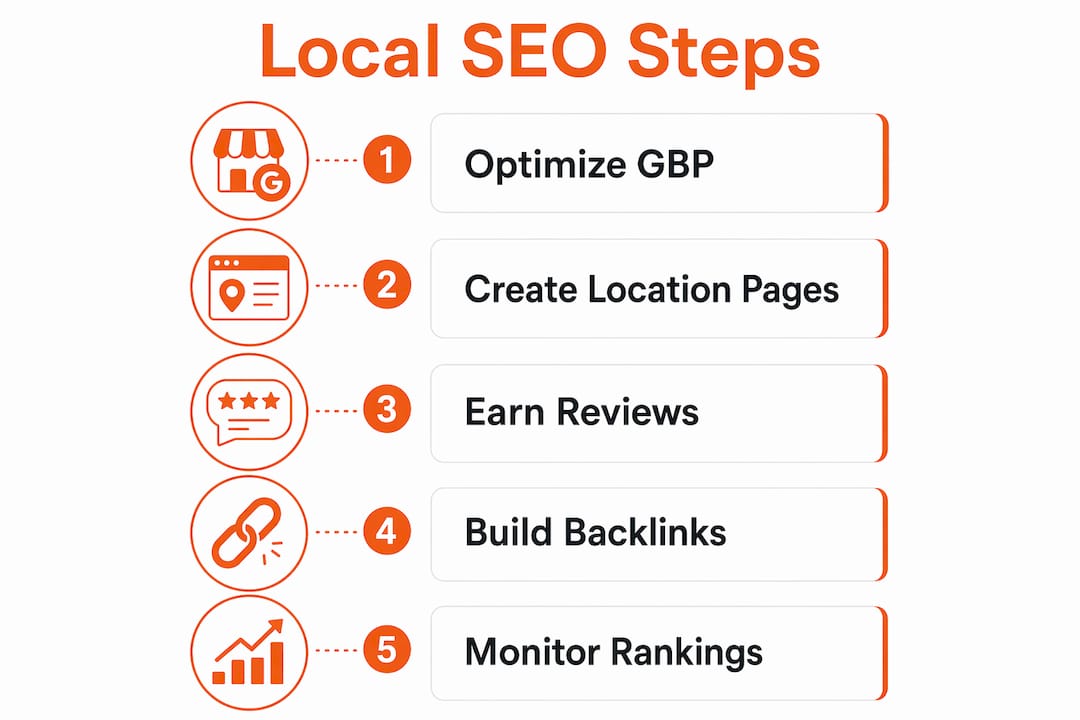
Your website must reinforce every claim your GBP makes. The most effective way to do that is through dedicated, geo-specific landing pages.

Dedicated location pages outperform generic "Areas We Serve" pages because each page can carry unique NAP data, local case references, neighborhood-specific content, and schema markup. A single page listing 15 cities tells Google nothing specific about any of them. A standalone page for your Chicago office, with a local phone number, a Chicago-specific case result, and a map embed, tells Google exactly where you operate and who you serve.
Each location page should include:
- Full NAP matching your GBP exactly
- A practice-area-specific headline using local intent keywords (e.g., "Car Accident Attorney in Austin, TX")
- At least one local reference, such as a courthouse name, neighborhood, or regional statistic
- Local Business Schema using the LegalService subtype with accurate geo-coordinates and business hours
- Internal links to relevant practice area pages on your main site
Pro Tip: Interlink your location pages with your practice area pages bidirectionally. A Chicago personal injury page should link to your main personal injury page, and vice versa. This passes authority in both directions and helps Google map your site's topical structure.
The content on each page must signal E-E-A-T. Include attorney bios with bar admission details, case outcomes where ethically permissible, and client testimonials specific to that location. Generic filler content on location pages is worse than no page at all because it signals low quality to Google's ranking systems.
| Page element | Purpose |
|---|---|
| Local NAP | Confirms geographic relevance to Google |
| LegalService schema | Structures entity data for AI-driven search |
| Location-specific content | Differentiates page from duplicate thin content |
| Internal links | Distributes authority across site architecture |
| Client reviews on page | Reinforces trust and E-E-A-T signals |
How do citations, reviews, and backlinks drive local SEO dominance?
Off-site signals validate what your website and GBP claim. Without them, even a perfectly optimized profile struggles to rank against established competitors.
Local citations are mentions of your firm's NAP on external websites. Directories like Avvo, Justia, FindLaw, and your state bar association website are high-authority citation sources for law firms. The value of a citation comes from consistency, not volume. One hundred citations with mismatched addresses hurt more than fifty clean, consistent ones.
"Review acquisition systems that ensure a steady flow and recency of reviews outperform firms relying on total counts alone." This principle separates firms that sustain rankings from those that spike and fade.
Review velocity is critical: firms with consistent new reviews rank better than those with stale totals. Build a post-case review request process into your client offboarding workflow. A simple email or text message sent within 48 hours of case resolution generates reviews at a rate that manual requests never match. Never incentivize reviews or post fake ones. Google's review policies are enforced, and violations result in listing penalties.
Backlinks from local and legal sources build prominence. Target links from local bar associations, legal aid organizations, local news coverage, and law school publications. A single link from your county bar association carries more local authority than ten links from generic business directories. Pair your law firm local marketing efforts with a deliberate outreach plan for these high-value sources.
What are common pitfalls when building a law firm local SEO presence?
Even well-resourced firms make avoidable mistakes that suppress rankings or trigger listing suspensions.
- Keyword stuffing the GBP name. This is the fastest way to lose your listing entirely. Use your exact registered business name every time.
- Linking GBP to the homepage. Your homepage serves every practice area and every location. A location-specific GBP needs a location-specific landing page as its destination.
- Ignoring category optimization. Choosing "Law Firm" as your primary category when you practice exclusively in family law means you miss every high-intent family law search in your area.
- Letting review velocity stall. A firm that earned 40 reviews two years ago and has added none since signals inactivity to Google's ranking algorithm.
- Using one generic location page for multiple cities. This is the most common website mistake law firm marketers make. Each city you serve needs its own page.
"Local pack results vary by precise searcher location, requiring marketers to track rankings across multiple points for accurate performance assessment."
Grid-based rank tracking across a metro area gives you a real picture of where your firm appears and where it doesn't. A single city-wide ranking report masks the gaps. Tools that generate a grid of ranking positions across a geographic area reveal which neighborhoods you dominate and which you need to target. Pair this with a quarterly NAP audit across all directories to catch discrepancies before they compound.
Pro Tip: Set up a Google Alert for your firm's name and address. When third-party sites publish incorrect information, you catch it immediately instead of discovering it during an audit months later.
Key takeaways
Building a law firm's local SEO presence requires consistent execution across your Google Business Profile, location-specific website pages, and off-site reputation signals.
| Point | Details |
|---|---|
| GBP is the top ranking factor | Google Business Profile signals drive 32% of local pack rankings for law firms. |
| Category selection is critical | Choose the most specific GBP primary category to appear in high-intent local searches. |
| Location pages beat generic pages | Dedicated geo-specific pages outrank single "Areas We Serve" pages for local relevance. |
| Review velocity matters more than volume | Consistent new reviews signal an active firm; stale totals lose ranking ground over time. |
| NAP consistency protects entity trust | Identical Name, Address, and Phone data across all listings prevents entity confusion with Google. |
What I've learned about local SEO that most guides won't tell you
The conventional advice is to "optimize your GBP and get more reviews." That is correct but incomplete. What I have seen consistently is that firms treating local SEO as a one-time setup project lose ground to firms that treat it as an ongoing reputation system.
The firms that dominate local packs in competitive markets are not necessarily the ones with the most reviews or the biggest websites. They are the ones with the most consistent signals. Every directory listing matches. Every location page has unique, locally relevant content. Every client gets a review request within two days of case close. That consistency compounds over months and becomes nearly impossible for a competitor to displace quickly.
The shift toward AI-driven search in 2026 makes entity consistency even more important. When Google's systems try to understand what your firm is, where it operates, and who it serves, they pull from dozens of data sources simultaneously. Contradictory signals create ambiguity. Ambiguity costs you rankings. Treat every online touchpoint, from your Avvo profile to your LinkedIn page, as a data point in Google's entity model for your firm.
Pairing local SEO with paid search campaigns accelerates visibility while organic rankings build. The two channels reinforce each other in ways that neither achieves alone.
— laya
How Omnivancemedia supports law firm local SEO growth
Law firm marketing teams that want to move faster than organic timelines allow need an integrated approach, not a collection of disconnected tactics.

Omnivancemedia builds local SEO systems for law firms that combine GBP optimization, location page development, citation management, and review acquisition into a single coordinated program. The team's SEO services are built for firms that need measurable results, not monthly reports full of vanity metrics. If your firm is ready to close the gap between where you rank now and where your best clients are searching, Omnivancemedia's law firm digital marketing specialists are the right next step.
FAQ
What is the most important local SEO ranking factor for law firms?
Google Business Profile signals account for approximately 32% of local pack rankings, making GBP optimization the single highest-impact activity for law firm local SEO.
How many reviews does a law firm need to rank in the local pack?
Total count matters less than velocity and recency. Firms with a consistent flow of new reviews outrank those with larger but stale review totals.
Should each law firm office have its own Google Business Profile?
Yes. Each physical office location should have its own verified GBP listing linked to a dedicated location page on your website, not a shared homepage.
What is NAP consistency and why does it affect local rankings?
NAP stands for Name, Address, and Phone number. Identical NAP data across your GBP, website, and all directory listings signals entity trust to Google and prevents ranking suppression from conflicting data.
How do I track local SEO rankings accurately for a law firm?
Use grid-based rank tracking tools that measure your local pack position across multiple points within a metro area. Single city-wide metrics mask the geographic gaps in your visibility.