Answer Engine Optimization: A 2026 Guide for Marketers

Answer engine optimization (AEO) is the practice of structuring your brand's content so AI-powered systems like ChatGPT and Google AI can extract it, trust it, and deliver it as a direct answer to a user's question, with your brand named as the source. The goal is not a higher page ranking. It is citation eligibility at the content chunk level.
The core technologies driving this shift are large language models (LLMs), retrieval-augmented generation (RAG), and AI platforms including ChatGPT and Google AI Overviews. These systems do not return a list of links. They synthesize a single response from multiple sources and cite the ones they trust most.
Getting cited requires content that is structured for extraction, not just discovery. That means:
- Clear, explicit answers placed at the top of each section, written as standalone responses
- Semantic HTML and logical heading hierarchy so AI parsers can navigate your content cleanly
- Structured data markup using FAQPage, Article, and HowTo schema types
- Self-contained content chunks where each H2 or H3 section answers a question without requiring surrounding context
- Authority signals including author credentials, third-party citations, and consistent brand mentions across the web
- Multimodal content covering video, audio, and PDFs alongside text
Why answer engine optimization is critical for the future of search
Gartner predicts that traditional search engine volume will drop 25% by 2026 as AI chatbots and virtual agents absorb more queries. ChatGPT has reached 800 million weekly active users, and that number keeps climbing. Users are no longer searching for links. They are asking questions and expecting complete answers.
For brand managers, this creates a visibility problem that traditional SEO cannot solve. When an AI engine synthesizes a response, it cites a handful of sources. Brands outside that citation set are effectively invisible to the user, regardless of how well their pages rank organically. Zero-click environments are becoming the norm, not the exception.
Traffic from AI-generated search experiences converts up to nine times better than traditional search traffic. Users treat LLMs as trusted advisors rather than search engines, which changes the quality of every visit that does come through.
The brands that adapt now will own the citation slots that competitors are leaving empty. Those that wait are not just losing traffic. They are losing the trust signal that AI systems use to decide who gets cited next.
How AEO differs from traditional SEO
SEO and AEO share a technical foundation. Strong organic rankings still matter because AI Overview citations overlap with organic rankings for top content, and that overlap has grown substantially over time. SEO is the prerequisite. AEO is the optimization layer that determines what happens once your content is eligible to be selected as the answer.
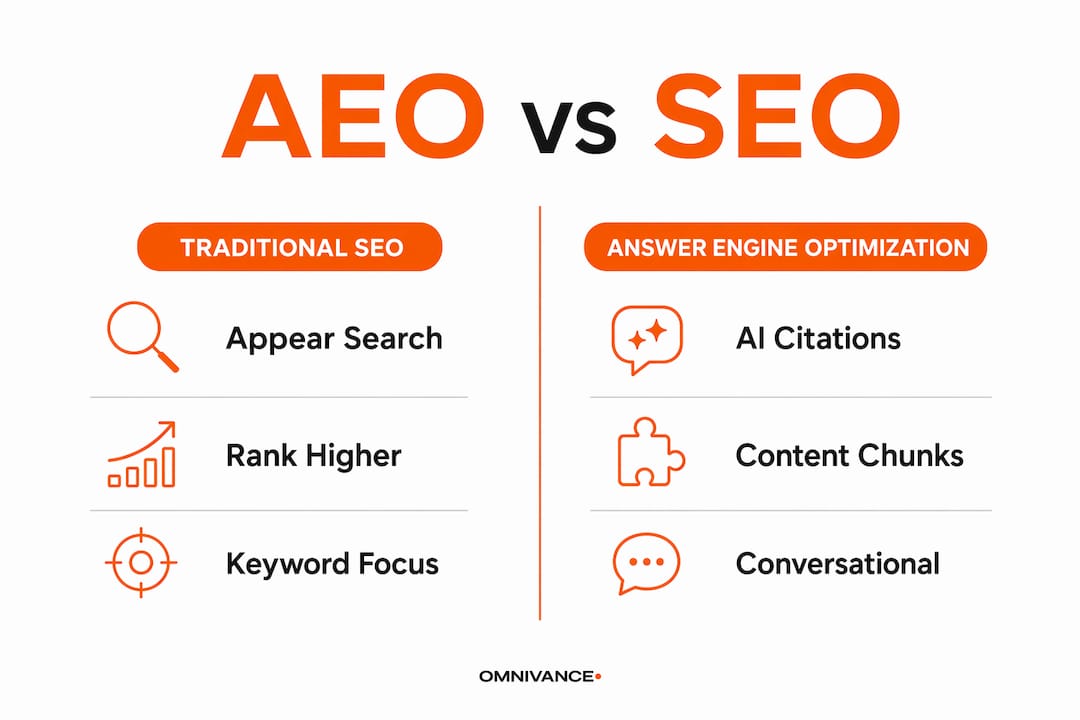
The differences become sharp once you move past that shared base.
| Dimension | Traditional SEO | AEO |
|---|---|---|
| Primary goal | Appear in a search result | Get cited in AI-generated responses |
| Optimization signal | Keywords, backlinks, page authority | Extractability, semantic clarity, entity recognition |
| Measurement | Rankings, organic CTR, sessions | Citation frequency, share of voice in AI responses |
| Content format | Keyword-optimized pages | Structured, answer-ready content with schema markup |
| Team ownership | SEO and content teams | Cross-functional: content, IT, analytics, compliance |
| Measurement tool | Google Search Console, rank trackers | AI monitoring platforms combined with GSC |
The measurement row is where most marketing teams feel the gap first. Google Search Console tells you nothing about whether ChatGPT is recommending a competitor for the exact questions your best customers are asking.
Key distinctions to internalize:
- Unit of optimization: SEO targets a full page for a keyword; AEO targets individual content sections that must stand alone as citable answers
- Content format: SEO rewards comprehensive pages; AEO rewards self-contained chunks with explicit definitions and no pronoun dependencies
- Measurement: Clicks and sessions do not capture AI citation influence, creating what Siteimprove calls the "Monitoring Gap"
- Team scope: AEO is not a content team project; it requires alignment across IT, compliance, and analytics in ways SEO never did
Pro Tip: If you want a deeper breakdown of how AEO, SEO, and Generative Engine Optimization (GEO) relate to each other, the AEO vs SEO vs GEO comparison at Omnivancemedia covers the distinctions clearly.
Essential strategies for optimizing content for AI answer engines
The most effective AEO content follows a specific structure. It is not about writing more. It is about writing so that each section can be lifted out of context and still make complete sense.

PwC's Multimodal AI Content Creation (MACC) approach makes the case that AI agents synthesize across formats, not just text. Brands that publish only articles are invisible to AI systems parsing video transcripts, podcast audio, and PDF whitepapers. Expanding into those formats is not optional for brands that want full AI discoverability.
Practical strategies that work:
- Lead each section with a BLUF opener: Write a direct 30–60 word answer at the top of every H2 or H3 section. This is what AI systems extract. Write it as if it is the only paragraph the reader will see.
- Use Q&A heading formats: Posing a question as a heading and immediately answering it helps AI systems match user intent and extract information cleanly.
- Write declarative sentences: Confident, direct statements reduce ambiguity and make content easier for AI to reuse without distortion.
- Eliminate pronoun dependencies: Phrases like "as discussed above" or "this approach" are extraction killers. Every chunk must use explicit noun references.
- Run content gap analysis with AI sub-queries: AI engines decompose queries into sub-questions before retrieving content. Map your existing content against those sub-questions and identify gaps.
- Maintain factual accuracy with sourced claims: AI systems weight authoritative, well-sourced content more heavily. Every factual claim that can be supported with a named source should be.
- Optimize across formats: Convert key content into video, audio, and PDF formats to maximize reach across AI discovery surfaces.
Conversational, human-centric content derived from real customer interactions trains LLMs better than generic static descriptions. Using internal sales scripts, support chat transcripts, and site search queries to inform your content language aligns your writing with the exact prompt patterns AI users generate.
How to structure content and build trust signals for AI citation
AI answer engines operate via RAG, which means they evaluate content by sections rather than whole pages. Each content chunk typically consists of an H2 or H3 heading, the content it introduces, and any structured elements like tables or lists within it. For a chunk to be citation-eligible, someone reading only that section must get a complete, useful response.
Structural best practices:
- Semantic HTML with logical heading hierarchy: The same technical properties that screen readers depend on are the same ones AI parsers use. Accessible content is structurally answer-engine-ready content.
- Explicit definitions: Every key concept needs a definition in the form "X is..." Implied definitions are invisible to LLM retrieval.
- Schema markup implementation: FAQPage, Article, and HowTo schema create machine-readable markup that directly increases content's AI visibility.
- Author credentials and brand entity signals: Consistent author attribution, organizational schema, and references to your brand as a named entity strengthen the trust signals AI systems use.
- Third-party citations and co-mentions: Being mentioned alongside well-known organizations signals credibility to LLMs.
| Schema Type | What it signals to AI | Best use case |
|---|---|---|
| FAQPage | Q&A structure AI systems look for | High-intent pages with direct questions |
| Article | Author, publish date, organization | News, blog posts, research content |
| HowTo | Step-by-step process structure | Implementation guides, tutorials |
| Speakable | Content suitable for voice delivery | Key definitions, summaries |
Pro Tip: Treat web accessibility improvements as AEO investments. Descriptive alt text, semantic heading structure, and clean HTML benefit both screen readers and AI extraction systems simultaneously.
How do you measure success in AEO?
Traditional SEO metrics miss most of what AEO produces. Clicks and organic sessions do not capture AI citation influence, which means brands relying solely on Google Search Console have a structural blind spot in their measurement infrastructure.
AEO performance requires five distinct KPIs:
| KPI | What it measures | How to track it |
|---|---|---|
| AI citation frequency | How often your brand appears in AI responses | AI monitoring platforms |
| Brand mention rate | How often your brand is named in AI answers | Direct prompt audits |
| Share of voice | Your brand's presence vs. competitors in AI responses | AI monitoring dashboards |
| Fan-out coverage score | How many AI sub-queries your content addresses | Manual content gap analysis |
| Zero-click rate trend | Whether AI answers are absorbing your traffic | GSC combined with AI monitoring |
The practical starting point is a monitoring baseline. Run structured prompt tests across ChatGPT and Google AI Overviews for the queries your buyers are actually asking. Document what comes back. Note who gets cited instead of you. Flag where your brand is misrepresented. Without that baseline, every optimization decision is a guess.
Ongoing manual audits of AI answer accuracy matter as much as automated tracking. AI systems can misrepresent brand claims, especially in regulated industries, and no dashboard catches every instance. Build a review cadence into your content governance process.
Challenges and emerging factors in AEO
AEO is not a one-time project, and the organizations treating it as one are building on a foundation they cannot measure. Several challenges make this harder than it looks.
- Continuous algorithmic change: AI models update frequently and without announcement. A content structure that earns citations today may need adjustment in three months.
- Organizational misalignment: AEO requires cross-functional collaboration across content, IT, analytics, and compliance. Handing it to the SEO team alone is a governance failure.
- Regulatory risk from AI misrepresentation: Brands must govern how AI systems represent them, particularly in regulated sectors. An AI misrepresentation of a financial product or health claim carries risk well beyond a bad blog post.
- Balancing human and AI readability: Overloading content with Q&A formats and schema markup can disrupt reading flow for human visitors. The goal is content that serves both audiences without sacrificing either.
- Avoiding AI-specific hacks: Google explicitly advises against AI-only files like llms.txt or artificial chunking. Foundational SEO remains the primary signal for generative AI search visibility.
- The Strategy Gap: Without reliable monitoring data, content teams cannot prioritize AEO investments or build a credible business case for leadership. The Monitoring Gap creates the Strategy Gap directly.
The brands that navigate these challenges best are the ones that treat AEO as an enterprise discipline with dedicated governance, not a content experiment.
Steps to prepare your brand for sustained AI-driven search visibility
Getting ready for AI-driven search requires changes to infrastructure, team processes, and content authoring habits. The sequence matters: monitoring first, optimization second, governance third.
- Audit your current AI brand representation: Run structured prompt tests across ChatGPT and Google AI Overviews for your highest-value queries. Document who gets cited instead of you and where your brand is misrepresented.
- Refine content authoring for extractability: Restructure existing high-intent pages with BLUF openers, explicit definitions, and no pronoun dependencies. Each section should answer its question without requiring the reader to have read anything else.
- Implement schema markup at scale: Work with your IT team to deploy FAQPage, Article, and HowTo schema across priority pages. This is not a content team task alone.
- Build multimodal content: Convert your strongest written content into video, audio, and PDF formats. AI agents synthesize across formats, and text-only brands leave citation opportunities on the table.
- Expand off-site authority: Earn mentions in industry publications, directories, and review platforms. AI systems weigh how the wider web perceives your brand, not just what your own site says. For practical guidance on AI tools for marketing teams, Omnivancemedia has covered the implementation side in detail.
- Establish a governance model: Define who monitors AI outputs, how often, and what the response process looks like when something is inaccurate. Integrate AEO monitoring into your existing content quality infrastructure.
Pro Tip: Integrate AEO monitoring with your accessibility compliance program. The same semantic HTML improvements that satisfy WCAG standards also make your content more extractable by AI systems. You get two returns from one investment.
Research insights and Omnivancemedia's experience in AEO
The business case for AEO is no longer theoretical. AI-referred traffic converts up to nine times better than traditional search traffic, a finding from Cornell research that reflects how differently users engage with AI recommendations versus a list of links. When an LLM recommends your brand, the user arrives already persuaded.
PwC's MACC framework reinforces this by showing that AI agents synthesize across video, audio, and PDFs, not just web pages. Brands that invest only in text content are optimizing for a fraction of the AI discovery surface.
Omnivancemedia's client results reflect what happens when integrated strategy replaces fragmented tactics. An HVAC contractor generated $340K in new contracts within 90 days. An e-commerce client grew monthly revenue from $80K to $420K. Neither result came from a single channel. Both came from coordinated SEO, content, and paid media working as one system, the same cross-functional model that AEO requires at the organizational level.
Pro Tip: Start with visibility before committing to any optimization investment. Establish what each AI engine says about your brand today. That single step closes the Monitoring Gap and makes every decision that follows a data-driven one.
How voice search shapes your AEO approach
Voice search accelerates everything AEO already demands. When a user asks a voice assistant a question, the device reads one answer aloud. There is no second result. The brand that gets cited is the only brand that exists in that moment.

Voice queries tend to be longer and more conversational than typed searches. "What's the best CRM for a small marketing team?" is a voice query. "CRM small business" is a typed one. Content structured for AEO naturally serves voice search better because it leads with direct, spoken-language answers rather than keyword-dense paragraphs. The Speakable schema type specifically flags content as suitable for voice delivery, and deploying it on key definition and summary sections gives voice assistants a clear extraction target.
The practical implication is that conversational language is not just a stylistic preference. It is a technical signal. Content written the way people actually ask questions trains AI systems to recognize your brand as the answer to those questions.
How structured data and semantic markup improve AI visibility
Structured data is the translation layer between your content and AI systems. Without it, an AI parser has to infer what your content means. With it, you tell the system exactly what each piece of content is, who wrote it, when it was published, and what question it answers.
Schema.org provides the vocabulary. The most important schema types for AEO are FAQPage, which explicitly identifies the Q&A format AI systems look for; Article, which provides machine-readable author, publish date, and organization signals; and HowTo, which makes step-by-step process content machine-readable. Speakable schema flags content for voice delivery. Beyond schema, semantic HTML does the structural work. Logical heading hierarchy, descriptive alt text, and clean document structure make content parseable by both AI systems and screen readers. These are not separate investments. The same markup improvements serve both audiences, and technical SEO best practices for AI search visibility reinforce this point directly.
The brands that implement structured data consistently across their highest-intent pages create a compounding advantage. Each schema-tagged section becomes a more reliable extraction target, and AI systems learn to treat that domain as a trustworthy source over time.
Real-world examples of AEO working in practice
The clearest evidence of AEO's impact comes from brands that have moved from organic search dependency to AI citation presence. A financial services firm that restructured its product explainer pages with FAQPage schema and BLUF openers saw its content begin appearing in Google AI Overviews for high-intent queries it had never ranked for organically. The content did not change in substance. The structure did.
A SaaS company that adopted the MACC approach, converting its written case studies into short video summaries and podcast-style audio clips, expanded its AI discoverability across platforms that never indexed its original text content. For more on maximizing content visibility in AI search, the SaaS context offers particularly useful tactical detail.
The pattern across successful implementations is consistent. Brands that win AI citations share three characteristics: their content is structured so each section stands alone as a complete answer, their authority signals extend beyond their own domain, and they monitor AI outputs continuously rather than auditing once and moving on. The technical foundation for AI-ready content starts with crawlability and schema, but the sustained advantage comes from governance.
Key Takeaways
Answer engine optimization requires structuring content at the section level, building cross-functional governance, and monitoring AI citations directly, because page rankings alone no longer determine brand visibility in AI-driven search.
| Point | Details |
|---|---|
| AEO targets content chunks, not pages | Each H2 or H3 section must answer its question independently, without requiring surrounding context. |
| AI-referred traffic converts up to nine times better | Users treat LLMs as trusted advisors, making citation presence a high-value conversion channel. |
| The Monitoring Gap is a real strategic risk | Traditional SEO tools cannot capture AI citation data; direct AI prompt audits are required to close it. |
| Schema markup directly improves AI extractability | FAQPage, Article, and HowTo schema types make content machine-readable and citation-eligible. |
| AEO demands cross-functional ownership | Content, IT, analytics, and compliance must align; no single team can run an effective AEO program alone. |
Ready to get your brand cited in AI answers?
Omnivancemedia builds integrated marketing systems that combine AI-ready SEO with paid advertising, CRM automation, and creative production into one coordinated program. The results speak for themselves: $340K in new contracts for an HVAC contractor in 90 days, and an e-commerce client growing from $80K to $420K in monthly revenue.
If your brand is not showing up in AI-generated answers, you are not just missing traffic. You are missing the highest-converting discovery channel in search right now. See what Omnivancemedia can do for your brand's AI visibility.