AI in Social Media Advertising: 2026 Guide

The role of AI in social media advertising is to automate targeting, generate content at scale, and continuously optimize campaigns for measurable ROI. 49% of marketers now use AI in social media campaigns, with 67% applying it to data analysis and 57% to content creation. That adoption rate signals a structural shift, not a trend. Platforms like Meta Ads Manager have embedded AI agents directly into campaign workflows, and tools from Emplifi to McKinsey's agentic AI frameworks are redefining how ads get built, targeted, and measured. This guide gives you a clear, research-backed view of what AI actually does inside social advertising, where it wins, and where human judgment still holds the edge.
How AI automates social media advertising workflows
AI in digital marketing operates across five connected workflow stages: Listen, Generate, Refine, Distribute, and Optimize. Each stage builds on the last, creating a feedback loop that improves performance over time.
1. Listen. AI pulls real-time audience data from social platforms, search behavior, and engagement signals. Tools like Emplifi use social listening to identify trending topics, audience sentiment, and competitor activity before a single ad is written. This stage replaces hours of manual research with automated insight.

2. Generate. Once audience signals are clear, AI generates ad copy, headlines, and visual concepts at scale. A campaign that once required a copywriter and designer for each variant can now produce dozens of tested assets in minutes. The output quality depends heavily on the creative brief and input library you provide.
3. Refine. AI tests messaging against brand voice guidelines and audience response data. It flags copy that drifts from tone, adjusts calls to action based on click patterns, and surfaces which creative elements drive the most engagement. This is where AI augments human creativity rather than replacing it.
4. Distribute. Automating social media ads at the distribution stage means AI selects optimal placement, timing, and audience segments without manual scheduling. It reads platform-specific performance data and shifts budget toward the highest-performing placements in real time.
5. Optimize. Continuous optimization is where AI delivers its clearest ROI advantage. Algorithms adjust bids, rotate creatives, and reallocate spend based on live performance signals. This end-to-end connected system drives better returns than any static campaign structure.
Pro Tip: Assign a human strategist to review AI-generated optimizations weekly. AI will maximize toward the metric you set, not necessarily the business outcome you want. A 30-minute review catches misaligned spend before it compounds.
Ai-generated vs. human ad creative: what the research shows
The debate over AI versus human creativity in advertising now has hard data behind it. A 2026 Ipsos study tested 20 AI-generated ads against 20 human-made ads with 3,000 US respondents. Human-made ads outperformed AI ads on sales impact by 16 points on average. That gap is significant enough to affect revenue at scale.
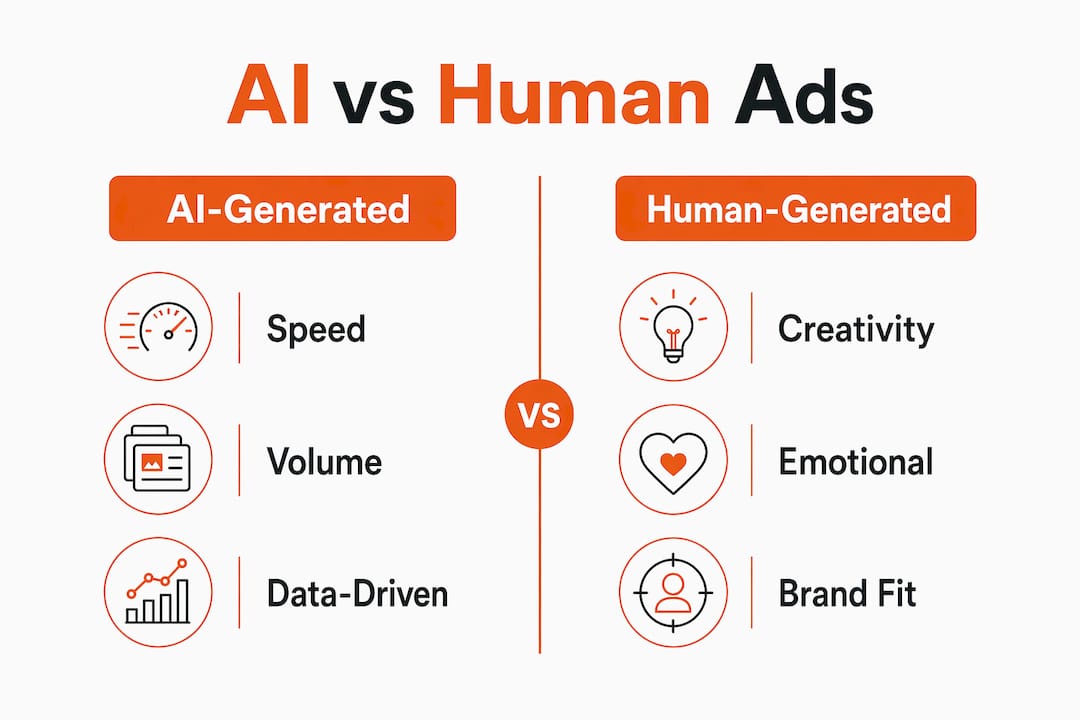
AI performs well on straightforward briefs: product announcements, promotional offers, and retargeting messages where clarity matters more than emotional resonance. It falls short on storytelling, brand narrative, and ads that require cultural nuance or humor. Human creative direction remains the deciding factor for campaigns built around emotional connection.
The practical answer is a hybrid workflow. Use AI for volume, iteration, and data-driven copy variants. Use human writers and art directors for the hero creative, the brand story, and any campaign where emotional appeal is the primary driver.
| Point | AI-Generated Ads | Human-Generated Ads |
|---|---|---|
| Speed | Produces dozens of variants in minutes | Slower production cycle |
| Scale | Handles high-volume iteration efficiently | Limited by team bandwidth |
| Storytelling | Weak on emotional narrative and nuance | Strong on brand voice and cultural resonance |
| Sales Impact | Lower average performance on sales lift | 16-point higher sales impact (Ipsos 2026) |
| Best Use Case | Retargeting, promotions, A/B testing | Brand campaigns, emotional storytelling |
Pro Tip: Build a creative library of your best-performing human-made ads and feed them as reference inputs to your AI tools. The output quality improves significantly when AI has strong examples to learn from.
How AI improves targeting and personalization in social ads
AI tools for ad targeting have moved well beyond basic demographic filters. The current generation of tools uses behavioral signals, purchase intent data, and real-time engagement patterns to build audience segments that update continuously. This is what separates AI-driven targeting from the manual audience builds most teams still rely on.
AI enables hyper-personalization through dynamic audience refinement, creative testing, and real-time budget allocation toward best-performing assets. A single campaign can now serve dozens of personalized ad variants to different micro-segments without any manual intervention after setup.
The most effective AI-driven personalization tactics used by social media managers in 2026 include:
- Dynamic creative optimization (DCO): AI assembles ad components (headline, image, CTA) in real time based on the viewer's profile and behavior history.
- Lookalike audience expansion: AI identifies patterns in your best customers and finds new users who match those patterns across Meta, TikTok, and LinkedIn.
- Predictive audience scoring: AI ranks prospects by their likelihood to convert, letting you concentrate spend on high-probability segments.
- Sequential messaging: AI delivers a series of ads in a specific order based on where each user is in the buying cycle, not just their demographic profile.
- Real-time bid adjustment: AI raises or lowers bids by audience segment based on live conversion probability, improving cost per acquisition without manual oversight.
The impact on engagement is measurable. Campaigns using AI-driven personalization consistently outperform static audience builds on click-through rate and conversion rate. The reason is simple: relevance drives response, and AI processes more relevance signals than any human team can manage manually.
What challenges does AI create for ad measurement?
AI compresses the consumer journey into fewer, faster, and less visible touchpoints. AI-driven funnel compression increases zero-click behavior and reduces the attribution signals that traditional measurement models depend on. When a user sees an AI-curated ad, searches for a brand inside an AI assistant, and converts without clicking a tracked link, your attribution model records nothing.
This is not a minor data gap. It represents a structural break in how performance is measured. Last-click and multi-touch attribution models were built for a world where users followed predictable, trackable paths. That world is shrinking.
Brand visibility now depends increasingly on appearing in AI-generated recommendations, which shifts the value of spend away from click-based search engine marketing toward generative engine optimization (GEO). Understanding the difference between AEO, SEO, and GEO is now a practical requirement for any marketer managing paid social alongside organic search.
Incrementality testing becomes the most reliable measurement tool in this environment. Instead of attributing conversions to specific touchpoints, incrementality tests measure the lift generated by running a campaign versus not running it. This approach survives funnel compression because it measures outcomes, not paths.
Pro Tip: Run holdout tests on at least 10% of your audience for every major campaign. Compare conversion rates between the exposed group and the holdout group. This gives you a real lift number that AI-driven attribution models cannot distort.
How meta's AI agents are changing ads manager
Meta launched AI agents inside Ads Manager in march 2026, making it the most visible real-world example of artificial intelligence social media integration at scale. These agents automate creative generation, audience targeting, bid management, and performance reporting within a single interface. Meta reported a 22% ROAS improvement for advertisers using the full AI agent workflow.
That number deserves context. The 22% figure reflects campaigns where marketers provided strong creative libraries and clean tracking setups. AI agent performance depends more on the quality of inputs than on the automation itself. Weak creative assets and broken pixel tracking produce weak results regardless of how sophisticated the AI is.
Key capabilities of Meta's AI agents include:
- Auto creative generation: Produces ad variants from your existing assets, including image crops, copy rewrites, and format adaptations for Reels, Stories, and Feed.
- Advantage+ audience targeting: AI expands or contracts audience parameters based on real-time performance signals, overriding manual audience constraints when it detects better opportunities.
- Automated bidding: AI adjusts bids at the impression level to hit your cost-per-result target across placements.
- Performance reporting: AI summarizes campaign performance and flags anomalies, reducing the time spent on manual reporting.
The limitation is real and worth stating directly. Only 32% of marketers using AI in campaigns trust it for autonomous ad buying. Most keep human oversight on bidding and optimization decisions. That caution is justified. AI agents optimize toward the objective you set, and if that objective is misaligned with your actual business goal, the automation accelerates the wrong outcome. For a practical checklist on deploying these tools, the AI implementation checklist for 2026 covers the setup steps most teams skip.
Key takeaways
AI improves social media advertising performance when it operates as a system connecting audience data, content generation, targeting, and optimization, with human oversight at every critical decision point.
| Point | Details |
|---|---|
| AI workflow coverage | AI handles five stages: Listen, Generate, Refine, Distribute, and Optimize for end-to-end campaign management. |
| Human creative advantage | Human-made ads outperform AI ads on sales impact by 16 points; use humans for storytelling and brand campaigns. |
| Personalization precision | AI-driven dynamic creative and predictive audience scoring improve conversion rates beyond static manual builds. |
| Attribution gap | AI funnel compression breaks traditional attribution; incrementality testing with holdout groups is now required. |
| Meta AI agents | Meta's 2026 AI agents deliver 22% ROAS gains when paired with strong creative libraries and clean tracking. |
Where i think most teams get this wrong
The most common mistake I see marketing teams make with AI in social advertising is treating automation as a strategy. They plug in Meta's Advantage+ or a third-party AI tool, let it run, and then report the numbers without questioning what the AI is actually optimizing toward. The results look fine on the dashboard. The business outcome tells a different story.
Agentic AI tools risk obscuring critical decisions when teams stop asking why the algorithm made a particular choice. I have seen campaigns where AI shifted 80% of budget to a single audience segment because it was generating cheap clicks. Nobody noticed for three weeks. The clicks were not converting. The AI was doing exactly what it was told.
The hybrid model works when humans own the strategy and AI owns the execution. That means a human sets the campaign objective, defines the creative brief, and reviews performance weekly. AI handles the volume, the testing, and the real-time adjustments. If you want to build that kind of team capability, training your team on AI marketing tools is the practical starting point most agencies overlook.
The future of AI in social media is not a world where marketers disappear. It is a world where the marketers who understand how to direct AI outperform everyone who simply uses it.
— laya
How Omnivancemedia helps you get more from ai-driven ads
Omnivancemedia builds paid social campaigns that combine AI-powered targeting with human creative direction, the exact hybrid model the research supports. Their team manages Meta, Google, and multi-channel campaigns with integrated CRM automation and creative production, so every part of the system feeds the next.
If your current agency manages ads in isolation from your CRM, your creative assets, and your attribution setup, you are leaving measurable revenue on the table. Omnivancemedia's paid advertising services connect all four layers into one accountable system. An e-commerce client scaled from $80K to $420K in monthly revenue using this approach. Explore the full services catalog to see where AI-augmented advertising fits your growth stage.
FAQ
What is the role of AI in social media advertising?
AI automates audience targeting, content generation, bid management, and campaign optimization across social platforms. It operates as a connected system that improves performance by processing more data signals than any manual workflow can handle.
Do ai-generated ads perform as well as human-made ads?
No. A 2026 Ipsos study found human-made ads outperform AI-generated ads on sales impact by 16 points on average. AI performs best on straightforward briefs; human creative direction is required for storytelling and emotional campaigns.
How does AI affect ad targeting on social platforms?
AI enables dynamic audience refinement, predictive scoring, and real-time budget allocation toward best-performing segments. Meta's Advantage+ and similar tools continuously update audience parameters based on live conversion signals.
Why is attribution harder with ai-driven advertising?
AI compresses the consumer journey into fewer trackable touchpoints and increases zero-click behavior. Traditional last-click and multi-touch models miss these conversions, making incrementality testing the most reliable measurement method available.
How should marketers approach AI adoption in social ads?
Start with AI handling volume tasks like creative variants and bid adjustments, while humans retain control over strategy, creative direction, and weekly performance reviews. Only 32% of marketers currently trust AI for fully autonomous ad buying, and that caution reflects real risk.